The storm broke after dark, and it was the best thing that could have happened to Alexander.
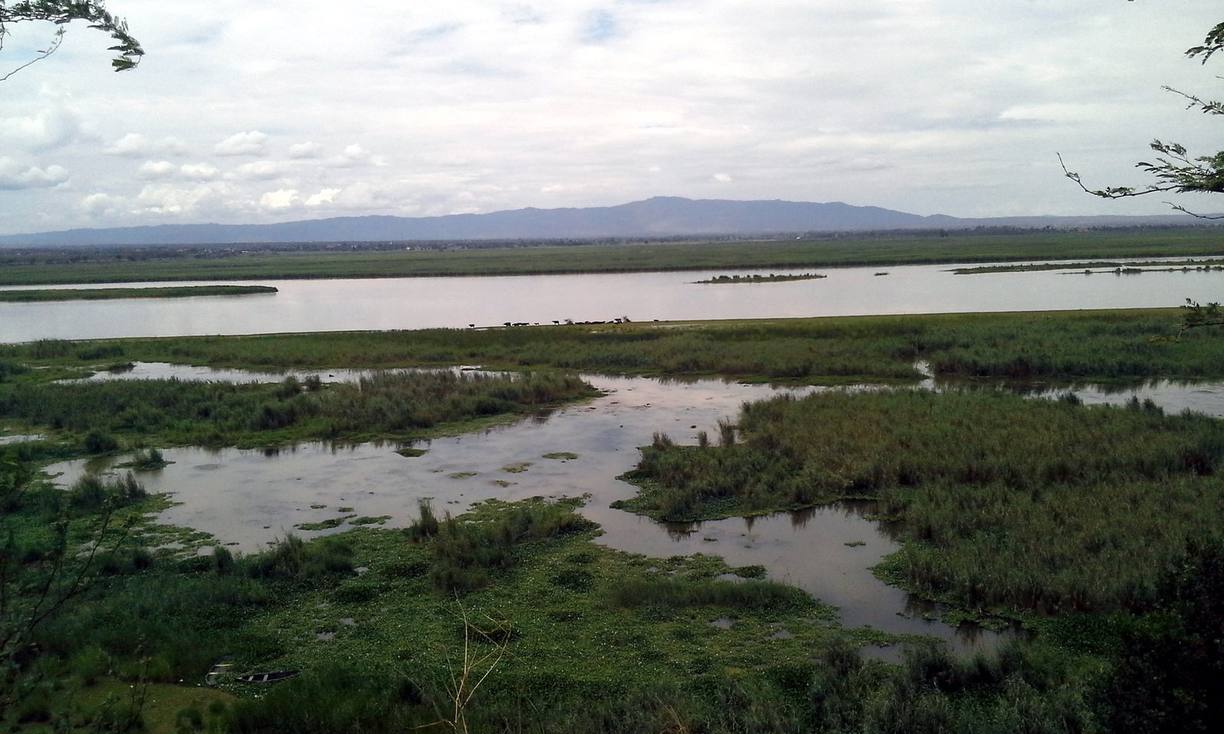
For weeks his army had camped on the west bank of the river the Greeks called the Hydaspes and Punjabis call the Jehlam: the Jhelum, westernmost of the five rivers that give Punjab its name. On the far bank a king the Greeks called Porus waited with his army and his elephants. Now, some seventeen miles upstream, hidden in a wood on a bend of the river, Alexander's men were stuffing leather hides with chaff to float the horses across, and fitting together warships that had been cut into sections on the Indus and hauled over the Pothohar plateau on wagons. The thunder swallowed every sound they made.
Towards dawn the wind and rain died down, and the boats slid out from behind a wooded island. In Alexander's own galley went four of his officers: Ptolemy, Perdiccas, Lysimachus and Seleucus. Within about twenty years three of them would be kings, and the fourth would briefly govern Alexander's whole empire as regent. One of them, Ptolemy, would write the account of this morning that most modern histories still follow.
Porus's lookouts saw the boats and galloped for the Indian camp. Alexander was first ashore. His cavalry formed up as they landed, and then somebody noticed the problem.
They were not on the far bank. They had landed on another island.
The hours that followed, with a ford chest-deep in flood water, a line of war elephants and an exchange between two kings that has been misquoted ever since, made the Battle of the Hydaspes one of the most famous battles ever fought on Punjabi soil. They also left a puzzle. Every account that survives comes from the winning side: from men who marched with Alexander, or from writers who read them centuries later. Porus's side of the story is lost. In what follows we tell the story as the sources tell it, show where they disagree, and follow the battle into Punjab's long memory.
At a glance
The Battle of the Hydaspes was fought in 326 BCE on the Jhelum River in Punjab, between the army of Alexander the Great and the army of Porus, who ruled the land between the Jhelum and the Chenab. Alexander won.
- When
- 326 BCE, late spring or early summer. Arrian's date falls roughly in late April or May; some historians prefer June or July.
- Where
- The Jhelum (Greek Hydaspes, Sanskrit Vitastā), in today's Punjab, Pakistan. The exact site is unknown.
- Who fought
- A Macedonian-led army, with Iranian, Central Asian and Punjabi allies, against Porus's infantry, cavalry, chariots and elephants
- Outcome
- Porus was wounded and captured, then restored as king under Alexander
- Why it matters
- It was Alexander's last great pitched battle. Weeks later, on the Beas, his army refused to go further.
- Evidence
- Greek and Latin histories written three centuries and more after the event, from lost eyewitness memoirs, and one issue of silver coins. No Indian account survives.
- How sure are we
- That Alexander won: Well-established. The sequence of events: Probable. The numbers and the location: Contested.
Most of the places in this story are in present-day Pakistan; the Beas, where the march ended, is in India. The labels on the notes, and the confidence scale, are the ones explained on our About page. Folklore, religious tradition and modern political narratives are each labelled where they appear.
Why a Macedonian king was standing in Punjab
Alexander III of Macedon, a kingdom on the northern edge of the Greek world, was twenty-nine and had been at war for eight years. Since crossing into Asia in 334 BCE he had destroyed the Persian Achaemenid Empire, which stretched from Egypt to the Indus, and fought for three hard years in its far north-east, in today's Afghanistan and Central Asia.
To Alexander, India was the rest of an inheritance: for two centuries the Persian kings had counted Gandhara and the Indus lands, Hindush in their inscriptions, among their provinces. Ambition and curiosity did the rest. Arrian, the most careful of his ancient biographers, often speaks of Alexander's pothos, his longing to go further.
Punjab was then a patchwork of kingdoms and self-governing peoples. Its greatest city between the Indus and the Jhelum, Taxila (Sanskrit Takṣaśilā), near modern Rawalpindi, welcomed the invader. Its ruler, whom the Greeks called Taxiles after his city (his own name appears in Greek and Latin as Omphis or Mophis, often rendered today as Ambhi), sent Alexander two hundred talents of silver, three thousand oxen, more than ten thousand sheep and thirty elephants. The name went with the throne, Curtius explains: on becoming king he took the name his father had carried. He had his reasons for welcoming Alexander. His great rival lay across the Jhelum.
That rival was Porus. Most historians read the name as a Greek rendering of Paurava, "descendant of Puru", after one of the great clans of the Rigveda; whether it was a personal name, a dynastic name or a title, we cannot say. Arrian even knows of a second Porus, a namesake and enemy who ruled beyond the Chenab, which suggests the name belonged to more than one man. Our Porus ruled between the Jhelum and the Chenab, in the land later called the Chaj Doab, from a capital whose site is unknown. The Greeks agree that he was huge: over five cubits in Arrian and Diodorus, which would make him well over seven feet, and four cubits and a span in Plutarch, which Plutarch's Loeb translator reckoned at six foot three. Ordered to pay tribute and to meet Alexander at his frontier, he replied, in the Roman historian Curtius's telling, that he would do one of those things: he would be waiting when Alexander entered his kingdom, armed.
Five rivers, many names
The Greeks renamed the rivers of Punjab from what their interpreters told them. The Punjabi word for a great river, dariā (ਦਰਿਆ · دریا), itself comes from Persian, in which it means the sea.
| Greek (Arrian) | Vedic Sanskrit | Punjabi | English |
|---|---|---|---|
| Hydaspes | Vitastā | Jehlamਜੇਹਲਮ · جہلم | Jhelum |
| Acesines | Asiknī | Chanābਚਨਾਬ · چنابin folk song, Jhanāṅਝਨਾਂ · جھناں | Chenab |
| Hydraotes | Paruṣṇī | Rāvīਰਾਵੀ · راوی | Ravi |
| Hyphasis | Vipāś | Biāsਬਿਆਸ · بیاس | Beas |
| Zaradros (in the geographer Ptolemy) | Śutudrī | Satlujਸਤਲੁਜ · ستلج | Sutlej |
Alexander crossed the first three and turned back at the fourth.
Weeks of noise on the riverbank
When Alexander reached the Jhelum it was at its most dangerous. As the summer solstice approaches, Arrian explains, snowmelt from the mountains and the first heavy rains swell every river of the plain. Porus held the far bank and guarded every place where it might be forded.
The real obstacle was the elephants. Horses unused to them panic at their smell and their trumpeting, and Alexander feared, Arrian says, that his would leap off their floats in midstream.
So he set out to make Porus stop watching. He let it be known that he would wait for the winter, when the rivers fall, and had grain carted into camp to make the story convincing. His boats sailed up and down, detachments marched this way and that, and night after night his cavalry rode along the bank shouting the war-cry as if about to cross. At first Porus shadowed every alarm with his elephants. Then he stopped.
Meanwhile Alexander had found his crossing: a wooded headland on a sharp bend, with an uninhabited, wooded island lying off it, some 150 stades (about seventeen miles) upstream. Craterus, one of his senior generals, stayed opposite Porus with a large force, including 5,000 Indian troops under Taxiles and other local chiefs, and orders to cross only if Porus moved his elephants away; the elephants alone, Alexander told him, made a landing impossible for horses. Campfires burned along the bank, and according to Curtius an officer named Attalus, who was Alexander's age and looked like him from a distance, wore the royal dress about the royal tent. Alexander himself took his best troops inland, out of sight of the river, to the wood on the headland.
By the night of the storm, Porus's sentries had heard Macedonians preparing to cross too many times to be alarmed, and the thunder covered the rest.
The island that was not the shore
The island was cut off from the true bank by a channel that was normally shallow, but the night's rain had swollen it. When the cavalry at last found a ford, the water, Arrian says, came over the infantrymen's chests, and only the horses' heads showed above it.
Plutarch preserves a better story, and sets Alexander's own account against it. Onesicritus, who later piloted Alexander's ship down the rivers (and afterwards, Arrian complains, passed himself off as its admiral), has the king cry out in the flood: "Men of Athens, would you believe the dangers I am running to win your good opinion?" That, says Plutarch, is Onesicritus's story. Alexander's own letter says only that they left their rafts and waded the breach in their armour, breast-high.
Once across, Alexander rode ahead with about 5,000 horsemen, leaving something under 6,000 infantry to follow. When Porus heard that armed men held his bank, Curtius says, he hoped at first that it was his ally Abisares, the king of the hill country to the north, arriving as they had agreed. Abisares never came. Instead a force led by one of Porus's sons went out to meet Alexander, and Arrian gives three versions of what happened next:
- Aristobulus, an engineer on the campaign: the prince brought about sixty chariots and failed to stop the crossing.
- Unnamed "other writers": he brought a larger force, wounded Alexander and killed his horse, Bucephalas.
- Ptolemy, who was there and whom Arrian follows: 2,000 cavalry and 120 chariots, arriving too late.
Alexander's own letter, in Plutarch, says a thousand horsemen and sixty chariots, and Curtius makes the leader not a son but Porus's brother, Hages, with a hundred chariots and four thousand horse. All agree on the result. The prince died with some four hundred of his men, and his chariots, too heavy for ground the rain had turned to clay, were captured.
Porus now faced a cruel choice. Alexander was across the river, and opposite the Indian camp Craterus was making every show of crossing too. Porus marched against Alexander with most of his army, leaving a few elephants to scare Craterus's horses off the bank. It was probably the right decision. It also meant fighting the most experienced army in the world on ground he had not chosen.
A wall of elephants
Porus chose the best ground he could find: sand rather than clay, level and firm enough for horses and chariots. In front he set his elephants, at least a plethron (about thirty metres) apart. His infantry stood behind them and in the gaps; cavalry and chariots held the wings. Greek and Roman writers, Diodorus and Curtius among them, reached for the same image, a city wall with the elephants as its towers. No horse would go through the gaps, and any infantry that tried would be trampled. The Punjabi hāthī (ਹਾਥੀ · ہاتھی), "elephant", comes from Sanskrit hastin: "the one with a hand", the hand being its trunk.
Curtius adds two details that sound like eyewitness memory. Drums, not trumpets, gave the Indian signals. And before the infantry was carried an image of a god the Greeks called Heracles, which its bearers were forbidden, on pain of death, to abandon. Greek writers used that name for an Indian god; which one, historians still argue.
How big was Porus's army? Nobody knows, and the ancient writers did not know either.
| Source | Infantry | Cavalry | Chariots | Elephants |
|---|---|---|---|---|
| Arrian | 30,000 infantry | 4,000 cavalry | 300 chariots | 200 elephants |
| Diodorus | over 50,000 infantry | about 3,000 cavalry | over 1,000 chariots | 130 elephants |
| Curtius | about 30,000 infantry | cavalry not given | 300 chariots | 85 elephants |
| Plutarch | 20,000 infantry | 2,000 cavalry | chariots not given | elephants not given |
Even the copies disagree: most editions of Curtius read 85 elephants, but one nineteenth-century edition reads 185. A little arithmetic shows why historians distrust all these figures. Two hundred elephants thirty metres apart would make a front six kilometres long before a single horseman had been placed on the wings; Alexander Cunningham, pacing it out on the ground in the 1860s, made the line about four miles. Alexander's numbers are no firmer. His strike force was about eleven thousand strong, but the troops left behind at the camp and along the bank crossed later and joined the pursuit. Curtius gives Alexander a line for the moment he saw the Indian army: at last, a danger equal to my courage, beasts and extraordinary men at once. Whether or not Alexander said it, Curtius knew what kind of battle this was.
The battle on the Jhelum
Alexander would not attack the elephants head-on. He threw his weight against the Indian left, where his cavalry had the advantage: first his mounted archers, among them the Dahae of the Central Asian steppe, then the Companions, the heavy cavalry of the Macedonian nobility.
At the same moment he sent Coenus, a veteran commander, with two cavalry regiments "towards the right", with orders to follow the Indian cavalry when they rode out. That sentence is among the most argued-over in Arrian; historians have sent Coenus round the far end of the Indian line, behind the Macedonian infantry, or straight at the Indian right, which is what Alexander's own letter, as Plutarch reports it, seems to say. The result is clear. As the Indian cavalry of the right hurried across to help their left, Coenus appeared behind them. Caught between two forces, they tried to face both ways, Alexander charged, and they fell back, in Arrian's phrase, on the elephants as on a friendly wall.
Now the elephants went in, and the battle turned. The mahouts drove them at the cavalry, and the Macedonian phalanx, a deep block of infantry armed with pikes five or six metres long, advanced to meet them. Arrian admits that this was unlike any fight they had known: wherever the animals could turn, they smashed into the phalanx and broke it apart. Diodorus describes men trampled, snatched up in trunks and dashed to the ground, or gored. Most terrible of all, Curtius says, was the sight of elephants seizing men and weapons in their trunks and handing them up to their riders.
The Macedonians answered with missiles and nerve. Javelin-men picked off the mahouts, and Curtius has soldiers hacking at legs with axes and at trunks with curved blades. Wounded, driverless and hemmed in, the elephants lost all direction and trampled friend and foe alike; because the Indians were packed around them, the Indians suffered worst. At last, Arrian says, the exhausted animals backed away, still facing the enemy like ships backing water, trumpeting thinly. Alexander's cavalry closed around the whole Indian army, his infantry locked shields and pushed forward, and the line broke. Craterus's men, crossing as the battle developed, took up the pursuit on fresh legs. Alexander's letter, as Plutarch reports it, says resistance did not end until the eighth hour of the day: early afternoon.
In Arrian's account Porus fought on from his elephant to the end. Arrian pointedly contrasts him with Darius of Persia, who had twice been first to flee his own battles: Porus fought on while any part of his army held together, and withdrew only when wounded in the right shoulder, the one place his armour did not cover. Plutarch tells a story, without naming his source, that his elephant, feeling its master weaken, knelt gently and drew the spears from his body with its trunk. Curtius has another: when soldiers came to strip what they took for Porus's corpse, his elephant fought them off and lifted him onto its back again. These may be embroidery. They are also the kind of story people tell about a man they have come to respect.
"Like a king"
Alexander wanted Porus alive, and sent Taxiles to ask for his surrender. It was a tactless choice. Porus turned his elephant on his old enemy and raised a javelin, and Taxiles escaped only by spurring out of range. In Curtius the messenger is Taxiles's brother, and Porus, knowing his voice, calls him the brother of a traitor to his own kingdom and kills him with his last javelin. At last Meroes, an old friend, persuaded Porus to stop. Parched, he climbed down, drank, and asked to be taken to Alexander. He came, Arrian says, not as a broken man but as one brave man comes to another, after fighting for his own kingdom against another king.
Alexander asked how he wished to be treated. "Like a king," Porus said. In Plutarch the answer is a single Greek word, basilikōs, "royally"; Arrian, who introduces the exchange with "the story goes", gives a short sentence: "Treat me like a king, Alexander." Asked if there was anything more, Porus said that everything was contained in that. The version so often quoted today, "treat me as one king treats another", is a modern elaboration.
The other writers tell it differently. Curtius's Porus, asked what the victor should do with him, answers: whatever this day advises, the day that has shown you how quickly good fortune passes. Diodorus has no exchange at all. His Porus collapses from loss of blood, is handed to his own people to be nursed, and is made king again once he recovers. And in Justin's summary the captured king is so ashamed of his defeat that he refuses food, will not let his wounds be dressed, and has to be persuaded to live.
How much weight can the famous words bear? Not much. Ancient writers loved a pithy royal reply, and Plutarch filed this one in his collection of the sayings of kings. Whatever Porus said also passed through an interpreter; Curtius notes that even Alexander's first meeting with the king of Taxila needed one. Porus would have spoken an early Indo-Aryan language, a Prakrit, since Punjabi as we know it took shape more than a thousand years later.
How sure are we? That Porus surrendered after the battle and was treated with conspicuous honour: Probable. The exact words: Contested.
What Alexander did next is not in doubt. He gave Porus back his kingdom and enlarged it (by the autumn, Arrian says, to seven peoples and more than two thousand towns), and reconciled him with Taxiles. The ancient writers call it magnanimity. Modern historians add a cooler reading: Alexander could not hold Punjab with Macedonians, and a strong local king, bound by gratitude and balanced against a rival, came cheaper than an army of occupation. Both can be true.
Neither king could know that within ten years both would be dead, and that one of them would be killed by the other's officer.
Who told this story?
It is time to admit how thin the evidence is.
Several men who marched with Alexander into India wrote about the campaign: Ptolemy, later king of Egypt; Aristobulus the engineer; Onesicritus the pilot; Nearchus the admiral. All their works are lost. What survive are later histories that used them: Diodorus of Sicily in the first century BCE, Quintus Curtius Rufus probably in the first century CE, Plutarch around 100 CE, Arrian in the second century CE, and Justin's still later summary of a lost history. Arrian, the fullest, follows Ptolemy and Aristobulus, and wrote more than 450 years after the battle.
The casualty figures show the problem in miniature.
| Source | Porus's losses | Alexander's losses |
|---|---|---|
| Arrian | Porus's army: nearly 20,000 infantry and 3,000 cavalry killed; every chariot destroyed; two of Porus's sons among the dead | Alexander's army: about 80 infantry, 10 mounted archers, about 20 Companions and 200 other cavalry killed |
| Diodorus | Porus's army: more than 12,000 killed and more than 9,000 captured; 80 elephants taken | Alexander's army: 280 cavalry and more than 700 infantry killed |
Few historians accept Arrian's figure for the Macedonian dead. An army whose phalanx has been broken open by elephants does not lose eighty infantrymen. Ancient casualty lists behave less like data than like rhetoric.
Then there is the silence. No Indian text of the period mentions Alexander or the battle, Porus is unknown to Indian literature by that name, and attempts to find him in much later Sanskrit works are guesswork. The silence does not mean the Greeks invented the war. The coins, the later Greek kingdoms of the north-west, and the inscriptions of the Mauryan emperor Ashoka, which some seventy years later name five Greek kings of his own day (one of them, confusingly, an Alexander, but not this one), all show that the contact was real. It does mean we hear only one side, and should listen accordingly.
The coin that made Alexander a god
The oldest surviving picture of the battle is a coin. Probably struck around 324–323 BCE, though where is uncertain (Babylon is the usual guess), it shows a horseman with a long lance charging an elephant whose two riders twist round to fight back. On the other side a figure in armour holds a thunderbolt, the weapon of Zeus, while a flying Victory crowns him. Only a handful of these large ten-drachma pieces are known. The British Museum, which holds one, is careful about it: Alexander's name appears nowhere on the coin, and nobody knows where it was made. But if Alexander issued it, the museum observes, he was claiming to be divine in his own lifetime.
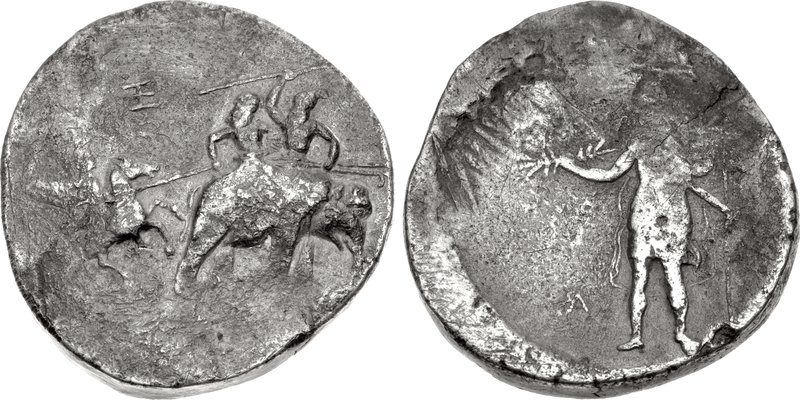
Frank Holt, in the fullest study of these "elephant medallions", reads the thunderbolt as a claim on the storm itself, the weather that hid the crossing recast as the king's own weapon, and suggests the coins were made as awards for veterans. Not every specialist accepts every detail, but the point stands. Within three years of the battle, the victor's version had been struck in silver.
Alexander understood this well. When he turned back from India, Plutarch and Diodorus say, he had oversized beds, mangers and horse-bits made and left about his camp, so that the people of the country would think his men had been giants. The battle on the Jhelum was fought twice: once on the riverbank, and once in the telling.
Cities, a dead horse, and an army that would go no further
Alexander sacrificed, held games, and founded two cities: Nicaea ("Victory") on the battlefield, and Bucephala where he had crossed, named for his horse Bucephalas, who died there. Arrian blames old age and exhaustion, at about thirty; most of the writers Plutarch read blamed wounds.
Where exactly was the battle fought?
Nobody knows, and the argument is old. By 1836 Mountstuart Elphinstone, Alexander Burnes and General Court, the French officer in Ranjit Singh's service, had each proposed a site. There are now two main schools of thought.
- Near the town of Jhelum, where the ancient road, forerunner of the Grand Trunk Road, crossed the river. Burnes and Court both put Alexander's camp there. Today the historian Jona Lendering argues that studies of the river's old courses show the Jhelum ran far from the sites downstream until about the eighth century CE, and places the crossing upstream, near the Mangla dam; the Leuven scholar P. H. L. Eggermont also rejected Jalalpur for that reason.
- Between Jalalpur Sharif and Haranpur, where the Salt Range meets the river. Alexander Cunningham, founder of the Archaeological Survey of India, walked the bank from Jalalpur to Jhelum in 1863 and in 1871 placed Bucephala at Jalalpur and Nicaea at Mong; Sir Aurel Stein, who surveyed the ground in person, argued in 1932 for a camp near Haranpur and a crossing by Jalalpur; and Michael Wood, retracing Stein's route in the 1990s, broadly agreed.
Cunningham had a particular reason to trust his eye. He had seen the field of Chillianwala a few days after the battle fought there in January 1849, in the Second Anglo-Sikh War, when rain had turned the ground to heavy clay, and he was sure the two battles had been fought on the same ground, between Mong and the southern end of the Pabbi hills.
A Buddhist monastic text of the early centuries CE, the Mūlasarvāstivāda Vinaya, names two cities on the Vitastā, Ādirājya, "the place of the first kingship", and Bhadrāśva, "the place of the good horse", which some scholars tentatively identify with Alexander's foundations. Local memory has not waited for the scholars. People in Phalia, across the river in Mandi Bahauddin District, say their town takes its name from Bucephalas, and both Phalia and Jalalpur Sharif are said to hold his grave; near Jalalpur, Michael Wood was told a shrine story that includes the death of a magical horse. These are folk traditions, worth recording for their own sake, but no excavation has confirmed any of them.
How sure are we? For any specific site: Contested.
On to the Beas
Alexander pushed east across the flooded Chenab, where, Ptolemy recorded, boats were wrecked on the rocks and men drowned, and across the Ravi. Beyond it he stormed Sangala, a stronghold of the Kathaioi whose site is unknown (Charles Masson once thought it was Harappa). Porus came to the siege with his remaining elephants and five thousand men, now fighting for Alexander. Arrian puts the Kathaioi's dead at seventeen thousand and the captured at more than seventy thousand, and Alexander razed the city. He marched on through the monsoon: seventy days of rain and thunder, Diodorus says, until his men were wearing recut Indian clothes and the horses' hooves were worn thin.
At the Hyphasis, the Beas, probably in today's Indian Punjab, the army refused to go on, alarmed by rumours of vast armies beyond the Ganges. According to Diodorus, Alexander asked Porus whether the reports were true, and Porus confirmed them, adding that the king who ruled there was said to be a barber's son. Coenus, who had led the flanking ride at the Hydaspes, spoke for the men. Alexander shut himself in his tent for two days and came out on the third; then, when the sacrifices for the crossing proved unfavourable, he yielded, and built twelve great altars to mark the end of his march. They have never been found.
Plutarch thought the struggle with Porus had blunted the army's courage. Modern historians spread the causes wider (eight years of war, the monsoon, homesickness, sheer distance), but the elephants on the Jhelum were surely part of it. Weeks later, back on the Hydaspes, Coenus fell ill and died, and the army was set to repairing the two new cities, which the rains had already damaged. In November 326 BCE a fleet of some eighty warships and, by Ptolemy's count, nearly two thousand vessels in all set off down the Jhelum towards the Indus, with the rest of the army marching along the banks. In the country of the Malli, traditionally placed near Multan, Alexander took an arrow in the chest and nearly died.
What the elephants did next
Alexander died at Babylon in June 323 BCE, not yet thirty-three, and his arrangements in Punjab soon came apart.
Porus did not outlive them long. Some time between Alexander's death and 317 BCE Eudemus, the Macedonian commander left in the region, had him murdered. We know only because Diodorus mentions it in a sentence about elephants: in 317 BCE Eudemus marched west to join the wars of Alexander's generals with 120 elephants, which he had acquired by treacherously killing King Porus. Of the murder itself we know nothing more. The last we hear of Porus's elephants, they are fighting for one Macedonian against another, in what is now Iran.
Punjab passed to a new power. Chandragupta Maurya, who according to Plutarch had seen Alexander as a young man, built an empire from the Ganges that swallowed the Greek garrisons of the north-west. Around 305–303 BCE Seleucus, the same Seleucus who had crossed the Jhelum with Alexander, marched east to recover the Indian provinces and came away instead with a treaty and five hundred war elephants. His envoy Megasthenes lived at Chandragupta's capital, Pataliputra (modern Patna), and wrote the fullest Greek account of India that antiquity produced, which survives only in quotations by later writers. In 301 BCE, at Ipsus in modern Turkey, Indian elephants helped Seleucus win the battle that fixed the shape of the Hellenistic world. The animals Alexander's soldiers had dreaded on the Jhelum had the last word.
It is easy to overstate the rest. Alexander spent about two years in the Indus lands, and his rule there did not outlast the decade. But the door stayed ajar. In the second and first centuries BCE Greek-speaking kings ruled parts of the north-west, among them Menander, remembered in a Buddhist dialogue as King Milinda of Sagala, today's Sialkot; and the meeting of Greek and Indian art in Gandhara shaped how the Buddha was carved for centuries.
Sikandar, Porus and the long memory of Punjab
In Punjab, Alexander is Sikandar.
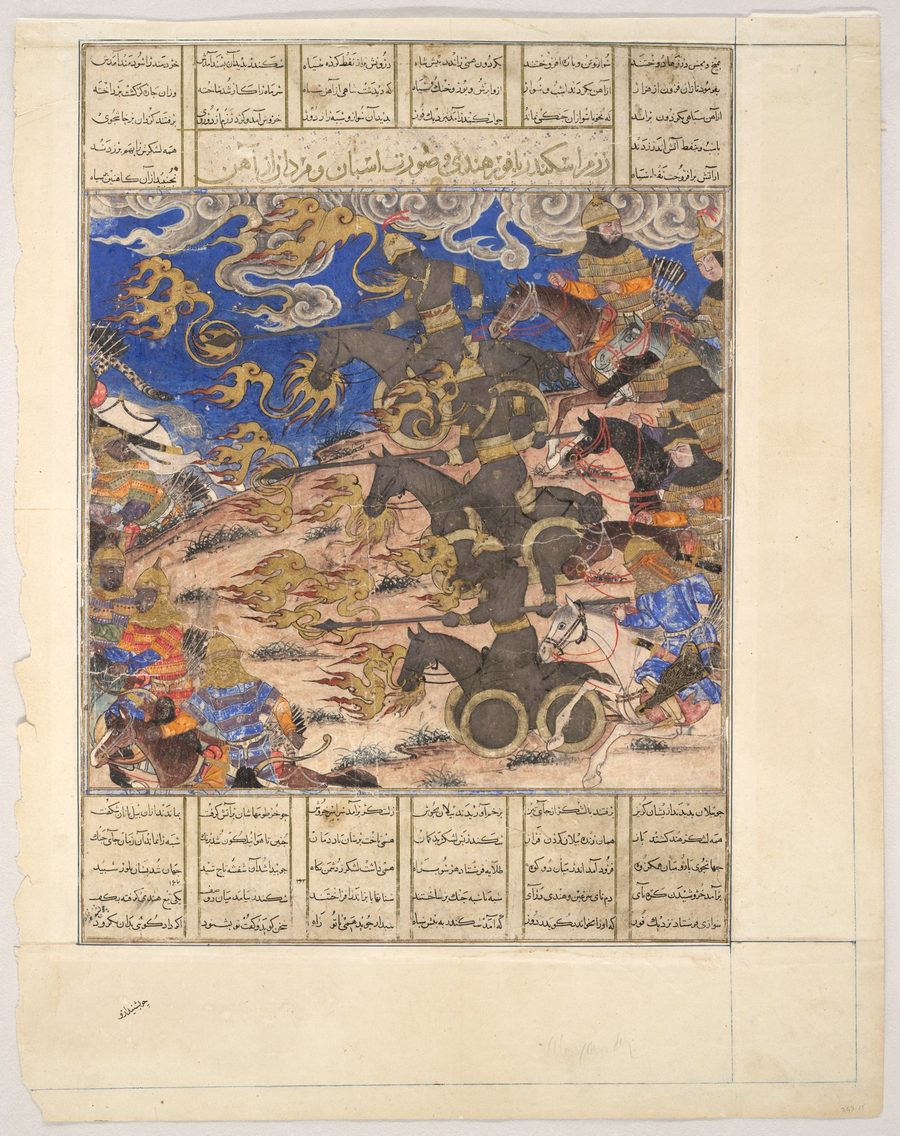
For most of the last thousand years, Punjabis who read about Alexander met him in Persian poetry rather than in Arrian. Ferdowsi finished his Shahnameh, the "Book of Kings", around 1010 CE and dedicated it to Mahmud of Ghazni, whose successors would make Lahore a capital. In it Iskandar fights Fūr of Hind: Porus, reshaped by Arabic, which has no letter p. Warned about Fūr's elephants, Iskandar has his smiths build iron horses and riders, fills them with naphtha and sets them alight; the burning army routs the elephants, and Iskandar kills Fūr in single combat. Neither the trick nor the duel began with Ferdowsi. Both come, by way of Arabic, from the Greek Alexander Romance, a fantastic life of Alexander that was translated across Asia, and Persian writers went on making the metal army more spectacular. Even Justin's sober summary has Porus asking for Alexander to be left to him. Poets from Nizami to Amir Khusrau of Delhi kept Alexander at the heart of Indo-Persian literature, and many classical Muslim commentators identified him with Dhu'l-Qarnayn, "the two-horned one" of the Qur'an, an identification others have always disputed.
Rulers took the name too. Alauddin Khalji styled himself "the second Alexander" on his coins, Sikandar Lodi ruled from Delhi, and in the twentieth century Sir Sikandar Hayat Khan led the government of undivided Punjab from 1937 to 1942.
Modern retellings chose sides. Sohrab Modi's film Sikandar (1941), with Prithviraj Kapoor as Alexander and Modi as Porus, made the story a patriotic epic in the last years of British rule, and some cinemas serving army cantonments banned it. A Hindi television series, Porus, followed in 2017–18. In Pakistan, writers have reclaimed Porus as a son of the soil who stood up to a foreign invader; one, writing in 2018, called him "the indigenous hero who conclusively blocked the tracks of the conqueror". Khukhrain Khatri families from the Salt Range country around Bhera, and some Jat and Rajput lineages, among others, have claimed him as an ancestor. The ancient sources record nothing of his caste, clan or religion, so none of these claims can be proved or disproved; they say more about the present than about 326 BCE.
It is tempting to read the Hydaspes as East against West. The men who fought it would not have recognised the description. Punjabis fought on both sides of the river, Alexander's cavalry included Iranians and Central Asians, and the king of Taxila wanted Porus beaten as badly as any Macedonian did. Within weeks, Porus himself was fighting for Alexander.
Myths and misreadings
"Porus actually won." The claim rests on three true observations: the fighting was hard, Porus kept his throne, and Alexander's army soon turned back. None of them shows a Macedonian defeat. Every ancient account, including Curtius, who is often sharply critical of Alexander, reports a Macedonian victory; Alexander marched east for weeks afterwards; and Porus ruled as his vassal. Some versions cite a passage attributed to E. A. Wallis Budge's 1896 translation of the Ethiopic Alexander Romance, a medieval legend translated into Ge'ez from Arabic in the fourteenth century, which can tell us nothing about a battle fought 1,600 years earlier. That Alexander won: Well-established. That the Greek writers played down their own losses: also Well-established.
"Roxana sent Porus a rakhi." A much-loved story, often told at Raksha Bandhan, says that Alexander's wife sent Porus a sacred thread, and that he spared Alexander in battle because of it. No ancient source contains it. The 1941 film Sikandar put it on screen: its Roxana ties a rakhi on Porus's wrist and asks him to spare Alexander. This is folklore, and modern.
"Porus said, 'Treat me as a king treats another king.'" Plutarch gives one word, basilikōs, "royally"; Arrian, a short sentence, "Treat me like a king, Alexander." The longer line is modern.
"Chandragupta and Chanakya fought Alexander." Plutarch says only that the young Chandragupta saw him. No ancient source puts either man at the Hydaspes.
"We know where the battle was fought." We do not. See Where exactly was the battle fought?
Timeline
Late 6th century BCE
Gandhara and Hindush under Persia
Persian royal inscriptions list Gandhara and Hindush, the Indus lands, among the Achaemenid Empire's provinces.
356 BCE
Alexander is born
At Pella, in Macedonia.
331 BCE
Gaugamela
Victory over Darius III, in modern Iraq; the Persian army includes fifteen elephants.
Spring 326 BCE
Across the Indus
Alexander crosses the Indus; Taxila welcomes him.
Late spring or early summer 326 BCE
The Battle of the Hydaspes
The night crossing in a storm, and the battle with Porus and his elephants.
Summer 326 BCE
The Chenab, the Ravi, Sangala
The army crosses the Chenab and the Ravi; Sangala is stormed and razed.
Late summer 326 BCE
The turn at the Beas
The army refuses to go beyond the Beas; twelve altars are built.
November 326 BCE
Down the Jhelum
Coenus has died; the fleet sails down the Jhelum.
c. 324–323 BCE
The medallions
The "Porus medallions" are probably struck.
June 323 BCE
Alexander dies
At Babylon.
323–317 BCE
Porus is murdered
Killed by Eudemus, the Macedonian commander in the region.
317 BCE
The elephants go west
Eudemus takes 120 elephants from Punjab to the wars of Alexander's successors.
c. 305–303 BCE
Seleucus and Chandragupta
Peace between Seleucus and Chandragupta Maurya; 500 elephants change hands.
301 BCE
Ipsus
Indian elephants help Seleucus win in modern Turkey.
c. 1010 CE
The Shahnameh
Ferdowsi completes the Shahnameh, with Iskandar's war on Fūr of Hind.
1849
Chillianwala
The battle of the Second Anglo-Sikh War, on ground Cunningham believed was Porus's battlefield.
1871
Cunningham's identifications
Alexander Cunningham proposes Jalalpur and Mong as Bucephala and Nicaea.
1932
Stein's survey
Aurel Stein publishes his survey of the crossing.
1941
Sikandar
Sohrab Modi's film.
2003
The medallions studied
Frank Holt's study of the elephant medallions.
Quick answers
Who won the Battle of the Hydaspes?
Alexander the Great. Porus was wounded and captured, and Alexander then restored him as a king under Macedonian overlordship. Every surviving ancient account reports a Macedonian victory; no Indian account of the battle survives.
Where was the Battle of the Hydaspes fought?
On the Jhelum River, the ancient Hydaspes, in what is now Punjab, Pakistan. The exact site is unknown. The main candidates are near the town of Jhelum and the stretch between Jalalpur Sharif and Haranpur, below the Salt Range.
When was the Battle of the Hydaspes?
In 326 BCE. Arrian dates it to the Athenian month of Mounychion, roughly late April to May; some historians argue for June or July, because Arrian also describes rivers already swollen by the rains.
What did Porus say to Alexander?
Asked how he wished to be treated, Porus answered "like a king": in Plutarch the single Greek word basilikōs, in Arrian "Treat me like a king, Alexander". Asked if he wanted anything more, he said everything was included in that. Curtius gives a different reply, about how quickly fortune turns, and Diodorus none at all.
How many elephants did Porus have?
The sources disagree: Curtius says 85, Diodorus 130 and Arrian 200. None of the ancient figures is reliable.
Did Porus defeat Alexander?
No surviving evidence supports this. Every ancient account describes a Macedonian victory, though the fighting was hard and the Greek writers almost certainly understated their own losses.
What is the Hydaspes River called today?
The Jhelum: Jehlam (ਜੇਹਲਮ · جہلم) in Punjabi. Its Sanskrit name is Vitastā, and in Kashmir, where it rises, it is the Vyath.
Why did Alexander turn back from India?
A few weeks after the battle his army refused to cross the Beas (Hyphasis), exhausted by eight years of war and the monsoon and alarmed by reports of huge armies further east. Plutarch believed the hard fight against Porus had sapped their will.
Key terms
- Companions
- Hetairoi: the heavy cavalry of the Macedonian nobility.
- Cubit
- An ancient length of roughly 45 centimetres, the forearm.
- Doāb
- ਦੋਆਬ · دوآب: land between two rivers, from Persian do, "two", and āb, "water".
- Mahout
- An elephant's driver; the English word comes from Hindustani mahāvat.
- Mounychion
- An Athenian month falling roughly in late April and May; Greek writers dated events by month and by the year's chief magistrate, the archon.
- Phalanx
- A deep, tightly packed block of infantry.
- Plethron
- A Greek length of about thirty metres.
- Prakrit
- The everyday Indo-Aryan languages of ancient India, as distinct from literary Sanskrit.
- Sarissa
- The Macedonian infantry pike, five to six metres long.
- Stade
- A Greek measure of distance, roughly 160–185 metres; Arrian's 150 stades is about 27 kilometres.
- Yavana
- The Indian name for Greeks, from "Ionian".