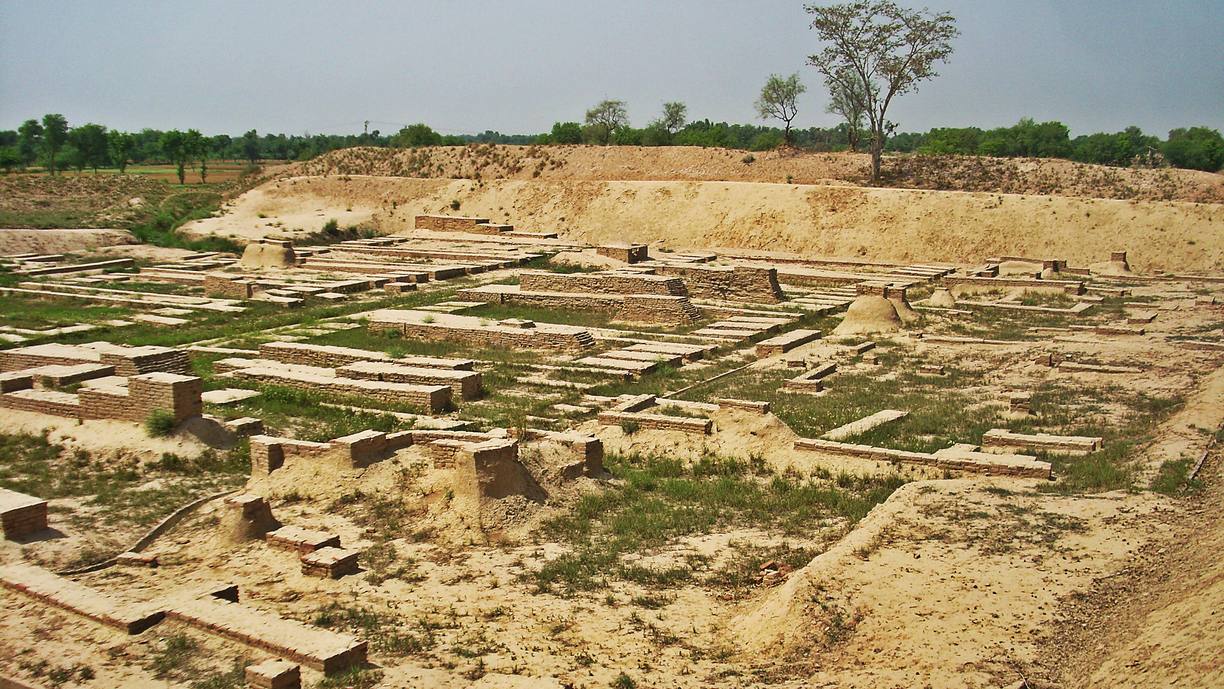
In short
- The Indus Valley Civilisation, also called the Harappan Civilisation, was one of the world's first urban societies. Its cities flourished from about 2600 to 1900 BCE across what are now Pakistan and north-western India.
- Harappa, on an old course of the Ravi in Sahiwal District of Pakistani Punjab, was the first of its cities to be systematically excavated, from 1921, and gave the civilisation its archaeological name.
- The cities are known for bricks and weights made to common standards, household wells and bathrooms, and covered street drains. No palace, royal tomb or scene of war has been securely identified.
- Their script survives on thousands of seals and other objects. It has not been deciphered.
- No invasion destroyed the cities. After about 1900 BCE they shrank and were abandoned over generations as climate, rivers and trade shifted, while village life carried on, much of it in Punjab and further east. How much weight each cause deserves is still argued.
Most of the places in this story are in present-day Pakistan; some are in India. We give each its modern district and country, and the tables near the end gather them. The labels on the notes, and the confidence scale, are the ones explained on our About page. Hover over or tap a Punjabi word to see it in both scripts.
Prologue: the bricks under the railway
In 1829 a young Englishman who called himself Charles Masson came to a village on the Ravi that he spelled Haripah. Masson was not his real name. He had been born James Lewis, and two years earlier he had deserted from the East India Company's Bengal Artillery. He had come down from Lahore, the capital of Maharaja Ranjit Singh, and was riding towards Multan in the camp of Thakur Singh, a Sikh sardar of sixteen or seventeen travelling on the Maharaja's business. The young chief would not let his guest pay for anything, and in return for help with a vocabulary of English he taught Masson the Gurmukhi alphabet.
What Masson saw at Haripah went into a travel narrative published in 1842. The camp was
pitched in front of the village and a ruinous brick castle
whose walls and towers
were still remarkably high. Behind it rose a large circular mound of earth,
obviously an artificial one
. To the west stood a rocky height crowned with broken
walls, which he took to be natural. Pipal trees grew everywhere, some so old that he read
them as proof of the place's age. The villagers told him that a city had once stood here,
reaching all the way to Chichawatni, thirteen kos away (the kos is an old measure of
roughly two to three kilometres), and that it had been destroyed by a particular
visitation of Providence
for the lust and crimes of its king.
That evening, warned that the plain swarmed with stinging gnats, the party climbed the
circular mound. There was room on the summit, Masson noted, for all of them and their
horses. From the top he convinced himself that every condition of Arrian's Sangala
was here fulfilled
: that this was Sangala, a town besieged by
Alexander's army in 326 BCE. He was out by
some two thousand years. Nor did the mound save them from the gnats. At sunset the horses
went frantic, and the whole camp packed up and marched through the night to
Chichawatni.
So the first outsider to describe Harappa in print stood on top of it, named it with
confidence, and was wrong. He had even taken its highest mound for natural rock. Forty
years later Cunningham found that the "rocky height" was only an accumulation of
masses of brick walls and broken bricks
.
Two years after Masson, Alexander Burnes, travelling up the rivers to Lahore with a gift
of English dray horses for Ranjit Singh, turned inland to see the ruins. He put them at
about three miles in circumference
and found the place a perfect chaos
:
its bricks had been carried off to build a village nearby. The first to look at Harappa
with an archaeologist's eye was Cunningham, an army engineer who would become the first
Director General of the Archaeological Survey of India. He visited in 1853 and 1856, dug
there in 1872–73, and found the site disappearing.
The Punjab plains have almost no stone. When engineers built the railway between Lahore
and Multan, they needed ballast, the hard rubble that holds a railway's sleepers in
place, and Harappa offered millions of bricks, fired hard four thousand years earlier.
Cunningham reported in 1875 that the ruins had more than sufficed to furnish brick
ballast for about 100 miles of the Lahor and Multan Railway
. By the time he dug, the
surface had been so completely cleared out by the Railway contractors
that he found
very little worth preserving
.
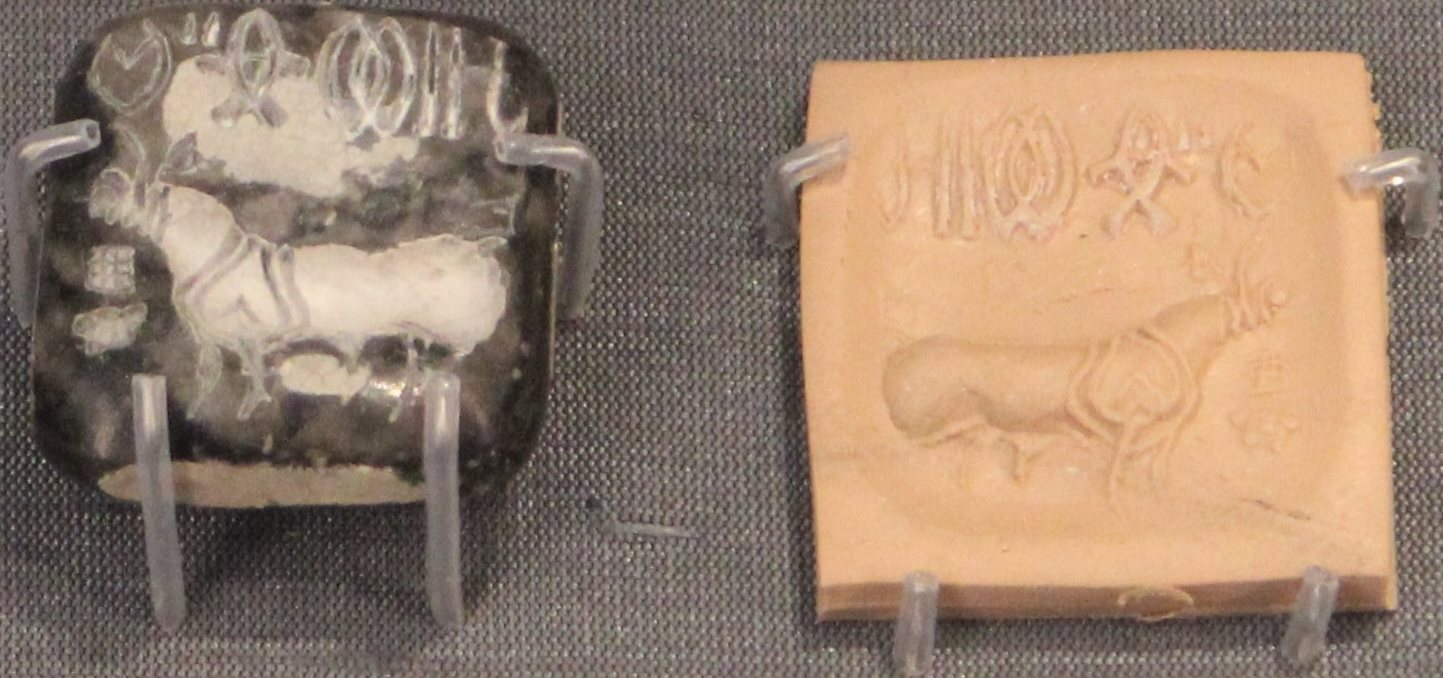
One thing he did publish was a small object that had come out of that ground: a seal of
smooth black stone
belonging to a Major Clark. It showed a bull without a hump,
two small stars beneath its neck and, above, a row of six signs. Cunningham wrote that
they were certainly not Indian letters
, and because the bull had no hump he
concluded that the seal is foreign to India
. It was the first inscription of the
Indus civilisation ever published. Nobody could read it then. Nobody can read it
now.
For almost half a century the mounds kept their secret. Then, in January 1921, Daya Ram Sahni of the Archaeological Survey began to excavate at Harappa under the direction of the Survey's Director General, John Marshall. The following year Rakhal Das Banerji, digging a Buddhist stupa of the early centuries CE on a mound in Sindh called Mohenjo-daro, some six hundred kilometres to the south-west, found seals of the same kind in older layers beneath it. On 20 September 1924 Marshall announced the discovery in the Illustrated London News. Within weeks, specialists in ancient Iraq wrote in to point out that seals of this type had turned up in Mesopotamia, in layers that could be dated. The Indus cities had been contemporaries of Sumer. At a stroke, the known history of cities in South Asia was pushed back by some two thousand years.
The questions raised in 1924 are still being argued a century later. Who built these cities, and what did they call themselves? How did a civilisation of this size govern itself without, as far as anyone can tell, a single king? Why can no one read its writing? And why, after seven centuries, did its cities empty? Some of these questions now have good answers. One of them was answered confidently, and wrongly, for decades. We will come to it.
What was the Indus Valley Civilisation?
The Indus Valley Civilisation was a Bronze Age urban society that flourished on the plains of the Indus and its neighbouring rivers from about 2600 to 1900 BCE. The Bronze Age is the period in which people made tools of copper and its alloy bronze, before iron came into general use. The civilisation was contemporary with Old Kingdom Egypt and the city-states of Mesopotamia, and it covered more ground than either: about a million square kilometres, on the usual estimate more than Egypt and Mesopotamia together. Its settlements reached from the Makran coast of Balochistan to the upper Ganga–Yamuna plain, and from the foothills of Jammu to Gujarat, with at least one trading outpost far to the north, at Shortugai on the Amu Darya in Afghanistan.
Archaeologists divide its story into three phases, each dated approximately and varying from region to region. The Early Harappan phase, about 3300–2600 BCE, saw regional farming cultures and growing towns. The Mature Harappan phase, about 2600–1900 BCE, was the age of the cities. The Late Harappan phase, about 1900–1300 BCE, saw smaller settlements and regional cultures. The American archaeologist J. Mark Kenoyer, who has worked at Harappa since the 1980s, calls them the eras of Regionalisation, Integration and Localisation, which describes what happened rather better.
More than a thousand settlements of the Mature phase are known, from hamlets to cities, and fewer than a hundred have been excavated in any depth. Five stand out for their size: Mohenjo-daro in Sindh, well over two hundred hectares; Harappa, about 150 hectares; Ganweriwala in the Cholistan desert, barely excavated; Rakhigarhi in Haryana; and Dholavira in Kachchh, Gujarat. Three of the five stand in land that is Punjab today or was until 1966: Harappa and Ganweriwala in Pakistani Punjab, and Rakhigarhi in Haryana, which was separated from Indian Punjab that year.
How many people lived in them is informed guesswork. Estimates for Mohenjo-daro cluster around 40,000; for Harappa at its height, between about 23,500 and 60,000. For the civilisation as a whole, figures from one to five million are quoted, and every one of them is Contested. There was no census, or none that we can read.
Before the cities, 7000–2600 BCE
Cities do not appear from nowhere, and the Indus cities had a long prehistory. The oldest part of it lies west of the Indus, at the foot of the Bolan Pass, where the mountains of Balochistan open onto the Kachhi plain.
There, from 1974, a French team led by Jean-François Jarrige excavated Mehrgarh, a village first settled around 7000 BCE and one of the earliest farming settlements in South Asia. Its people grew barley and wheat, kept sheep and goats, and in time domesticated the humped zebu cattle that are still the working animals of the region. They were also, it turns out, remarkably skilled with small things. Eleven molars from Mehrgarh burials, between about 7,500 and 9,000 years old, carry small, neat holes drilled while their owners were alive: the oldest known evidence of dentistry. A copper bead from a burial of the sixth millennium BCE preserved the mineralised fibres of the thread it was strung on, and the thread was cotton, some of the oldest known anywhere. Both findings are Well-established, from laboratory study published in Nature and the Journal of Archaeological Science.
Over the following millennia villages spread east across the Indus plains and into Punjab, and by the fourth millennium BCE distinct regional cultures had emerged, which archaeologists name after their pottery or their type sites: Hakra in Cholistan, Amri and Kot Diji in Sindh, Sothi-Siswal in what are now Haryana and Rajasthan. At Harappa the first village, of the Ravi phase, dates from about 3700 BCE. On its pots from around 3300 BCE are marks scratched into the wet clay, which some excavators see as early steps towards writing and others as potters' or owners' marks.
Further east, at Kalibangan in Rajasthan, excavators in the 1960s found a ploughed field buried beneath the town and dated to around 2800 BCE. Its furrows cross in two directions, one set about 30 centimetres apart and the other about 1.9 metres, and farmers in the area still plough this way to grow two crops together, such as gram (chickpea) and mustard. That it is the oldest excavated ploughed field in the world is often said and is Probable. The site's name means "black bangles", after the broken bangles that littered its surface.
Then, around 2600 BCE, something happened that archaeologists still struggle to explain. Across a vast area, perhaps within a few generations, the regional traditions gave way to one strikingly uniform culture: the same bricks, weights, seals and signs, and the same red pottery painted in black, from the Makran coast to Haryana. At some settlements, including Kot Diji, a layer of burning marks the change, though whether it records conflict, accident or rebuilding is debated. Trade, shared belief, a new ruling class and networks of families grown rich on exchange have all been proposed to explain the speed of it. We will return to the question when we ask who, if anyone, was in charge.
Inside a Harappan city
Stand today in the brick lanes of Mohenjo-daro or Harappa and the first surprise is how unmonumental it all is. There are no pyramids, no ziggurats (the stepped temple towers of Mesopotamia), no colossal statues. The monuments of these cities are their streets, drains and wells: the equipment of daily life, built with a care that many ancient societies kept for palaces and temples.
A civilisation of bricks
Everything began with the brick. Harappan builders used fired bricks wherever a wall had to resist water and sun-dried mud bricks for bulk, and they made both to the same proportions: thickness, width and length in the ratio 1:2:4, typically about 7 by 14 by 28 centimetres for a house. The ratio held at sites hundreds of kilometres apart, for centuries. Bricks of this shape interlock neatly in a wall, and the persistence of the standard speaks of shared training, perhaps of shared rules.
Punjabi has an old word for what they made. An iṭṭ (ਇੱਟ · اِٹ) is a brick: a pakkī iṭṭ, literally a "cooked" brick, has been fired in a kiln, and a kachchī iṭṭ, a "raw" one, has only dried in the sun. The word descends from the Sanskrit iṣṭakā. The object is older in this region than any language we can name.
The cities stood on massive platforms of brick and packed earth, raised against floods, and Mohenjo-daro was rebuilt so often that today's ruins stand on the remains of earlier cities. The high western mounds at both sites were long called "citadels", Mortimer Wheeler's word from the 1940s, which suggests a fortress and a garrison that the evidence does not show.
Streets, blocks and doors that face away
Textbooks often describe a perfect grid. The reality is looser. The main streets of Mohenjo-daro run roughly north–south and east–west and divide the lower town into large blocks, but the blocks are irregular, lanes bend, and the plan changed over centuries of rebuilding, even as the main streets kept their lines. Houses were built around courtyards and mostly turned a blank wall to the main street, with doors on the side lanes and small, high windows: an architecture of privacy that also kept out dust and heat. Stairways show that many had an upper storey or a flat roof used as living space, as roofs across the plains still are on summer nights. Houses range from single rooms to a dozen rooms or more around several courtyards. Wealth was unequal, even if we cannot say how it was held.
Seven hundred wells
Water was the city's first concern. Mohenjo-daro had an estimated seven hundred wells, roughly one for every three houses, according to the German architect and archaeologist Michael Jansen, who spent years mapping them. The figure is an estimate from the parts excavated, and Probable. Many were private, reached from inside a house. They were lined with wedge-shaped bricks that lock into a tight circle, and raised whenever the city's ground level rose, so that excavators who later dug away the surrounding deposits left some shafts standing alone, like brick chimneys.
The Punjabi for a well is khūh (ਖੂਹ · کھوہ). Until tubewells spread in the twentieth century, the brick-lined khūh was the centre of farming and village life across both Punjabs, its water often raised by a Persian wheel turned by oxen. Its builders solved the problem the Harappans had solved: reaching groundwater through soft river-laid soil without the shaft collapsing.
Bathrooms, toilets and the drains under the street
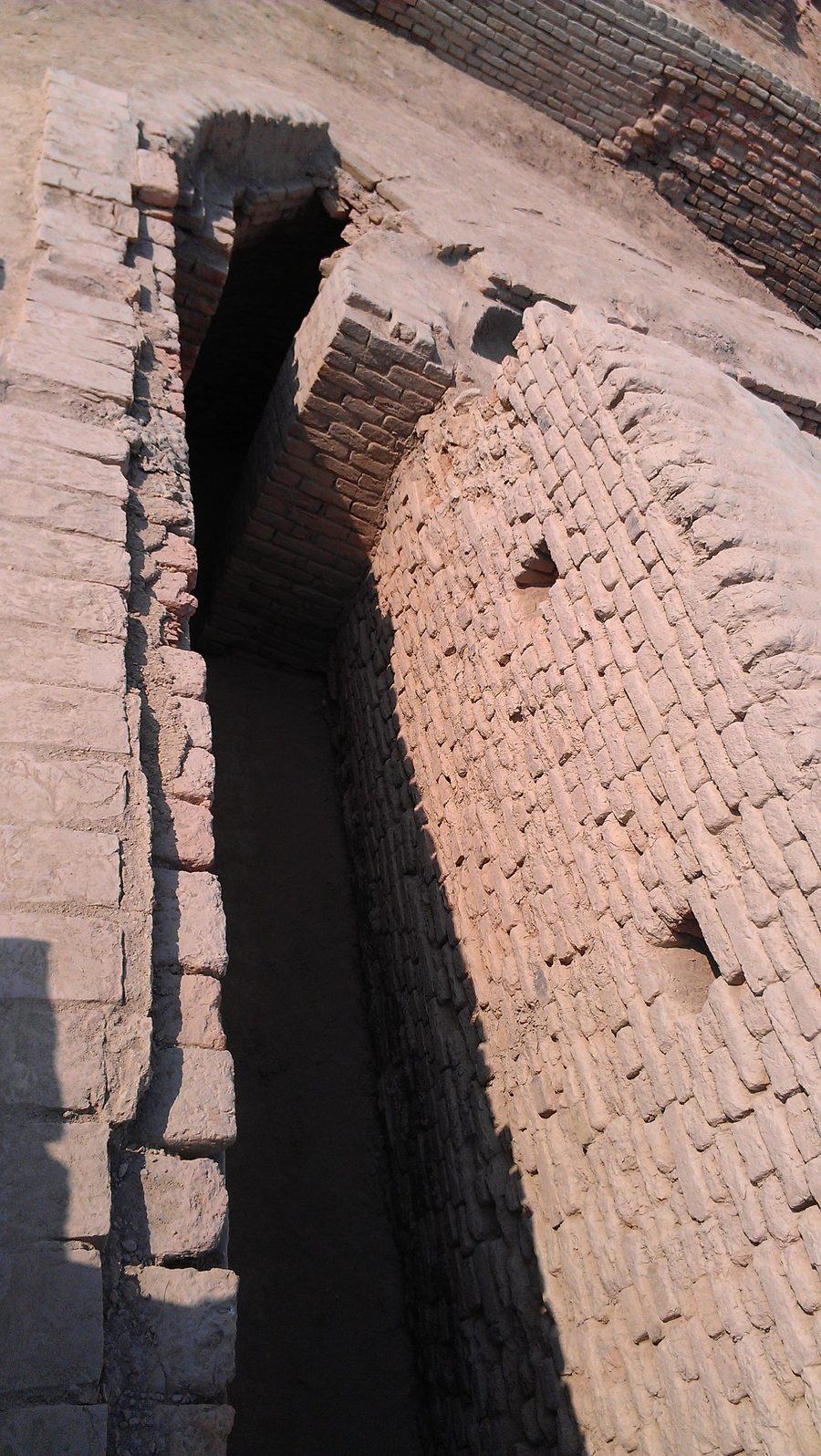
Inside many houses, one room was set aside for bathing, with a watertight floor of fine fired bricks sloping to a corner, where the water ran out through the wall. Some houses had latrines, usually a seat over a brick-lined chute or a pot set into the floor, cleaned by pouring water by hand. Waste water from bathrooms, kitchens and upper floors flowed into brick drains along the streets and lanes. The drains were covered with loose bricks or slabs that could be lifted, and at intervals the builders set sumps, pits where solids settled before the water flowed on. Sumps fill up. Someone had to empty them, week after week, for centuries, and that is evidence of something the ruins cannot show directly: an institution, or at least a settled custom, whose job it was.
Other Bronze Age cities had drains, in palaces and in some houses. What sets Mohenjo-daro and Harappa apart is how ordinary such facilities were: bathing floors connected to street drains were a feature of house after house across whole neighbourhoods. That no other city of the third millennium BCE did this on such a scale is Probable, and hard to test, since so few have been dug as widely.
The Great Bath
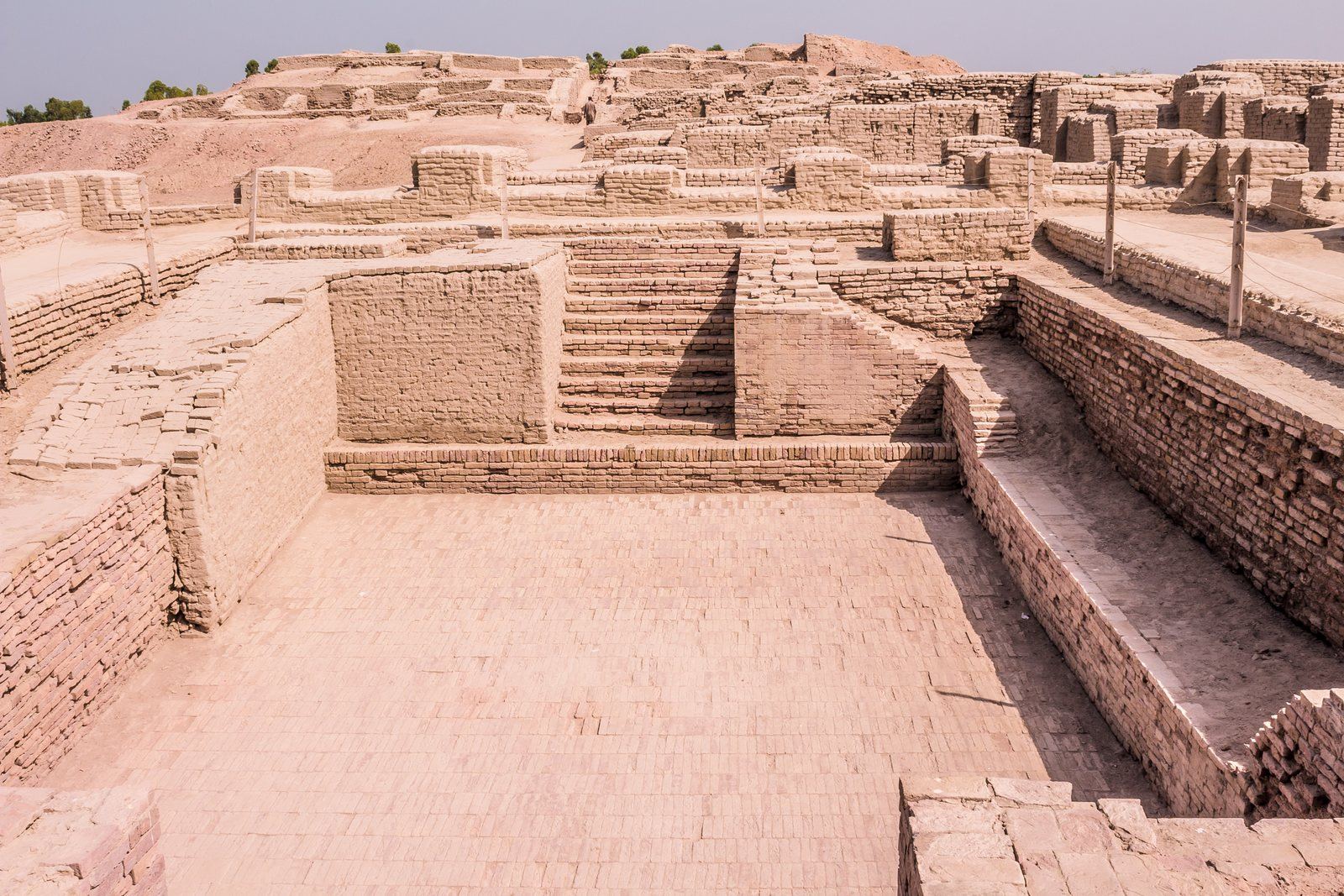
The most famous building of the civilisation is a pool. On the western mound at Mohenjo-daro, excavators in the 1920s uncovered a tank about 12 metres long, 7 metres wide and 2.4 metres deep, in a courtyard surrounded by a colonnade and rooms. Its floor and sides are of fired bricks set on edge in gypsum mortar, backed by a layer of bitumen, a natural tar, to keep it watertight. Steps lead down at each end. A well in an adjoining room filled it, and an outlet emptied it into a great drain roofed with a corbelled arch, in which courses of brick step inwards until they meet.
What was it for? No text tells us. Its careful construction and central position have led most scholars to suggest ritual bathing, perhaps by a select group, rather than everyday washing, a reading that is Probable but no more. It is tempting to draw a line from here to the sacred waters of later South Asia: the tank (kuṇḍ) of a Hindu temple, the pool (sarovar) of a gurdwara, the ablution pool (hauz) of a mosque. The line may be real in the broadest sense, as a long regional habit of linking water with purity. But thousands of years separate them, and no evidence joins the dots: the connection is Contested.
Granaries that may not have been granaries
Two large buildings, at Mohenjo-daro and at Harappa, were identified early in the twentieth century as state granaries. Later researchers found no stored grain, storage jars or bins in either, and many archaeologists now call them simply "great halls", purpose unknown. The lesson recurs throughout Indus archaeology: names given in the 1920s and 1940s still shape how we see these buildings, and several of them were guesses.
Harappa's gates
Harappa was not one walled city but several walled neighbourhoods on separate mounds. Its best-studied gateway, at the south-east corner of Mound E, was built between about 2600 and 2200 BCE: a street about 2.6 metres wide, a wooden door about 2.35 metres wide, and small side rooms that may have held officials or guards. The excavators, the Harappa Archaeological Research Project, read such walls less as defences against armies than as a way of controlling who and what came in, so that goods could be inspected and perhaps taxed.
Dholavira: a city built to catch rain
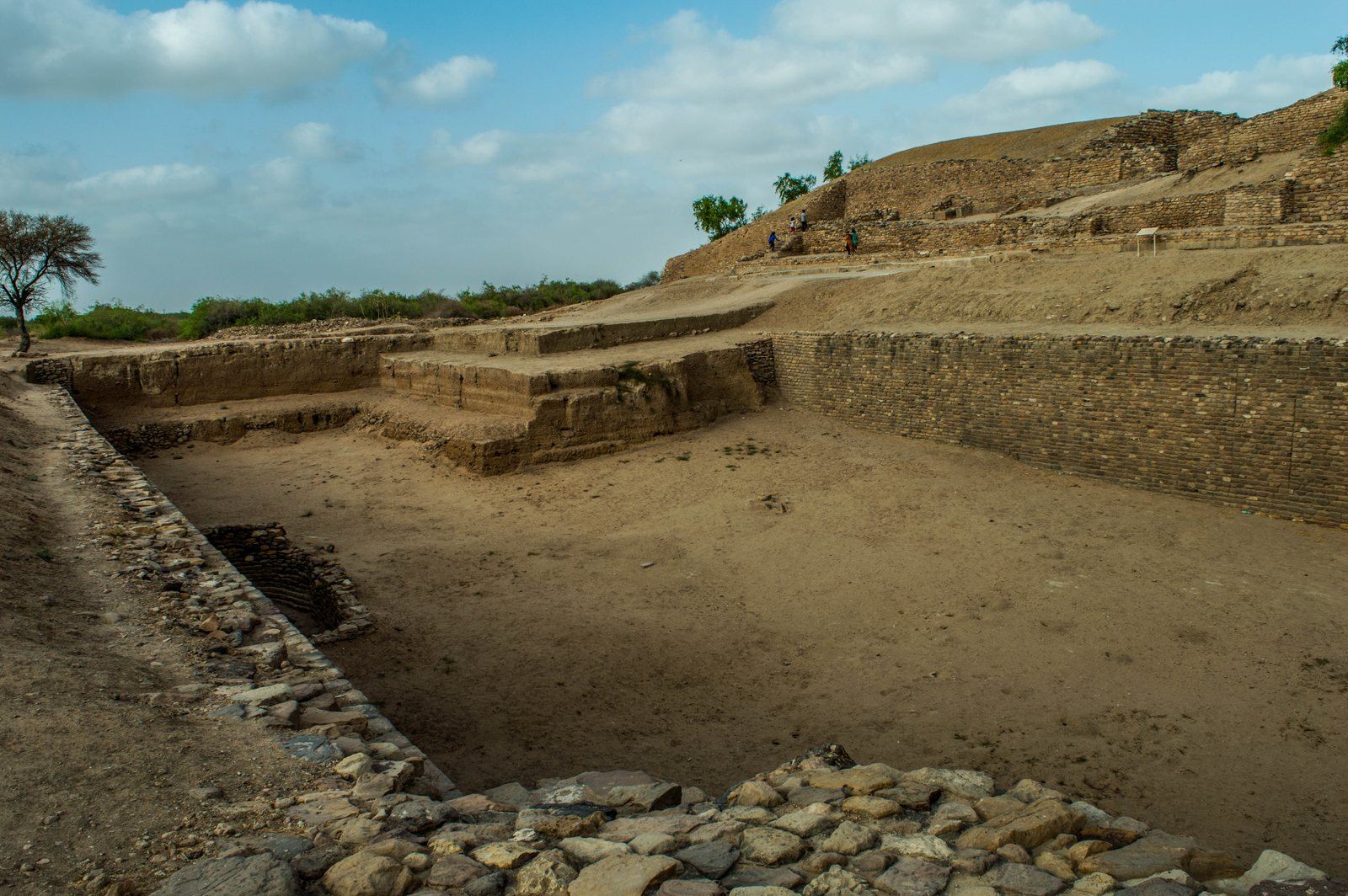
Not every Indus city stood beside a great river. Dholavira stands on Khadir Bet, an island in the salt flats of the Great Rann of Kachchh in Gujarat, where rain is scarce and unreliable. Its builders dammed two seasonal streams and built or cut at least sixteen reservoirs, covering roughly a tenth of the walled city; the largest, about 73 by 29 metres, is cut deep into the rock. Near the north gate, the excavator R.S. Bisht's team found ten large signs of the Indus script, each about 37 centimetres high, made of white gypsum pieces once set into a wooden board some three metres long. It may have been a signboard over the gate; its signs are the largest known in the script. Dholavira became a UNESCO World Heritage Site in 2021.
Lothal: dock or reservoir?
At Lothal, near the head of the Gulf of Khambhat in Gujarat, S.R. Rao excavated in the late 1950s a brick-lined basin more than 210 metres long, which he identified as the world's earliest known dock. Critics argued that it was more probably a freshwater reservoir, since the site lies well inland. A 2024 study of the old courses of the Sabarmati argued that the river once flowed past Lothal and that boats could have reached the basin. The dock reading has gained support, not proof: it is Probable.
Interlude: one morning at Harappa, about 2300 BCE
What follows is imagined. The people in it are invented; the things they use have been found at Harappa or its sister cities.
The smoke comes first, before the light. By the time the sun clears the far bank of the Ravi, the kilns at the edge of the city have been burning for hours, and the air smells of wet clay and dung fire.
At the gate on the south side of the mound, a cart is waiting. Its wheels are solid discs of wood, and the ox in its traces is humped and pale. The driver has come upriver with bundles of cotton cloth, each tied with cord and sealed with a lump of clay that carries the impression of a small square seal: an animal with a single horn, and above it a row of signs. The man at the gate breaks nothing. He reads the sealings, sets a bundle on one pan of a balance and adds cubes of polished stone to the other until the beam hangs level. The smallest cube in his box weighs less than a gram. Its twin, in a merchant's box in a city six hundred kilometres to the south, weighs the same.
Inside, a lane runs between blank brick walls. In a courtyard behind one of them, a bead-maker sits on a mat with a bow drill, working a hole through a bar of red carnelian as long as his finger. He has been drilling it for days. When it is finished and polished, it may leave the city by river and sea and end its journey in a grave in Mesopotamia. He will never know.
Water runs past his door in a covered drain, down from a house where someone is bathing. A child sits in a doorway with a clay cart, a small copy of the one at the gate, and a whistle shaped like a bird that she has been told not to blow. Somewhere a woman is grinding grain. Somewhere a man is counting.
No one in this scene has a name we can read. The signs on the seal meant something to the man at the gate. To us they still say nothing.
Farmers, craftspeople and traders
Two harvests
Beneath the cities lay a flexible farming economy. The Indus plains receive the summer monsoon and lighter winter rain from the west, and Harappan farmers used both: winter crops such as wheat, barley, lentils and peas, sown in autumn and harvested in spring, and summer crops such as millets, cotton and, in places, rice. That many communities grew crops in both seasons, spreading the risk that one harvest would fail, is Probable.
Punjabi farmers still divide the year this way, between hāṛhī, the winter-sown crop gathered in spring, and sāuṇī, the crop sown with the summer rains. The names are far younger than the cities, and the continuity is one of practice, not proof of descent: the same climate invites the same solutions.
What they ate
At Farmana in Haryana, starch grains of ginger and turmeric were found on human teeth and in a cooking pot from about 2500–2200 BCE. Newspapers called it the world's oldest curry, which goes too far, since "curry" is a much later word for a whole family of dishes, but the find does put two staples of South Asian cooking in a pot four and a half thousand years ago. Fats absorbed into pottery point to the cooking of meat and dairy, though the chemistry is not always easy to read, and the animal bones show that cattle, mostly humped zebu, dominated the herds.
Beads, bangles and a drill made of stone
The finest Harappan ornaments are long beads of carnelian, a translucent red stone, some more than ten centimetres long and drilled lengthwise from both ends. The drills were tiny cylinders of an extremely hard stone, named ernestite after the excavator Ernest Mackay, turned with a bow, and a single long bead could take days. A belt of forty-two such beads from Mohenjo-daro represents an enormous investment of skilled labour. At Chanhu-daro in Sindh, Mackay found a workshop with beads at every stage of making, and the finished beads travelled far: beads of Indus type lie in the royal graves of Ur in Mesopotamia.
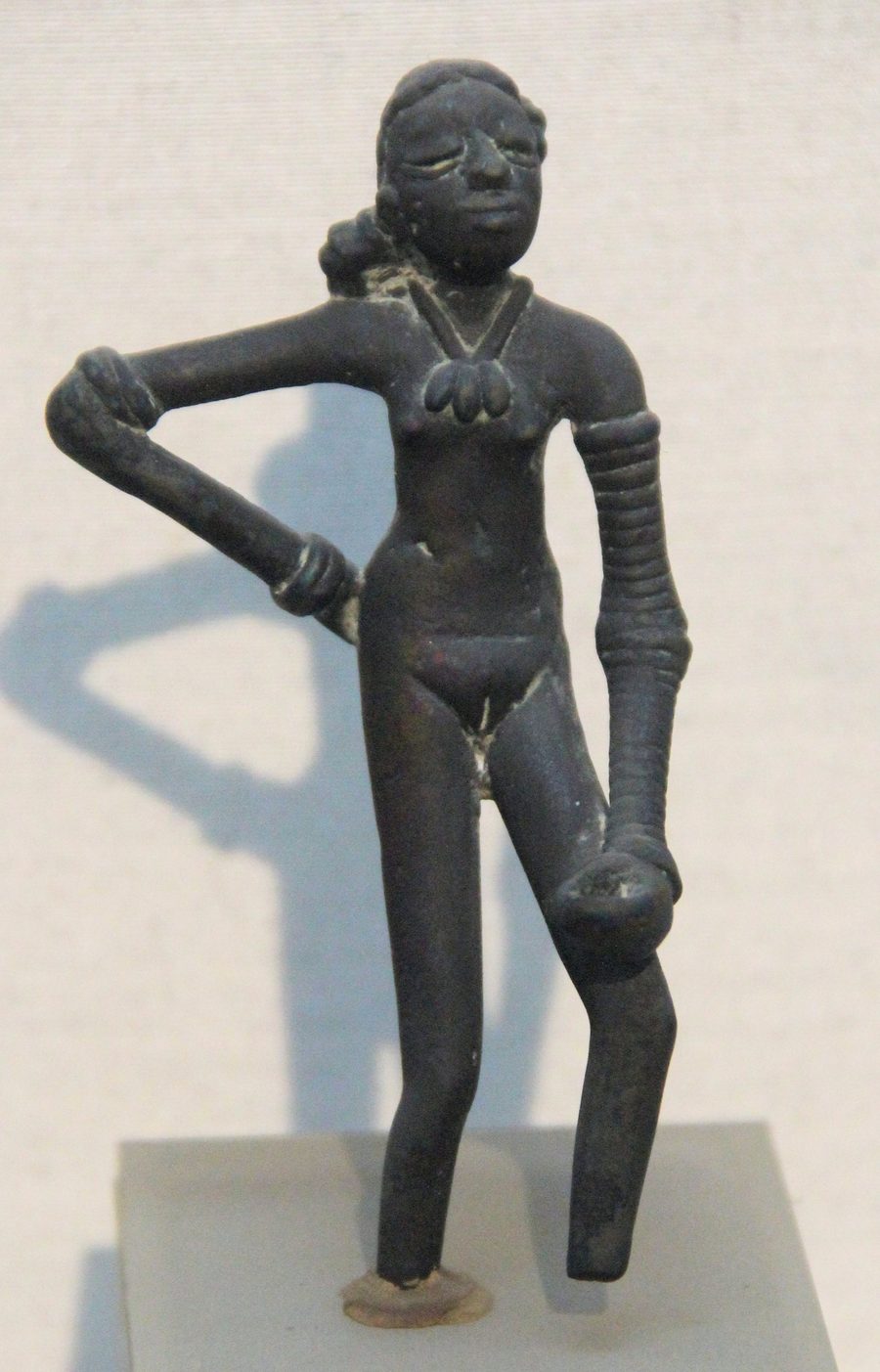
Bangles were everywhere, of shell, terracotta, faience (a glazed material made from crushed quartz) and a very hard stoneware, and the bronze figurine from Mohenjo-daro known as the "Dancing Girl" wears them almost from wrist to shoulder on one arm. We will meet her again.
Weights and measures
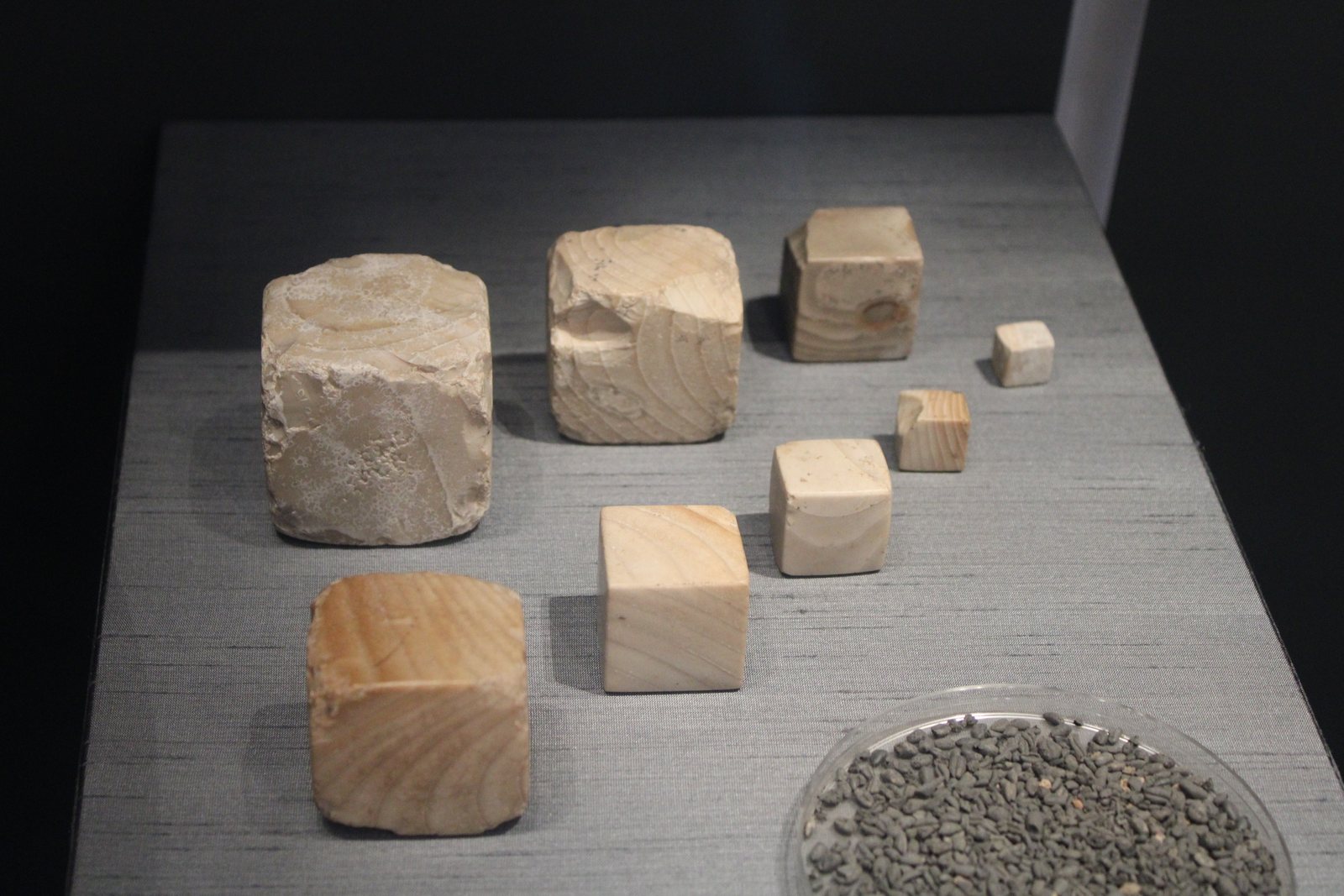
Harappan weights are small polished cubes, mostly of chert, a hard stone. The smaller units double, 1, 2, 4, 8, 16: the commonest, about 13.7 grams, is sixteen times the smallest, about 0.86 grams, and larger weights continue in multiples of ten. The same standard held across the civilisation for centuries, which is Well-established, and which implies shared rules and, very likely, people whose task was to enforce them. Lengths were measured as finely: a fragment of an ivory scale from Lothal is marked in divisions less than two millimetres apart.
Toys, dice and footprints
Children played with terracotta carts, bird-shaped whistles and animals with nodding heads; adults threw dice marked from one to six. At Mohenjo-daro one brick carries the footprint of a child who stepped on it while it was drying, and another the tracks of a goat and her kid crossing it in opposite directions.
The carts deserve a second look. Model carts with solid wheels are among the commonest toys at Indus sites, and ruts left by real carts have been found in Harappa's streets. The heavy ox-cart of the Punjab plains, the gaḍḍā (ਗੱਡਾ · گڈّا), carried the harvest to market in both Punjabs until tractors largely replaced it in the twentieth century, and it was built on the same principle as many of the Harappan models: two wheels, a pole and a pair of oxen.
Meluhha: the Indus as Mesopotamia saw it
The Indus cities left no account of themselves that we can read. Their neighbours did. Around 2300 BCE Sargon of Akkad, the first ruler to bring the cities of Mesopotamia under one king, boasted that ships from Meluhha, Magan and Dilmun were moored at the quay of his capital. Magan is generally placed in Oman and Dilmun in Bahrain. Meluhha, the most distant of the three, is identified by most scholars with the Indus region, and the identification is Probable. Mesopotamian texts list its exports as carnelian, gold, ivory and fine timber, and Indus seals and beads have been found in Mesopotamian cities.
One small object says more than a shipping list. A cylinder seal of the Akkadian period, now in the Louvre, belonged to a man named Shu-ilishu, and its inscription calls him an interpreter of the Meluhhan language. Meluhhans spoke a language foreign enough to need a professional translator, and there was enough business to keep one employed.
Seals were the tools of this trade, pressed into clay on bundles, jars and doors to identify goods and vouch for their owners. The Punjabi word for a seal, mohar (ਮੋਹਰ · مہر), arrived much later, through Persian, the language of government under the Mughals and in Ranjit Singh's empire, but it names the same act: pressing a mark into something so that others will trust it. To put one's mohar on something is still, in Punjabi, to approve it.
After the fall of the Third Dynasty of Ur, around 2000 BCE, Meluhha fades from Mesopotamian texts, and later Assyrian scribes used the name for a different land altogether, in north-east Africa.
Power without palaces
Here is the strangest thing about the Indus cities. Egypt's pharaohs built pyramids, and Mesopotamia's kings raised statues of themselves and recorded their conquests. At Harappa and Mohenjo-daro, archaeologists have found no securely identified palace, no royal tomb, no monumental statue of a ruler and no scene of battle. Weapons are scarce, and burials are modest: the dead were laid out with pots and ornaments, not treasure.
Even the most famous portrait shows how little we know. The steatite bust from Mohenjo-daro called the "Priest-King", 17.5 centimetres high, bearded, with a band across the forehead and a robe patterned with trefoils that still hold traces of red pigment, was named soon after it was found in the 1920s. The name is a guess; nothing tells us that he was a priest, a king or either. He is now in the National Museum of Pakistan in Karachi.
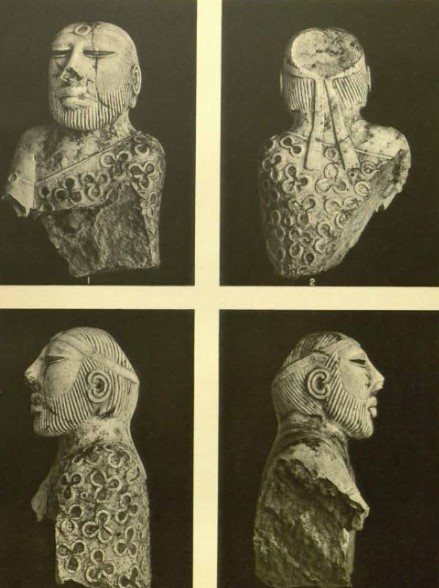
So who was in charge? Scholars have proposed merchant families or landowning elites, ritual specialists, councils that shared power, a single great state and a loose federation of cities. One recent argument, the archaeologist Adam Green's, holds that Indus society deliberately avoided concentrating power in one ruler and invested instead in things that served many households: drains, wells, reliable weights. What is not in doubt is that someone set standards and kept them for centuries. None of this means peace. Skeletons from Harappa show violent injuries, more often in the city's last centuries. The Indus cities were a society whose rulers, whoever they were, did not put themselves on display.
Gods, rituals and what we cannot know
Religion is where the silence of the Indus script hurts most, and where modern hopes rush in to fill it.
The evidence is real but mute. Figurines of ornamented women were called "mother goddesses" by early excavators; they may equally have been toys or offerings. At Kalibangan, Lothal and a few other sites, rows of clay-lined pits holding ash have been read as fire altars. The leaf of the pipal, the tree that grew so thickly around Harappa when Masson camped there and that is sacred today in Hinduism, Buddhism and Jainism, appears on pottery and seals; whether it meant anything comparable four thousand years ago is unknown.
The most discussed object is a seal from Mohenjo-daro showing a figure seated with knees bent and heels drawn together, wearing a horned headdress and surrounded by an elephant, a tiger, a rhinoceros and a buffalo.
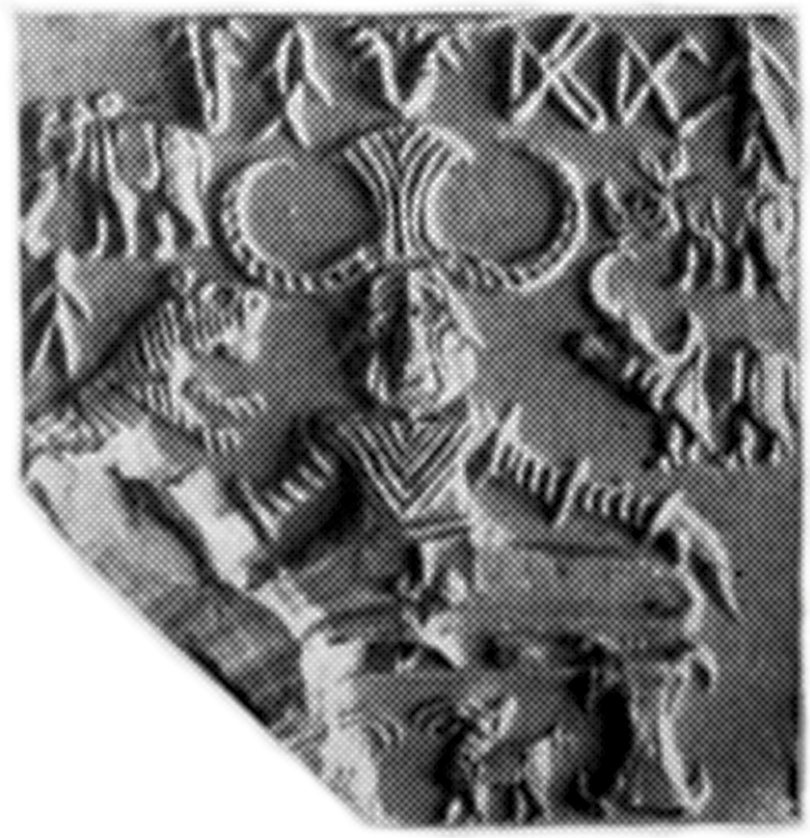
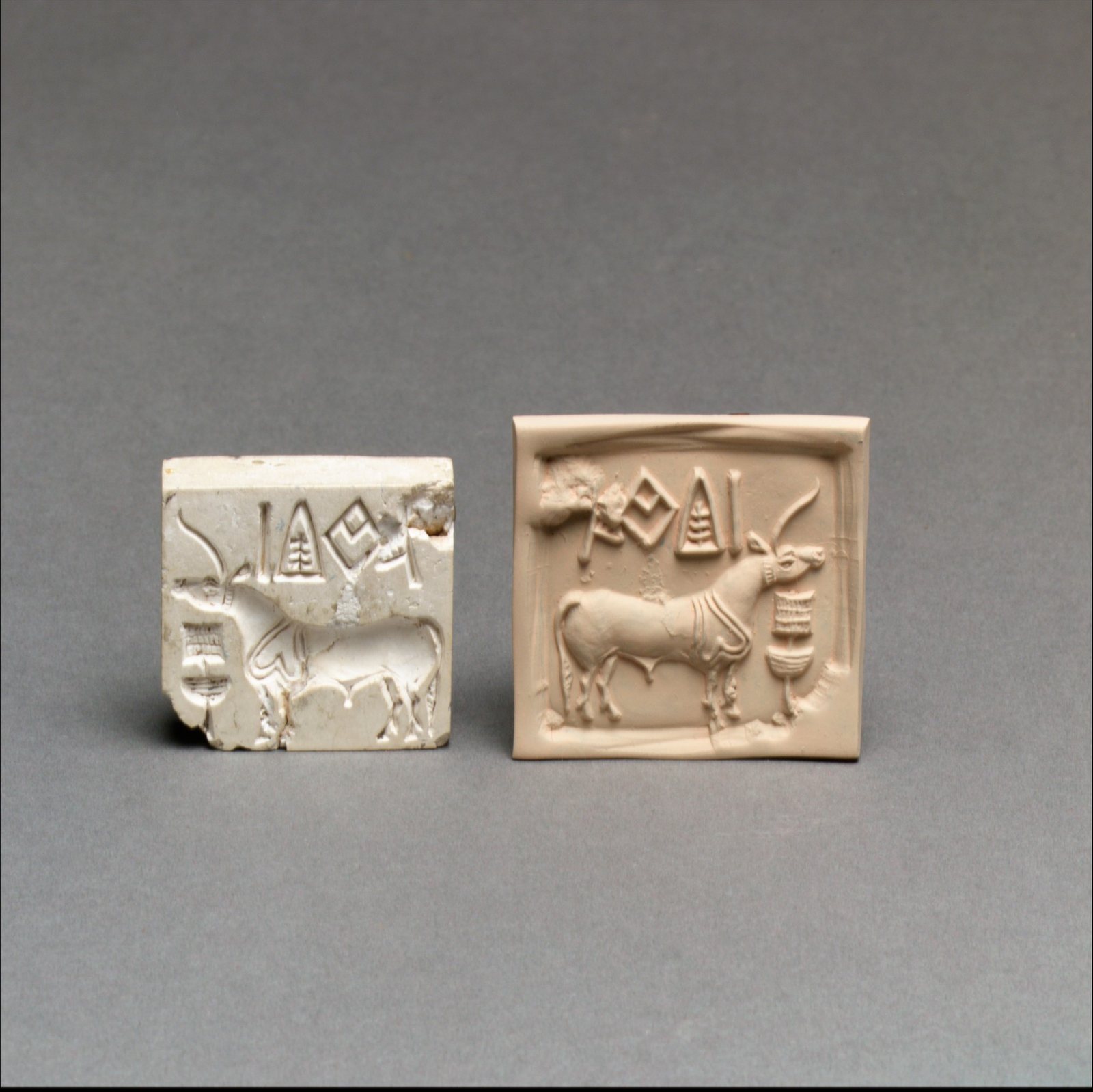
The commonest image on the seals is not a god at all but the so-called unicorn, a bull-like animal with a single horn, perhaps the emblem of a clan, a guild or a city. Nobody knows.
A careful historian can say this much: these people invested in water and purity, in fire, and in certain trees and animals. Beyond that, every confident statement about their gods is a modern reading, not an ancient report.
The Indus script: the world's most famous unread writing
More than four thousand inscribed objects survive, most of them seals and the sealings they impressed, carrying some four hundred distinct signs; counts run from about 400 in Iravatham Mahadevan's concordance of 1977 to around 700 in some later catalogues, depending on how variants are grouped. The inscriptions are short, about five signs on average and some twenty-six at the longest, and most were written from right to left: the signs crowd together at the left-hand end where a writer ran out of room. That much is Well-established. A sign list of this size, too large for an alphabet and too small for a script with a sign for every word, suggests a mixed system like Sumerian cuneiform or Egyptian hieroglyphs, in which some signs stand for words and others for sounds; that inference is Probable.
Why can no one read it? The texts are too short to reveal grammar. There is no bilingual inscription, no Indus Rosetta Stone. And no one knows what language the Harappans spoke. The most fully argued candidate, developed over decades by Asko Parpola and Iravatham Mahadevan, is an early form of Dravidian, the family of Tamil, Telugu, Kannada and Malayalam, and of Brahui, still spoken in Balochistan. Others propose an early Indo-Aryan language, from the family of Sanskrit and Punjabi; a language related to the Munda languages of eastern India; or one with no living descendants. In 2004 three scholars argued that the signs did not record speech at all. A statistical study in 2009 replied that their sequences have the structure of language.
Every few years someone announces a decipherment. None has been accepted, because none yields readings that can be tested against inscriptions its author has not yet seen.
Why did the Indus Valley Civilisation decline?
The short answer is that there was no single cause and no sudden end. From about 1900 BCE, over several generations, the large cities shrank and were abandoned, their standards fell out of use, and people moved into smaller settlements, many of them further east. Most specialists see several pressures acting together: a weakening monsoon, rivers changing course, the loss of long-distance trade, and the strain these placed on a complex society. The long answer includes a murder mystery that turned out to have no murder.
What changed after 1900 BCE
In the last phases of Mohenjo-daro, houses were subdivided and built of reused brick, kilns appeared inside the city and drains were no longer kept up. The seals, the script and the standard weights passed out of use. People moved. In Cholistan, surveyed by the Pakistani archaeologist Rafique Mughal in the 1970s, well over a hundred settlements of the Mature phase gave way to about fifty of the Late phase, while villages multiplied in Haryana and western Uttar Pradesh. Farmers grew more summer millets, which tolerate drought. The civilisation broke into regional cultures that archaeologists group as Late Harappan: Cemetery H in Punjab, Jhukar in Sindh, Rangpur in Gujarat. All of this is Well-established.
The invasion that never was
For much of the twentieth century, the best-known explanation was invasion. In 1947
Mortimer Wheeler, then Director General of the Archaeological Survey of India, pointed to
skeletons in the upper levels of Mohenjo-daro, apparently left where they fell, and to
hymns of the Rigveda in which the god Indra destroys forts. He allowed that climatic,
economic, political deterioration may have weakened it
, but thought the end more
likely a deliberate destruction. On circumstantial evidence,
he wrote, Indra
stands accused.
The story was vivid, and it was taught in schools for decades.
It did not survive examination. In 1964 the American archaeologist George Dales showed, in an article called "The Mythical Massacre at Mohenjo-daro", that the skeletons could not be shown to belong to one period, let alone one event; that no destruction layer covers the last city; that there is no sign of burning and no weapons among the dead; and that not a single body lay in the fortified citadel, where a last stand would have been made. Archaeologists today reject the invasion theory, and that rejection is Well-established. Whether speakers of Indo-Aryan languages came into South Asia is a separate question, taken up below. Whoever they were, they did not sack the Indus cities.
A weakening monsoon
The strongest evidence now points to the sky. Around 2200 BCE a drought known as the 4.2-kiloyear event (4,200 years before the present) struck much of the northern hemisphere, coinciding with the fall of the Akkadian empire in Mesopotamia. Geologists now use it to mark the start of the Meghalayan, the latest age in the Earth's history, named after the region of north-east India where a cave stalagmite records it. Closer to Harappa, sediments from Kotla Dahar, a former lake in Haryana, show its water falling sharply about 4,100 years ago, as the summer monsoon weakened; that record is Well-established. A modelling study published in 2025 identified four long droughts between about 4,450 and 3,400 years ago, each lasting more than eighty-five years, and argued that repeated "river droughts" pushed communities towards more dependable water.
The timing matters. The drought began two or three centuries before the cities emptied, and the Harappans adapted before they left, as their mixed harvests show; that sequence is Probable. Climate was a stress on the system, not a switch.
Rivers that moved, and the Sarasvati question
The Indus and the five rivers of Punjab carry vast loads of Himalayan silt, raise their own beds and from time to time break out into new courses; the Ravi has long since moved away from Harappa. The Punjabi word for a great river, dariā (ਦਰਿਆ · دریا), came from Persian, but the rivers' wandering habits are older than any of their names.
The great puzzle is the Ghaggar-Hakra, which flows only seasonally today, from the Shivalik hills through Haryana and Rajasthan into Cholistan, where it dies in the sand. Hundreds of Harappan sites line its course. Was its drying the cause of the decline? The scientific evidence is divided. A 2017 study argued that the Sutlej, which once fed it, moved away about 8,000 years ago, long before the cities; a 2019 study argued that Himalayan water still reached it until about 4,500 years ago. Both accept that it was not a large snow-fed river in the later Harappan centuries, which is Probable.
The river matters beyond geology because of its name. The Rigveda praises a great river, the Sarasvatī, which many scholars, especially in India, identify with the Ghaggar-Hakra; hence the name "Sindhu–Sarasvati Civilisation". Others identify it with the Helmand in Afghanistan, whose ancient Iranian name, Haraxvaitī, is the same word. In India the question has become entangled with arguments about national origins. The evidence allows the identification. It does not require it, and the identification remains Contested.
When the ships stopped coming
Trade was another casualty, and perhaps a cause. After about 2000 BCE Mesopotamian references to Meluhha grow rare, and the Gulf trade was reorganised through Dilmun. For merchants and craftspeople whose wealth depended on distant markets, the loss would have been severe. Whether trade declined because the cities weakened, or the cities weakened partly because trade declined, is hard to untangle.
Disease, violence and who paid the price
Bones record what texts do not. The bioarchaeologist Gwen Robbins Schug and her colleagues found that skull injuries of the kind caused by blows were fewest in the cemetery of the urban period and far more common in the burials of Harappa's last phase, and that women and children were among the injured. In a second study they found that infectious disease, leprosy and tuberculosis among it, became more common as the city declined, and fell hardest on the communities with least. The samples are small, and the pattern is Probable, but it is a familiar one: when a society comes under strain, violence and disease rise, and the people with the least protection suffer most.
Collapse or transformation?
Put the evidence together and the picture is less a fall than a transformation. Over two or three centuries, a system of large cities, shared standards and distant trade came apart under several pressures at once. In its place came a more rural and more regional way of life, rooted in villages better suited to an uncertain climate. Many people moved east, towards the Himalayan foothills and the Ganga–Yamuna plain, where the rains were more reliable. The cities ended. The people did not.
How sure are we?
| Claim | What kind of claim | Confidence |
|---|---|---|
| The large cities shrank and were abandoned after about 1900 BCE | Established consensus | High confidence |
| Invaders destroyed the cities | Rejected by archaeologists | High confidence that it did not happen |
| A weaker monsoon from about 2200 BCE put the system under stress | Consensus on the climate; interpretation of its effects | Moderate to high confidence |
| Shifting rivers, including the Ghaggar-Hakra, changed where people lived | Competing interpretations, mainly about timing | Moderate confidence |
| The Ghaggar-Hakra was the Rigveda's Sarasvatī | Competing interpretation, and part of modern political narratives | Low confidence |
| The end of the Mesopotamian trade contributed | Interpretation | Moderate confidence |
| Violence and disease increased at Harappa | Interpretation from small samples | Moderate confidence |
| A single cause explains the decline | Rejected by most specialists | High confidence that it does not |
After the cities: what Punjab inherited
Cemetery H
At Harappa, the last chapter of the city is written in a cemetery. In the 1920s and 1930s Madho Sarup Vats excavated a burial ground that he labelled Cemetery H. Its pottery was new: large jars painted with stars, plants, cattle and peacocks, some of the peacocks carrying tiny human figures on their backs, which Vats read as the souls of the dead being carried away. Some of the dead were buried whole; others, as bones gathered into jars. The Cemetery H culture, dated to roughly 1900–1300 BCE, spread across Punjab, Cholistan and Haryana. It is the clearest sign that life in the heartland of the Indus cities carried on, changed, after the cities themselves had faded. It would be more than a thousand years before cities rose again in Punjab, at places such as Taxila.
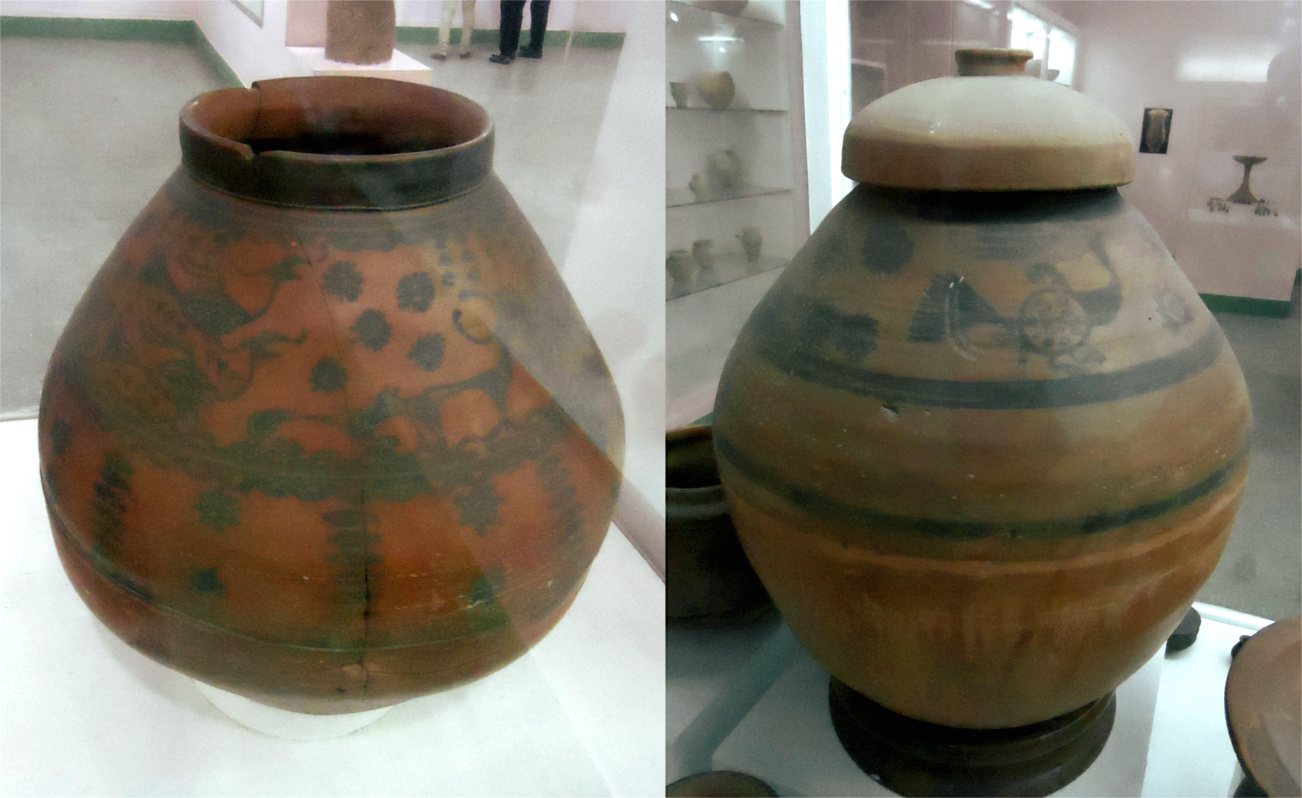
Ropar and the Harappans of east Punjab
Harappan settlement reached well into what is now Indian Punjab. The most important site there is Ropar (ਰੋਪੜ · روپڑ), officially Rupnagar, where the Sutlej leaves the Shivalik hills. Excavated in 1953–55 by Y.D. Sharma, it was the first Harappan site excavated in independent India, and its layers run on into medieval times; the Archaeological Survey of India opened a site museum there in 1998. Nearby Kotla Nihang Khan had been recognised as Harappan by M.S. Vats as early as 1929.
Partition in 1947 ran a new border through this landscape. Harappa and Mohenjo-daro fell to Pakistan, and the finds were divided too: the objects from Mohenjo-daro, some twelve thousand in all, most of them pottery sherds, were shared equally between the two new states, and by some accounts necklaces were taken apart so that their beads could be counted into two piles. Pakistan asked for the Priest-King; India kept the Dancing Girl, now in the National Museum in New Delhi. The account is Probable, and the split necklace is real.
The division had an unexpected result. Indian archaeologists went looking for Harappan sites on their side of the border and found hundreds, among them Kalibangan, Lothal, Dholavira and Rakhigarhi. In Pakistan, Rafique Mughal mapped hundreds more in Cholistan, and since 1986 the Harappa Archaeological Research Project, an American and Pakistani collaboration, has made Harappa one of the most intensively studied of all Indus sites. The civilisation is now studied from both sides of a border its people never knew.
The Rigveda and the Aryan question
Some centuries after the cities faded, in the same land of rivers, poets composed the hymns of the Rigveda, the oldest surviving text in an Indo-Aryan language, conventionally dated to about 1500–1200 BCE; the dating is Probable. Its geography is largely Punjab's: the hymns name the Sindhu, the Indus, and the rivers now called the Jhelum, Chenab, Ravi, Beas and Sutlej, and speak of seven rivers, sapta sindhavaḥ. The world they describe is one of herders and farmers, horses and chariots, fire sacrifice and poetry, not of brick cities with drains.
How were the two worlds related? It is the most contested question in the ancient history of South Asia, and it helps to separate three things.
The first is the view of most linguists, archaeologists and geneticists. Indo-Aryan languages, the family of Sanskrit and later of Punjabi, came into South Asia from the north-west during the second millennium BCE, after the urban phase. They came not with an invading army but through the movement of people over many generations, who mixed with the descendants of the Harappans. Vedic culture grew out of that meeting.
The second is a minority view, held mainly by scholars in India. It holds that Indo-Aryan languages were native to South Asia, that the Harappans spoke an early form of Sanskrit and that Vedic culture continued theirs, and it is sometimes called "Indigenous Aryanism" or "Out of India". Most linguists and geneticists reject it, chiefly on the evidence of how the Indo-European languages are related and of ancient DNA.
What ancient DNA says
In 2019 a team led by Vasant Shinde and David Reich published the first genome from an Indus city, from a woman buried at Rakhigarhi between about 2800 and 2300 BCE. Her ancestry was mostly related to ancient people of the Iranian plateau, with a smaller part related to the ancient hunter-gatherers of South Asia, and she had little if any ancestry from the herders of the Eurasian steppe. The Iranian-related part came from a lineage that had branched off before the plateau's first farmers, which suggests that farming here was not brought by a great migration from the west. These findings are Probable. A larger study published the same year concluded that ancestry of this Indus-related kind is the largest single source for most people in South Asia today, and that steppe ancestry arrived during the second millennium BCE.
One poorly preserved genome is a thin thread on which to hang a civilisation. But the findings fit the linguistic picture. Most people in modern Punjab carry a large share of ancestry related to the people of the Indus cities, alongside ancestry that arrived later, and Punjabi itself belongs to the language family that, on the majority view, arrived after the cities had faded.
Carts, bangles and bricks: what survived
What did Punjab keep? Not the script, the seals, the standard weights or the cities. But a good deal of how people lived on these plains has a long pedigree, and some of it runs back to the Harappans or beyond. The two harvests. Cotton, which people here were among the first in the world to grow and weave. Humped zebu cattle, domesticated in this part of the world. The ox-cart with its pair of wheels. Wells lined with brick. Bangles: the women of Kalibangan wore so many that the site is named after the black fragments on its surface, and the Dancing Girl of Mohenjo-daro wears them almost to her shoulder. A Punjabi bride's chūṛā, the set of red and ivory bangles she wears after her wedding, belongs to a South Asian tradition of wearing bangles that is very old, though no one can trace an unbroken line from one to the other; any such line is Contested.
And the mounds themselves. Across both Punjabs, many villages stand beside a
theh
(ਥੇਹ ·
تھیہ), the
Punjabi word for the mound left by a settlement abandoned long ago; archaeologists call
such a mound a tell. Maya Singh's Panjabi Dictionary, published in Lahore in
1895, defines it as a hillock or mound formed by the ruins of a town
. The word
survives in place names such as Budha Theh in Amritsar district and Theh Polar in Kaithal
district of Haryana. For generations, farmers dug the theh for its rich soil and its
bricks. Oh theh toṅ iṭṭāṅ kaḍḍhde san: "they used to dig bricks
out of the mound." It is the sentence that describes what happened to Harappa in the
nineteenth century, and to many smaller mounds since. Every theh on the plains is a
question no one has yet asked.
Harappa today
Harappa is still a place where people live. The modern town lies beside the mounds in Sahiwal District, Punjab, Pakistan, about 25 kilometres south-west of the city of Sahiwal, in the Bari Doab, the land between the Ravi and the Beas and Sutlej. A doāb, in Punjabi, is any stretch of land between two rivers; the region called Doaba takes its name from the word. The ancient site covers more than 150 hectares, has been on UNESCO's Tentative List for World Heritage status since 2004, and appears on our illustrated map of Punjab.
Walk across the mounds and you walk across four thousand years. Cunningham found coins of the Indo-Scythians and their successors there by the thousand, and an Idgah said to have been built in Akbar's reign. On the high north-western mound lies the long grave of a saint known as the Naugaza, "nine yards", which Cunningham measured at 46 feet; its shrine is still visited. The Harappa Museum, founded in 1926, displays finds from the site. In 2005 a plan to build an amusement park on part of the site was abandoned after construction work turned up artefacts.
Where to see the finds
| Museum | City | Among its Indus holdings |
|---|---|---|
| Harappa Museum | Harappa, Pakistan | Finds from the site |
| National Museum of Pakistan | Karachi | The "Priest-King" |
| Lahore Museum | Lahore | Indus collections |
| Mohenjo-daro Museum | Mohenjo-daro, Pakistan | Finds from the site |
| National Museum | New Delhi | The "Dancing Girl"; Cemetery H jars |
| Archaeological Site Museum | Ropar (Rupnagar), India | Finds from Ropar |
| British Museum | London | Cunningham's seal from Harappa; chert weights |
| Louvre | Paris | Shu-ilishu's cylinder seal |
| Metropolitan Museum of Art | New York | The unicorn seal shown above |
| Penn Museum | Philadelphia | Finds from Mohenjo-daro |
| Museum of Fine Arts | Boston | Finds from Chanhu-daro |
Coda: the seal still waiting
Go back to the beginning, to the first object from Harappa that anyone published: a small black seal with a bull, two stars and six signs, printed in Cunningham's report of 1875. It is in the British Museum now. Its signs belong to the oldest writing known from South Asia, and a century and a half after they were first printed, they are still unread.
The Harappans left us no kings to remember, no battles and no names. They left drains and wells, weights that still balance, bricks made to a rule and a script that keeps its secret. It is an unusual inheritance. The first cities of this land are remembered not for what they conquered but for how carefully they handled water. For a land whose name means "five waters", that seems a fitting place for its story to begin.
Timeline
The ancient story (all dates approximate)
| Date | Event |
|---|---|
| c. 7000 BCE | Farming village at Mehrgarh, Balochistan |
| c. 3700 BCE | First village at Harappa (the Ravi phase) |
| c. 3300 BCE | Marks scratched on pots at Harappa, possible forerunners of the script |
| c. 3300–2600 BCE | Early Harappan cultures: Hakra, Amri, Kot Diji, Sothi-Siswal |
| c. 2800 BCE | Ploughed field at Kalibangan |
| c. 2600 BCE | Mature Harappan phase begins: cities, script, standard weights |
| c. 2300 BCE | Sargon of Akkad records ships from Meluhha at his capital |
| c. 2200 BCE | The 4.2-kiloyear drought begins |
| c. 2000 BCE | Fall of the Third Dynasty of Ur; Mesopotamian mentions of Meluhha dwindle |
| c. 1900 BCE | The cities begin to decline; Late Harappan cultures, including Cemetery H in Punjab |
| c. 1500–1200 BCE | Hymns of the Rigveda composed in the land of the Indus and the Punjab rivers |
| c. 1300 BCE | Late Harappan traditions give way to later regional cultures |
The rediscovery
| Date | Event |
|---|---|
| 1829 | Charles Masson camps below the mound at "Haripah" |
| 1831 | Alexander Burnes visits the ruins |
| 1853, 1856 | Alexander Cunningham visits; he digs there in 1872–73 |
| 1860s | Harappa's bricks are taken for ballast on the Lahore–Multan railway, opened in 1865 |
| 1875 | Cunningham publishes the first Indus seal |
| 1921 | Daya Ram Sahni begins excavating at Harappa |
| 1922 | R.D. Banerji finds seals beneath the stupa at Mohenjo-daro |
| 1924 | John Marshall announces the civilisation (20 September) |
| 1926 | The Harappa Museum is founded |
| 1920s–30s | M.S. Vats excavates Cemetery H (published 1940) |
| 1947 | Partition divides the sites and the finds |
| 1953–55 | Excavations at Ropar, the first in independent India |
| 1961–69 | Excavations at Kalibangan |
| 1964 | George Dales dismantles the "massacre" at Mohenjo-daro |
| 1974 | Excavations begin at Mehrgarh; the Cholistan survey runs to 1977 |
| 1980 | Mohenjo-daro becomes a UNESCO World Heritage Site |
| 1986 | The Harappa Archaeological Research Project begins |
| 1989–2005 | Excavations at Dholavira |
| 2004 | Harappa is placed on UNESCO's Tentative List |
| 2019 | The first genome from an Indus city (Rakhigarhi) is published |
| 2021 | Dholavira becomes a UNESCO World Heritage Site |
Places then and now
Indus sites named in this article
| Site | Where it is today | Why it matters |
|---|---|---|
| Harappaਹੜੱਪਾ · ہڑپہ | Sahiwal District, Punjab, Pakistan | Type site; one of the five largest cities |
| Mohenjo-daroموئن جو دڙو (Sindhi) | Larkana District, Sindh, Pakistan | The largest known city; World Heritage Site |
| Ganweriwala | Cholistan desert, Punjab, Pakistan | One of the five largest cities; barely excavated |
| Rakhigarhiਰਾਖੀਗੜ੍ਹੀ · راکھی گڑھی | Hisar District, Haryana, India (part of Punjab until 1966) | One of the five largest cities; ancient DNA |
| Dholavira | Kachchh District, Gujarat, India | Water system; World Heritage Site |
| Lothal | Ahmedabad District, Gujarat, India | The basin: dock or reservoir? |
| Kalibangan | Hanumangarh District, Rajasthan, India | Ploughed field; fire altars |
| Ropar (Rupnagar)ਰੋਪੜ · روپڑ | Rupnagar District, Punjab, India | First excavation in independent India |
| Kotla Nihang Khanਕੋਟਲਾ ਨਿਹੰਗ ਖ਼ਾਨ · کوٹلا نہنگ خان | Near Ropar, Punjab, India | Recognised as Harappan in 1929 |
| Farmana | Rohtak District, Haryana, India | Ginger and turmeric in a cooking pot |
| Mehrgarh | Kachhi District, Balochistan, Pakistan | Farming from about 7000 BCE |
| Kot Diji | Khairpur District, Sindh, Pakistan | Early Harappan town |
| Chanhu-daro | Sindh, Pakistan | Bead workshop |
| Shortugai | Northern Afghanistan, on the Amu Darya | Distant trading outpost |
The rivers
| River today | In the Rigveda | In Greek writers |
|---|---|---|
| Indusਸਿੰਧ · سندھ | Sindhu | Indos |
| Jhelumਜੇਹਲਮ · جہلم | Vitastā | Hydaspes |
| Chenabਚਨਾਬ · چناب | Asiknī | Akesines |
| Raviਰਾਵੀ · راوی | Paruṣṇī | Hydraotes |
| Beasਬਿਆਸ · بیاس | Vipāś | Hyphasis |
| Sutlejਸਤਲੁਜ · ستلج | Śutudrī | Zaradros |
| Ghaggar-Hakraਘੱਗਰ · گھگر | Often identified with the Sarasvatī (contested) | Not named |
Greek names are those used by historians of Alexander's campaign; spellings vary between ancient authors.
Quick answers
When did the Indus Valley Civilisation exist?
Its cities flourished from about 2600 to 1900 BCE, the Mature Harappan phase. The civilisation grew out of farming cultures that go back to about 7000 BCE at Mehrgarh, and its Late Harappan successors continued in smaller settlements until about 1300 BCE. All these dates are approximate and vary by region.
Where was Harappa, and was it in Punjab?
Harappa lies in Sahiwal District of Punjab, Pakistan, about 25 kilometres south-west of Sahiwal, beside an old course of the Ravi, so yes: it was, and is, in Punjab. Other Harappan sites lie in Indian Punjab, such as Ropar, and in Haryana, which was part of Punjab until 1966.
What were the main cities of the Indus Valley Civilisation?
Five stand out for their size: Mohenjo-daro in Sindh, well over two hundred hectares; Harappa, about 150 hectares; Ganweriwala in the Cholistan desert; Rakhigarhi in Haryana; and Dholavira in Kachchh, Gujarat. Three of the five lie in land that is Punjab today or was until 1966. More than a thousand settlements of the Mature phase are known, and our table of sites lists every one this article names.
Why is it called the Harappan Civilisation?
Archaeologists name an unknown culture after the first place where it was identified, its type site. Harappa was the first city of this civilisation to be excavated, so the whole culture is called Harappan, wherever its sites are found.
What was special about Indus town planning?
Streets were broadly aligned to the points of the compass, and bricks were made to standard proportions. Houses had wells, bathing floors and sometimes latrines, connected to covered street drains with sumps and lifting covers. What stands out is how ordinary these facilities were across whole neighbourhoods, not only in grand buildings.
Why did the Indus Valley Civilisation decline?
There was no single cause. From about 1900 BCE the cities shrank over generations under several pressures at once: a weakening monsoon after about 2200 BCE, shifting rivers, the end of trade with Mesopotamia and growing social strain. The old theory that invaders destroyed the cities has been rejected.
Has the Indus script been deciphered?
No. More than four thousand inscriptions survive, but they are short, there is no bilingual text, and the language they record is unknown. Many decipherments have been announced. None has been accepted, because none produces readings that can be tested against inscriptions its author has not seen.
Who were the Harappans?
We do not know what they called themselves or what language they spoke. Ancient DNA from Rakhigarhi suggests that they descended from populations related to early people of the Iranian plateau and to South Asian hunter-gatherers, and that this ancestry is the largest single source for most South Asians today.
What was the Great Bath used for?
No text says. The watertight brick pool at Mohenjo-daro, about 12 by 7 metres and 2.4 metres deep, is most often interpreted as a place of ritual bathing, because of its careful construction and central position. This is an informed interpretation, not a proven fact.
Is the Ghaggar-Hakra the lost Sarasvati river?
Possibly, but it is not proven. Many scholars, especially in India, identify the Ghaggar-Hakra with the Sarasvatī of the Rigveda; others point to the Helmand in Afghanistan. Geologists also disagree about when the Ghaggar-Hakra stopped receiving Himalayan water.
Punjabi words in this article
| Word | Say it | Meaning |
|---|---|---|
| thehਥੇਹ · تھیہ | “tay”, with a breathy t; the written ਹ is heard as a tone, not a sound | mound of ruins; tell |
| iṭṭਇੱਟ · اِٹ | “it”, with the tongue curled back and the t held | brick |
| khūhਖੂਹ · کھوہ | “khoo”, with a breathy k; the written ਹ is heard as a tone | well (for water) |
| gaḍḍāਗੱਡਾ · گڈّا | “gud-daa”, the d curled back and held | ox-cart; heavy cart |
| moharਮੋਹਰ · مہر | “mor”, with a tone on the o | seal, stamp; gold coin (mohur) |
| hāṛhīਹਾੜ੍ਹੀ · ہاڑھی | “haa-Rhee”, with a falling tone; the subjoined ਹ is not sounded | the winter-sown crop cycle |
| sāuṇīਸਾਉਣੀ · ساوݨی | “saa-oo-NEE” | the monsoon-sown crop cycle |
| dariāਦਰਿਆ · دریا | “dur-yaa” | river |
| chūṛāਚੂੜਾ · چُوڑا | “choo-raa” | the red-and-white bridal bangles worn on both forearms |
| duābāਦੋਆਬਾ · دوآبہ | “do-aa-baa” | doab, the land between two rivers |
Punjabi is written in two scripts, Gurmukhi and Shahmukhi. Each word in the table links to its full entry in the Punjabi word archive, with its origin, cultural background and an example sentence. The Shahmukhi spellings on this page, and the new Gurmukhi, are awaiting review by a native reader.