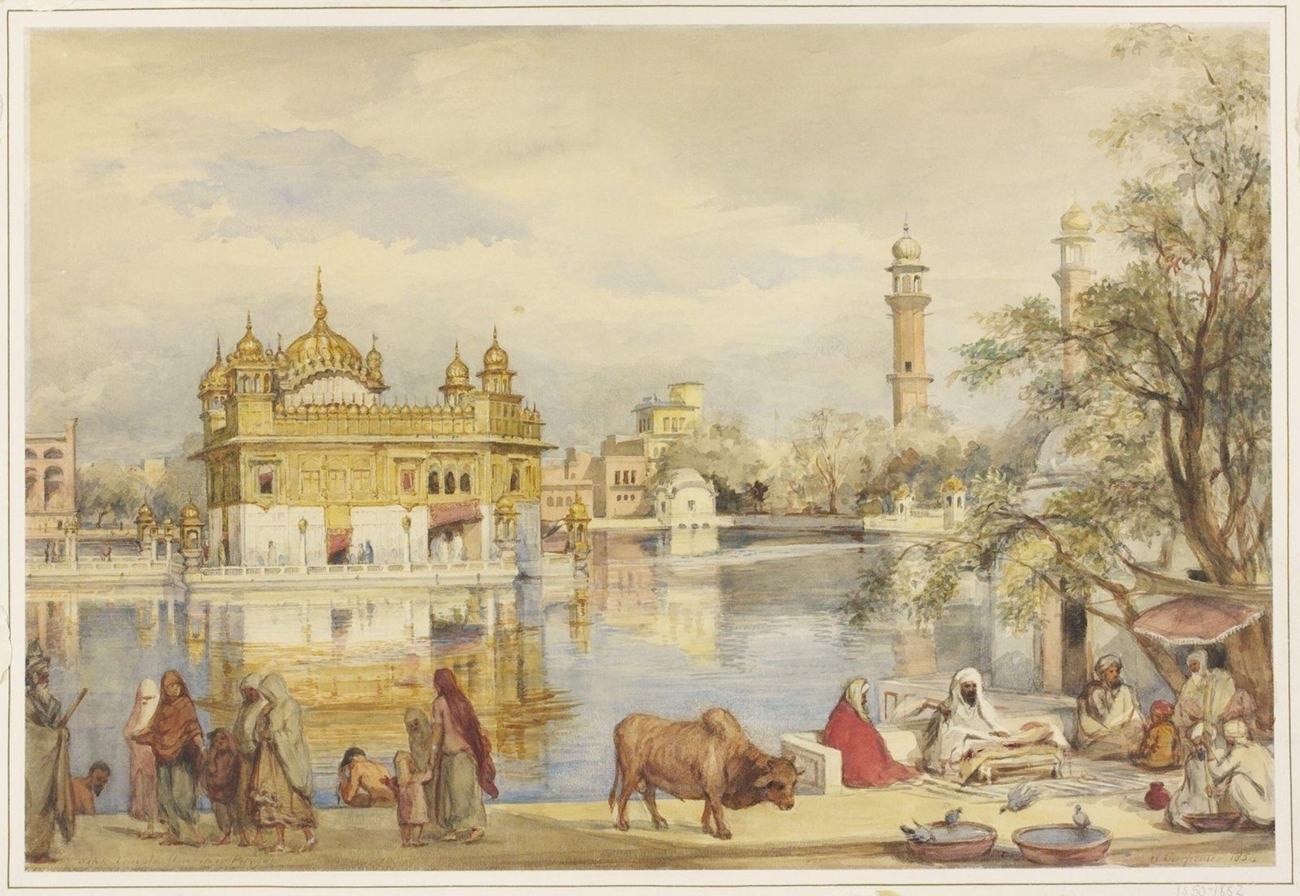
In 1604, the fifth Sikh Guru, Guru Arjan, completed the first compilation of Sikh scripture — the Adi Granth (“first book”) — and installed it in the newly built central shrine at Amritsar, the Harmandir Sahib (later, after its 19th-century gilding, popularly the “Golden Temple”). The act fixed Amritsar as the spiritual heart of Sikhism, where it remains. The date and the event are Well-established.
Building the shrine
The sacred pool (sarovar) had been developed by the fourth Guru, Guru Ram Das, from 1577; the town that grew around it took the pool's name — Amritsar, “pool of nectar.” Guru Arjan had the shrine built lower than its surroundings, so that worshippers step down to enter — a deliberate sign of humility — and gave it four doors, signalling openness to people of every caste and faith.
The scripture
The Adi Granth gathered the hymns of the Gurus together with those of Hindu and Muslim saints such as Kabir, Namdev, and Farid — an unusually inclusive scripture for its time, and a deliberate statement that truth was not the property of one community. On 16 August 1604 it was installed in the Harmandir Sahib with Baba Buddha as its first granthi (custodian-reader). It would later be finalised and, under Guru Gobind Singh, declared the eternal Guru — the Guru Granth Sahib.
1577
The pool at Amritsar
Guru Ram Das develops the sarovar; a town gathers around it.
1580s–1601
The shrine is built
Guru Arjan raises the Harmandir Sahib in the pool — set low, with four open doors.
16 August 1604
The Adi Granth installed
The first Sikh scripture takes its seat; Baba Buddha is its first granthi.
1606 and after
Martyrdom and the Akal Takht
Guru Arjan is executed by the Mughal state; Guru Hargobind builds the Akal Takht facing the shrine.
Aftermath
The shrine's growing prominence heightened tension with the Mughal state; Guru Arjan was executed at Lahore in 1606, the tradition's first martyrdom of a Guru. His son Guru Hargobind built the Akal Takht facing the shrine, adding a seat of temporal authority beside the spiritual one. The complex was damaged and rebuilt several times in the turbulent eighteenth century before Maharaja Ranjit Singh's gilding gave it the golden appearance the world knows.
Modern place-names
Amritsar, Punjab, India. The Harmandir Sahib complex remains the pre-eminent centre of Sikh devotion, and its langar is among the largest free kitchens on Earth.