For two or three days the Afghan guns had been battering the little
fort at Jamrud, where the Khyber Pass opens onto the plain of Peshawar. Its garrison of
a few hundred Sikhs was short of water, and a breach had been knocked in one wall wide
enough, one account says, for a troop of horse to ride through. Below it, on the stony
ground, the sons of the Amir of Kabul had camped with several thousand cavalry and
matchlockmen and a great many tribesmen from the hills. They were already
congratulating one another. Then, on the morning of 30 April 1837, as Charles Masson,
who was living in Kabul at the time, later set it down, the governor of Peshawar unexpectedly
attacked their position, and for the moment carried all before him.
Three Afghan divisions broke. Fourteen guns were taken. One of the Amir's younger sons, a boy who had never seen a battle, left the field in tears. For a while it looked like the most complete victory of the governor's career. Then a fresh body of Afghan horse under Shams al-Din Khan, the Amir's nephew, came up late, rode into the Sikhs scattered in pursuit, and turned the day. The governor rode forward to rally his men, though his officers begged him not to, and was struck by two musket balls, one in the side and one in the stomach. He kept his saddle as far as his tent, fainted as they lifted him down, and was dead before the day was out.
Among his last instructions, the Sikh accounts say, was that nobody beyond his tent was to be told.
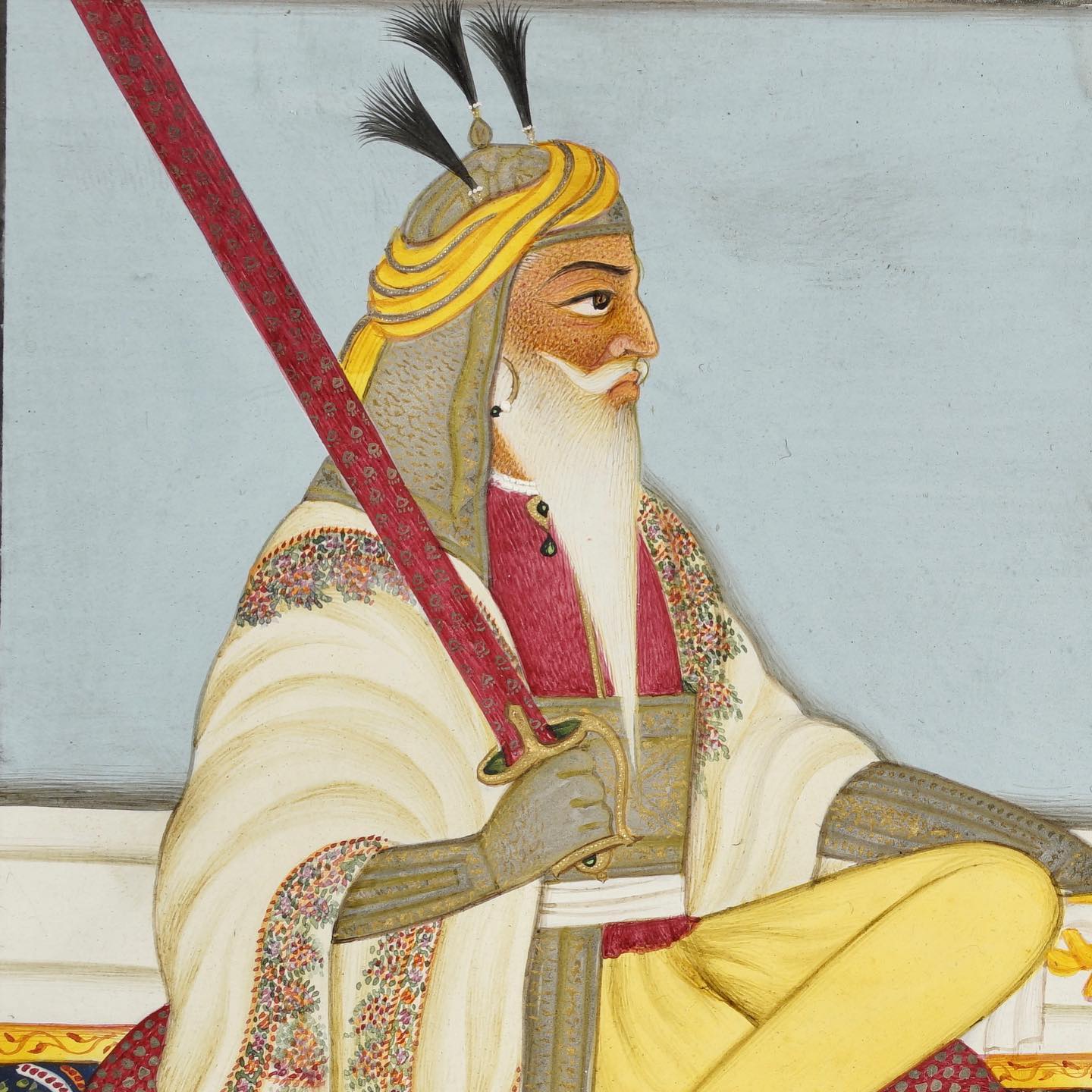
The dead man was Hari Singh, known to the Punjab as Nalwa. To the poets who made
ballads of his life, and to generations of Sikhs since, he was the greatest general of
Maharaja Ranjit Singh's kingdom, the
man who carried its frontier across the Indus to the foot of the Khyber. To the
Pashtun villages of the Peshawar valley, whose tribute he had collected at the point
of the sword, he was something else. In 1865 a British official compiling the
histories of the Punjab's leading families described him as the general with the
terror of whose name Afghan mothers used to quiet their fretful children
.
Three questions run through this story. How did the son of a minor cavalry officer from Gujranwala come to hold the most dangerous frontier in the kingdom? What really happened at Jamrud, and who can fairly claim to have won? And did mothers across the frontier truly hush their children with his name, and if they did, what does that tell us? The sources for each are uneven, and we say where they disagree. By the end, we think, you will see why the man looks so different from each end of the Khyber road.
At a glance
- Born
- 1791, at Gujranwala, in April by the Encyclopaedia of Sikhism. A few works give 1793.
- Family
- Uppal Khatris from Majitha, near Amritsar, in the service of the Sukerchakia chiefs, Ranjit Singh's forebears
- Served
- Maharaja Ranjit Singh, from 1804 or 1805
- Governed
- Kashmir, 1820–21; Hazara, 1822–37; Peshawar, 1834–37
- Founded
- Haripur, in Hazara, 1822–23, beside his fort of Harkishangarh
- Titles
- Nalwa, of uncertain origin, and Baghmar, "tiger-killer"
- Died
- 30 April 1837, of wounds taken at Jamrud, at the mouth of the Khyber Pass
- Remembered
- As a hero in Punjabi ballads; as a figure of fear, and of a grudging respect, in the Pashtun memory of the Peshawar valley
Most places in this story are in present-day Pakistan. Where the chapter needs it, we give the historical name first and its modern location after; the list at the end gathers them. The labels on the notes, and the confidence scale, are the ones explained on our About page.
A boy from Gujranwala
To see how a dying man's name could matter so much at Jamrud, we have to start with the world he was born into, and with a fear that was older than he was.
For most of the eighteenth century the Punjab was the road between Kabul and Delhi. Afghan armies crossed it again and again, above all those of Ahmad Shah Durrani, and the people who lived beside that road learned to think about it in a proverb still heard on both sides of today's border: khādhā pītā lāhe dā, rahindā Ahmad Shāhe dā, "what we eat and drink is our gain; what is left belongs to Ahmad Shah". It is a farmer's arithmetic: whatever is saved will be taken, so enjoy what you can. That century, and the proverb, have their own telling in The Afghan Century and the Rise of the Misls. Keep the proverb in mind. Its mirror image waits near the end of this story.
Into the gap left by failing empires stepped the Sikh misls, bands of Sikh horsemen under their own chiefs, who fought Afghan and Mughal governors alike and carved out territories of their own. One of them, the Sukerchakia misl, was based at Gujranwala, some forty miles north of Lahore. Its chiefs, Charat Singh and then his son Maha Singh, were the grandfather and father of Ranjit Singh.
Hari Singh's family served them. They were Uppals, a clan of Khatris, a Punjabi caste long associated with trade, writing and government, many of whose families had become Sikhs, and they came originally from Majitha, near Amritsar. His grandfather, Hardas Singh, was killed in action in 1762, fighting Ahmad Shah's army according to the Encyclopaedia of Sikhism. His father, Gurdial Singh, rode on all the Sukerchakia expeditions, was given the village of Balloki near Shahdara to live on, and held the rank of deradar, the leader of his own small troop of horse.
Hari Singh was born at Gujranwala in 1791, the only son of his parents. (A few works, the Encyclopaedia of Sikhism among them in one of its own entries, give 1793.) He was seven when his father died. His mother, Dharam Kaur, took him to live with her brothers, who saw to his education: Punjabi, and Persian, still the language of government and letters across northern India, together with the skills expected of a cavalryman's son, riding, the matchlock and the sword. At about ten he took initiation into the Khalsa.
The map was being redrawn around him. In 1799 the young Sukerchakia chief Ranjit Singh took Lahore, and in 1801 he was proclaimed Maharaja of the Punjab. One by one the misls were absorbed into a single kingdom, and the men who would run it were found in service families like this one.
How Hari Singh entered that service comes to us in more than one version. His first modern biographer, Autar Singh Sandhu, who in the 1930s questioned the family's surviving members, says that in 1804, at about fourteen, the boy was sent to Lahore by his mother over a dispute about his father's estate. Asked who he was, he explained that his father and grandfather had served the Maharaja's own father and grandfather. Ranjit Singh settled the case in his favour and took him into his service. The Encyclopaedia of Sikhism puts it a year later and makes it a trial of skill, at which he rode and shot well enough to be taken on as a personal attendant. The court historian Diwan Amar Nath dates his first real command, eight hundred horse and foot, to 1804.
Within months, the same tradition says, he did the thing that fixed his name. It involved a tiger.
The tiger and the name
Every life of Hari Singh stops at the same scene. He is out hunting, after a deer, when a great cat breaks cover and springs at him. His horse goes down under it. His companions ride up to help, and he waves them away. In Sandhu's telling he takes the blows on the shield in his left hand and drives a dagger into the animal with his right, and the second stroke finishes it. In the Encyclopaedia of Sikhism he splits its head with his sword. Later tellings add a painter who happened to be riding with the party, and who drew the fight.
Stories like this cling to famous soldiers, and a historian's first instinct is to
doubt them. Here, unusually, there is a witness from the man's own lifetime. On
8 January 1836 the Austrian traveller Baron Charles von Hügel, on his way to Lahore,
stayed as Hari Singh's guest at Gujranwala. He had read up on his host beforehand, and
in his book, published in English in 1845, he recalls that he surprised him by my
knowledge whence he had gained the appellation of Nalwa, and of his having cloven the
head of a tiger who had already seized him as its prey.
Hari Singh's response was
to send for some drawings. He gave Hügel his portrait, in the act of killing the
beast.
That does not prove the fight happened the way the ballads have it. It proves something nearly as useful. The story was being told in his lifetime, to foreign visitors, and he did not merely accept it: he had it painted, and handed the picture to a guest. The details of the date, the weapon and the fallen horse come from later biographies and family memory, and they vary from telling to telling.
The name is harder. In Punjabi it is written
Nalwa, and
the oldest written explanation we have found is a candid one. Lepel Griffin, the
British official who compiled The Panjab Chiefs in 1865, wrote that its
origin is uncertain, and several stories are related regarding it, one of them more
curious than polite.
He thought it most probably
an amplification of Nal,
the hero-king of the ancient story of Nala and Damayanti, given to Hari Singh on
account of his unsurpassed bravery.
The family's own account, as his descendant and
biographer Vanit Nalwa gave it in 2018, makes the same connection through the tiger:
Ranjit Singh, hearing of the fight, exclaimed wah, mere Raja Nal, wah, "bravo,
my Raja Nal, bravo". The historian Gurbachan Singh Nayyar records a third
reading, that the comparison was with Nal's famous generosity, and sets it aside in
favour of Hügel's tiger.
What is clear is that he had a second title, quite separate, which does mean what people think Nalwa means: Baghmar, the tiger-killer. Popular writing runs the two together. They are different words with different histories, and only one of them has a plain meaning.
One more name deserves notice. Like every initiated Sikh man, Hari Singh bore the name Singh, "lion". In north Indian speech the line between lion and tiger has always been blurred; the everyday word sher serves for both, and Sandhu himself calls the animal of the hunt a lion before giving the title that means tiger-killer. Half a century after Jamrud, old men in the Peshawar valley would describe him to a French visitor as "the tiger". We shall come back to them.
Whatever the truth about the tiger, Ranjit Singh plainly saw something in the boy. Within three years he was riding with the army.
An apprenticeship in war
The army he joined was changing as he entered it. The misls had fought as swarms of mounted musketeers, loyal to their own sardar rather than to any state. Ranjit Singh wanted an army that could take fortresses and hold provinces, and over three decades he built one, adding drilled infantry and artillery and, from 1822, hiring veterans of Napoleon's wars to train them. Hari Singh belonged to the older world, a sardar with his own mounted following, paid for from a jagir, the revenue of lands assigned to him in return for service. But he learned to command both kinds of force, and he learned his trade in the long, grinding sieges of these years.
His first recorded fight was the siege of Kasur, south of Lahore, in 1807, when he was about sixteen. He behaved there, Griffin says, with such gallantry that the Maharaja made him a sardar and gave him a jagir. Campaigns followed at Sialkot, Sahiwal and Khushab. Multan taught him what sieges cost. In March 1810, during an assault on that great fortress of the south-west, he was badly burned by a fire-pot, an earthenware grenade of burning material, flung down from the walls, and it was some months before he was fit to serve again. Multan held out.
Three years later came the battle that shaped the rest of his life. On 13 July 1813, near Attock, where the main road crosses the Indus, the Lahore army under Diwan Mohkam Chand met the army of Fateh Khan Barakzai, the all-powerful minister of the Kabul throne, and beat it in the open field. Hari Singh was among the senior commanders; the Encyclopaedia of Sikhism calls him second-in-command. Fighting on the other side was Fateh Khan's younger brother, Dost Mohammad Khan. Twenty-four years later, as Amir of Kabul, Dost Mohammad would send his sons against Jamrud.
Attock gave Lahore the Indus. Kashmir took longer. A first expedition in 1814 foundered in the passes; Hari Singh was on that expedition too. In 1818 Multan fell at last, and he was with Prince Kharak Singh, the Maharaja's heir, in the army that took it. That November, with Afghanistan falling into civil war after Fateh Khan's murder, Ranjit Singh's troops crossed the Indus and entered Peshawar for the first time. They did not stay. The city's Barakzai governor agreed to pay tribute and was left in place. But a door had opened.
In the summer of 1819 Kashmir fell. Afghan governors had held the valley for sixty-seven years. The Lahore army went over the Pir Panjal passes in columns, Hari Singh commanding one of them, and on 5 July broke the Afghan governor's troops at Shopian. He was twenty-eight. He had fought on the Indus and in the mountains, been wounded, and led men in his own right. The following year the Maharaja gave him Kashmir to govern. It is the part of his career his admirers tend to hurry past.
Kashmir: two verdicts
Hari Singh governed Kashmir for little more than a year, from 1820 until his recall in
1821. He replaced a Hindu official, Diwan Moti Ram, who according to Griffin was
thought too gentle a ruler for the rude and unsettled population
. The year was
long enough to leave two very different reputations.
The first is kept in the Sikh reference works. The Encyclopaedia of Sikhism describes a governor who restored order after the conquest; divided the valley into revenue districts, each under a collector, with police posts under their own officers; bound over the habitual criminals and suppressed the robber bands of the forests; began forts at Uri and Muzaffarabad, today on either side of the Line of Control; built gurdwaras; started a great garden on the Jhelum; and organised relief when the valley flooded in 1821.
The second is older, and blunter. Griffin, writing in 1865 from the records and
recollections of the Punjab's families, said that Hari Singh did not err on the side
of leniency. He ruled with a strong hand, and the Kashmiris hated him so much
that
the Maharaja had to recall him and put Moti Ram back. Kashmiri Muslim memory,
and much modern scholarship, remembers the whole Sikh period in the valley, from 1819
to 1846, as a time of heavy taxation and religious restriction, which the
Ranjit Singh article
sets out. Historians also note that for the Kashmiri Pandits, the valley's Hindu
minority, the Afghan governors before him were remembered as worse.
A coin shows how tangled the evidence is. Hari Singh was allowed to strike a rupee at
Srinagar in his own name, a rare favour, and the Hari Singhi rupee stayed in
use long after him; Griffin found it still current in all parts of the Panjab
in
1865. It was also a base coin. Sandhu, who admired him without reserve, admits that it
was worth about two-thirds of the ordinary rupee. And when he left Kashmir, the
Maharaja excused him from rendering accounts for it at all.
What can fairly be said is this. Governors of the period, Afghan and Sikh alike, were expected to send revenue to the capital and to do well for themselves on the way; the system was built to extract. A year is too short a term on which to build either a legend or an indictment. And whatever the reason for his recall, it did not cost him the Maharaja's trust. He was sent next to the hardest posting in the kingdom.
Across the Indus: Hazara and Haripur
Hazara is the hill country between the Indus and the mountains of Kashmir, wooded valleys and terraced slopes crossed by the old road to the valley. In 1821 it was a patchwork of clans and small chiefdoms, Tanaolis, Jaduns, Tarins, Swathis, Mashwanis and others, some speaking Pashto and many Hindko, a language close to Punjabi. They had paid the Afghans irregularly and had no intention of paying Lahore.
Hari Singh's introduction to them was violent. Late in 1821 the Maharaja summoned him
from Kashmir to give an account of his charge, and he came down by Muzaffarabad with
about seven thousand infantry and the treasure and goods of the province. At Mangal,
in Hazara, the Gazetteer of the Hazara District records, he found
the road held by Jaduns and Tanaolis estimated at not less than 25,000 men
, who
demanded a toll on everything he carried. He parleyed, asking only for free passage,
and then fought. By the Gazetteer's figure two thousand of them were killed, and the
Jaduns paid a fine on every house to save their villages. He built a fort at
Nawashahr and went on to Lahore, where the Maharaja, pleased with the treasure and
with the victory, let the Kashmir accounts go and made him governor of all
Hazara. He held it until his death.
The Gazetteer, compiled sixty years later from local memory and the Sikh records, is
frank about what followed: The Sikhs always won a fight in the plains, and as
regularly displayed an incapacity for fighting in the hills.
In 1822 they won a hard
battle under the Gandgar range and were beaten in the Srikot hills. In 1823, while Hari
Singh was away in the south, the country rose behind him. The Tanaolis stormed the Sikh
fort at Darband and the Swathis the one at Shinkiari, killing both garrisons, and the
Swathis carried off young Hindu women and married them by force. Hari Singh came back
in haste to relieve Nawashahr, which had barely held. In 1824, Griffin says, his own
harshness set Darband alight again.
Griffin's verdict on him in Hazara deserves quoting in full, because it is the view of
the Punjab's next rulers and because it is not simple. He was not a man suited to
conciliate the Hazara tribes, for he hated all Muhammadans fiercely and was never so
happy as when fighting against them, but he was brave even to recklessness, fertile in
resource and prompt in action.
Masson, who knew his reputation from the Afghan side,
said he held the Afghans in bitter contempt and called them dogs and cowards. Against
that stands the record of what he built. At Haripur, Nayyar notes, the new town was
given a mosque as well as a temple.
Haripur was his real answer to Hazara. In 1822, on the left bank of the Dor river near Salik Serai, he began a fort named Harkishangarh in honour of the eighth Guru, Guru Har Krishan, and beside it laid out a town that took his own name: Haripur, "Hari's town". The word at the end of the fort's name, garh, is the Punjabi for a fort, and it will come back at Jamrud.
Hügel passed through on 23 December 1835, while Hari Singh was away. The fort, then
twelve years old, was only of mud
. The town's walls were falling down, and yet it
had a large and densely-crowded population, and a respectable bazar, and was the
largest town I had seen in Ranjit Singh's territories in this direction.
His
servants melted into it within minutes, one to smoke a pipe at a stall, one to buy
spices, others to eat sweets or listen to the music outside the Hindu temple, and the
baron was left sitting on a stone by a spring holding his horse. Fifty years on, the
Gazetteer still called Haripur the only place in the district worthy the name of
'town'
, with nearly five thousand people, a garden known as Hari Singh's, and his
fort in use as the police station. The name survives. Haripur is today the
headquarters of Haripur District in Khyber Pakhtunkhwa, Pakistan.
Between these years came the battle that decided whether the kingdom would stop at the Indus. In March 1823 Mohammad Azim Khan, master of Kabul, came down to punish his brothers at Peshawar for submitting to Lahore. While the Maharaja fought a great host of Yusufzai tribesmen at Nowshera, on the north bank of the Kabul river, Hari Singh commanded the part of the army watching Azim Khan across it. The tribesmen held their hills until sunset and cost the Sikhs dearly; the Akali leader Phula Singh was killed. Azim Khan withdrew towards Kabul without crossing, and died later that year. The Ranjit Singh article tells the battle. Pakistani historians who have reconstructed it from Pashtun sources remember it as heroic resistance and a costly victory for Lahore, and both things can be true at once. For eleven years after it, Peshawar paid tribute to Lahore.
A holy war, and a mission to Simla
In 1826 a new kind of opponent appeared on the frontier. Sayyid Ahmad of Rae Bareli, a reforming Muslim preacher from north India, arrived among the Yusufzais with followers from Hindustan and declared a holy war on Sikh rule. For five years his movement gave Lahore more trouble than any Afghan prince. He is remembered very differently on the two sides of today's border: in much South Asian Muslim tradition as a reformer and martyr, in Sikh histories as an insurgent.
Early in 1827 Hari Singh was sent with a large force to hold the Indus crossings until
the Maharaja could come up. But prudence was not part of Hari Singh's nature
, says
Griffin, and half his army, under Budh Singh Sandhanwalia, crossed the river and dug in
at Saidu, where the Sayyid's host surrounded it. Budh Singh talked the Barakzai chiefs of
Peshawar out of the Sayyid's camp and then broke his army. For the next four years Hari
Singh campaigned through Hazara and the Yusufzai country against the Sayyid's allies.
The movement's undoing came as much from the villages as from the battlefield, as its
attempt to impose its own religious order on Pashtun custom lost it many of the khans
who had welcomed it. In May 1831, at Balakot in the Kaghan valley, Sayyid Ahmad was
killed with many of his followers by a Sikh force under Prince Sher Singh.
That same spring Hari Singh went on a very different errand. He rode with Fakir Azizuddin, the Maharaja's foreign minister, on a mission to the British hill station of Simla, to invite the Governor-General, Lord William Bentinck, to meet Ranjit Singh. The meeting took place that October at Ropar, on the Sutlej.
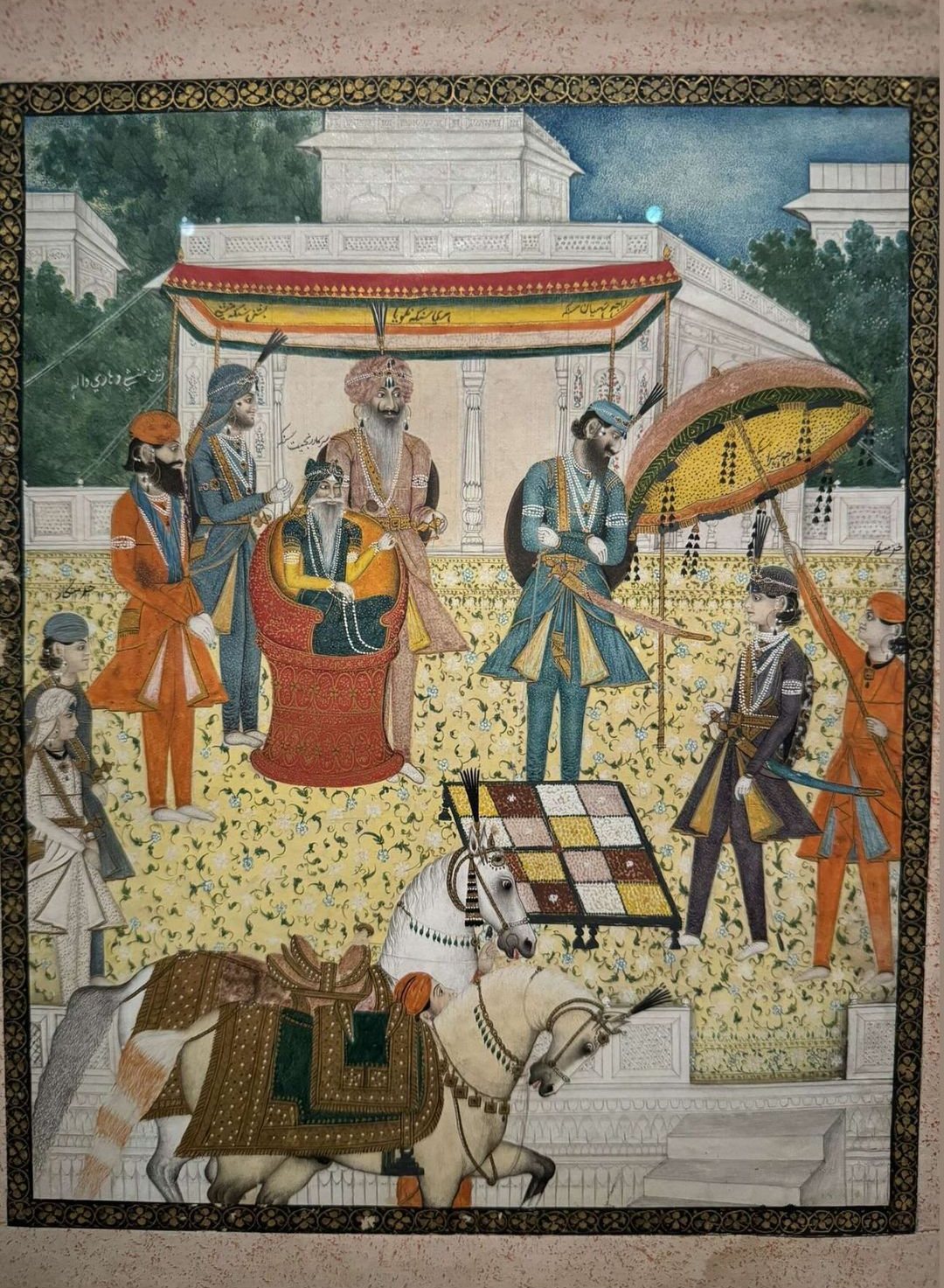
It is Hügel, again, who lets us see the man behind the reputation. When the baron
reached Gujranwala in January 1836, Hari Singh was, in Hügel's words, commander-in-chief
of all the Maha Raja's troops, the French legion alone excepted
, and he lived well.
His house had a mud fort round it and a garden Hügel thought the finest he had seen in
India, with oranges bigger than any he knew, plane trees brought down from Kashmir,
and jonquils so thick that the scent was almost overpowering. Hari Singh met him on the
terrace with twenty-five plates of sweets and a dozen baskets of fruit, and when the
baron mentioned the cold, ordered two stoves carried to his rooms.
They talked, and the conversation surprised Hügel. Because the baron knew most of the
people Hari Singh had met at Simla, it was, he wrote, very different from the majority
of such interviews in India, and really consisted of a due exchange of ideas
. Hari
Singh's questions proved him to have thought and reasoned justly: he is well informed
on the statistics of many of the European States, and on the policy of the East India
Company, and, what is very rare among the Sikhs, he can both read and write the Persian
language.
Next morning Hügel found him sitting on the terrace in the sun with a cold
and a slight fever, still asking questions, and having the answers written down.
It is not the figure of the popular legend. It is recognisably the same man, though: a hard frontier soldier who was also curious, literate and good company. Eighteen months before Hügel's visit, he had ridden into Peshawar.
Peshawar
- Ranjit Singh
- 1780–1839. Maharaja of the Sikh kingdom of Lahore; Hari Singh's master
- Dost Mohammad Khan
- Barakzai Amir of Kabul; fought at Attock in 1813
- Mohammad Akbar Khan
- His son, about twenty in 1837; the Afghan commander at Jamrud
- Sultan Muhammad Khan
- Dost Mohammad's half-brother, chief of the "Peshawar sardars"
- Nau Nihal Singh
- Ranjit Singh's grandson; the nominal commander at Peshawar in 1834, aged thirteen
- Mahan Singh
- Mahan Singh Mirpuria, commander of the garrison at Jamrud in 1837
- Paolo Avitabile
- Italian officer in Sikh service; governor of Peshawar after Hari Singh
- Charles Masson
- English deserter, antiquarian and British informant; watched Peshawar fall in 1834, and lived in Kabul in 1837
- Alexander Burnes
- British envoy; passed Jamrud four months after the battle
Peshawar was the prize of the frontier. It is among the oldest cities in South Asia, the Purushapura of the Kushan kings, and under the Durranis it had been the winter capital of the Afghan kingdom, a city of gardens and caravanserais at the eastern foot of the Khyber. Since 1818 it had been held by a group of Barakzai brothers, the "Peshawar sardars", who paid tribute to Lahore while keeping up ties with their half-brother Dost Mohammad Khan, now master of Kabul, who resented both their independence and their submission.
A word about names. In the nineteenth century "Afghan" usually meant a Pashtun, a speaker of Pashto, whether he lived in Kabul or in the Peshawar valley. The Afghan kingdom was one thing; the Pashtun people, who lived on both sides of what later became an international border, were another. Most of those who came to fear Hari Singh were Pashtun farmers of the Peshawar valley and the hills around it, after 1834 his own subjects, not courtiers in Kabul.
In the spring of 1834, while Dost Mohammad was busy fighting off the exiled Shah Shuja, who had tried to win back his throne by way of Kandahar, Hari Singh camped with an army at Chamkani, a few miles outside Peshawar, and asked for the annual tribute. Charles Masson had just arrived in the city, and he watched what followed. Hari Singh took the tribute horses and turned them down as unsuitable, to gain time. The sardars sent their families across the Kabul river and kept their own horses saddled day and night; twice or three times a day the servants ran out with saddles on their heads at a false alarm. Every wooden door and window that could be carried had already gone from their houses, which Masson understood had happened every time the Sikhs camped near Peshawar.
Then came a polite message. Prince Nau Nihal Singh, the Maharaja's thirteen-year-old
grandson, wished to see the city; perhaps the sardars would withdraw to a garden
outside while he rode round the walls. Next morning Sultan Muhammad Khan, spyglass in
hand, saw the Sikh army moving, and the house emptied in moments. Masson climbed onto
the roof and watched the prince go by on an elephant with Hari Singh, a host of cavalry
round them and the French general Court's battalions behind. There was firing from the
gardens, and a sharp fight when a Pashtun chief, Haji Khan, turned on the pursuers and
handled them severely
; one Afghan, Masson heard, cut down six of his opponents.
But the sardars had fled. When Masson's secretary went to the Sikh camp later that day,
Hari Singh asked, joking, where they had gone. To Tehkal, to prepare for battle, said
the secretary. Hari Singh laughed: nasgher, nasgher
, Masson's attempt at the Punjabi
nass gae, "they've
run away, they've run away", some to Kohat and some to the Khyber. On 6 May 1834
Peshawar was annexed to the kingdom of Lahore, with Hari Singh as its governor. Masson
thought his army had not exceeded nine thousand men.
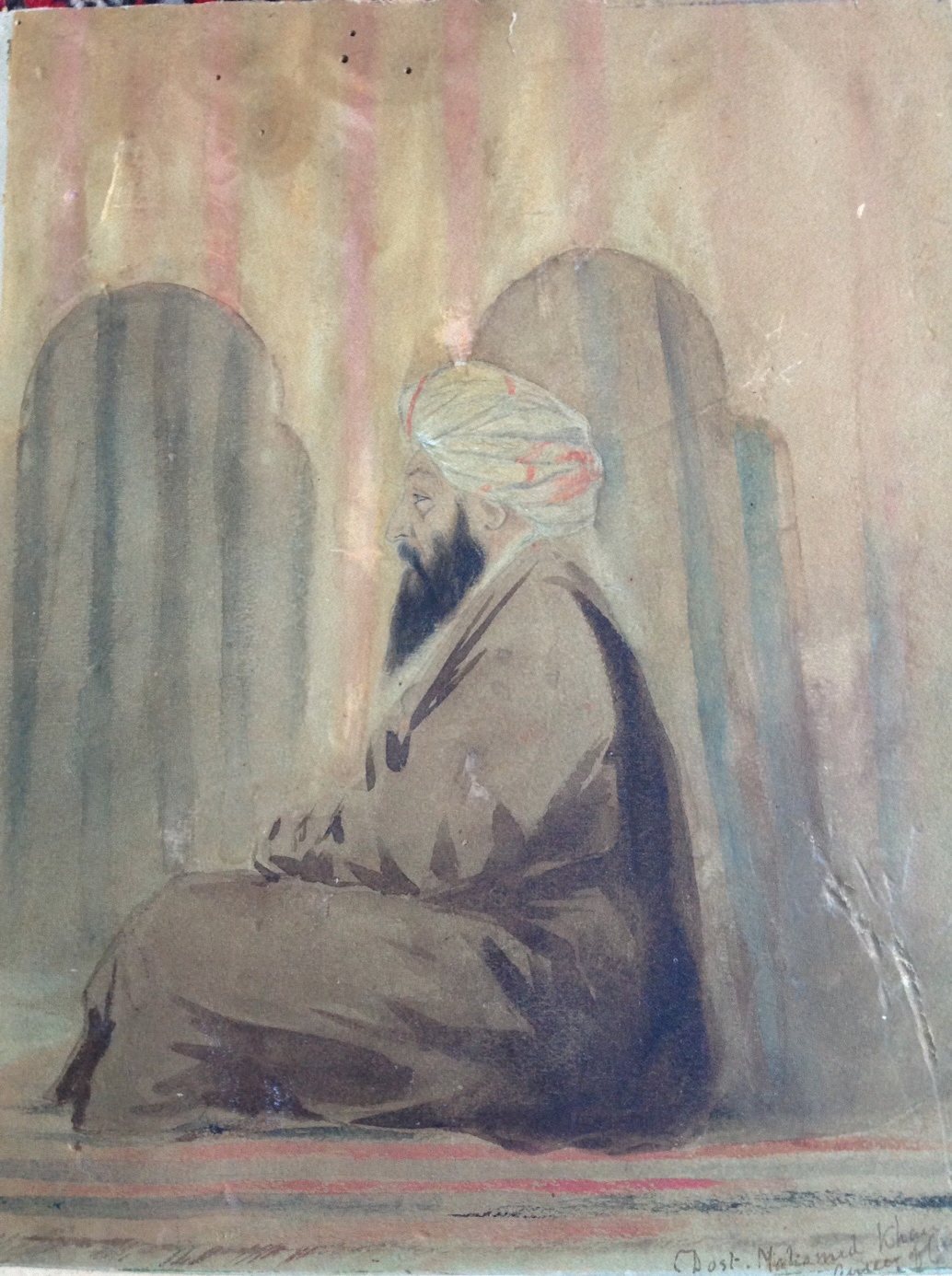
Kabul's answer came within the year. Dost Mohammad took the title Amir al-Mu'minin, Commander of the Faithful, proclaimed a holy war for Peshawar, and early in 1835 came down through the Khyber with an army swollen by tribal volunteers. Through the winter and spring the two sides skirmished. In one of those fights, Sandhu admits, Hari Singh was worsted, losing a hundred and fifty men killed and wounded, and fell back on Peshawar. The general later described as unbeaten was nothing of the kind.
In May 1835 Ranjit Singh came up in person with a much larger army and chose not to fight. He talked, bribed and divided instead. His envoys in the Afghan camp, Fakir Azizuddin and an American adventurer in his service named Josiah Harlan, worked on the jealousies between Dost Mohammad and his half-brothers, and Sultan Muhammad Khan slipped away from the Amir's camp with his men. On the night of 11 May, without a battle, Dost Mohammad withdrew through the Khyber.
The stand-off settled who held Peshawar. It did not bring peace. By every account,
Hari Singh's government of the valley was hard, and the best witness is British and
contemporary. Alexander Burnes, passing through in 1837, recorded that he was in the
habit of making yearly incursions among the Euzoofzyes, burning their villages and
crops, and seizing horses, &c., as tribute.
Burnes named five villages of the
Utmanzai Yusufzais that he had destroyed at different times, and noted that two years
earlier a tax of four rupees a house had been agreed in place of every other demand. In 1836, when
Fateh Khan of Panjtar, the leading Yusufzai chief, rose again, Hari Singh marched on
Panjtar, a cluster of five small villages, beat him, destroyed his village and made him
sign a submission and a promise of tribute. At Lahore these were victories. In the
Yusufzai hills they were remembered otherwise, and that memory is as much a part of
this story as anything said at court.
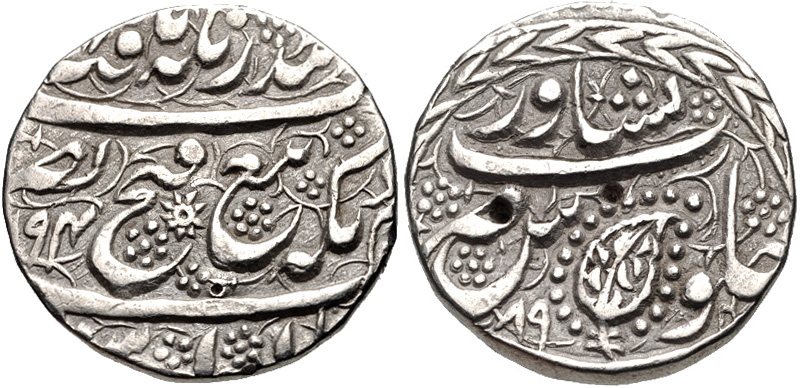
By then he was already looking further west, to a village at the very mouth of the pass.
The gate of the Khyber
The Khyber Pass runs for some fifty kilometres through the Safed Koh, from the edge of the Peshawar plain to Torkham on today's Afghan border. For centuries it was the main road between Kabul and the Indus, the way armies, caravans and ideas passed between Central Asia and the subcontinent. It was also, then as now, the country of Afridi and Shinwari tribesmen who controlled its traffic and expected to be paid for safe passage. The Mughal emperors paid them. In time, so would the British.
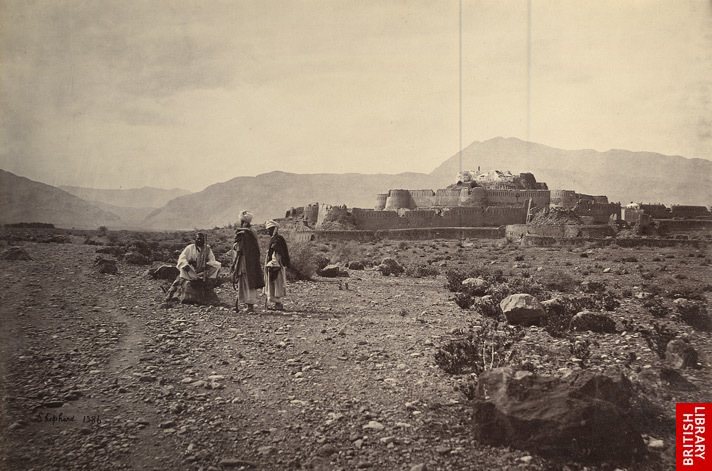
Jamrud lay at its eastern mouth: a village with a small fort and a brick
fountain, a few miles short of where the hills close in. In 1836, Griffin says, Hari
Singh was ordered to build a fort there, one from the walls of which the Maharaja
might see Jalalabad
. Sandhu gives the day the foundation stone was laid as the sixth
of Poh in the Bikrami year 1893, that is December 1836, and says the work was finished
in fifty-four days. It was, in Griffin's words, of small strength or size, but
impregnable to the Khaibar tribes who possessed no artillery.
That winter there was
fighting all round it; in the first weeks of 1837 Afridis carried off some Sikh
soldiers, and when talking failed to free them, Hari Singh attacked.
What the fort meant depended on where you stood. From Lahore it was a cork in a bottle: a garrison at the mouth of the pass could watch the road, tax its traffic and give early warning of any army coming down from Kabul. From Kabul it looked like a stepping-stone, the first move of an advance on Jalalabad and perhaps on Kabul itself, and the Khyber chiefs were writing to the Amir that unless he sent troops they would have to acknowledge Ranjit Singh. Dost Mohammad built a fort of his own further up the pass, at Ali Masjid. From the villages of the Khyber, Jamrud was a foreign fort on their land. Within five months all three points of view would meet beneath its walls.
In March 1837, much of the Lahore army went to a wedding.
Jamrud, 30 April 1837
The wedding was the grandest occasion of Ranjit Singh's last years. Nau Nihal Singh, the prince who had ridden into Peshawar three years before, was married that March, and the Maharaja turned the festivities into a display of power for his most important guest, the British Commander-in-Chief in India, Sir Henry Fane. The best troops and generals were called in from across the kingdom to parade before him, Peshawar included. Hari Singh stayed on the frontier with what the historian Hari Ram Gupta calls a small force of inferior troops. Griffin says he was ill with fever.
He was right to stay. The court record, as Gupta reconstructs it, shows his warnings arriving. On 10 March a letter reached the Maharaja reporting that Dost Mohammad had come down to Jalalabad and meant to attack; the reply was that troops would be sent once the British guests had gone. On 21 April a second letter reported that the Amir's sons were through the Khyber and had entrenched themselves about three kilometres from Jamrud, between the fort and Peshawar. That day the Maharaja ordered Nau Nihal Singh, his European generals, the Attariwala sardars and a string of others to reach Peshawar, five hundred kilometres away, in five days. On 28 April came a third letter: one wall of Jamrud was down.
The Afghan army was led by the Amir's son Mohammad Akbar Khan, then about twenty, with
the minister Mirza Sami Khan. Several of Akbar's brothers were with him, among them
Mohammad Afzal Khan, who would briefly reign in Kabul thirty years later, and a boy
named Mohammad Haidar Khan; so were the Amir's nephew Shams al-Din Khan and his elder
brother, the Nawab Jabbar Khan. Griffin gives it seven thousand horse, two thousand
matchlockmen and eighteen guns, joined by twelve or fifteen thousand Khyber tribesmen.
Gupta has nine thousand more irregulars and about twenty thousand tribesmen. Inside
the fort, Mahan Singh Mirpuria held out with eight hundred men by Griffin's count, six
hundred by Gupta's. Why the Amir sent them is still argued: to destroy a fort that
threatened his road, as Griffin thought, to win back the prestige he had lost in 1835,
or, as Masson heard Akbar Khan say once he learned that no help had reached Hari Singh,
to make a decisive impression upon Peshawer
.
The fort had not been built for a long siege. The Afghans cut its water channel, and their guns went to work on the southern face. Mahan Singh sent message after message to Peshawar. Sikh tradition keeps a story of those days that no contemporary document confirms but that is told with great affection. When no man could be found to carry the last message through the Afghan lines, Sandhu writes, a woman named Harsharan Kaur, who worked in the garrison's kitchens, wrapped herself in a dog's skin, crawled out at night, walked the eleven miles to Peshawar and knocked at the gate at four in the morning; a gun was fired from the city to tell the garrison she was through. It should be read as tradition. It is worth noticing what the tradition chooses to remember: that the siege was endured by everyone inside the walls, not only by the soldiers.
How Hari Singh came to the fight is told three ways. Griffin has him march out, ill as he was, with six thousand foot, a thousand regular cavalry and three thousand irregulars, cover only two miles the first day, and then face the Afghans for a week before he attacked. Gupta has him leave Peshawar on 29 April, the Ekadashi, after feeding Brahmins, send Mahan Singh a letter meant to be intercepted saying that he was too ill to come, and open the battle next morning with a cannonade and a feigned retreat. Masson, whose informants were on the Afghan side, has him appear without warning on the morning of the 30th. Griffin and Masson agree, and Gupta broadly, on what happened next, and it is the scene this article began with: the first rush, the broken divisions and captured guns, Afzal Khan's two thousand standing firm, the Sikhs spreading out after plunder, and Shams al-Din Khan's horse arriving late to turn the day.
Masson adds two scenes from the Afghan side that its heroes would rather he had left
out. In a hollow among the low hills, a small party of Sikh horse blundered on Akbar
Khan and his brother Akram, who had about a hundred men between them; they drove it
off, and Akbar Khan killed one of the Sikhs, on which account he arrogated to himself
high credit
. When other chiefs later made a successful charge, Akbar hurried over and
struck his spear into the ground as though the credit were his. The minister, Mirza Sami
Khan, spent the fighting hidden in a cave, sobbing and tearing his beard, and
afterwards announced that his prayers had won the day.
Somewhere in the confusion Hari Singh was mortally wounded. How it happened depends on whom you read.
- Two musket balls. Griffin, in 1865, says he rode to the front against his officers' pleas and was hit by two balls, one in the side and one in the stomach. Gupta says the same.
- Many wounds. The Encyclopaedia of Sikhism gives four gunshot wounds and two sabre cuts across the chest, the last shot in the side.
- A marksman from Surkhai. When the French scholar James Darmesteter
visited Jamrud in 1886, local men pointed out a house in the red village of Surkhai,
on the black hill beyond the tank, as the place from which Mohammed Khan, arbab of the
Khalil clan, had fired
the famous shot
. The musket, they said, was kept as a relic by his family at Tehkal, outside Peshawar. - A duel. The Afghan court chronicle Siraj al-Tawarikh, written in Kabul in the early twentieth century, has Akbar Khan meet him in single combat and cut him down.
- Treachery. The Sikh chronicler Giani Gian Singh, writing in the 1890s, reports a belief that he was shot in the back by Yar Muhammad Khan, one of the Barakzai brothers, at the instigation of the Dogra Raja Gulab Singh.
The first version fits best what we know of battles like this, in which most men fell to musket fire, and the third is the Pashtun countryside's own memory of the same event, which agrees with it. The duel belongs to an old genre of court chronicle in which princes seek out princes, and it is not hard to see it growing from the Sikh horseman Akbar Khan really did kill in that hollow, though that is our guess. The treachery story was answered by Sandhu in 1935. Yar Muhammad had been dead for nearly ten years, killed fighting Sayyid Ahmad's followers, and Gulab Singh had no post at Peshawar until after Ranjit Singh's death. The story says more about the bitter politics of the Lahore court after 1839, when the Dogra brothers were blamed for much that went wrong, than about Jamrud.
He reached his tent, fainted as he was lifted from his horse, and died soon after: within half an hour, in Griffin's account, by evening in Masson's. Gupta lists four last wishes: that the holy men travelling with him be sent home, that his daughter's marriage be arranged, that his men stand by Mahan Singh, and that his death be kept secret.
How long the secret held is disputed. Griffin gives it two whole days, after which
it could be no longer a secret, and the dismay of the army was extreme.
Gian Singh,
sixty years on, has the body preserved in oil and meals carried daily to the tent for a
fortnight. Gupta tells a quieter and more plausible story: Mahan Singh, whose own
brother Jawahar Singh had been killed in the fighting, burned the two bodies together and let
it be thought that the second was his brother's. That would square with Masson, who
was told in Kabul that the general expired, and was burnt the evening of the
action.
What held the Afghans back seems to have been their own quarrels more than any deception. As the Sikhs fell back under the walls and dug in, Akbar Khan, elated, proposed to march on Peshawar. Mirza Sami Khan emerged from his cave and begged him to be satisfied with what had been done, and Akbar Khan and the Nawab Jabbar Khan fell to arguing about whether to go on. The Sikhs had no water, and Griffin says they would have had to cut their way out if not for a fall of rain most unusual at that time of year. Then the relief arrived. Gupta has Raja Dhian Singh reach Jamrud with ten or twelve thousand horse on the morning of the seventh day after leaving Chiniot, and the rest of the army crossing the Indus behind him; Griffin says it came twelve days after the battle. Before the Afghan chiefs could agree, they had to go. They left by night, their own camp market plundered as they went, and withdrew to Jalalabad, taking the heads of Sikh dead to show in Kabul.
Later tellings improved the story. In some, the dead general's body was propped on the ramparts, or set on his horse, to persuade the enemy that he still lived. There is no early evidence for it, and the motif should sound familiar: the same is told of the Castilian hero El Cid, said to have been tied dead to his horse to rout the besiegers of Valencia. The simpler version is remarkable enough.
So is one that the admiring histories mostly leave out. When the avenging army
reached Jamrud, Sandhu wrote, it committed horrible atrocities in the vicinity
:
villages were plundered and houses set on fire, and many people were left homeless.
At Lahore, Masson heard, the Maharaja was seriously affected by the news.
Who won at Jamrud?
Few battles have been claimed so confidently by both sides.
In Kabul, Jamrud was a national victory. The city was lit up and bonfires burned, and Akbar Khan's mother gave feasts and persuaded her husband that all the honour was her son's. The Afghans had killed the most feared commander on the frontier and brought home trophies to prove it. Akbar Khan's reputation as a soldier dates from that day, and a district of modern Kabul still bears his name. In Lahore, Jamrud was a successful defence: the fort had held, Peshawar had not been retaken, and the Afghan army had gone home as soon as a Sikh field army appeared.
The men nearest the events hedged. Masson, no friend of Akbar Khan, wrote that the
Afghans had really not much to boast of in this action, although Mahomed Akbar Khan
plumed himself on a transcendent victory. The Sikhs scarcely acknowledged defeat, but
their loss in the person of their chief was irreparable.
Burnes called the place the
scene of a Sikh defeat. Griffin thought the results of this battle were not
important
: each side lost three guns, and the Afghans had retired without trying to
improve their victory. Sandhu, a Sikh writing in 1935, called it an indecisive combat,
at most a drawn battle. Modern reference works on Afghanistan tend to list it as an
Afghan victory, and many Indian histories as a Sikh one. And Dost Mohammad, speaking to
Burnes once his sons were home, as Gupta quotes him, was the most candid of all: My
sons and people may speak in exaggerated terms of our late success, but it is too
evident that our power is not one-tenth of that of the Panjab.
Our own reading is this. On the field, on 30 April, the Afghans had the better of the day: they checked a Sikh attack and killed its commander. As a campaign, it failed. The fort still stood, and Peshawar stayed in Lahore's hands, as it would until the British annexed the Punjab in 1849. The Sikh kingdom kept its frontier and lost the man who knew it best, and it never advanced beyond Jamrud again.
The aftermath was quieter than the battle. Dost Mohammad wrote to Ranjit Singh
disowning his sons' attack as done without his approval, and sent a present of horses.
At Lahore, the Maharaja did what
he usually did when a great man died. At his death Hari Singh held more land than any
other man in the Punjab proper, jagirs worth more than eight lakh rupees a year, and
his four sons were already fighting over them. Ranjit Singh, always glad of an
opportunity to fill his own treasury
, as Griffin put it, took back all but a small
allowance; Gupta adds eighty lakhs in cash lodged with the bankers of Amritsar. The
frontier was reorganised. Teja Singh held Peshawar for a short time, and then the
Italian Paolo Avitabile.
The largest consequences lay beyond the Khyber. Gupta records that the British now forbade the Maharaja to advance past Jamrud under any circumstances, and that by September he was telling their agent he would give up Peshawar if he could keep his honour. That same month Burnes rode into Kabul. What Dost Mohammad wanted above all was Peshawar, and that was the one thing the British, unwilling to offend Ranjit Singh, would not give him. When Burnes's mission failed, the Governor-General, Lord Auckland, turned to the exiled Shah Shuja instead, made a treaty with him and with Ranjit Singh in 1838, and in 1839 sent an army into Afghanistan. The First Anglo-Afghan War ended in 1842 with the destruction of a British army on the retreat from Kabul. Among the Afghan leaders the British came to fear most in those years was Mohammad Akbar Khan, who in December 1841 killed the British envoy, Sir William Macnaghten: the victor, in Afghan eyes, of Jamrud.
It is sometimes said that Hari Singh Nalwa drew the border between Pakistan and Afghanistan. That is too simple. The Durand Line of 1893 was agreed between the British and Amir Abdur Rahman Khan, and in places it runs well to the west of anything the Sikhs held; the whole Khyber Pass lies on the Pakistani side. But the conquests of 1834–37 did move Peshawar out of Kabul's orbit and into Lahore's, and in 1849 the British inherited that frontier. That much of the claim holds.
"Hush, or Hari Singh will come"
Of everything said about Hari Singh Nalwa, the claim most often repeated today is that Afghan mothers used his name to frighten their children. In the version that circulates in Punjabi and Indian retellings, in books and speeches and endlessly on social media, the words are chup sha, Haria raghle, usually rendered "hush, Hari Singh is coming". The phrase is Pashto, or meant to be. Transcriptions vary, and what matters is the practice rather than the exact words.
Nursery threats are rarely written down; they live in kitchens and courtyards, not in archives. So the first question is whether there is any early evidence at all.
There is, and more of it than is usually cited. The oldest we have found is the
sentence quoted at the start of this article, from Griffin's Panjab Chiefs of
1865, less than thirty years after Jamrud: the general with the terror of whose name
Afghan mothers used to quiet their fretful children
. Griffin was a British official
in Lahore, working from the Punjab side, and he does not say where he heard it. For
that, we need a Frenchman.
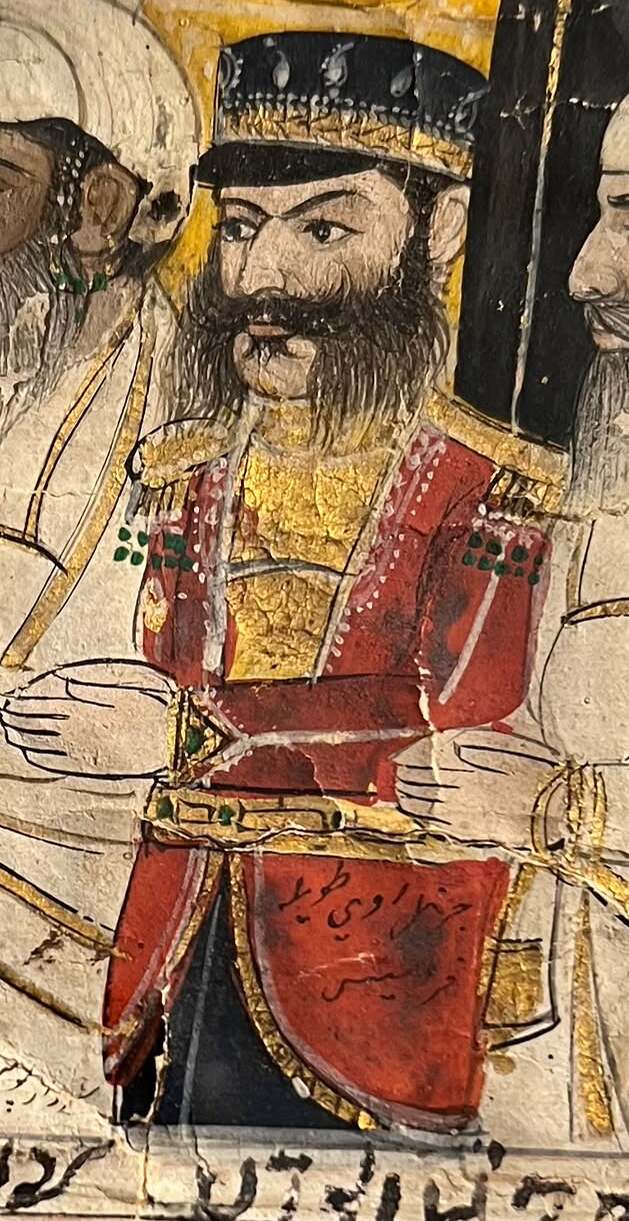
In 1886 and 1887 James Darmesteter, professor of Persian at the Collège de France and a translator of the Zoroastrian scriptures, spent eleven months in north-western India studying Pashto as a living language. With two local assistants he took down more than a hundred folk songs as singers performed them, many in and around Peshawar, and published them as Chants populaires des Afghans. His impressions of the frontier went into a lively book of travel letters, Lettres sur l'Inde (1888). In the seventh letter he turns to the Sikh years. For twenty years, he writes, the Afghans of the Peshawar country were crushed by two men, the Sikh Hari Singh and the Italian Avitabile, who left among them a long memory of admiration and horror. Every year Hari Singh, with his Akalis, went up to take the tax from the Yusufzais, hunting them through the mountains to their most inaccessible refuges. And long after his death, mothers said to a crying child:
« Tais-toi, ou Hari Singh va venir. »
"Hush, or Hari Singh will come."
The old men, Darmesteter adds, still showed the places where the tiger
had
chased them like sheep; he glosses the word himself as the Singh
. And there were
villages, perched like eagles' nests on their crags, that counted it their patent of
nobility never to have seen Hari Singh.
This is precious evidence, for three reasons. It was written down by an outsider with no stake in either Sikh or Afghan pride. It was recorded half a century after Jamrud, within the lifetimes of people who had known his rule. And it comes from the Pashtun side of the frontier, describing a specific practice in a specific place: the villages of the Peshawar valley and the Yusufzai hills, whose people had paid him tax, fled from him and fought him. Burnes's list of burned villages, written in 1837, is the other half of the same story. It records what was done; Darmesteter records how it was remembered.
It also sets limits on what can honestly be claimed. Darmesteter does not say that all
Afghans used the name, or that anyone in Kabul did; he speaks of the Peshawar country.
He pairs Hari Singh with Avitabile, whose rule was, if anything, more savage: every
hillman taken, armed or not, went to the gallows, and two hanged Afghans a day were
wanted at his windows. Yet Darmesteter found that Peshawar remembered Avitabile with a
kind of admiration, as a man of their own temper
, and Peshawar writers still report
that mothers warned children that Abu Tabela would come for them. And Darmesteter calls
the memory of both men mixed. The name frightened because the man had been frightening.
It was also, as those proud villages on their crags show, a yardstick of defiance.
One small thing in the same book bears on the phrase itself. Sitting in a Peshawar courtroom, Darmesteter noticed that the judge, the policeman and the clerk all kept telling long-winded witnesses tchoup chah!, which he translates "tais-toi", be quiet. It is the ordinary Pashto for "hush", the first half of the phrase the modern retellings give. The rest of it has not, so far as we know, been checked by a Pashto scholar, and we give it here only as it is usually quoted.
Does the practice survive? Here the evidence turns anecdotal. Sikh visitors to the frontier report hearing the phrase in recent decades, one of them from a taxi driver near Jamrud who remembered his mother using it. Testimony like this deserves recording, but it is not systematic, and it reaches us already shaped by the fame of the story. A fair verdict is that the practice is well attested for the middle and later nineteenth century, plausible in family memory since, and impossible to measure today.
The thing itself is old and widespread. Around 1309 the French chronicler Jean de
Joinville, remembering the crusades, wrote that when Saracen children cried their
mothers would say, Wisht! here is King Richard
, meaning Richard the Lionheart, and
that Saracen riders whose horses shied at a bush asked them whether they took it for
King Richard. Joinville, too, had it at second hand: as it is written in the book of
the Holy Land
. English nurses of the Napoleonic wars threatened children with
"Boney". And the Punjab had its own version, as we saw at the beginning: the proverb
that gave up to Ahmad Shah everything not eaten. A bogeyman's name is one of the ways a
community remembers power that fell on it from outside, overwhelming, violent and
personal. It preserves the experience of the people on the receiving end. It is not a
verdict on the character of the man named.
That is why this story needs telling carefully. In much Sikh and Indian retelling it is
offered as a boast: proof that a people famous for defying empires once feared a single
Sikh general. In Pashtun memory it belongs to another story, of villages burned over
unpaid tribute and of resistance to a foreign governor. Sandhu, his first biographer and
no critic, saw both in 1935: To the Mohammadans he is to this day a violently bigoted
and cruel soldier, who wounded their religious feelings and destroyed their
independence. To the Sikhs he is their national hero, a man of super-human powers, a
demi-god.
Both memories are real. Neither is the whole truth about Hari Singh, and the
history of the frontier is poorer if either is forgotten. Darmesteter's pairing of
admiration and horror may be the most honest epitaph anyone has written for him.
Ballads, graves and heirs
Hari Singh's first biographers were poets. The earliest, and in some ways the most surprising, was Qadir Yar, a Muslim poet born early in the century at Machhike, in what is now Sheikhupura district, and best known for his version of the legend of Puran Bhagat. He composed a poem in the general's praise, the Siharfi Sardar Hari Singh Nalwa, a siharfi, whose verses follow, one after another, the letters of the Persian alphabet. It centres on the defence of Jamrud and his death there. A Muslim poet praising a Sikh general who fought Muslim armies is less of a paradox than it may seem: Punjabi poetry of the period moved easily across religious lines, and its subject was valour and loyalty as much as faith. A later poet, Misr Hari Chand, admired Qadir Yar enough to borrow his pen-name for his own Siharfian Hari Singh Nalwa, first printed at Sargodha in 1924 and edited by the historian Ganda Singh in 1965; its scenes of Jamrud are the most vivid in the literature. Other vars and war-ballads followed, and dhadi singers still perform his story. We will publish annotated texts of these poems separately.
The graves came quickly. He was cremated at Jamrud, and when Darmesteter toured the fort in 1886 he found, in one corner, a samadh holding his ashes. A Sikh holy man named Fateh Singh had kept it for eighteen years on thirty rupees from the British government, alone, as the Frenchman put it, with the flies, the shade of Hari Singh and the scripture, which he unwrapped for visitors from its many silk cloths. The legend was already running away from the facts. An English sergeant assured Darmesteter that the fort had not been built by Hari Singh at all, but by another famous Sikh, named Jamrud. The memorial there now carries an inscription, which Sandhu recorded in 1935, naming the Peshawar man who raised it, Gajju Mal Kapur. There is a second samadh at Gujranwala, in the house where he lived.
The house itself tells the family's story. His four sons, by two wives, had never got
on, and within months of his death two of them held the fortified house while the other
two held the town, which was when the Maharaja took the estates. The general sent to
seize them, another Gulab Singh, threatened to hang Arjan Singh, who took his revenge
years later by burning the general's village. In October 1848, as the second war with
the British began, Arjan Singh shut himself in the Gujranwala house with a hundred or so
men and defied the government until troops were sent against him; he fled, and died that
year. His half-brother Jawahir Singh escaped from prison in Lahore to join the Sikh army
and led the charge of irregular cavalry at Chillianwala in January 1849, which Griffin
says so nearly ruined the fortune of the day
for the British. Eight years later
Jawahir Singh rode for the British through the rising of 1857, and in 1862 he was made
an honorary magistrate at Gujranwala. By 1865 the house was the Deputy Commissioner's
residence.
Other memorials are claimed for him. Haripur keeps his name. At Hasan Abdal he is credited with building the first gurdwara at Panja Sahib, one of the most revered Sikh shrines in Pakistan. At Katas, in the Salt Range, a ruined mansion by the ancient temple tanks is still known locally as his haveli. Tradition credits him with gold for the dome of the Akal Takht at Amritsar, and with a long list of forts, wells, temples, gurdwaras and mosques.
In modern India he has been remembered in other ways too: a line in a celebrated 1967 film song, an Amar Chitra Katha comic, a postage stamp issued on 30 April 2013, and "Vaar", a posthumous release in 2022 by the Punjabi singer Sidhu Moose Wala. In 2023 a song in the Hindi film Animal brought his son Arjan's name to a new audience. In Punjabi he is often simply Jarnail Hari Singh Nalwa, jarnail being the English word "general", long since made Punjabi.
The fort at the mouth of the pass
Jamrud still stands, much rebuilt, on its rise at the edge of the plain. It belongs to the Pakistani state, and the road beneath it carries lorries towards Torkham and Afghanistan. Somewhere inside is the small memorial over the place where the general was burned. It is a military site, and few visitors see it.
It is tempting to end a life like this with a verdict. The Punjabi ballads offer one: the champion of the Khalsa, true to his salt, dying at the gate he had opened. Pashtun memory offers another: the tiger who hunted the villages, the name that made children fall silent. The historian's task is to hold both, and to notice that they describe the same man, seen from opposite ends of a sword.
What can be said with confidence is less dramatic and more interesting. The son of a minor cavalry officer, schooled in Persian and the matchlock, governed three provinces, founded a town that still carries his name, took his kingdom's frontier to the Khyber, talked European statistics with an Austrian baron, and died at a small fort he had raised that winter. Within thirty years his name was a ballad on one side of the frontier and a warning on the other.
At Gujranwala, where the story began, a proverb had once taught Punjabi villagers to spend what they had before the Afghans came for it. Near the mouth of the Khyber, a generation after Jamrud, Pashtun mothers were telling their children to be quiet before Hari Singh came for them. Between those two sayings lies the history of a frontier, and of how the people who live on frontiers remember the armies that pass through them.
Quick answers
Who was Hari Singh Nalwa?
A general of Maharaja Ranjit Singh's Sikh kingdom of Lahore (1791–1837). He governed Kashmir, Hazara and Peshawar, founded the town of Haripur, and built the fort at Jamrud at the mouth of the Khyber Pass, where he was mortally wounded on 30 April 1837.
Why was he called Nalwa?
Nobody knows for certain. The oldest explanation on record, Griffin's in 1865, is that it compares him to Raja Nal, a legendary hero-king; his family links the comparison to a tiger he is said to have killed as a youth. It is a different title from Baghmar, "tiger-killer".
How did he die?
He was mortally wounded leading an attack on the Afghan army besieging Jamrud, and died the same day. The best-attested account says he was hit by two musket balls; a duel with Akbar Khan and treachery by his own side are later claims.
Who won the Battle of Jamrud?
Both sides claimed it. The Afghans checked the Sikh attack and killed Hari Singh; the Sikhs held the fort and kept Peshawar, which stayed under Lahore until 1849. The writers closest to the events thought it close to a draw. It is fairest to call it an Afghan success on the day and a failed campaign.
Did Afghan mothers really use his name to scare children?
In the Peshawar valley, yes. Lepel Griffin recorded it in 1865, and James Darmesteter heard it from the Pashtun side in 1886–87: "Hush, or Hari Singh will come". The Italian Avitabile's name was used the same way. There is no evidence for it across Afghanistan as a whole.
Was he commander-in-chief of the Sikh army?
Contemporaries used the title. Hügel called him commander-in-chief of all the Maharaja's troops except the French-trained legion, and Griffin commander-in-chief on the frontier. There was, though, no single commander of the whole army below the Maharaja.
Was he ever defeated?
Yes. He was in the failed Kashmir expedition of 1814, Sikh troops under his government were beaten in the Srikot hills in 1822, he was worsted by the Afghans in 1835, and he was killed at Jamrud. The claim that he never lost is modern.
Did Pashtuns start wearing the shalwar because of him?
No. A story popular online says Pashtun men took to loose trousers to pass as women and escape Sikh soldiers. But Mountstuart Elphinstone, who was in Peshawar in 1809, years before a Sikh army crossed the Indus, described Yusufzai men wearing cotton trousers under their tunics. The story is a modern invention, and an insulting one.
Is Haripur named after him?
Yes. He founded it in 1822–23 beside his fort of Harkishangarh in the Dor valley of Hazara. It is now the headquarters of Haripur District in Khyber Pakhtunkhwa, Pakistan.
Where is his samadh?
He was cremated inside the fort at Jamrud, near Peshawar, where a samadh was kept by 1886. There is a second at his old house in Gujranwala. Jamrud Fort is a military site and access is restricted.
Timeline
1791
Born at Gujranwala
Only son of Gurdial Singh, a Sukerchakia cavalry officer. His father dies in 1798.
1804–1805
Enters Ranjit Singh's service
Tradition places the tiger fight in these years.
1807–1813
Kasur, Multan, Attock
Made a sardar at Kasur; burned at Multan in 1810; at the defeat of Fateh Khan near Attock, 13 July 1813.
1818–1819
Multan and Kashmir
Multan falls in 1818; Kashmir in July 1819.
1820–1821
Governor of Kashmir
Strikes the Hari Singhi rupee; recalled in 1821. Fights his way through Hazara at Mangal.
1822–1823
Hazara and Haripur
Governor of Hazara; founds Haripur. The battle of Nowshera, March 1823.
1827–1831
Sayyid Ahmad's holy war
Saidu, 1827; Balakot, May 1831. The mission to Simla, spring 1831.
6 May 1834
Peshawar annexed
Hari Singh becomes governor. Dost Mohammad withdraws without battle, 11 May 1835.
1836
Jamrud
A fort is built at the mouth of the Khyber, finished early in 1837.
30 April 1837
Battle of Jamrud
Hari Singh dies of his wounds. The fort holds; the Afghans withdraw.
1839–1842
First Anglo-Afghan War
Akbar Khan kills the British envoy at Kabul in December 1841.
1848–1849
His sons against the British
Arjan Singh holds the house at Gujranwala; Jawahir Singh charges at Chillianwala. The Punjab is annexed.
1865–1888
"Hush, or Hari Singh will come"
Griffin (1865) and Darmesteter (1888) record mothers using his name.
Modern place-names
Gujranwala, Lahore, Kasur, Sialkot, Multan, Attock, Hasan Abdal, Katas and Sheikhupura are in Punjab, Pakistan. Haripur, Mangal, Darband, Nowshera, Peshawar, Panjtar, Jamrud and the Khyber Pass are in Khyber Pakhtunkhwa, Pakistan. Majitha, Amritsar and Ropar (Rupnagar) are in Punjab, India. Srinagar, Shopian and Uri are in Indian-administered Kashmir, and Muzaffarabad in Pakistan-administered Kashmir. Jalalabad and Kabul are in Afghanistan.