In short
- What happened
- On the afternoon of 13 April 1919, Brigadier-General Reginald Dyer marched fifty Indian Army riflemen into the Jallianwala Bagh, an enclosed waste ground in Amritsar, and without warning ordered them to fire on a crowd of many thousands of unarmed people. The firing lasted about ten minutes; 1,650 rounds were fired.
- When and where
- Sunday 13 April 1919, the day of Vaisakhi, between about 5 and 5.15 in the afternoon, a few minutes' walk from the Harmandir Sahib. Amritsar was then in the Punjab province of British India; today it is in Punjab, India.
- Why people were there
- A meeting had been called to protest against the Rowlatt Act and the deportation of two local leaders. It was also Vaisakhi, and many in the crowd were visitors from the villages. Dyer had banned gatherings that morning, but his proclamation was read in only part of the city.
- The dead
- The government's figure is 379, reached months later. Indian figures at the time ran from about 500 to about 1,000, and two modern historians put it at about 700 and at 500 to 600: Well-established that several hundred died; Contested on any exact total.
- What followed
- Martial law in five Punjab districts, two rival inquiries, a bitter debate in Parliament, and, with the Khilafat grievance, the end of Gandhi's co-operation with British rule in August 1920.
- The echo
- In March 1940, in London, Udham Singh shot dead Sir Michael O'Dwyer, who had governed the Punjab in 1919 and approved Dyer's action.
Almost everything we know about that afternoon rests on two inquiries of 1919 and 1920: the government's Disorders Inquiry Committee, known by its chairman's name as the Hunter Committee, and the Indian National Congress's own inquiry, which collected statements from survivors. Each had its standpoint, and where they disagree we say so. Quotations are given word for word from the record, and where a number is disputed, we name whoever gave it. The labels on our notes are explained in our editorial standards. Hover over or tap a Punjabi word to see it in both scripts; the Shahmukhi spellings await a native reader's review.
Prologue: thirty seconds
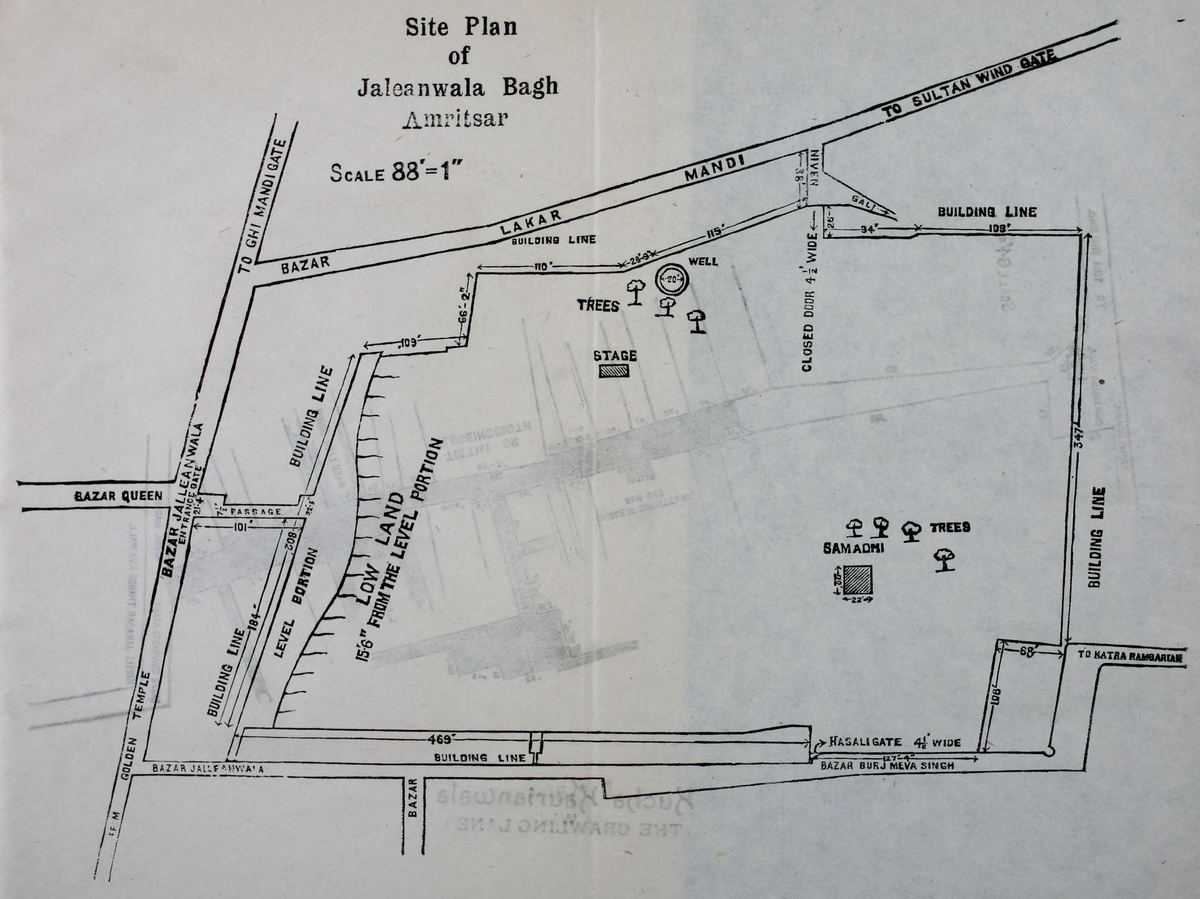
The alley was too narrow for the armoured cars. Brigadier-General Reginald Dyer had brought two of them through the old city of Amritsar that Sunday afternoon, each mounting a machine gun, and they had to be left in the street. The passage into the Jallianwala Bagh was, in the words of his brigade-major, "a small alley just about broad enough for two men walking abreast".
At the end of the alley the ground rose into a low bank. Twenty-five Gurkhas and twenty-five Indian riflemen, Frontier Force men by Dyer's account and Baluchis by the Hunter Committee's, filed onto it, half to each side. About a hundred yards away, thousands of people were sitting and standing around a makeshift platform where a man was speaking. On a chair beside him, propped up to preside over the meeting, stood a photograph of Dr Saifuddin Kitchlew, who had been taken away from the city three days earlier.
It was Vaisakhi, a little after five in the afternoon. Dyer later told the inquiry how long he took to decide what to do: it "did not take me more than 30 seconds to make up my mind as to what my duty was." Yet he also told it that when he first heard of the meeting, hours earlier, he "had made up my mind that I would fire immediately" if it went ahead. He gave no warning and no order to leave. He ordered his men to fire.
They fired for about ten minutes, then he marched them away. He did not count the dead, and he sent no help to the wounded. This article asks how a general came to that decision, which by his own account took thirty seconds in the Bagh and had been made before he reached it, and what it cost, from the weeks that led into the Bagh to a lecture hall in London nearly twenty-one years later. It begins with a war, a law, and a shutter coming down over a shop front.
I. The road to Amritsar
A province that gave its sons
By 1914 the Punjab, which Britain had annexed in 1849, was the Indian Army's recruiting ground. The war made the demand relentless. In April 1919 the Lieutenant-Governor, Sir Michael O'Dwyer, claimed about 360,000 combatants raised; the official war history later counted at least 380,000 recruits, Muslims the largest group and Sikhs, about one Punjabi in eight, giving nearly double their share. Not all came willingly: the Hunter Committee found "instances of reprehensible means of securing recruits". Then the influenza of 1918, by O'Dwyer's own count, "carried off half a million of the Punjab population".
O'Dwyer, an Irishman who had governed since 1913, trusted the soldier-peasant and distrusted the town-bred politician. He had spent the war crushing the Ghadar movement of Punjabi emigrants from North America, whose revolutionaries came home in 1914 and 1915 and were met by special tribunals and the gallows. In London, meanwhile, the Secretary of State for India, Edwin Montagu, had promised in 1917 "the progressive realisation of responsible government in India". The Punjab expected something for its sons. What came first was a law.
"No pleader, no appeal, no argument"
A committee under an English judge, Sir Sidney Rowlatt, recommended keeping some of the government's wartime emergency powers in peacetime. The bill that followed, the Anarchical and Revolutionary Crimes Act, passed the Imperial Legislative Council on 18 March 1919 by 35 votes to 20, carried on the official vote; every Indian non-official member who voted opposed it. In areas the government chose, political cases could go to three judges sitting without a jury, with no appeal, and suspects could be detained by orders reviewed in private, where they had no right to a lawyer. When disorder broke out in the Punjab that April, the Act had not yet been brought into force anywhere, and it was repealed in 1922. What mattered was what it said: the wartime emergency, carried into peace. Muhammad Ali Jinnah resigned his seat, writing that a government that passed such a law in peacetime "forfeits its claim to be called a civilized Government".
In the Punjab the Act acquired a slogan, heard at Gujranwala on 5 April and sung by a crowd at Gujrat nine days later: nā dalīl, nā vakīl, nā apīl, no argument, no lawyer, no appeal. Motilal Nehru called it "as true a description of the Act as any that can be given in six words, though the author of it has been convicted and sentenced by a Martial Law Commission."
A century later the judge's name came round again. In 2019 his great-grandson, the BBC correspondent Justin Rowlatt, wrote an essay for the first English translation of a Punjabi poem about the massacre, a poem published in May 1920 and banned soon after. We will come to it.
Shops shut, cups shared
The man who turned anger at the Act into a movement was Mohandas Karamchand Gandhi, not yet the figure he would become. His instrument was the haṛtāl, the shutting of shops: an old sign of mourning, and an old Punjabi word, which the Mahan Kosh, Kahn Singh Nabha's great dictionary, derives from the Sanskrit for putting a lock on the shops. Gandhi made it a protest for all of India. Amritsar shut on 30 March and again on 6 April, and both days passed quietly.
The city's protest had two leaders, and their partnership was the point. Saifuddin Kitchlew was a Muslim barrister with a Cambridge degree and a German doctorate; Satyapal was a Hindu doctor. On 30 March a crowd put by the official count at 30,000 to 35,000 heard Kitchlew in the Jallianwala Bagh, the city's usual meeting ground. "The resistance should be a passive one," he told them, and sent them home. Satyapal had been forbidden to speak in public the day before; on 4 April Kitchlew was served with the same order.
On 9 April came Rām Naumī, the festival of Rama's birth, and Muslims joined its procession to cries of Hindu-Musalmān kī jai. The Hunter majority described "people of the different creeds drinking out of the same cups publicly and by way of a demonstration", and declined to call it sinister. The Deputy Commissioner, Miles Irving, watched from a verandah as each float stopped before him "and the band played 'God save the King.'" That evening the orders to deport Kitchlew and Satyapal reached him.
Thursday, 10 April
On the morning of 10 April the two men were summoned to Irving's house and driven away under escort to Dharamsala, in the hills of Kangra. As the news spread the shops shut, and crowds that the police later put at 30,000 in all made for the Civil Lines, the British quarter, to demand their release. At the Hall Gate bridges over the railway, a mounted picket fired on them. The two inquiries never agreed on what the crowd was. To the Congress commissioners it was "a crowd of mourners bareheaded, many unshod, and all without sticks"; to the Hunter majority that picture was "a travesty of facts".
Part of the crowd turned back into the city in fury, and within half an hour the National Bank was burning. A second firing at the bridges followed at about two o'clock. The Hunter majority put the dead from the troops' fire that day at about ten; the Congress inquiry counted about twenty from the second firing alone. At the National Bank the manager, Stewart, and his assistant, Scott, were beaten to death and their bodies burned on a pile of the bank's furniture. The manager of the Alliance Bank, Thomson, a railway guard, Robinson, and an army electrician, Sergeant Rowlands, were killed too: five Europeans in all. In a narrow lane a mob beat an English missionary, Marcella Sherwood, and left her for dead; Indians picked her up and hid her.
Both halves of that day matter, but British memory dwelt on one. As the historian Kim Wagner has argued, burned buildings and murdered Europeans closely matched what the British in India remembered of 1857, the great rebellion they called the Mutiny. Asked about the days that followed, Irving said that if the villages around the city had risen, "we should have had a situation not paralleled since the Mutiny".
The general
The man sent to restore order had been born in the Punjab, at Murree, in 1864, where his father managed the brewery. Reginald Dyer spent most of his career in the Indian Army, and in 1919 commanded the brigade at Jullundur, now Jalandhar. He reached Amritsar on the evening of 11 April and, by his own account, Irving told him the situation "was beyond all civil control". The army took the city. Martial law itself would not be declared until the 15th. On the 12th Dyer prohibited "all meetings and gatherings", but left the publishing of the order to the police.
That afternoon, in the compound of a school, a former railway ticket collector named Hans Raj announced a meeting for the next day in the Jallianwala Bagh, where letters from Kitchlew and Satyapal would be read. Afterwards he turned approver, giving evidence for the Crown in return for a pardon. Whose side he was really on has been argued ever since.
II. Vaisakhi, 13 April 1919
The festival
13 April 1919 was a Sunday and the first day of Visākh: Vaisakhi, the spring festival of the wheat harvest and the solar new year, a day of fairs when Hindus, Muslims and Sikhs alike went to the melā. For Sikhs it also marks, by tradition, the founding of the Khalsa in 1699, told in our article on the Khalsa's creation. Pilgrims came to bathe in the tank of the Harmandir Sahib, a few minutes' walk from the Bagh, and farmers came in for the horse and cattle fair.
A garden that was not a garden
Jallianwala Bagh means, roughly, the garden of the Jallas: the Encyclopaedia of Sikhism traces the name to the family of Sardar Himmat Singh of Jalla, a noble at the court of Maharaja Ranjit Singh. A bāġh is a garden. Today the name is usually written ਜਲ੍ਹਿਆਂਵਾਲਾ, with a small ਹ under the ਲ: one of Gurmukhi's foot letters, which marks a tone rather than an h sound.
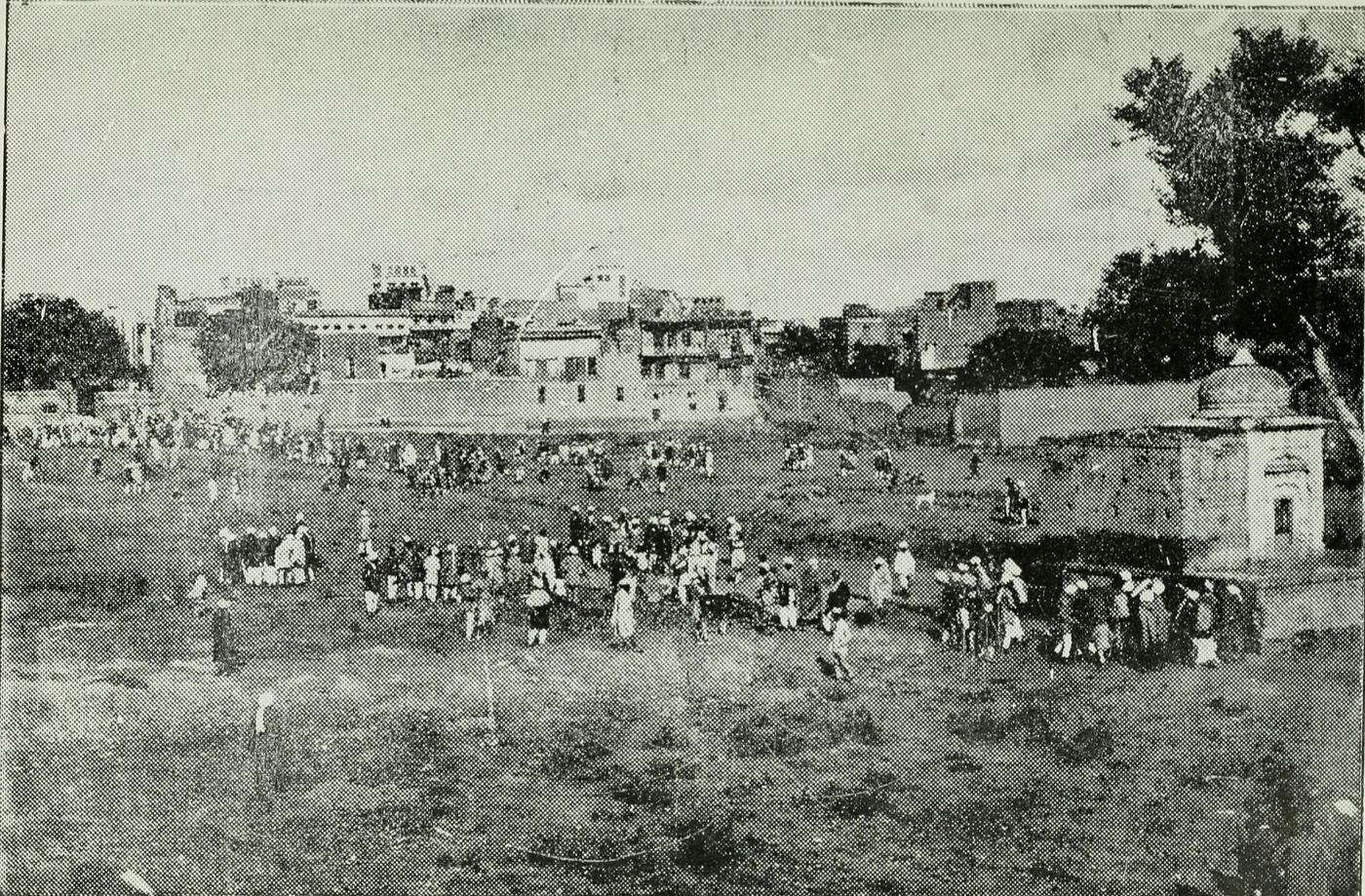
By 1919 it was, the Hunter Committee wrote, "not in any sense a garden as its name would suggest" but "unused ground covered to some extent by building material and debris", "almost entirely surrounded by the walls of buildings". The Congress commissioners noted "three trees in the quadrangle, a dilapidated Samadh (tomb) with a dome, and a well"; the samādh can be seen in the photograph at the head of this page. What mattered on 13 April was its shape. "The main entrance is a narrow passage through which armoured cars happily could not pass," they wrote. "There were no other regular entrances, but at 4 or 5 points, it was possible to get out through narrow openings."
Sunday, by the clock
Morning. Dyer went through the city with a column of troops, and at intervals a drum was beaten and a proclamation read: no one living in the city to leave it without a pass; "any persons found in the streets after 8 are liable to be shot"; "any gathering of 4 men" to be "dispersed by force of arms if necessary". It was read in less than half the city: by one reckoning, to eight or ten thousand people out of 160,000. The police officer guiding the column explained why it stopped short: "the General remarked that it was getting too hot for the troops." That day, too, the meeting was cried through the streets to the beat of an empty tin: before the proclamation, by the Congress inquiry's account, and after it, by the police's.
About one o'clock. Dyer heard that the meeting would be held. No pickets were posted at the Bagh's lanes, and no notices put up at its entrances.
From about three. The speeches began, Congress witnesses said, before the four o'clock that had been announced, with Kitchlew's photograph in the chair. They remembered resolutions against the Rowlatt Act and the firing of the 10th, a poem, and an aeroplane hovering over the meeting. One remembered a speaker telling the crowd: "We need not fear anything. The sarkar is our father and mother: why should Government kill its own children?" Dyer later called the speeches violent incitement; the Hunter majority found "no evidence as to the nature of the address". Most of those present were men and boys, some with small children, many of them villagers in town for the festival.
A little after five. The column came through the alley. Dyer reckoned the crowd at 5,000 at the time and later raised his estimate as high as 25,000 to 30,000; the Hunter majority thought 10,000 to 20,000 probable.
Ten minutes
Dyer fired first into the centre of the crowd. As people ran for the exits at the far end, he agreed at the inquiry that he had "directed it to places where the crowds were thickest". "The firing was directed towards the gates through which the people were running out," Girdhari Lal, watching from a roof, told the Congress inquiry. Some lay flat; asked whether he had fired on them, Dyer said: "I probably selected another target. There might have been firing on the people who were still lying down though I think there were better targets than that." Someone at the platform shouted that the soldiers were firing blanks. The riflemen fired, reloaded and fired again: 1,650 rounds, thirty-three for each man. Dyer said he stopped when the crowd had dispersed and his ammunition was "running short". Asked whether he would have used the machine guns if the armoured cars had got in, he said: "I think probably yes."
The night
As the soldiers marched out, a bookseller, Partap Singh, went in to look for his son. A dying man asked him for water, and when he went to a pit opening off the covered water channel he "saw many dead bodies floating in it". Men hiding there asked him: "Are they (i. e. soldiers) gone?"
The curfew began at eight. Before it, the Bagh filled with people searching for their own. Girdhari Lal reckoned that three or four hundred bodies had been carried away and five or six hundred still lay there. Many had to leave their dead and wounded for fear of being shot after eight, and some of the wounded died in the streets on the way home. "It was thus," he said, "that the people of Amritsar held their Baisakhi fair."
Ratan Devi found her husband's body in a heap of dead. She begged at nearby houses for help to carry him home and was told, each time, that no one could go out after eight. So she sat by him with a bamboo stick to keep off the dogs, near a boy of about twelve who begged her not to leave and asked for water she could not find. At six, neighbours came with a cot.
"Amidst hundreds of corpses, I passed my night, crying and watching. I cannot say more. What I experienced that night is known to me and to God."
The next morning the army allowed burials, eight men to each body and no processions. At the cremation ground of the Durgiana temple, a man who had brought his seventeen-year-old nephew saw about seventy more bodies brought in within the hour.
III. The reckoning
How many died?
For more than two months, and by the Chief Secretary's own account until about the end of July, nobody in authority set about counting the dead. Dyer estimated 200 to 300 killed by dividing the rounds fired by five or six. In September, in the Legislative Council, Madan Mohan Malaviya read from a friend's letter: "530 killed and 190 wounded", among them 42 boys, the youngest a child of seven months "who was being carried by his father". The government's own count, 291 by the end of August and 379 by the autumn, came from its inquiries, made "with the assistance of" a list of 480 names compiled by the Allahabad Seva Samiti, a volunteer relief society. The Congress report gave the Samiti's traced figure as 500, "the minimum".
| Estimate of the dead | Whose | When |
|---|---|---|
| 200 to 300 | Dyer, from the rounds fired | April 1919 |
| 530, with 190 wounded | Malaviya, from a friend's inquiries | September 1919 |
| 500, "the minimum" | The Seva Samiti's tracing, as the Congress report gives it | 1920 |
| About 379 | The Hunter majority, from the government's inquiry | 1920 |
| At least 379, about 1,200 wounded | The Hunter minority | 1920 |
| About 1,000 | The Congress commissioners, endorsing Girdhari Lal's estimate | 1920 |
| About 700 | V. N. Datta, historian | 1969 |
| 500 to 600 | Kim A. Wagner, historian | 2019 |
Martial law and the crawling lane
On 14 April, at Gujranwala, crowds burned the railway station and government buildings, and an aircraft from Lahore bombed and machine-gunned the town and nearby villages; that day, the Deputy Commissioner counted eleven dead. On 15 April martial law was proclaimed in the Lahore and Amritsar districts, and soon spread further. Dyer had already received his superior's verdict, sent to him by aeroplane: "Your action correct and Lieutenant-Governor approves."
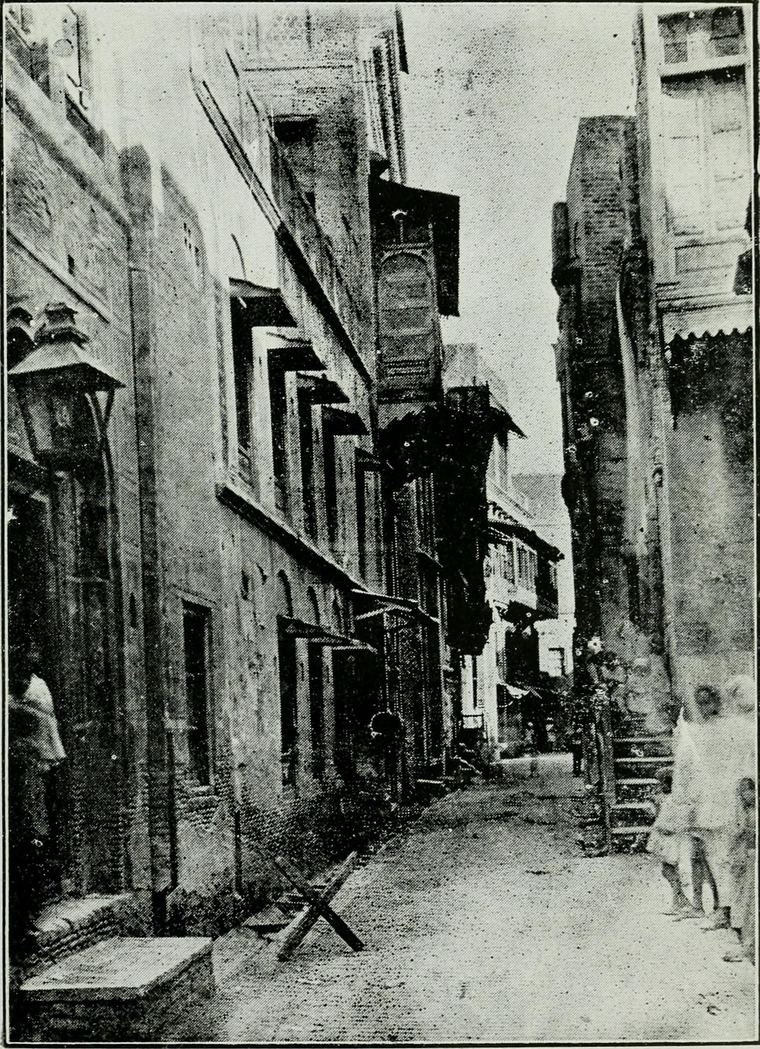
He turned to the lane where Marcella Sherwood had been beaten, Kucha Kaurianwala. "I felt the street ought to be looked upon as sacred," he told the inquiry, so he ordered that any Indian who had to pass along it "must go on all fours". From 19 to 26 April about fifty people crawled its length, among them people who lived there and had no other way home; the Congress commissioners described them crawling flat on their bellies, with rifle butts for anyone who raised a knee. A flogging triangle stood in the lane. The Punjab government had the order withdrawn. Elsewhere men were made to skip in public, to salaam British officers, to answer roll-calls in the heat. "The crawling order and other fancy punishments," the Congress commissioners concluded, "were unworthy of a civilized administration."
A robe of honour at the Golden Temple
The Golden Temple was then run by a government-appointed manager, a sarbarāh, Sardar Arur Singh. During the weeks of martial law he and the priests honoured Dyer with a siropā, a robe of honour, and the symbols of the Sikh faith. In 1920 Dyer's defenders told Parliament he had been "made a Sikh"; his admiring biographer, Ian Colvin, writing in 1929, added a scene in which Arur Singh waived the uncut hair and a priest let him give up smoking gradually, a dialogue we have found in no earlier source.
To Sikhs who had long campaigned to take their shrines back from government nominees, it was proof of their case. The presents to Dyer, Ruchi Ram Sahni wrote, "recalled and revived the agitation against the Manager". In August 1920 Arur Singh came to a Sikh meeting held, of all places, in the Jallianwala Bagh, begged forgiveness with folded hands, and resigned. By the end of the year reformers held the Akal Takht and had formed the Shiromani Gurdwara Parbandhak Committee. Complaints about the shrines' management went back to at least 1905, but the historian Mohinder Singh calls the misuse of the Golden Temple in 1919 "the proverbial last straw" that set the stage for the Akali struggle.
Two inquiries
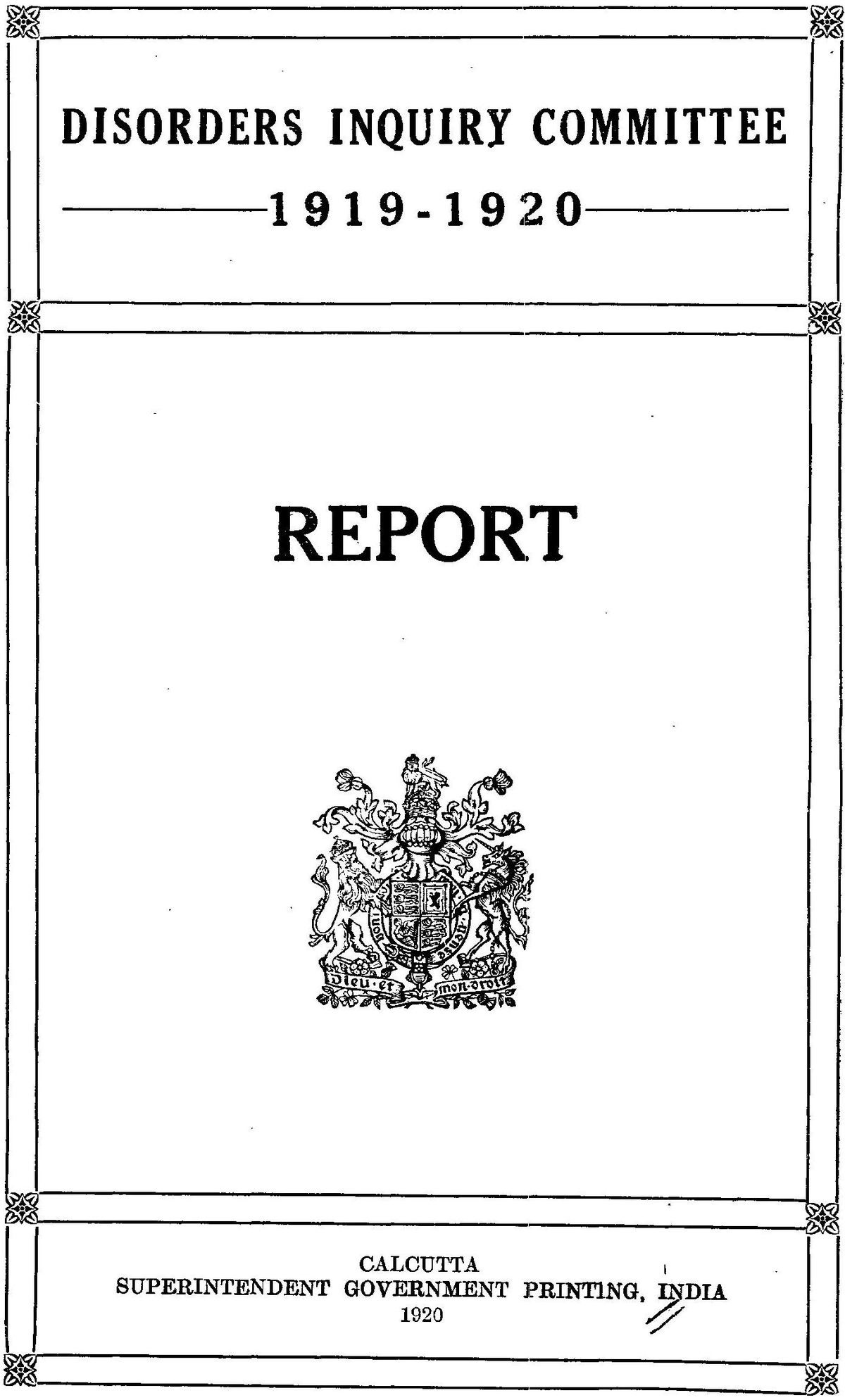
For weeks the press of the Punjab was censored. By the end of May enough had "trickled through the gagged silence" for Rabindranath Tagore to ask the Viceroy to relieve him of his knighthood: "The time has come when badges of honour make our shame glaring in their incongruous context of humiliation." In September an Indemnity Act shielded officials from prosecution. In October the government appointed Lord Hunter, a Scottish judge, to inquire; three of his seven colleagues were Indian. The Congress boycotted it and held its own inquiry, whose report was signed by Gandhi, C. R. Das, Abbas Tyabji and M. R. Jayakar.
On 19 November 1919, in Lahore, Dyer gave evidence without a lawyer, and answered with a frankness that damaged him more than any accuser could. Asked why he had supposed the crowd would not have left if ordered to, he said: "Yes; I think it quite possible that I could have dispersed them perhaps even without firing." Why had he not? He "could not disperse them for some time; then they would all come back and laugh at me, and I considered I would be making myself a fool." Had his idea been to strike terror? "Call it what you like. I was going to punish them." And had he done anything for the wounded?
"No, certainly not. It was not my job. But the hospitals were open and the medical officers were there. The wounded only had to apply for help."
The report, published in May 1920, spoke in two voices. The British majority found that the districts placed under martial law had been in "open rebellion", but that Dyer should have given the crowd notice to disperse, and that in continuing to fire for so long he had committed "a grave error", acting on "a mistaken conception of his duty". The three Indian members went further: "There was no rebellion which required to be crushed," and Dyer's "inhuman and un-British method" had done "great disservice to the interest of British rule in India". Dyer was relieved of his command and retired in July 1920. He was never prosecuted.
Late in 1919 a young lawyer named Jawaharlal Nehru shared a night train with Dyer and heard him tell fellow officers that he had had Amritsar at his mercy and had felt like reducing it to ashes, but took pity on it. Dyer got off at Delhi, Nehru noted, in pyjamas with bright pink stripes.
Two Britains
On 8 July 1920 the House of Commons debated the case. Winston Churchill, the Secretary of State for War and no sentimentalist about empire, called the massacre "a monstrous event, an event which stands in singular and sinister isolation", and dismissed the idea of ruling by terror in one line: "Frightfulness is not a remedy known to the British pharmacopœia." The figure often quoted for the vote mixes up two divisions. A Labour motion fell by 247 to 37; the real test, Sir Edward Carson's pro-Dyer motion to cut Montagu's salary, failed by 230 to 129. Just over a third of the members voting took Dyer's side. The House of Lords went the other way, passing by 129 to 86 a motion that deplored his treatment as unjust.
The Morning Post raised more than £26,000 for him; Kim Wagner records that Rudyard Kipling gave £10. The families of the dead were valued differently. The historian Hardeep Dhillon has shown that when the figures came out in September 1920, the average paid for a European death was ₹68,617 and for an Indian one ₹346, nearly two hundred times less. When compensation was finally paid to Indian families, in July 1922, more than 700 people shared ₹226,000, less than half what about a dozen Europeans had received. Dyer died in England in 1927.
IV. The long echo
From co-operation to non-co-operation
The deepest damage was done to an idea: that British rule could be held to its own principles. In December 1919 the Congress met in Amritsar itself, "the first Gandhi Congress", Nehru called it, and resolved to buy the Bagh. On 1 August 1920 Gandhi returned to the Viceroy the Kaisar-i-Hind medal he had been given for humanitarian work in South Africa. Over the Ottoman caliphate, the Khilāfat, he wrote that the government had acted in an "unscrupulous, immoral and unjust manner": "I can retain neither respect nor affection for such a Government." The Punjab added to it: the "light-hearted treatment of the official crime" and the House of Lords debate had "estranged me completely". That day the non-co-operation movement began.
Historians warn against reading 1919 backwards: Wagner notes that after independence the massacre was "teleologically refashioned as a key moment in the freedom struggle". But it changed the temperature of Indian politics, and nowhere more than in the Punjab. A widely told story has the young Bhagat Singh, then eleven, bringing home some of the Bagh's blood-soaked earth.
Udham Singh
He was born Sher Singh at Sunam, in the princely state of Patiala, in 1899 by the Encyclopaedia of Sikhism's account, and grew up in the Central Khalsa Orphanage in Amritsar. Was he in the Bagh on 13 April 1919? The Encyclopaedia says he was, and Anita Anand notes that he said so too, but at his trial he said only that he was living in the Punjab and remembered the shooting. The historian Navtej Singh concludes that he was abroad; Anand, who saw the files the British long kept closed, that his whereabouts that day are unknown. Contested that he was present.
His life went abroad: army service in Basra and East Africa, then the United States, where he came under the influence of the Ghadar party. He was arrested in Amritsar in 1927 with revolvers and revolutionary papers, was in prison until 1931, and had reached England by the mid-1930s. By 1940 he called himself Mohamed Singh Azad, had the name tattooed on his arm, and wrote from prison: "do not try to change my name". The police read it as "a co-ordination of the Mohamedan and Hindu Faiths"; its last word is the Persian āzād, free.
On 13 March 1940, at a meeting in Caxton Hall, Westminster, on Afghanistan, with the Secretary of State for India, Lord Zetland, in the chair, Sir Michael O'Dwyer, now seventy-five, spoke from the floor. As the meeting ended a man walked forward and fired six shots. Two hit O'Dwyer, who died almost at once, and three others were wounded. The gunman ran for the door until a woman named Bertha Herring stood in his path and caught him by the shoulders.
"I did it because I had a grudge against him. He deserved it."
At his trial at the Old Bailey in June 1940 the judge directed the press not to report his speech from the dock; the shorthand notes survive: "I am not afraid to die. I am proud to die, to have to free my native land." He was hanged at Pentonville on 31 July 1940. Gandhi, Reuter reported, called it an act of insanity. The verdict of later decades was different. In 1974, by most accounts, his remains were brought home and cremated at Sunam, and since 2018 his statue has stood at the entrance to the Bagh.
Words for a wound
Punjabi has more than one name for what happened in the Bagh. It is a hattiākāṅḍ, the formal word for a massacre; a qatleām, a general slaughter, from Arabic through Persian; and it is also remembered as a sākā. The Mahan Kosh defines a sākā as a deed worthy of remaining famous in history, and in Sikh usage it came to name the martyrdoms and massacres a community keeps remembering. Its dead are shahīd, martyrs, from the Arabic for a witness, a word Punjabi Muslims, Sikhs and Hindus all use.
A Punjabi poem about the massacre came from a survivor. Nanak Singh was born Hans Raj in 1897, no relation to the meeting's organiser. By his family's account he lost two close friends in the firing and was knocked unconscious in the crush. In May 1920 he published Khūnī Visākhī, "Bloody Vaisakhi". It was banned, nearly every copy was seized, and it was lost for sixty years. Nanak Singh went on to be celebrated as the father of the Punjabi novel. In 2019 his grandson, the diplomat Navdeep Suri, translated the poem into English, and Justin Rowlatt, great-grandson of Sir Sidney Rowlatt, wrote one of its essays.
Saadat Hasan Manto grew up in Amritsar and was six in 1919. His first story, Tamāshā, has a six-year-old boy in an unnamed city watching aeroplanes drop leaflets and waiting all afternoon to be taken to the "show" his father has told him about. In 1919 kī ek bāt (1951), written after Partition had made him a Pakistani, he came back to Amritsar's April. The memory of the Bagh crossed the new border with him.
The garden after
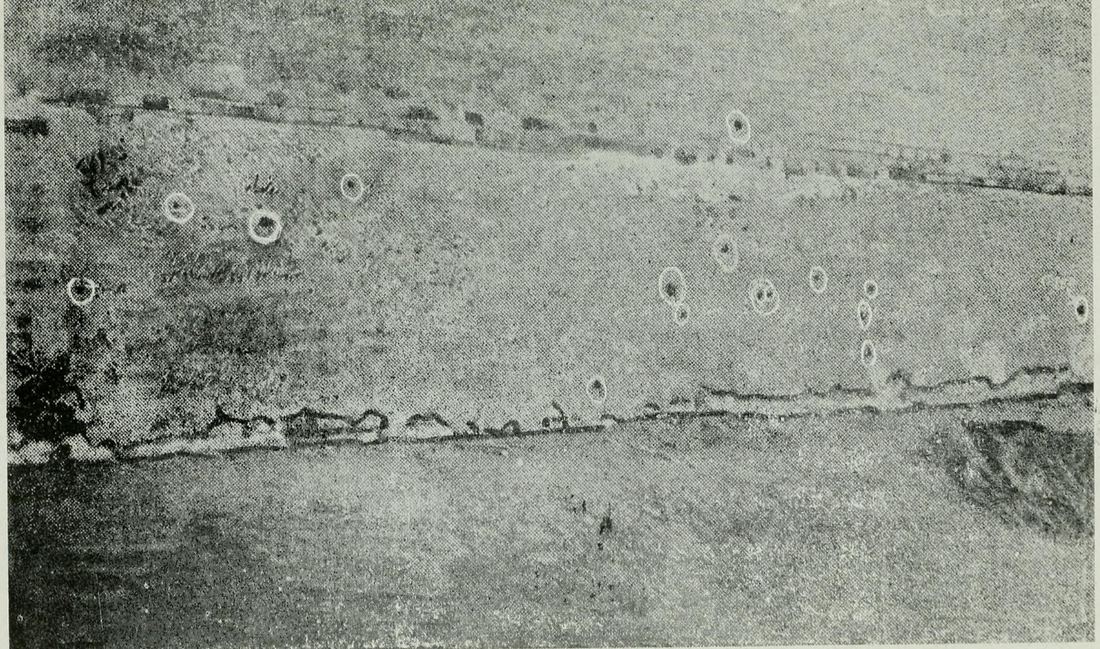
The Congress bought the Bagh in 1920 for 5,60,472 rupees, promising a memorial with not "a word on it calculated to promote or encourage bitterness or ill will against anybody". On 13 April 1961 President Rajendra Prasad inaugurated the national memorial, with a thirty-foot pylon of red stone, the Flame of Liberty, at its centre. The bullet marks in the walls are outlined, as they were ringed in the photographs the Congress report printed in 1920, and the well is enclosed as the Martyrs' Well. A renovation reopened in 2021, its entrance lane rebuilt as a gallery of sculpted figures; historians and some descendants of the dead objected that a place of mourning had been prettified.
British leaders have expressed regret and never formally apologised. Queen Elizabeth II spoke in 1997 of "some difficult episodes in our past", naming Jallianwala Bagh; David Cameron wrote in 2013 that it was "a deeply shameful event in British history"; in 2019 Theresa May called it "a shameful scar on British Indian history", and the Archbishop of Canterbury lay face down at the memorial and apologised in a personal capacity. The demand for a formal state apology remains open.
What historians still argue about
What happened in the Bagh is largely settled; why, and how to weigh it, is not. The charge that the massacre was planned is as old as the massacre: in 1920 Pearay Mohan called Hans Raj "the secret agent of the police" and accused Dyer of having "set up a death trap", and in 1969 the historians V. N. Datta and Raja Ram renewed the case. Kim Wagner, in the fullest recent study, finds no plot, but argues that the decision came out of an empire of fear, in which the burnings and killings of 10 April were read through the memory of 1857 and such violence was "not exceptional in terms of the logic". Nick Lloyd, more sympathetic to Dyer, is read by Joash Lawrence as arguing that he panicked and changed his account afterwards. Against that stands Dyer's own evidence that his mind was made up in the car: if his orders had been defied, he would fire at once.
| Question | What is established | Where the argument is |
|---|---|---|
| How many died? | Several hundred; the government counted 379 | Totals from about 500 to about 1,000 |
| Was it planned? | By his own account Dyer decided on the way to fire at once if the meeting defied his order | Whether anyone planned more; Hans Raj's part |
| One exit? | One narrow main entrance, held by troops, and a few small ways out | How many, and whether one was wider |
| Was Udham Singh there? | The massacre shaped his life | Where he was on 13 April |
| An exception, or the system? | Condemned at the time as exceptional | How far it shows what colonial rule was |
Epilogue: a garden indeed
In January 1920, writing in Gujarati in his paper Navajivan, Gandhi hoped a memorial would, in the English of his Collected Works, "convert the heap of refuse which today goes under the name of a garden into a garden indeed". A century on, it has: lawns, trees, a stone flame, and walls whose bullet marks can be counted. Each Vaisakhi the wheat ripens on both sides of a border that did not exist in 1919, and the Golden Temple fills with pilgrims, as it did that morning.
Dyer said he was going to punish them. The people who died in the Bagh are shahīd, and the word once meant, simply, a witness. The garden still asks the same of everyone who comes in through the lane.
Timeline
| When | What |
|---|---|
| 1849 | Britain annexes the Punjab. |
| 1914–18 | At least 380,000 Punjabis are recruited into the army. |
| 20 August 1917 | Montagu promises "the progressive realisation of responsible government in India". |
| 18 March 1919 | The Rowlatt Act passes, 35 votes to 20; it becomes law on 21 March. |
| 30 March, 6 April 1919 | Hartals against the Act. |
| 9 April 1919 | Ram Naumi: Hindus and Muslims march together in Amritsar. |
| 10 April 1919 | Kitchlew and Satyapal are deported. Troops fire on crowds at the Hall Gate bridges, killing about ten (Hunter); in the riots that follow, five Europeans are killed. |
| 11 April 1919 | Dyer arrives in Amritsar. |
| 13 April 1919 | Vaisakhi. A little after 5 pm, about ten minutes of firing in the Bagh; 1,650 rounds. |
| 14–15 April 1919 | Gujranwala is bombed from the air; martial law in the Lahore and Amritsar districts. |
| 19–26 April 1919 | The crawling order. |
| May 1919 | Tagore asks to be relieved of his knighthood. |
| 19 November 1919 | Dyer gives evidence in Lahore. |
| December 1919 | The Congress meets in Amritsar and resolves to buy the Bagh. |
| May 1920 | The Hunter report is published. Nanak Singh's Khūnī Visākhī appears, and is soon banned. |
| July 1920 | The Commons debate (Carson's motion fails, 230 to 129); the Lords back Dyer, 129 to 86. |
| 1 August 1920 | Gandhi returns his medals and launches non-co-operation. |
| August–December 1920 | The Bagh is bought. Arur Singh resigns; the SGPC is formed. |
| July 1922 | The Compensation Committee's awards are paid out to Indian families in Amritsar. |
| 13 March 1940 | Udham Singh shoots Sir Michael O'Dwyer dead at Caxton Hall. |
| 31 July 1940 | Udham Singh is hanged at Pentonville. |
| 13 April 1961 | The national memorial is inaugurated. |
| 1997, 2013, 2019 | British expressions of regret; no formal apology. |
Quick answers
What happened at Jallianwala Bagh in 1919?
On 13 April 1919, the day of Vaisakhi, Brigadier-General Reginald Dyer led troops into the Jallianwala Bagh in Amritsar, where thousands had gathered for a meeting, and without warning ordered fifty riflemen to fire. They fired 1,650 rounds in about ten minutes, aiming, by Dyer's own admission, where the crowd was thickest; a Congress witness said the fire was directed at the narrow ways out. Dyer then marched them away and gave no help to the wounded.
How many people died?
The government's figure is 379, reached months later. Indian figures at the time were higher: about 500 by the Seva Samiti's tracing, 530 according to a letter read by Madan Mohan Malaviya in September 1919, and about 1,000 according to the Congress inquiry. Historians' estimates include about 700 (V. N. Datta) and 500 to 600 (Kim Wagner). The exact number will never be known.
What was the Rowlatt Act?
A law passed on 18 March 1919, over the opposition of every Indian non-official member who voted, that let the government try political cases before three judges without a jury or appeal, and detain suspects. It became the target of Gandhi's first all-India protest, and was repealed in 1922.
What happened to General Dyer?
The Hunter Committee condemned his conduct; he was removed from his command and retired in 1920, and was never prosecuted. The House of Lords backed him and a newspaper fund raised more than £26,000 for him. He died in England in 1927.
Did Udham Singh kill General Dyer?
No. Dyer died of natural causes in 1927. On 13 March 1940, in London, Udham Singh shot dead Sir Michael O'Dwyer, who had governed the Punjab in 1919 and approved Dyer's action. Udham Singh was hanged on 31 July 1940. Whether he was in the Bagh on 13 April 1919 is disputed.
Did people die in the well?
A plaque says 120 bodies were taken from the well. No record of 1919 or 1920 mentions bodies being recovered. In July 1919 the municipality had the well dragged and found none, although Malaviya insisted he had seen a corpse in it that June. Of the Congress witnesses, one saw people fall in and another saw one or two bodies in it. Read the plaque's figure as a memorial, not a count.
Has Britain apologised?
Not formally. Queen Elizabeth II spoke of "difficult episodes" in 1997, David Cameron called it "a deeply shameful event" in 2013, and Theresa May "a shameful scar" in 2019.
What do Punjabis call it?
A sākā (ਸਾਕਾ / ساکا), a deed or a martyrdom that history keeps; a hattiākāṅḍ (ਹੱਤਿਆਕਾਂਡ), the formal word for a massacre; or a qatleām (ਕਤਲੇਆਮ), a general slaughter. Its dead are shahīd, martyrs.
Punjabi words in this article
Every Punjabi word on this page, in the order it first appears. Words with a link have an entry in our word archive, with pronunciation, origin and an example sentence; all of them, and above all their Shahmukhi spellings, await a native reader's review.
| Word | Say it | Meaning |
|---|---|---|
| jalhiāṅvālā bāġhਜਲ੍ਹਿਆਂਵਾਲਾ ਬਾਗ਼ · جلیانوالہ باغ | “jul-yaan-vaa-laa baagh” | the garden of the Jallas: named, says the Encyclopaedia of Sikhism, for the family of Sardar Himmat Singh of Jalla, a noble at Ranjit Singh's court; the walled ground in Amritsar where the massacre took place |
| ġhadarਗ਼ਦਰ · غدر | “ghuh-DUR” | revolt, mutiny; from Arabic, where it first means treachery. The name of the émigré paper launched in San Francisco in 1913, and of the movement that grew from it |
| nā dalīl, nā vakīl, nā apīlਨਾ ਦਲੀਲ, ਨਾ ਵਕੀਲ, ਨਾ ਅਪੀਲ · نہ دلیل، نہ وکیل، نہ اپیل | “naa duh-LEEL, naa vuh-KEEL, naa uh-PEEL” | no argument, no lawyer, no appeal: the Punjab's six-word summary of the Rowlatt Act in 1919 |
| dalīlਦਲੀਲ · دلیل | “duh-LEEL” | an argument, a reasoned case, a proof; Arabic, through Persian |
| vakīlਵਕੀਲ · وکیل | “vuh-KEEL” | an advocate, a lawyer; first, anyone who acts for another; Arabic, through Persian |
| haṛtālਹੜਤਾਲ · ہڑتال | “hur-TAAL” | the shutting of shops; a strike or shutdown in protest or in mourning. The Mahan Kosh derives it from Sanskrit for putting a lock on the shops |
| rām naumīਰਾਮ ਨੌਮੀ · رام نومی | “raam NAU-mee” | the festival of Rama's birth, on the ninth day of the bright half of Chet; in 1919 it was kept in Amritsar on 9 April |
| visākhਵਿਸਾਖ · وساکھ | “vi-SAAKH” | the month that begins in mid-April; its first day is Vaisakhi and the solar new year |
| visākhīਵਿਸਾਖੀ · ویساکھی | “vih-saa-khee” | the spring harvest festival on the first day of Visākh, usually 13 or 14 April; for Sikhs, by tradition, also the day the Khalsa was founded in 1699 |
| melāਮੇਲਾ · میلہ | “may-laa” | a fair: a festival gathering for trade, wrestling, music and worship |
| khālsāਖ਼ਾਲਸਾ · خالصہ | “KHAAL-saa” | the order of initiated Sikhs, founded by Guru Gobind Singh, by the main tradition at Vaisakhi 1699 |
| bāġhਬਾਗ਼ · باغ | “baagh” | a garden or orchard; from Persian |
| samādhਸਮਾਧ · سمادھ | “su-MAADH” | a memorial raised over the place where someone was cremated; one stood, domed and dilapidated, in the Bagh in 1919 |
| sevā samitīਸੇਵਾ ਸਮਿਤੀ · سیوا سمتی | “SAY-vaa SUH-mi-tee” | a service society. The Allahabad Seva Samiti was a volunteer relief body; its list of 480 named dead was used, with the government's own inquiries, to reach the official figure of 379 |
| kūchāਕੂਚਾ · کوچہ | “KOO-chaa” | a narrow lane or alley; from Persian |
| sarbarāhਸਰਬਰਾਹ · سربراہ | “sur-buh-RAAH” | a manager or superintendent; from Persian. Under British rule, the government-appointed manager of the Golden Temple |
| siropāਸਿਰੋਪਾ · سروپا | “si-RO-paa” | a robe or a length of cloth given as a mark of honour; from Persian sar-o-pā, head and foot |
| khilāfatਖ਼ਿਲਾਫ਼ਤ · خلافت | “khi-LAA-fut” | the caliphate. The Khilafat movement of 1919 to 1924 defended the Ottoman sultan's claim to it |
| āzādਆਜ਼ਾਦ · آزاد | “aa-zaad” | free, independent; from Persian |
| hattiākāṅḍਹੱਤਿਆਕਾਂਡ · ہتیا کانڈ | “HUT-tee-aa-kaand” | a massacre, in formal register; from Sanskrit hatyā, a killing, and kāṇḍa, a chapter |
| qatleāmਕਤਲੇਆਮ · قتلِ عام | “qut-lay-AAM” | a general slaughter, a massacre; Arabic qatl, killing, and ʿāmm, general, joined in the Persian way |
| sākāਸਾਕਾ · ساکا | “SAA-kaa” | a deed worthy of being remembered in history (Mahan Kosh); in Sikh usage, above all a martyrdom or massacre the community keeps |
| shahīdਸ਼ਹੀਦ · شہید | “shuh-HEED” | a martyr; from Arabic, where it first means a witness |
| khūnī visākhīਖ਼ੂਨੀ ਵਿਸਾਖੀ · خونی وساکھی | “KHOO-nee vi-SAA-khee” | “Bloody Vaisakhi”: Nanak Singh's long poem of 1920, banned, and lost for sixty years |