Culture

The Land of Five Rivers

Punjab is a land defined by water. Its very name says so — from the Persian panj (five) and āb (water), Punjab means “the land of the five rivers.”

The Naqsha  ਨਕਸ਼ਾ نقشہ

Walk the land

An illustrated map of undivided Punjab, from the foothills to the meeting of the waters — every shrine, field, courtyard, and riverbank a door into the archive. Hover or tap a place for its margin-note; open it for the full story.

The Naqsha is a modern illustration — a drawn map, not a historical document. Every place on it links to an article that cites its sources.

Interactive map. Drag or use the arrow keys to pan; pinch, scroll, or use the plus and minus keys to zoom. Tab moves between places on the map; Enter opens a place's card; Escape closes it. Every place is also listed in the index after the map.

ਜੇਹਲਮ جہلم Jhelum ਚਨਾਬ چناب Chenab ਰਾਵੀ راوی Ravi ਬਿਆਸ بیاس Beas ਸਤਲੁਜ ستلج Sutlej pattan — the crossing ਸ਼ਿਵਾਲਿਕ شوالک SHIVALIK HILLS Taxila Anandpur Sahib Kartarpur AMRITSAR LAHORE Harappa ا Kasur Pakpattan MULTAN ਪੰਜਨਦ پنجند Panjnad the passage outward ਮਾਝਾ ماجھا MAJHA ਦੋਆਬਾ دوآبہ DOABA ਮਾਲਵਾ مالوا MALWA ਪੋਠੋਹਾਰ پوٹھوہار POTHOHAR KIRANA BAR ਸਾਂਦਲ ਬਾਰ ساندل بار SANDAL BAR ਥਲ تھل THAL ਚੋਲਿਸਤਾਨ چولستان CHOLISTAN Grand Trunk Road · ਜਰਨੈਲੀ ਸੜਕ ਪੰਜਾਬ پنجاب P A N J A B the land of five rivers A DRAWN MAP · PUNJABIA N

Drawn on one canvas with no border and no flags — the landscape as the rivers know it. The map remembers where you left it while you read.

Open the full-screen map

The index

Every place on the map

The same destinations as the map, as a plain list — grouped the way the land groups them. Entries marked in progress link to the nearest live section until their article is written.

The Waters

  • River Jhelum — The westernmost of the five waters — Vitastā to the Sanskrit poets, Hydaspes to the Greeks who met Porus on its banks in 326 BCE.
  • River Chenab — The river of lovers — Heer and Ranjha, Sohni and Mahiwal; Punjabi romance keeps returning to its waters.
  • River Ravi — The river of cities: Harappa rose on its old bed, Lahore on its banks, and Guru Nanak's Kartarpur beside it.
  • River Beas — Where, tradition and the Greek sources agree, Alexander's weary army refused to march further east — the limit of his world.
  • River Sutlej — The longest of the five, running down past Ropar — where Harappan traders once worked — to gather the others in.
  • The pattan — ford and boatman — The crossing-place, where the boatman carries you to the far bank — the oldest Punjabi image of passage from one shore, one generation, to another.
  • Panjnad confluence — Five waters becoming one — the meeting that gives the land its name and this site its mark; no stream is lost in the joining.

The Foothills and the North

  • Shivalik foothills — The low green wall where the plains end — the rivers begin their descent here, and with them everything downstream.
  • Taxila — One of the ancient world's great centres of learning, on Punjab's north-west edge — students crossed half of Asia to study here. in progress — opens the History timeline for now
  • Anandpur Sahib — The hill town where, on Vaisakhi of 1699, Guru Gobind Singh initiated the first five members of the Khalsa.

The Cities and Sacred Places

  • Kartarpur on the Ravi — Where Guru Nanak farmed, taught, and fed all comers from one kitchen — the first Sikh community, reached today by a corridor across a border the map does not draw.
  • Harmandir Sahib, Amritsar — Guru Arjan built the shrine low, so every visitor steps down to enter, and gave it four doors — one facing each direction.
  • Lahore, the walled city — Undivided Punjab's great capital — Mughal court city, Ranjit Singh's seat, and the centre of Punjabi letters for centuries.
  • Badshahi Mosque — One of the largest mosques of the Mughal world, completed in 1673 — its courtyard faces Lahore Fort across a single square.
  • Shalimar Gardens — Terraced Mughal gardens of falling water — Lahore's rendering of paradise as the Persian tradition imagined it.
  • Harappa — A great city of the Indus age stood here on the Ravi's old bed — its streets, seals, and granaries have been coming out of the earth for a century.
  • Pakpattan — The shrine of Baba Farid, whose Punjabi couplets — the language's first great poetry — were later gathered into Sikh scripture.
  • Multan — The City of Saints — Sufi shrines sheathed in blue tile, and the potters who still fire that blue today. in progress — opens the Culture portal for now

The Agrarian Heart

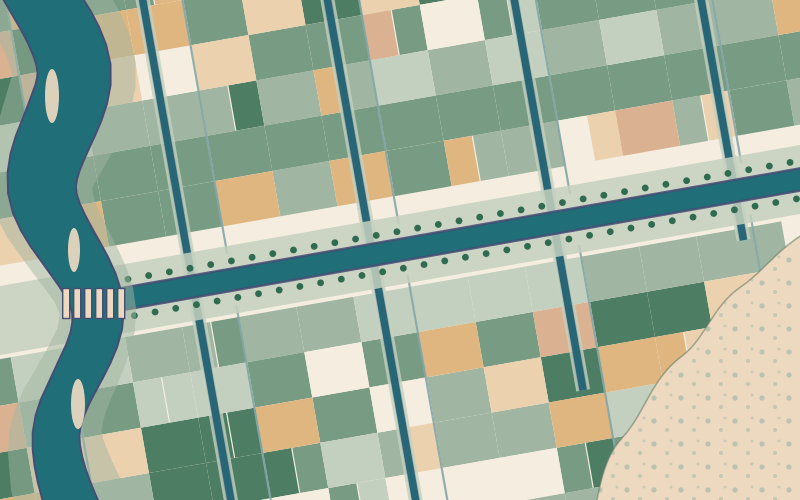
  • Canal headworks — The straight-ruled canals that turned the western bar country into farmland — and moved whole village communities west to work it.
  • The granary — What is saved from this harvest plants the next — continuity kept in mud brick, the archive's own logic standing in a farmyard.

The Village Common

  • The Lohri bonfire — Midwinter fire, rewri and peanuts, and the song of Dulla Bhatti — Sunder Mundriye — sung around the flames.

The Bazaar and the Word

  • The school of two scripts — One language, two hands: Gurmukhi and Shahmukhi side by side on the writing boards — the visual proof that the tongue was never divided.
  • The poets' baithak — The mushaira — poets trading couplets deep into the night; Waris Shah's Heer was read aloud in gatherings like this one.

Music, the Rivers, and the Passage

  • The dargah courtyard (qawwali) — Harmonium, tabla, and clapped rhythm at the shrine — verses of Bulleh Shah passed around the circle like embers.
  • The music stageDhol, tumbi, algoza, sarangi — the instruments of the plains, each with its own article in the gallery.
  • The Sandal Bar (Dulla Bhatti country) — The bar country of Dulla Bhatti — the rebel remembered every Lohri for standing between Punjab's daughters and their abductors.
  • The ship at the water's edge — Where the waters leave the map, the passage outward begins — soldiers, students, labourers, the Komagata Maru — the diaspora this archive serves.

Pillar I

Geography — the foundation

Established consensus

A topographic map of the Punjab region: its rivers thread the plain between the higher ground to the north and the drier tracts to the south.
The topographic setting of Punjab — the rivers threading the plain between the northern hills and the drier country to the south. Map by Apuldram, CC BY-SA 3.0, via Wikimedia Commons.

Punjab sits where the mountains meet the plain. To the north and west rise the foothills of the Himalaya and the passes toward Central Asia; to the south stretch the flat, open plains that make Punjab one of the great agricultural regions of the subcontinent. Between the rivers lie the doabs — a doab (from do, “two,” and āb, “water”) is the tongue of land between two rivers — and these tracts became the natural units of settlement, dialect, and identity.

Punjabis have long divided their homeland into regions that cut across today’s international border. Majha, the heartland around Amritsar and Lahore, lies between the Ravi and the Beas. Malwa spreads south of the Sutlej. Doaba sits between the Beas and the Sutlej. West of the Ravi lie the regions of what is now Pakistani Punjab. These names are still used in daily speech, in music, and in the way people describe where they are from — a reminder that the older cultural map does not always match the modern political one. (Lahore is today in Pakistan, Amritsar in India; Majha spans both.)

The land’s fertility came at a price: openness. The same plains that grew wheat and sustained cities also lay along the invasion-and-trade highway between Central Asia and the Gangetic heartland. For millennia, armies, merchants, and migrants passed through — and each left something behind. Punjab’s culture is, in large part, the record of that ceaseless exchange.

The Bar — Punjab’s own steppe

Not all of Punjab is watered ground. The high centre of each doab, lifted above the river floodplains and beyond the reach of the old wells, was for centuries dry, open country the Punjabis called the bār — a semi-arid grassland of scrub and thin rainfall, sometimes only a few inches a year: Punjab’s own belt of steppe. Each stretch had its own name — the Kirana Bar between the Jhelum and Chenab, the Sandal Bar between the Chenab and Ravi, the Ganji Bar and Neeli (Nili) Bar toward the Sutlej — with the sandy Thal drier still to the west.

For centuries the Bar was pastoral country, grazed by herding tribes such as the Kharals, Dogars, and Jats, who moved between the riverbanks in the dry months and the open grass after the rains. It was also the setting of some of Punjab’s best-loved folklore: the heartland of Heer Ranjha around Jhang lay on its edge, and the rebel-hero Dulla Bhatti, still sung at Lohri, was a son of the Sandal Bar. From the 1890s the British cut a vast web of irrigation canals across these tracts — the canal colonies — clearing the scrub and turning the grazing steppe into some of the most productive farmland on Earth, and, with it, remaking who lived there and how.

Explore the land

The Five Rivers Regions & Doabs soon Cities soon Climate & Agriculture soon The Bar & Canal Colonies soon

Pillar II

Arts

Established art history Living folk tradition

A phulkari — traditional Punjabi folk embroidery — worked in bright floss silk in dense floral and geometric patterns on a coarse cotton ground.
Phulkari, traditional Punjabi folk embroidery. Textile to be sourced from Wikimedia Commons — credit rendered on publication.

Out of this crossroads came a body of art as layered as the land itself. Punjab’s creative traditions run from the intimate to the monumental — from a grandmother’s needle to the courts of emperors and maharajas.

Its music is perhaps its most travelled export: the devotional qawwali of the Sufi shrines, the folk songs of the fields and weddings, the deep tradition of sung poetry carried on instruments like the rabab, and, in the modern era, a Punjabi popular music heard around the world. Its textiles and embroidery — above all phulkari, the folk embroidery whose bright floral-work is stitched across communities on both sides of the border — turn cloth into biography. Its painting includes the refined miniature traditions shaped by Mughal and Pahari courts, and the portraiture of the Sikh era. Its dance — the vigorous bhangra, the graceful giddha, the jhumar — grew out of the agricultural calendar before the world ever saw it on a stage.

Explore the arts

Sung Poetry: Bulleh Shah Reader: “Tere Ishq Nachaya” Waris Shah’s Heer Music Phulkari & Textiles soon Dance soon Miniature Painting soon Architecture soon

Pillar III

Heritage

Established history Religious tradition Oral tradition

A 19th-century watercolour of the Harmandir Sahib (Golden Temple) at Amritsar, its gilded shrine reflected in the surrounding sacred pool.
The Harmandir Sahib, watercolour by William Carpenter, 1854.

What Punjab made, it also kept — in stone, in ritual, and in story. Its heritage is both tangible and intangible: the monuments you can visit, and the traditions you can only inherit.

The land holds one of the world’s oldest urban legacies at Harappa, a great city of the Indus Valley Civilisation on an old course of the Ravi. It holds a shared sacred landscape — the Harmandir Sahib at Amritsar, the Sufi shrines of Punjabi Islam, and ancient temple sites — that belongs, in different ways, to Sikh, Muslim, and Hindu Punjabis alike. It holds forts, gardens, and the grand architecture of successive empires.

But heritage here is not only architecture. It lives in the festivals tied to the turning of the agricultural year — the spring harvest of Vaisakhi, the midwinter fires of Lohri, the yellow of Basant — and in the great qisse, the epic love-tragedies of Heer Ranjha (read Waris Shah’s Heer) and Sohni Mahiwal that Punjabis have told and sung for centuries. These stories, passed by voice long before they were printed, are as much a monument as any fort.

The festival year

Because the festivals grew out of the farming year, they still follow the old bikramī calendar of the land more than any official one — each marking a turn of the season or a harvest brought in.

Seasonal & agricultural Religious tradition

Lohri · mid-January
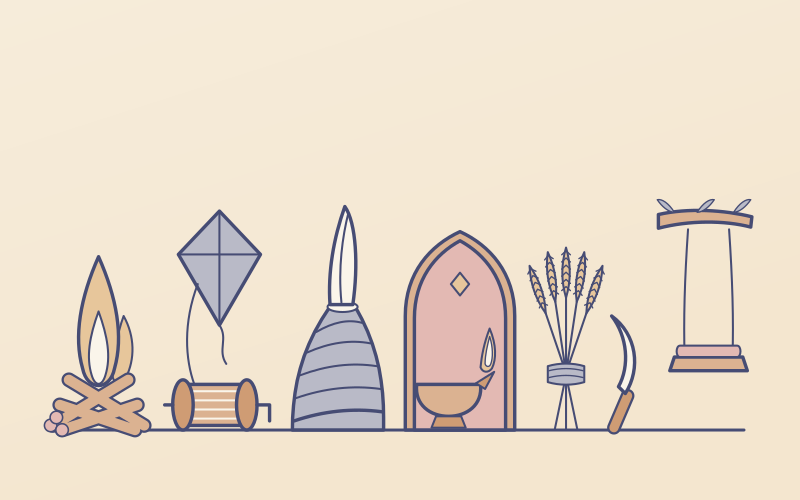
The great midwinter bonfire, welcoming the lengthening days — sung with the ballad of Dulla Bhatti, folk-hero of the Sandal Bar. A festival of the family and of the coming harvest.
Maghi · 14 January
The winter turning-point (Makar Sankranti), the morning after Lohri. For Sikhs it also remembers the Chālī Muktē, the “forty liberated ones,” at the Battle of Muktsar (1705).
Basant · early spring
The arrival of spring, dressed in yellow for the blossoming mustard and long marked — especially around Lahore — by kite-flying.
Vaisakhi · 13–14 April
The great spring harvest festival, danced with bhangra and giddha — and, since 1699, the anniversary of the founding of the Khalsa.
Teeyan · monsoon (Sawan)
A women’s festival welcoming the rains, marked by giddha, folk songs, and swings hung from the trees.
Holla Mohalla · March
A Sikh martial festival at Anandpur Sahib, the day after Holi — mock battles, gatka sword-play, and processions.

The growing portal

What this archive will hold

Geography

  • Five Rivers live
  • Regions & Doabs
  • Cities
  • Climate & Agriculture

Arts

  • Music
  • Phulkari & Textiles
  • Dance
  • Miniature Painting
  • Architecture
  • Sung Poetry Bulleh Shah, Waris Shah live

Heritage

Future pillars

  • Cuisine
  • Fashion
  • Sports
  • Diaspora
  • Folklore & Belief
  • Traditional Occupations
  • Seasonal Traditions
  • Flora & Fauna
  • Symbols

Items marked live are readable now; the rest are forthcoming and will be linked here as they are published.