If you're outside on Diwali night, look up. Something is missing.
There is no moon. Diwali always falls on the new moon of Kattak, the autumn month that runs from October into November. Every clay lamp on a rooftop in Amritsar, every candle in a window in Lahore, every string of fairy lights on a house in Brampton or Southall is lit on the darkest night of the month. The darkness is the point.
Ask ten Punjabis why the lamps are lit and you'll get more than one answer. A prince coming home after fourteen years in the forest. A goddess who calls only at houses that are clean and bright. A Guru who walked out of a Mughal fortress with fifty-two princes holding on to his cloak. A teacher freed from rebirth, and eighteen kings who lit the dark he left.
And there is a fifth answer, written down a thousand years ago by a scholar from Central Asia: a king let out of the underworld for one day a year.
They sound like five different festivals. Look closer and all five have something in common, and it explains the lamps. We'll get there by the end.
Diwali in thirty seconds
- What
- The festival of lights, kept by Hindus, Sikhs and Jains on one autumn night. For Sikhs it is also Bandi Chhor Divas. What it is
- When
- The new moon of Kattak: one evening between mid-October and mid-November. The panel below works out this year's for your city. When is it this year?
- Why
- Four stories from three traditions: Ram comes home, Lakshmi comes in, the Guru walks free, Mahavira's light. The four stories
- Do
- Lamps at dusk, a puja at home or prayers at the gurdwara, sweets for everyone, and the whole family on the roof. If you're invited
- Say
- “Happy Diwali”, or in Punjabi, “Diwali diyan vadhaiyan”. What to say
What is Diwali?
Diwali (ਦੀਵਾਲੀ, دیوالی, dee-VAA-lee, also spelt Divali), the festival of lights, is kept by Hindus, Sikhs and Jains on the new-moon night of Kattak, the month called Kartik in Hindi, which falls between mid-October and mid-November. The name comes from the Sanskrit dipavali, “a row of lamps”. For many Hindus, Punjab's among them, it is the night Ram came home to Ayodhya and the night of Lakshmi, the goddess of good fortune. For Jains it is the night Mahavira, the last of their great teachers, reached nirvana. For Sikhs it is also Bandi Chhor Divas, “the day of release”, which remembers the sixth Guru, Guru Hargobind, freed from the fortress of Gwalior in central India and coming home to Amritsar. Across Punjab and its diaspora it means clay lamps and fairy lights, a scrubbed house, new clothes, boxes of mithai and the crack of patake.
The lamp at the centre of it all is a diva: a shallow clay saucer with a pinched lip, a twist of cotton for a wick, and mustard oil. (Yes, a diva. In Hindi it's a diya; in Punjabi it has always been a diva, and it has never once been difficult.)
Bandi Chhor Divas: the Sikh night
For Sikhs the night belongs first to Guru Hargobind, the sixth Guru: the Guru who wore two swords, one for the spirit and one for the world, piri and miri, and who raised the Akal Takht, the Sikhs' seat of authority, facing the Harmandir Sahib. Sikh tradition says he came home from Gwalior to Amritsar at Diwali. The Shiromani Gurdwara Parbandhak Committee (SGPC), which runs the Golden Temple, tells how Baba Budha, who had known Guru Nanak as a boy and served every Guru since, lit lamps across the city to welcome him. Sikh tradition
So on Diwali night gurdwaras are lit as well as homes, and there is langar for whoever comes. The greeting is “Bandi Chhor Divas diyan vadhaiyan”, and plenty of families say Diwali and Bandi Chhor Divas in the same breath.
What Sikhs take from the night is in the way the story ends: when the order came to free him, the Guru would not leave the fort without the fifty-two princes held there with him. Freedom, in this telling, is something you win for others too. Interpretation The theme has come back in the message the jathedar of the Akal Takht reads to the Sikhs on the day: in 2004 it asked for detainees in India and Pakistan to be freed, and in 2025 for the Sikh prisoners known as the Bandi Singhs, a name with bandi, captive, at its root.
The fort remembers him too. Gurdwara Data Bandi Chhor Sahib stands in Gwalior Fort, where he was held, and in 2021 a nagar kirtan, a procession behind the Guru Granth Sahib, set out from it for Amritsar to mark what its organisers called the 400th Bandi Chhor Divas.
At the gurdwara
Bandi Chhor Divas, the short version
- When
- Diwali evening. At the Golden Temple, the evening the SGPC names: in 2024 and 2025, the second of two.
- What
- Gurdwaras and homes lit, kirtan and ardas, langar. At Amritsar, lamps along the parikrama, the jathedar's message and, most years, a short display of fireworks.
- You
- Cover your head, take off your shoes, stay for langar, and say “Bandi Chhor Divas diyan vadhaiyan”.
- Why
- Guru Hargobind's return from Gwalior and, in the Sikh telling, the fifty-two who walked out of the fort with him.
When is Diwali this year?
Diwali is kept on massia, the new moon, of Kattak. Punjab counts its months by the moon as well as the sun (our calendar shows both), and twelve moons come to about eleven days short of a year, so the date moves: Diwali can fall anywhere from mid-October to mid-November. About two weeks later, the full moon that ends Kattak brings Guru Nanak's gurpurab.
The moon fixes the night; your sunset fixes the day. Diwali is the evening on which the new moon is in force at dusk, so in some years the same new moon reaches Vancouver's evening a day before Amritsar's, and in others it covers two evenings and calendars disagree.
This panel works out this year's Diwali evening for Amritsar, Lahore, London or Vancouver on your device, and it needs JavaScript. Diwali is the new moon of Kattak, between mid-October and mid-November; your gurdwara or mandir will have this year's date.
The calendar could not be loaded just now, so this year's date can't be shown. Diwali is the new moon of Kattak, between mid-October and mid-November: try again in a moment, or ask your gurdwara or mandir.
Sending Diwali wishes? Lay a rangoli, put it on a card and send it, in a couple of minutes. Make a card
The five days
Diwali is one night, but in North India it sits in the middle of five days, and the season around it starts weeks before. Here is the month on the moon:
Dussehra comes first, when Ravan is burned in effigy for Ram's victory. Then Karva Chauth, when many married women fast for their husbands' long life, without food or water from dawn until the moon rises; a new bride looks at it through a sieve. Then Ahoi, when mothers fast for their children until the stars come out. Then the five days themselves:
Two days before
Dhanteras: buy something that shines
- When
- Usually two days before Diwali.
- What
- Shopping. Gold or silver, a coin or two, a new pan or a set of steel plates. In Amritsar, that means Guru Bazaar, the gold and silver market.
- You
- If you were going to buy a new kettle anyway, today is the day.
- Why
- Dhan means wealth and teras the thirteenth day of the waning moon. Something new brought into the house today is said to bring good fortune in with it.
The day before
Chhoti Diwali: the night before
- When
- Usually the day before Diwali.
- What
- The last of the cleaning, the last boxes of sweets delivered, the first few lamps lit.
- You
- Help carry the sweet boxes round to the neighbours.
- Why
- “Little Diwali”, as many call it: the rehearsal. In parts of Punjab it is also Kani Diwali: one lamp, with a cowrie shell in its oil, set where the house's water drains away, to see bad luck out. Elsewhere it remembers Krishna's victory over the demon Narakasura.
The new moon
Diwali: the night of lamps
- When
- The new moon, from dusk.
- What
- Lamps lit at sunset; Lakshmi puja in Hindu homes; for many Sikh families the gurdwara, then home; sweets, visits, fireworks.
- You
- Arrive with sweets or dry fruit, and help light the lamps.
- Why
- Ram's homecoming, Lakshmi's visit, Guru Hargobind's return, Mahavira's nirvana.
The day after
Vishwakarma Day: the craftsman's day
- When
- Usually the day after Diwali.
- What
- The holiday list of India's Punjab calls it Vishwakarma Day, for Vishwakarma, the divine craftsman. Many Hindu families keep it as Govardhan Puja too, for the hill Krishna lifted to shelter a village from a storm.
- You
- Leftover mithai for breakfast. Nobody will judge.
- Why
- A day for the gods' own craftsman, and for the god who sheltered a village.
Two days after
Bhai Dooj: brothers and sisters
- When
- Usually two days after Diwali.
- What
- Sisters mark a tikka on their brothers' foreheads and pray for them, and many eat nothing until they have. Brothers bring a present. In Punjabi the day is also simply called Tikka.
- You
- Got a sister? Call her. Got a brother? He owes you a present.
- Why
- In the old story, Yama, the god of death, goes to eat at his sister Yamuna's house on this day.
Invited? The short version
Nobody expects a guest to know any of this, and you'll be welcome whatever you get wrong. These eight will cover you.
- Bring something sweet. A box of mithai, dry fruit or good chocolates. Leave the wine at home unless you know your hosts drink: some families keep the day of the puja meat- and alcohol-free.
- Say it. “Happy Diwali” is the safe choice. To a Punjabi friend, “Diwali diyan vadhaiyan” (ਦੀਵਾਲੀ ਦੀਆਂ ਵਧਾਈਆਂ, دیوالی دیاں ودھائیاں): congratulations on Diwali. To a Sikh friend, “Happy Bandi Chhor Divas” too. In Pakistan you'll hear “Diwali Mubarak”.
- Dress up. Bright and festive. Punjabi or South Asian clothes are a compliment, not a costume.
- At a puja, follow the family. Shoes off, sit or stand quietly, and take the prasad, the blessed sweet, in cupped hands.
- At a gurdwara, cover your head, take your shoes off and wash your hands. Sit on the floor, and stay for langar, the free meal, which is always vegetarian.
- Say yes to food. It will keep coming.
- Mind the fireworks. Keep a bucket of water handy, wear closed-toe shoes, keep children back, and check the local rules: many towns allow them only at set hours, or not at all.
- Leave with more than you brought. You will be sent home with a box of someone else's sweets. This is the system working.
How Punjab keeps it
In Punjab the festival starts with a bucket. In the days before Diwali the whole house is cleaned, and often freshly painted: cupboards emptied, curtains washed, every corner made fit for a goddess. Then the shopping: new clothes, clay divas from the potter, sweets and presents for everyone you know, and bags of coloured powder for a rangoli, the pattern laid on the floor at the door. In the villages Diwali comes just after the paddy harvest is sold, and when the money is late, farmers say it will be a dark Diwali.
Try one: there is a rangoli floor at the end of this page, and your pattern can go on a Diwali card. Make a rangoli
At dusk the lamps come out: a diva on the doorstep and along the edge of the roof, candles in the windows, and these days far more strings of electric lights than either. In a village a lamp goes to every place that matters, from the well and the pipal tree to the cattle trough and even the dung heap. Hindu families gather for the Lakshmi puja; many Sikh families go to the gurdwara for the evening prayer, the ardas, and come home to light their own lamps. After that, everyone ends up on the roof.
Diwali is mithai season: one estimate from 2003 put sales in Ludhiana alone at a million one-kilo boxes. In Amritsar the shops fill with pinni made with ghee and dry fruit, boondi laddoos and petha. Boxes go out to relatives, neighbours and colleagues, boxes come back, and somewhere in every street is a box of soan papdi, a flaky gram-flour sweet, that has been round the whole neighbourhood and come home again. Many families give dry fruit instead, which keeps, and raises fewer worries about adulterated sweets.
And then the patake: sparklers for the children, fountains, rockets, and the one enormous bang an uncle insists on setting off himself. They are the loudest part of the night and, these days, the most argued about: their smoke settles on top of the smoke from burning paddy stubble, and after Diwali in 2025 parts of Jalandhar, Ludhiana and Amritsar hit the top of the air-quality scale. In recent years India's Punjab has allowed only “green” crackers, and only from 8 to 10 pm on Diwali night. Not everyone listens.
In some homes the night ends over cards, on an old Punjabi belief that whoever wins tonight will win all year. Gambling at Diwali is an old Indian habit (a French traveller wrote about it in the seventeenth century), and in the run-up to Diwali the police in Punjab's cities raid a gambling den or two.
Across the border
In Pakistan's Punjab, Diwali belongs above all to its Hindu citizens and whoever they invite. It is not a national holiday in Pakistan: government staff who are not Muslim may take it as one of their optional holidays, and Sindh gives its Hindu staff the day off. Families light clay lamps at home. Lahore's main celebration is at the Krishna Mandir on Ravi Road, one of the city's two working Hindu temples, hung with coloured lights for the night; in 2025 Muslim, Sikh and Christian guests came to its ceremony. In 2024 the chief minister of Pakistan's Punjab, Maryam Nawaz, held a Diwali ceremony with Lahore's Hindu families, and in 2025 the prime minister hosted one in Islamabad.
Abroad
Abroad, families keep the night at home and at the mandir or gurdwara, with fireworks where the rules allow them and city displays where they don't. In Surrey families light clay divas; in Mississauga the Ontario Khalsa Darbar gurdwara has stopped using fireworks; and Canada's federal government and British Columbia's mark Bandi Chhor Divas with official greetings. Leicester's Belgrave Road puts on what is often called one of the biggest Diwalis outside India, London keeps Diwali on the Square in Trafalgar Square, and Brampton, which banned personal fireworks, held its first city Diwali fair, a mela, in 2023. New York City's public schools have closed for Diwali since 2024, and California added it to its state holidays from 2026.
One night, four stories
Which story you hear depends on whose house you're in. Each is the meaning of the night for the people who keep it, so the four doors below are drawn alike, in no order of rank. Choose one.
- Ram comes homeHindu tradition
- Lakshmi comes inHindu tradition
- The Guru walks freeSikh tradition
- Mahavira's lightJain tradition
Ram comes home Hindu tradition
Prince Ram of Ayodhya is the hero of the Ramayana, and many Hindus worship him as an avatar of the god Vishnu: a form Vishnu took on earth. On the eve of his coronation he is sent into the forest for fourteen years, and his wife Sita and his brother Lakshman go with him. There Sita is carried off by Ravan, the demon king of Lanka, and Ram wins her back in a war and kills him. North India marks that victory at Dussehra, about three weeks before Diwali, by burning Ravan in effigy.
Meanwhile his brother Bharat refuses the throne. For fourteen years he rules from Nandigram, outside the city, with Ram's sandals on the throne, waiting.
Then the exiles come home, riding Ravan's own chariot of the sky, the Pushpak. On the night they reach Ayodhya, the story goes, the whole city lights lamps to welcome them through the dark. In Punjab, that's the reason most often given for Diwali.
Lakshmi comes in Hindu tradition
Diwali night is also the night of Lakshmi, the goddess of wealth and good fortune. In Hindu homes the evening turns on her puja, an act of worship: the family gathers before her image, lights the lamps and prays for a good year. Her offering can be the simplest thing in the house: sugar drops, puffed rice and fox nuts in a little clay bowl, shared out among the children afterwards. In some Punjabi homes her lamps stand on a hatri, a toy-sized clay shop with a dome and a tower at each corner, and in Amritsar a whole bazaar sells candied sugar toys for her puja.
Lakshmi, it's said, comes only to houses that are clean, lit and open. Hence the scrubbing that starts days before, and the door many families leave open late into the night. Prosperity, in this telling, is a guest: you clean for her and light her way. Interpretation
The Guru walks free Sikh tradition
In the early 1600s the Mughal emperor Jahangir had the sixth Sikh Guru, Guru Hargobind, held in the fortress of Gwalior, where the Mughals kept royal and noble prisoners. Bhai Gurdas, who knew him, noted in a single line of verse that emperors once came to the Guru's house, but this Guru was shut up in a fort by the emperor.
The rest comes to us through Sikh tradition. When the order came to free him, the Guru would not leave without fifty-two princes held there with him. The emperor, the story goes, agreed that as many could go as could hold on to the Guru's cloak. So the Guru had a cloak made with fifty-two strings, and walked out of the gate with a prince holding each one. He reached Amritsar at Diwali, and the city lit its lamps for him.
That is why Sikhs call the night Bandi Chhor Divas, the day of release, and the Guru Data Bandi Chhor: the generous one who freed the captives. Sikhs take a plain lesson from it: he would not walk out free and leave the others behind.
Mahavira's light Jain tradition
For Jains, Diwali is the night Mahavira, the twenty-fourth and last of the tirthankaras, the great teachers of Jainism, reached nirvana at Pavapuri, in Bihar: freed, Jains believe, from the cycle of rebirth for good.
The Kalpa Sutra, a scripture of the Svetambara Jains, says that eighteen kings who were keeping a fast there that night lit up the dark: since the light of knowledge had gone out of the world, they said, they would make a light the eye could see. The same night, it says, Mahavira's chief disciple, Indrabhuti Gautama (not the Buddha), reached perfect knowledge. Many Jains begin their new year with him at sunrise the next morning, when Jain merchants open the year's new account books in the names of Mahavira and Gautama. In India's Punjab the Jains are a small community, fewer than one person in five hundred, but the night is as much theirs as anyone's.
And the fifth answer
Around 1030 the scholar al-Biruni, a Central Asian who had measured the size of the earth from a hilltop in the Salt Range, in what is now Pakistan's Punjab, wrote a long book about India. In it he describes a festival called Dibali, on the new moon of Kartik. People bathe, dress up, give each other betel leaves and areca nuts, ride to the temples to give alms and “play merrily with each other till noon”, and at night light so many lamps “that the air is perfectly clear”.
The reason he was given? Once a year, on this day, Lakshmi lets Bali, a demon king held prisoner deep beneath the earth, out into the world; so the feast was called Balirajya, Bali's kingdom. Bali still has his day, the day after Diwali, in parts of India, and his is one of the oldest written explanations of the night. It, too, is about a prisoner set free.
Diwali in Amritsar
There is a Punjabi saying for this:
ਦਾਲ ਰੋਟੀ ਘਰ ਦੀ, ਦੀਵਾਲੀ ਅੰਬਰਸਰ ਦੀ دال روٹی گھر دی، دیوالی امبرسر دی Daal roti ghar di, Diwali Ambarsar di.
Literally, “dal and roti of home, Diwali of Amritsar”: nothing beats the food at home, or Diwali in Amritsar, or Ambarsar, as Punjabis say it. On Diwali night the Harmandir Sahib, the Golden Temple, is lit from top to bottom, and its reflection lies on the dark water of the sarovar, the pool around it. People come by the lakh, the hundred thousand. Families light their own small lamps at the places set aside along the walkway, the parikrama, a short display of fireworks goes up over the water, and the jathedar of the Akal Takht, the seat of Sikh authority facing the shrine, reads his annual Bandi Chhor Divas message to the Sikhs.
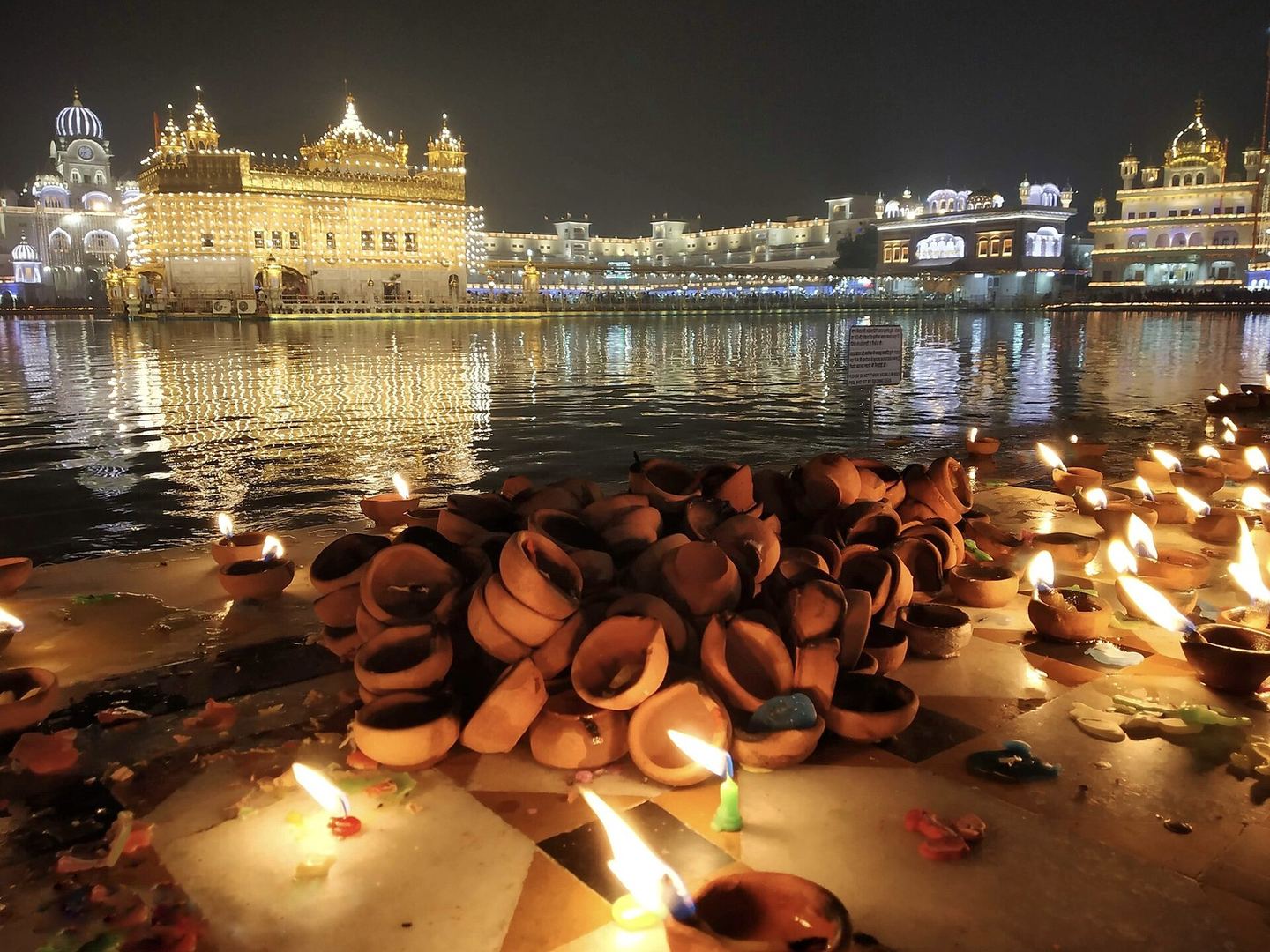
Some years the lights are kept low. In 2024, when the day fell on the fortieth anniversary of the killings of Sikhs in Delhi in November 1984, the Akal Takht asked for no fireworks, no electric lights and only a token of lamps.
Why the lamps?
Put the stories side by side and look at what happens in each. Ram comes home through the dark to a lit city. Lakshmi is let in at a door left open and lit. Guru Hargobind walks out of a fortress and, in the Sikh telling, fifty-two prisoners walk out with him. Mahavira is released, Jains believe, from the round of rebirth. Bali is let out of the underworld for a day. Interpretation
Every one of them is about a door: someone coming home through it, someone let in, someone let out. And every one is told of the darkest night of the month, when a lamp means most. On a night with no moon, a lamp on a doorstep does two things at once. It shows the way, and it says that someone is expected.
That, more or less, is what the cleaning is for (the house made ready), what the sweets are for (the welcome shared), and what the new things bought on Dhanteras are for (the good year asked in). Even the fireworks, a late addition to a very old festival, make sure that nobody, anywhere, can miss that tonight the town is lit.
Now look at the top of your screen. If you've read this far, every lamp in the row is lit. A row of lamps, in Sanskrit, is a dipavali. In Punjabi, Diwali.
Make a rangoli, send a card
Two steps and a couple of minutes: lay a rangoli in coloured powder, then put it on a Diwali card and send it to someone.
Step 1 of 2
Make a rangoli
Pick a colour and tap the floor. The powder falls into every matching part at once, so the pattern mirrors itself all the way round. The pattern is ours, drawn for this page. Not sure where to start? Tap Surprise me, then change whatever you like.
Or skip it and send a card with the rooftops
On a keyboard, the arrow keys move from the centre outwards and back, Space drops the powder, Delete sweeps it away, and the keys 1 to 6 pick a colour.
Step 2 of 2
Send the card
Choose a greeting, add your name, and send it. It arrives in a message as a card, and a tap on it opens this page with your greeting, and your rangoli if it has one, at the top. You can save the picture too.
Questions people ask
Do Sikhs celebrate Diwali?
Most Sikhs mark the night, and Sikhs have gathered on it for centuries. Guru Amar Das made Diwali one of three days a year when Sikhs gathered at Goindwal in the 1500s; Bhai Gurdas, who died in 1636, used Diwali's lamps in his verse as a picture of things that soon pass, set against the lasting joy of the Guru's word; and in the 1700s Sikhs gathered at Amritsar at Diwali even when it was dangerous to. Sikhs connect the night with Guru Hargobind's release and return. The name Bandi Chhor Divas is old in its parts (the Guru Granth Sahib calls God bandi chhor, the freer of captives) but newer as the name of the day: it became the usual name in the last few decades. Sikhs do not all keep it the same way. Many say Diwali, many Bandi Chhor Divas, many both, and in years of mourning the night is kept quietly: in 2024, when it fell on the fortieth anniversary of the 1984 killings, the Delhi gurdwara committee asked Sikhs not to light lamps at home.
Is Diwali a Hindu festival?
It is kept by Hindus, Sikhs and Jains, each for reasons of their own. Most people who keep it are Hindu, and its best-known stories, Ram and Lakshmi, are Hindu stories. In Punjab, Hindus and Sikhs have kept it side by side for centuries, often on the same street and with the same box of sweets.
Why does the date change every year?
Because it follows the moon. Twelve lunar months are about eleven days shorter than a solar year, and about once every three years the calendar adds a month to catch up, so Diwali wanders between mid-October and mid-November. The panel under “When is Diwali this year?” works it out for you.
Why is Diwali twenty days after Dussehra?
A story that goes round every year says it took Ram twenty days to walk home from Lanka. The Ramayana doesn't say so: in Valmiki's telling he flies home in the Pushpak, a chariot of the sky. The gap is the moon's. Dussehra falls on the tenth day of a waxing moon, and Diwali on the new moon after the next full moon: twenty lunar days later, a little under three weeks on a wall calendar.
Is Bandi Chhor Divas always on the same day as Diwali?
Usually. In years when the new moon is in force at two sunsets, calendars differ, and the Golden Temple has kept the later evening: in 2024 Bandi Chhor Divas at Amritsar was on 1 November, when India was split between 31 October and 1 November, and in 2025 it was on 21 October, a day after most of India. In 2025 Punjab ended up setting off fireworks on both nights.
Were there really fifty-two kings?
That is how Sikh tradition tells it, and the tellings differ on who they were: Hindu princes, kings, chiefs or simply prisoners. The detention itself is history: Bhai Gurdas, the Guru's contemporary, mentions it, and so does a Persian account by a man who met the Guru. How long it lasted is not settled. Sikh tradition says forty days and the Persian Dabistan twelve years; historians mostly put it at a few months to a few years, somewhere between 1607 and 1619. The Shiromani Gurdwara Parbandhak Committee (SGPC), which runs the Golden Temple, gives 1609 to 1612.
What do you say on Diwali?
“Happy Diwali” is the safe choice. In Punjabi, “Diwali diyan vadhaiyan”, or, to be generous, “Diwali diyan lakh lakh vadhaiyan”: a hundred thousand congratulations. For Sikh friends, “Bandi Chhor Divas diyan vadhaiyan”. In Pakistan and in Urdu, “Diwali Mubarak”. In Hindi you'll also hear “Shubh Deepavali”.
Is Diwali the same as Deepavali?
Yes. Deepavali is the Sanskrit name, dipavali, and Diwali is its everyday form.
Is Diwali the Hindu new year?
For some. Many Jains begin their new year the morning after Diwali. Punjab's year turns in spring: the lunar Bikrami year with the first waxing moon of Chet, in March or April, and the solar year at Vaisakhi in April.
Do Muslims celebrate Diwali?
It isn't a Muslim festival, but Muslims have long come as guests. Hindus who knew Lahore before 1947 told the historian Haroon Khalid that people of every faith gathered at Laxmi Chowk to see its lamps. Oral history In recent years Pakistan's prime minister and the chief minister of Pakistan's Punjab have both hosted Diwali gatherings, and in 2025 Muslim guests came to the central ceremony at Lahore's Krishna Mandir.
Keep going
The calendar
Every new moon and every month's first day, the sangrand, worked out day by day for Amritsar, Lahore, London and Vancouver.
The founding of the Khalsa
Vaisakhi 1699, and the gatherings at the Guru's seat that came before it.
The Afghan century and the misls
The Sarbat Khalsa at Amritsar, and the other Bandi Chhor: Jassa Singh Ahluwalia.
Punjabi wedding traditions
Including the jaggo: a pot of lamps carried through the street on the eve of the wedding.
The word archive
Hundreds of Punjabi words in both scripts, diva and mithai among them.
Go deeper: how Diwali used to be kept
- Lamps, not bulbs. Until a generation or two ago the lamps were clay, made by the village potter and filled with oil, and lighting them along every parapet was an evening's work. Electric lights came to the cities, and now they are everywhere; at the Golden Temple a computerised lighting system replaced the old strings of bulbs in 2017.
- The Amritsar fair. In the 1880s and 1890s the Diwali fair at Amritsar was also a big livestock fair. In October 1884 a young reporter named Rudyard Kipling, who called its horse fair “recently established”, counted some fifteen hundred horses and thirty thousand head of cattle there, watched the square around the Darbar Sahib, the Golden Temple, break “into a hundred lines of fire”, and judged the fireworks “not good”.
- The Sikh gatherings. Guru Amar Das made Diwali one of three days a year when Sikhs gathered at Goindwal, his town on the Beas. In the eighteenth century, when it was dangerous to gather, Sikhs still came to Amritsar at Diwali, and their chiefs met there as the Sarbat Khalsa, the whole community in council; the earliest such meeting known was at Diwali in 1723.
- The gathering that cost a life. In the 1730s Bhai Mani Singh, the learned custodian of the Harmandir, was given permission by the Mughal governor of Lahore to hold the Diwali gathering for a fee. Learning that troops would be sent against it, he warned the Sikhs to stay away; the fee went unpaid, and he was executed at Lahore. Sources give 1734 (the Shahid Bilas) or 1737 (the Encyclopaedia of Sikhism).
- Lahore before 1947. In colonial Lahore, as the historian Haroon Khalid puts it, Diwali and Holi were kept “with as much fanfare as Eid and Basant”, and the city's biggest Diwali crowd gathered at Laxmi Chowk.
- The Mughal court. A modern essay, drawing on the historian Stephen Blake, says the Mughal court kept Diwali with fireworks from the time of Akbar and Jahangir. The tall lamp of the Ain-i-Akbari, often cited for it, guided soldiers to the imperial camp and has nothing to do with Diwali. The name often given to the court's festival online, Jashn-e-Chiraghan, does not appear in any Mughal source we have found.
- Ranjit Singh's Lahore. The Lahore Darbar of Maharaja Ranjit Singh observed Diwali among its main festivals, with Vaisakhi, Dussehra, Basant and Holi.
Go deeper: the stories and the sources
How old is Diwali?
Very old, though nobody can say exactly how old. The earliest mention the historian P. K. Gode found is a “night of the Yakshas”, nature spirits, in the Kamasutra, which the twelfth-century scholar Hemachandra took to be Diwali. Kashmir's Nilamata Purana describes rows of lamps on the new moon, decorated shops, the worship of Lakshmi and gambling, and in 959 the Jain poet Somadeva wrote of whitewashed palaces and rows of lights. Al-Biruni's account of about 1030 is one of the earliest by a visitor. Which story came first is not something the sources can settle, and different regions told different ones.
Ram and the lamps
The Ramayana is older than any text we have found that links it to Diwali. Valmiki's text tells of Ram's return to Ayodhya and his coronation, with flags, watered streets and decorated houses but no festival of lamps, and it places his homecoming early in a lunar fortnight, not at a new moon. The link belongs to later North Indian tradition; it is now the story most often told in Punjab.
What we know about Gwalior
The detention is certain: Bhai Gurdas, who knew Guru Hargobind, mentions it, and the Persian Dabistan-i-Mazahib, whose author met the Guru, says it lasted twelve years. Most historians think that far too long. The Encyclopaedia of Sikhism gives a few months, some time in 1617 to 1619; Teja Singh and Ganda Singh gave 1612 to 1614; I. B. Banerjee, at most five years, 1607 to 1612; the SGPC gives 1609 to 1612; Sikh tradition, forty days. The fifty-two princes and the cloak come from later Sikh chronicles, and their earliest written source is not certain. The shrine at Gwalior Fort was looked after by Muslim faqirs, holy men, until after 1947; the present gurdwara, Data Bandi Chhor Sahib, was begun in 1968.
The name
Bandi chhor is an old phrase: Guru Arjan uses it of God in the Guru Granth Sahib, and Bhai Gurdas uses it of the Guru. As the name of the day it is much newer. Reports of the Akal Takht's Diwali message call it simply Divali in 2001 and “Bandi Chhor Divas (Divali)” in 2002, and by the end of that decade the newer name was routine. When the Nanakshahi calendar of 2003, a Sikh calendar set by the sun, gave most Sikh holy days fixed solar dates, it left three to the moon: Hola Mohalla (the Sikh festival of martial games the day after Holi), Guru Nanak's gurpurab and Bandi Chhor Divas.
The Jain account
The Kalpa Sutra's word for what the kings made is old and obscure: its English translator, Hermann Jacobi, rendered it illumination and noted that its meaning is not clear and was already unclear to the old commentator. Jain tradition reads it as lamps. The Kalpa Sutra belongs to the Svetambara Jains; Digambara Jains keep the night as Mahavira's nirvana too.
The other Bandi Chhor
Guru Hargobind is not the only person Punjab has called bandi chhor. Sikh tradition gives the same title to Jassa Singh Ahluwalia, who in 1761 is said to have freed some 2,200 women being carried off as captives by the Afghan army. The number cannot be checked.
Where this comes from
How this page was written. It describes how Diwali and Bandi Chhor Divas are kept in the 2020s, in both Punjabs and in the diaspora, and the stories told about the night. The stories are religious traditions and are labelled so; where history can be told apart from tradition, the page says so. It rests on the Encyclopaedia of Sikhism, the SGPC's own website, scholarly translations of the primary texts, Punjab's own reference works, the Punjabi and Pakistani press, and government notices. Popular explainers were read as leads, with the exceptions the list names: P. V. Kane and P. K. Gode, read through published summaries, and a 2017 essay on the Mughal court. The Gurmukhi and Shahmukhi on this page, the card's greetings among them, are waiting for a native reader's review.
How sure are we? High on how the night is kept today, on the date rule, and on what each tradition says. The detention of Guru Hargobind at Gwalior is history. How long it lasted, and when, is disputed, so the page gives the range rather than a year; the fifty-two princes and the cloak are tradition. The date panel uses the site's own calendar. In years when the new moon is in force at two sunsets, as in 2024 and 2025, or at none, it names both evenings and says that calendars differ. Last checked October 2026.
The scripts. Every Punjabi word with a dotted underline opens in Gurmukhi, and in Shahmukhi where we have it. Words already in Punjabia's word archive are copied from it; the rest are new and, like all the Punjabi script on this page, await review by a native reader. This page quotes no scripture: where it reports what a sacred text says, it does so in its own words.
Sources
- The Encyclopaedia of Sikhism, ed. Harbans Singh (Punjabi University, Patiala): “Divali” (S. S. Vanjara Bedi); “Hargobind, Guru” (Fauja Singh); “Gwalior”, “Sarbatt Khalsa” and “Mani Singh, Bhai” (Gurmukh Singh); “Amar Das, Guru” (Piara Singh Padam); “Dabistan-i-Mazahib” (Syad Hasan Askari); “Jahangir” (Sri Ram Sharma); “Lahore Darbar” (B. J. Hasrat). eos.learnpunjabi.org
- Shiromani Gurdwara Parbandhak Committee, “Sri Guru Hargobind Sahib Ji”, on its website. sgpc.net
- Bhai Gurdas, Vaaran, Var 26, pauris 20 and 24, and Var 19, pauri 6, in the Shabad OS database 4.8.7, with Jodh Singh's translation.
- Punjabi University, Department of Distance Education, History of the Punjab, 1469 to 1799, lesson 2.1, on the length of the detention, citing Teja Singh and Ganda Singh, and I. B. Banerjee.
- Pal Singh Purewal, “Movable dates of gurpurbs”, on the Nanakshahi calendar. purewal.biz
- The Tribune, on the Akal Takht's Diwali message (16 November 2001; 6 November 2002; 12 November 2004), the Golden Temple's lights and fireworks (3 November 2021; 24 October 2022; 30 October and 2 November 2024), the Delhi committee's appeal (29 October 2024), and Bandi Chhor Divas 2025 (20 and 22 October 2025), and the nagar kirtan from Gwalior Fort (28 October and 3 November 2021). tribuneindia.com
- Rudyard Kipling, “The Amritsar Fair”, Civil and Military Gazette, 22 and 23 October 1884 kiplingsociety.co.uk; and a Punjab horse-breeding report on the “Amritsar (Diwali) Horse Show” of 1890 and 1891, National Library of Scotland, India Papers.
- Al-Biruni, Alberuni's India, trans. Edward C. Sachau (London, 1910), vol. 2, p. 182. columbia.edu
- David Pingree, “Biruni, Abu Rayhan iv. Geography”, and C. E. Bosworth, “Biruni, Abu Rayhan i. Life”, Encyclopaedia Iranica. iranicaonline.org
- The Kalpa Sutra, trans. Hermann Jacobi, Sacred Books of the East 22 (Oxford, 1884), Life of Mahavira, sections 123 to 128. sacred-texts.com
- Nalini Balbir, “Divali”, JAINpedia. jainpedia.org
- Valmiki, Ramayana, Yuddha Kanda, sargas 111 to 116, critical edition e-text. sanskritdocuments.org
- P. V. Kane, History of Dharmasastra, vol. 5, part 1, chapter 10, on Dipavali, read through Silpisikha Baruah's summary, “Festival of Lights in Various Religious and Literary Texts of South Asia”, Sahapedia; and P. K. Gode's history of the festival (1945), read through Noor Anand Chawla, “A History of Diwali”, JSTOR Daily (2024). daily.jstor.org
- Punjab's reference works, through Punjabipedia: Kirpal Kazak, Bal Vishwakosh (Punjabi University), on Diwali, Kani Diwali and the hatri; Punjab Kosh (Bhasha Vibhag, Punjab), on Ahoi, Karva Chauth and Bhai Dooj; Punjabi University's Punjabi Kosh, on Tikka. punjabipedia.org
- The Tribune, on Diwali in Amritsar and Ludhiana: sweets, lights and markets (23 October 2003; 17 October 2009; 30 October 2024), new clothes and rangoli colours in Amritsar's markets (17 October 2025), Bhai Dooj in Chandigarh (7 November 2002); gambling raids (30 October 2023); fireworks rules and air quality (22 and 23 October 2025); the paddy harvest (21 October 2024).
- Haroon Khalid, on Diwali in pre-1947 Lahore, Dawn, 13 August 2018; Arab News Pakistan, 31 October 2024; Associated Press of Pakistan, 20 October 2025; Evacuee Trust Property Board, 2025; Aaj News, on Pakistan's optional holidays (2024); Government of Sindh, holiday notification (2023).
- Leicester City Council (2024); BBC News (2009) and Visit Leicester; Mayor of London (2019); CBC News, on Surrey (2021) and on Brampton and Mississauga (2023); City of Brampton (2023); Government of Canada and Government of British Columbia, Bandi Chhor Divas statements; New York City and New York State (2023); State of California, AB 268 (2025); Gulf News, on a guest's etiquette (2005).
- Somok Roy, “Fireworks and Firearms: The Festival of Lights in the Mughal Court” (2017), quoting Jean de Thevenot and drawing on Stephen P. Blake.
- Government of Punjab, list of public holidays for 2026, as reproduced by the Office of the Accountant General (A&E), Punjab; the Census of India 2011, religion tables for Punjab, through census2011.co.in.
- Punjabia, “The Afghan century and the misls”, on Jassa Singh Ahluwalia, after Hari Ram Gupta; and “The Adi Granth”, on Baba Budha, after the Encyclopaedia of Sikhism.
How this archive sources, labels and corrects its work: editorial standards.