Punjab's past as one flowing river — from the Indus cities to the present, in order. Hover any point on the river to meet its people, its dates, and the story's hook; click through to read the article. Where evidence is strong we say so; where scholars disagree, we show you the debate.
Thirty-five moments, one river
The river of time
Every event is a point on the river. Hover one to meet its people, its dates, and the hook of the story — then click through to read it in full. On touch screens, tap once to open an event and tap again to read. Use the era chips to follow a single current.
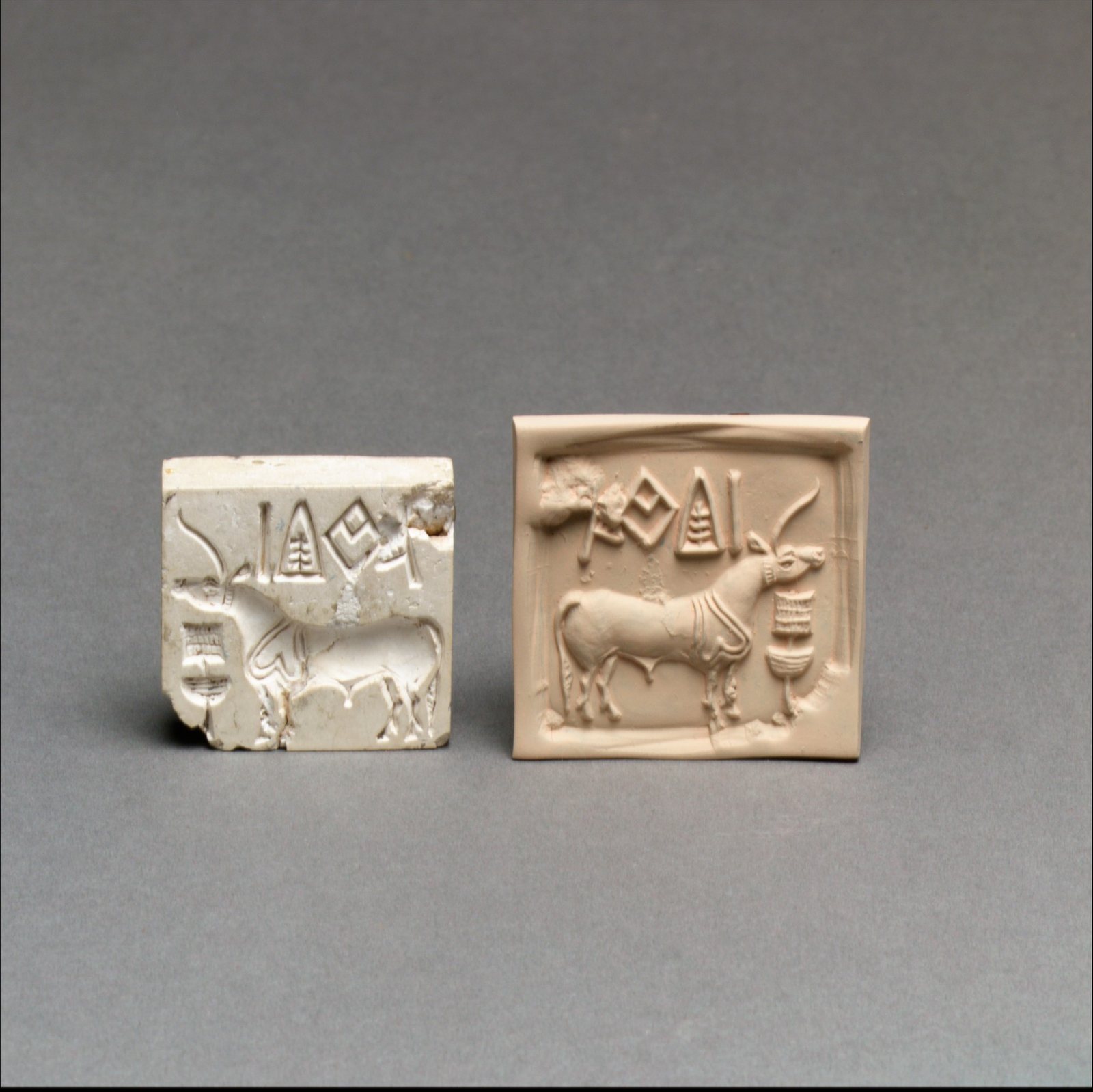
Harappa, on an old course of the Ravi, was one of the great cities of the Indus Valley Civilisation: covered drains, household wells, bricks and weights made to one standard, and a script still unread. After 1900 BCE its cities slowly emptied. No invasion destroyed them.
An Indus stamp seal and its modern impression: the one-horned animal and a line of still-unread signs, c. 2600–1900 BCE. Metropolitan Museum of Art, New York; public domain.Read the article →
c. 1500 BCEThe Rigveda among the rivers
c. 1500 – 1200 BCEOral poets of the Sapta Sindhu
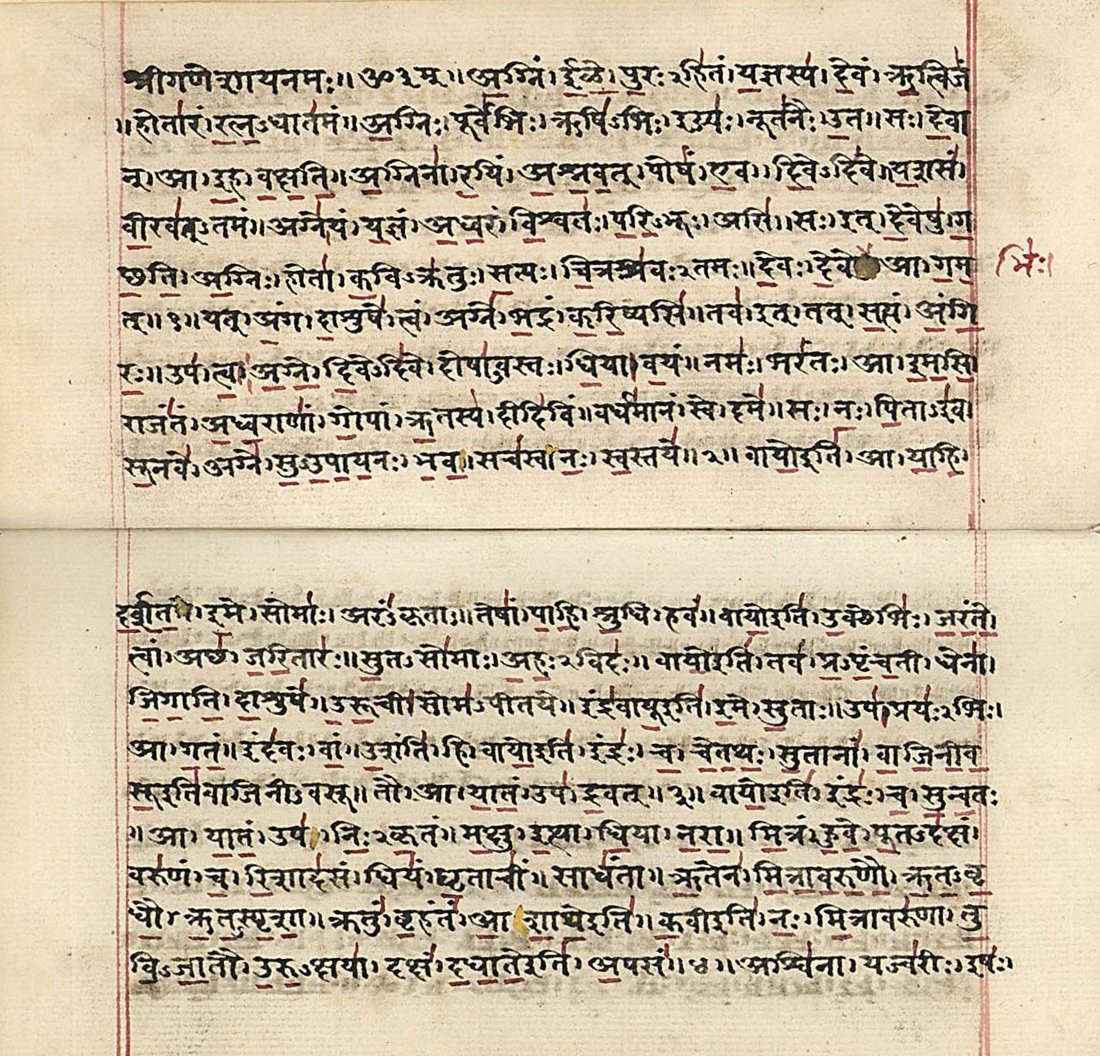
The oldest surviving text of the subcontinent takes shape as oral poetry in the river country its hymns call the Sapta Sindhu, the “seven rivers”. Its verses name waters Punjabis still live beside — the Beas, Sutlej, Ravi, Chenab and Jhelum. It is the first time the land of the five rivers speaks in a voice we can still read.
A page from an early 19th-century Rigveda manuscript — every surviving copy is far younger than the orally transmitted text it preserves.Article coming soon
c. 6th century BCE – 5th century CEthe teachers of Taxila · Jīvaka · Āmbhi
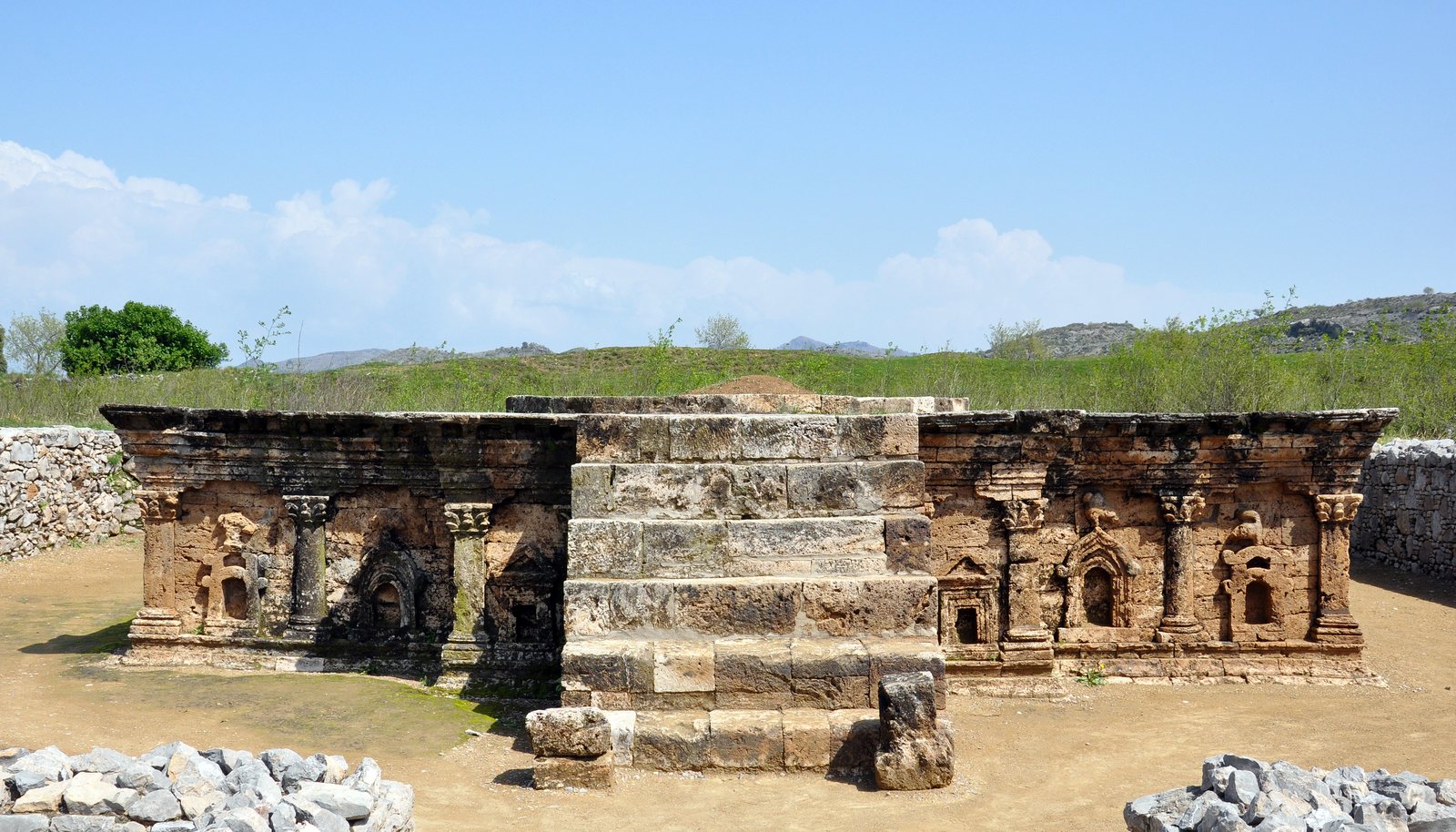
For a thousand years students walked to this valley between the Indus and the Jhelum to learn from its teachers. It was never the “world’s first university” of modern legend, but something older: a city of independent teachers at the crossroads of empires.
The Shrine of the Double-Headed Eagle at Sirkap, Taxila: Greek pediments, curved arches and early Indian gateways side by side. Photograph by Furqanlw, CC BY-SA 4.0, via Wikimedia Commons.Read the article →
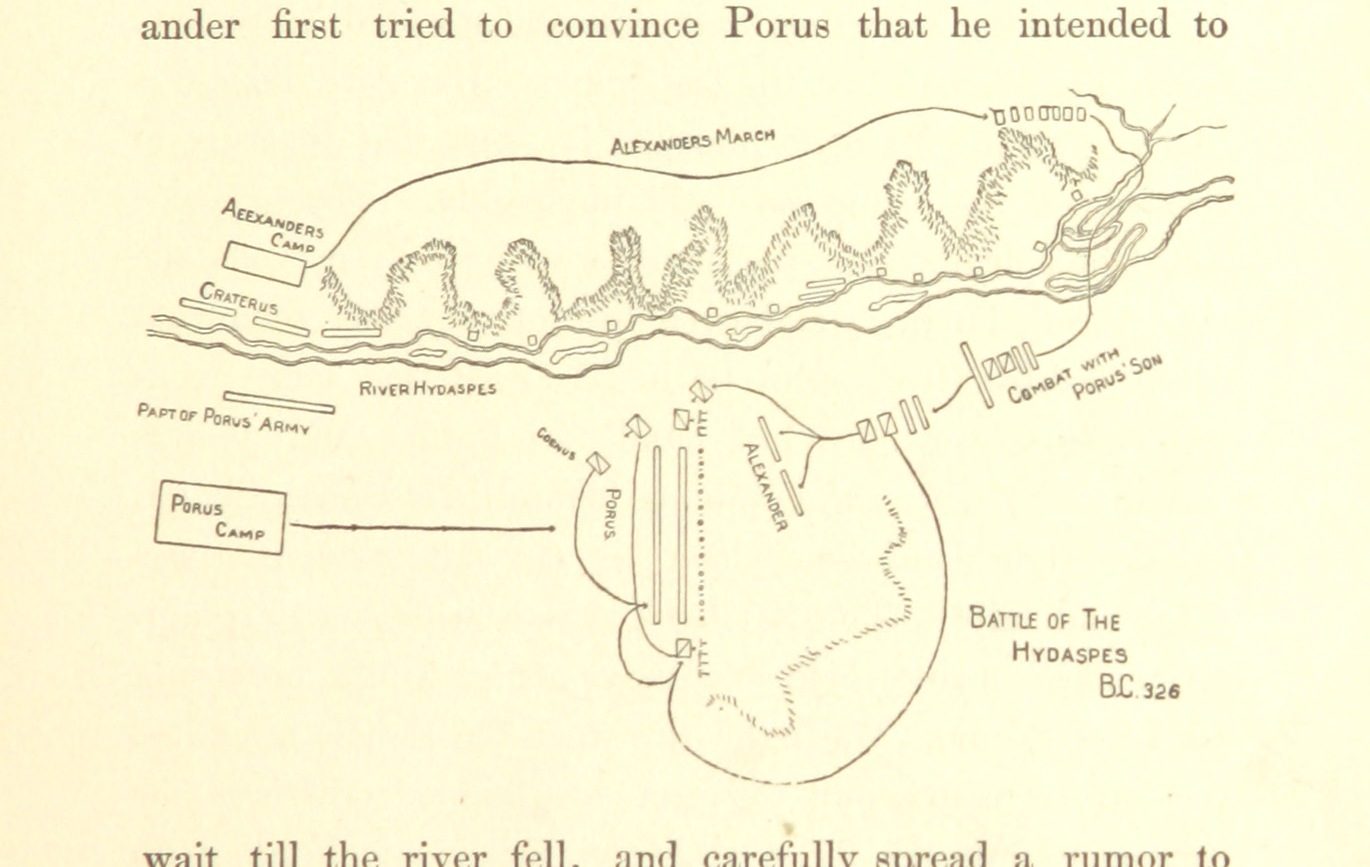
After a stormy night in 326 BCE, Alexander slipped across the flooded Jhelum to fight Porus and his war elephants. Every account we have comes from the winning side.
Porus before Alexander after the Hydaspes — 19th-century engraving.Read the article →
c. 260 BCE – c. 1000 CEAshoka · Menander · Kanishka · Xuanzang
For about a thousand years, stupas and monasteries rise from Taxila to the Yamuna, paid for by Mauryan, Greek, Scythian, Kushan and even Hun kings, and by merchants, monks and laywomen. Buddhism is one of the Punjab's great religions, never its only one. Then the faith thins, its scripts fall silent, and its monuments lose their names.
The Dharmarajika Stupa at Taxila, Punjab, Pakistan. Conventionally dated to the Mauryan period; the standing structure is the result of centuries of rebuilding. Photograph by Mhtoori, CC BY-SA 4.0, via Wikimedia Commons.Read the article →
Medieval Punjab
c. 9th c.The Hindu Shahi kings
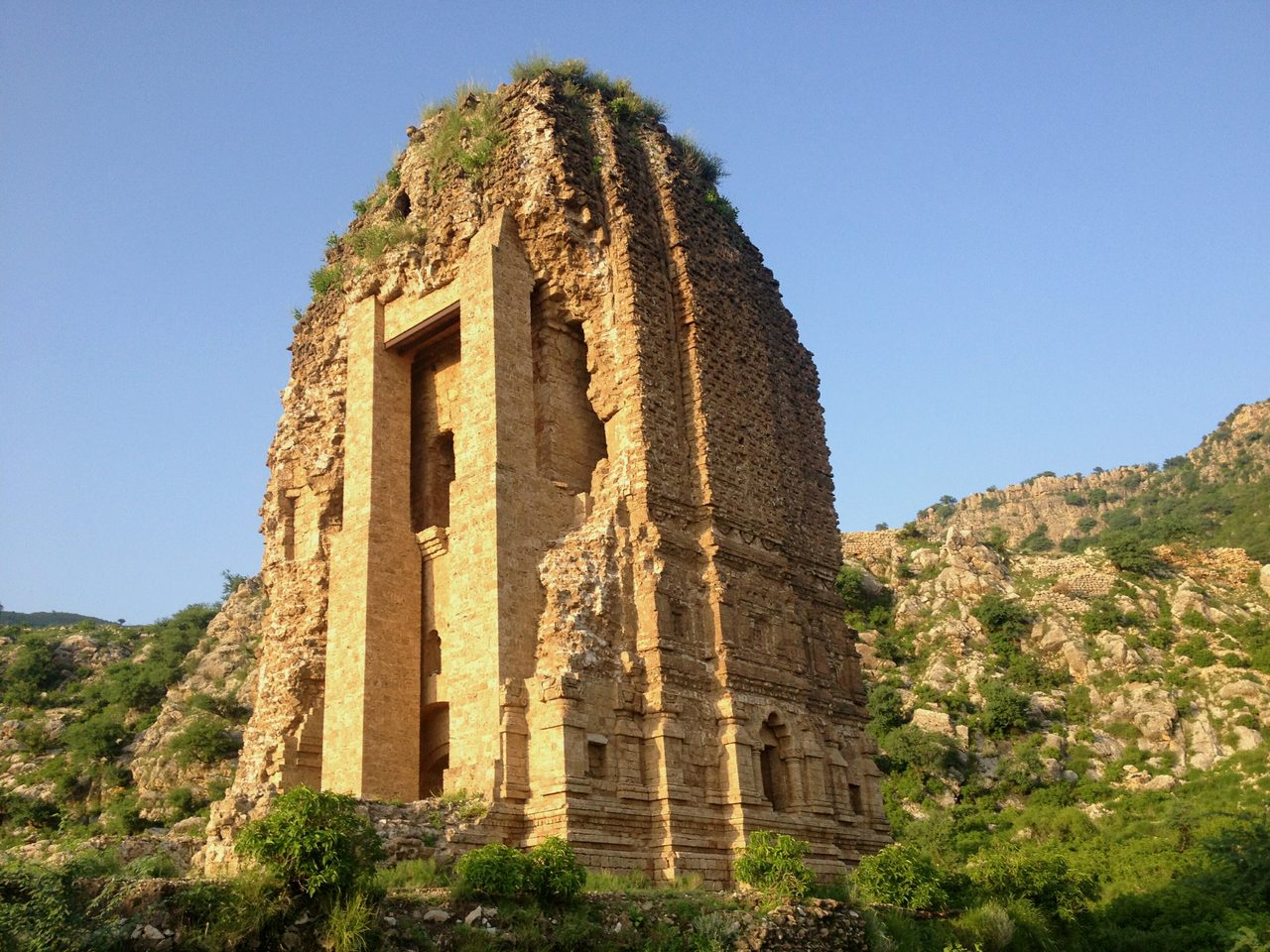
The main temple at Amb, in the Salt Range, Khushab district, Punjab, Pakistan, dated on its style to the Hindu Shahi period, 9th to 10th century. Photograph by Djshaheer, CC BY-SA 4.0, via Wikimedia Commons.Coming soon
1021 – 1186 CEMahmud of Ghazni · Ali Hujwiri · Masʿūd Saʿd Salmān
Mahmud of Ghazni annexes the Punjab plain, and Lahore passes to the Ghaznavids — first as their eastern capital, at the end as their only one. For the first time the city is a seat of power rather than a provincial town. What grows there is Persian-speaking and Punjabi-living: the poet Masʿūd Saʿd Salmān writes here; the Sufi Ali Hujwiri, remembered as Data Ganj Bakhsh, teaches here and is buried here. Islam arrives in Punjab not as an event but as an address.
Silver dirham struck at Mahmudpur — Lahore — AH 418–419 (1027–28 CE). The Islamic declaration of faith appears in Arabic on one face and in Sanskrit, in the Sharada script, on the other. Photograph by CNG Coins, CC BY-SA 3.0, via Wikimedia Commons.Read the article →
c. 1250Baba Farid and the first Punjabi poetry
c. 1188 – 1266 CEFariduddin Masud · Ganj-i-Shakar
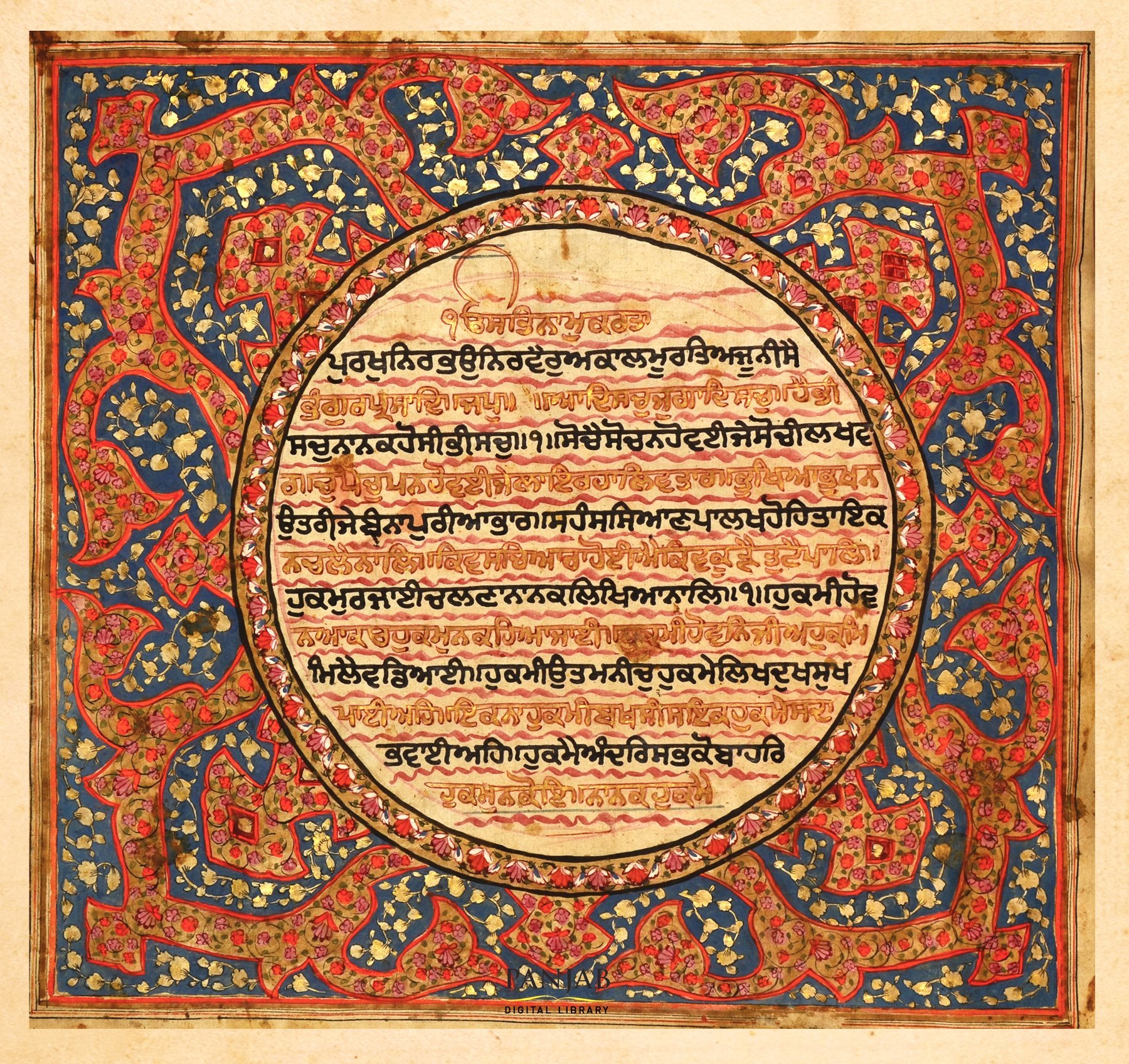
Fariduddin Masud, a Sufi teacher of the Chishti order, settles at Ajodhan on the Sutlej — the town now called Pakpattan. The verses attributed to him are the earliest substantial poetry surviving in the Punjabi language. Three and a half centuries later Guru Arjan gathers them into the Adi Granth, where they are still sung: a Muslim saint becomes one of the founding voices of Punjabi literature, and of Sikh scripture.
An illuminated folio from a 19th-century manuscript of the Guru Granth Sahib — the scripture in which Farid's Punjabi verses are preserved.Article coming soon
c. 1260Multan and the Sufi south
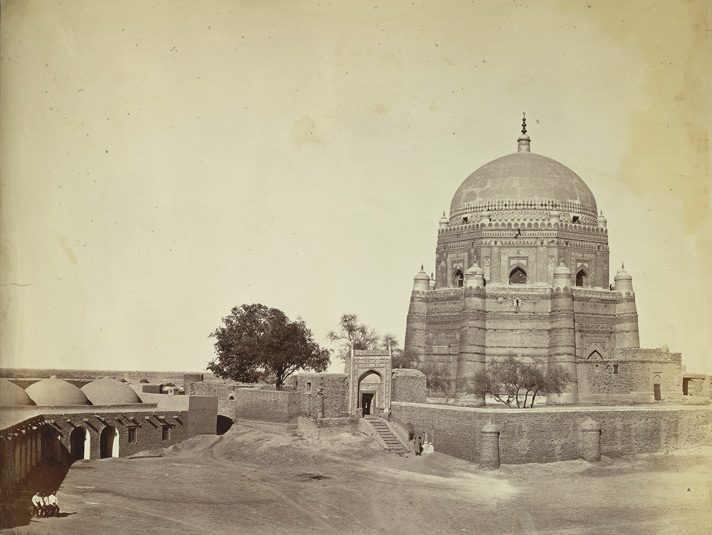
The tomb of Shah Rukn-e-Alam, grandson of Bahauddin Zakariya, at Multan: a fourteenth-century building, photographed in the 1860s. Photograph by William Henry Baker. Public domain, via Wikimedia Commons.Coming soon
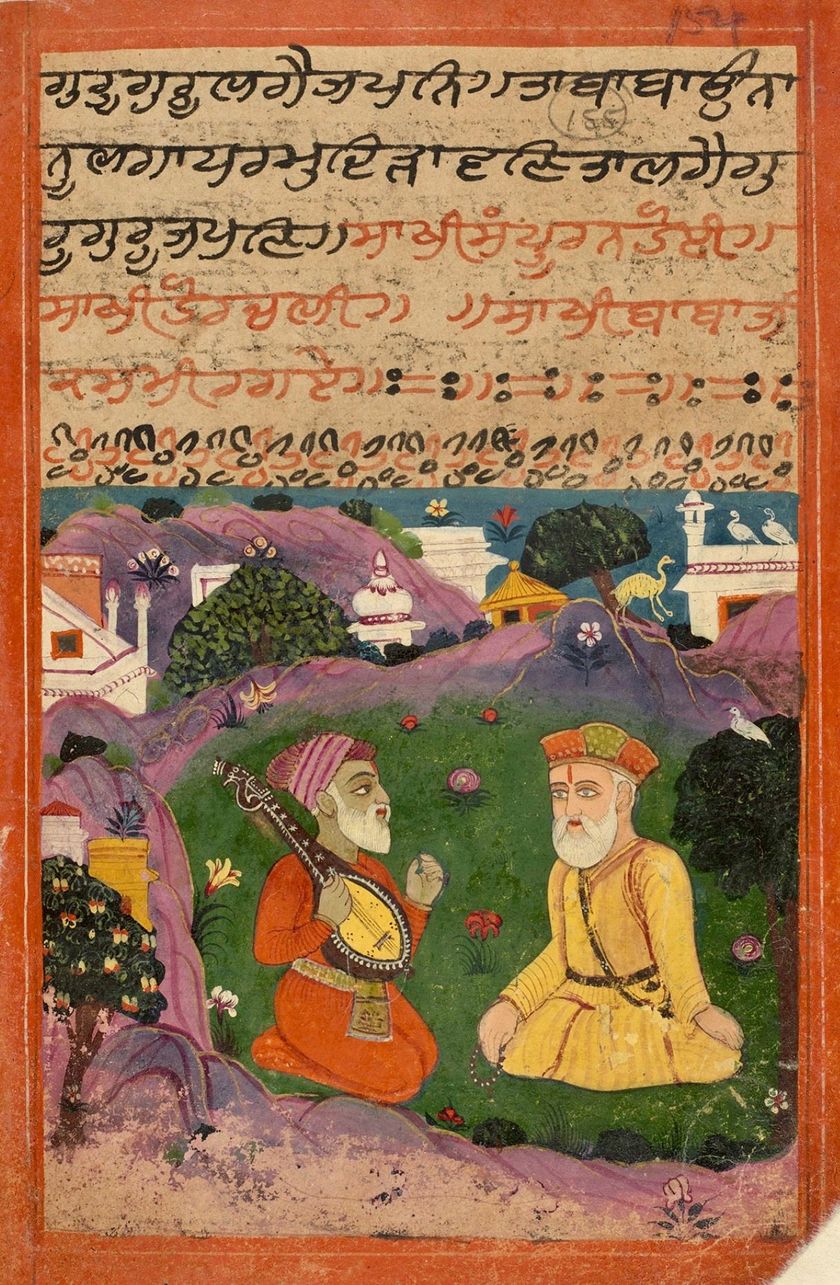
A storekeeper at Sultanpur walks into the Kali Bein and, the tradition says, comes back three days later saying there is no Hindu and no Musalman. What began there took forty years, a Muslim musician and a disciple named Lehna, and its first chapter closed in 1708, when the Guruship passed to a book.
Guru Nanak and Mardana with his rabab, from the B40 janamsakhi, completed in 1733: devotional art, not a likeness. British Library, MS Panj. B 40. Photograph by Ms Sarah Welch, CC BY-SA 4.0, via Wikimedia Commons.Read the article →
c. 1520 – 1539Guru Nanak · Lehna · the first sangat
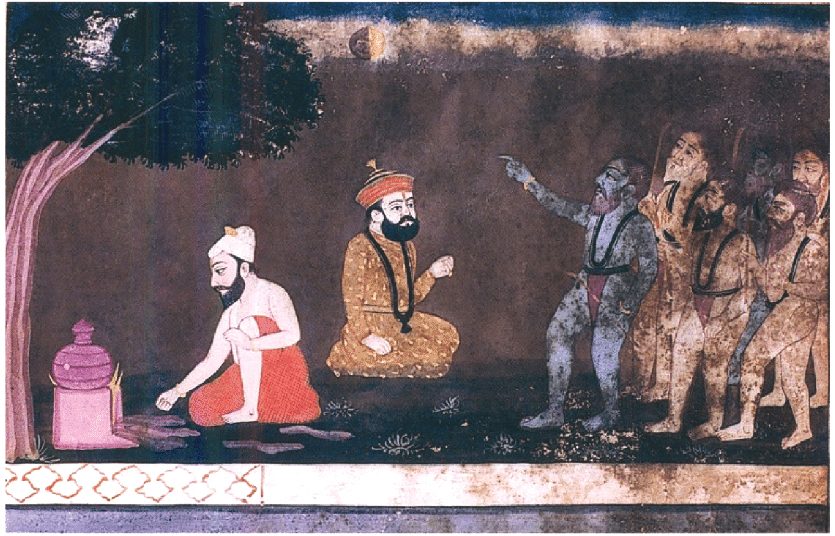
After some twenty years on the road, Guru Nanak put off the traveller’s robe and settled among farmers on the Ravi. At Kartarpur the first settled Sikh community sang, worked and ate together, and there he chose a disciple, Lehna, over his own sons as his successor.
Guru Nanak and the eclipse, a janamsakhi painting: devotional art, made generations after his life.Read the article →
1526The Mughals take Punjab
21 April 1526Babur · Sultan Ibrahim Lodi
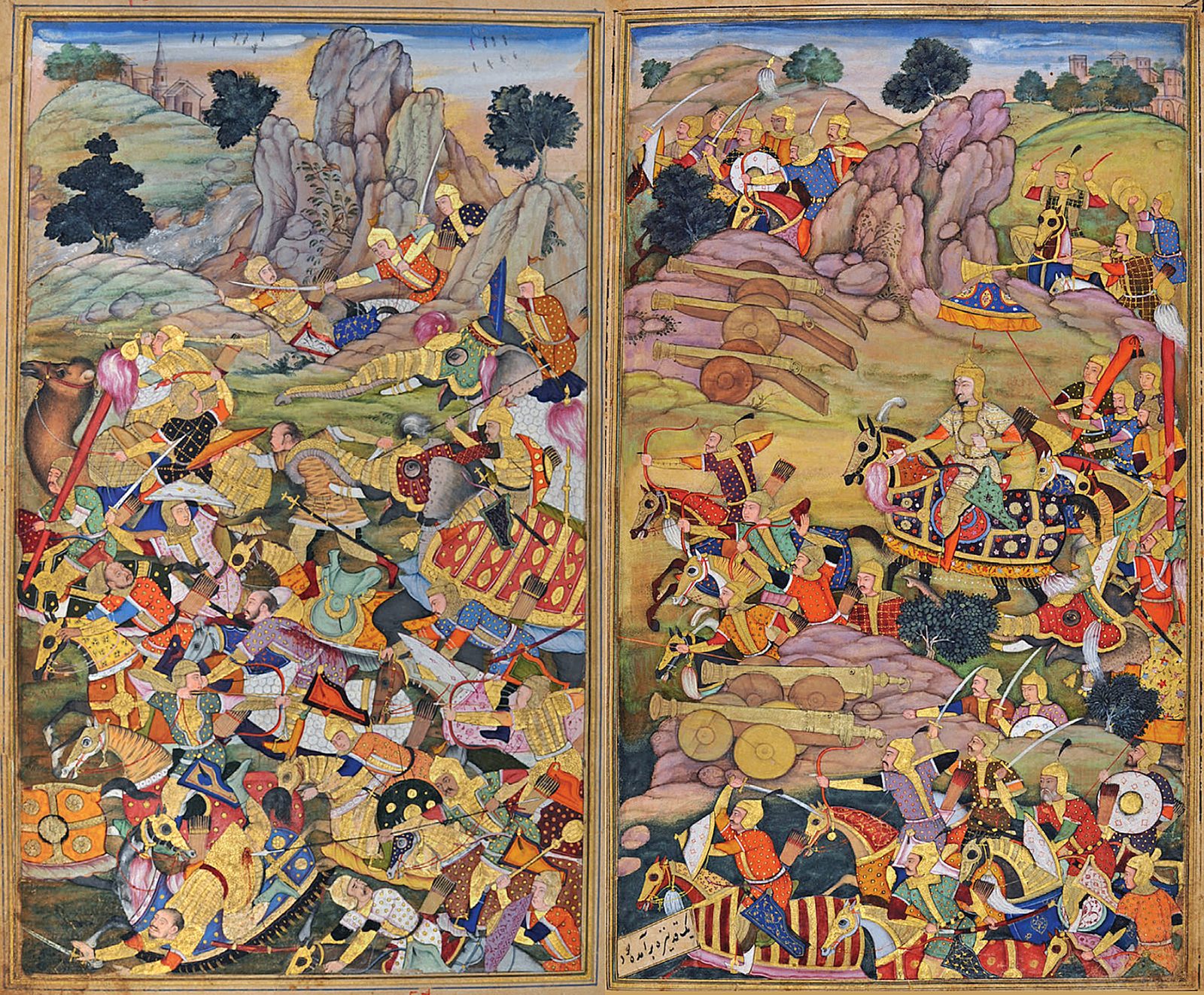
After years of raids across the five rivers, Babur defeats Sultan Ibrahim Lodi at Panipat. Punjab passes into the new Mughal Empire — and Lahore will grow into one of its greatest cities.
The First Battle of Panipat, from a 1598 manuscript of the Baburnama.Article coming soon
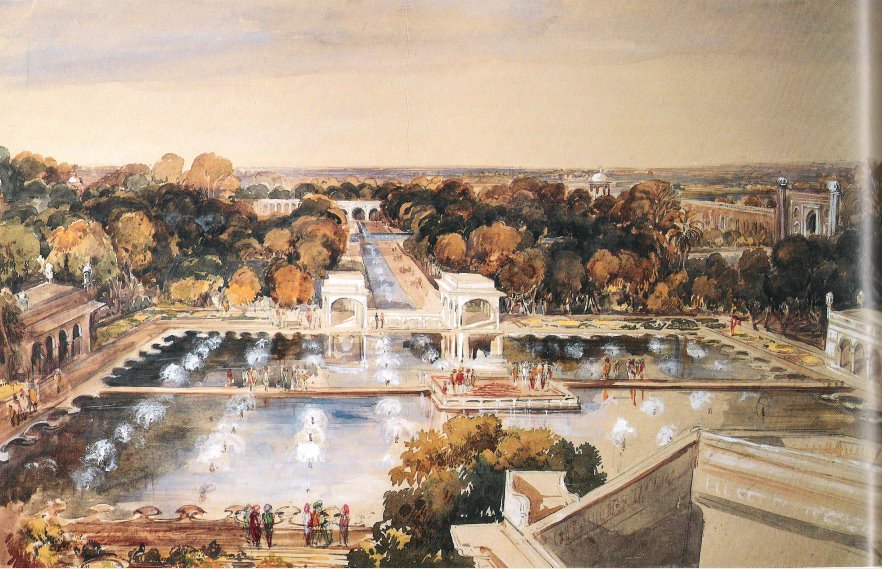
From 1586 to 1598 the emperor Akbar governs the empire from Lahore, and the city enters the greatest building period in its history. The Lahore Fort is rebuilt; the Wazir Khan Mosque is tiled; the Shalimar Gardens are laid out in 1641 as a terraced water-garden, fed — characteristically for Punjab — by canal. Aurangzeb's Badshahi Mosque completes the skyline in 1673.
The Shalimar Gardens at Lahore — watercolour by Charlotte Canning, February 1860.Read the article →
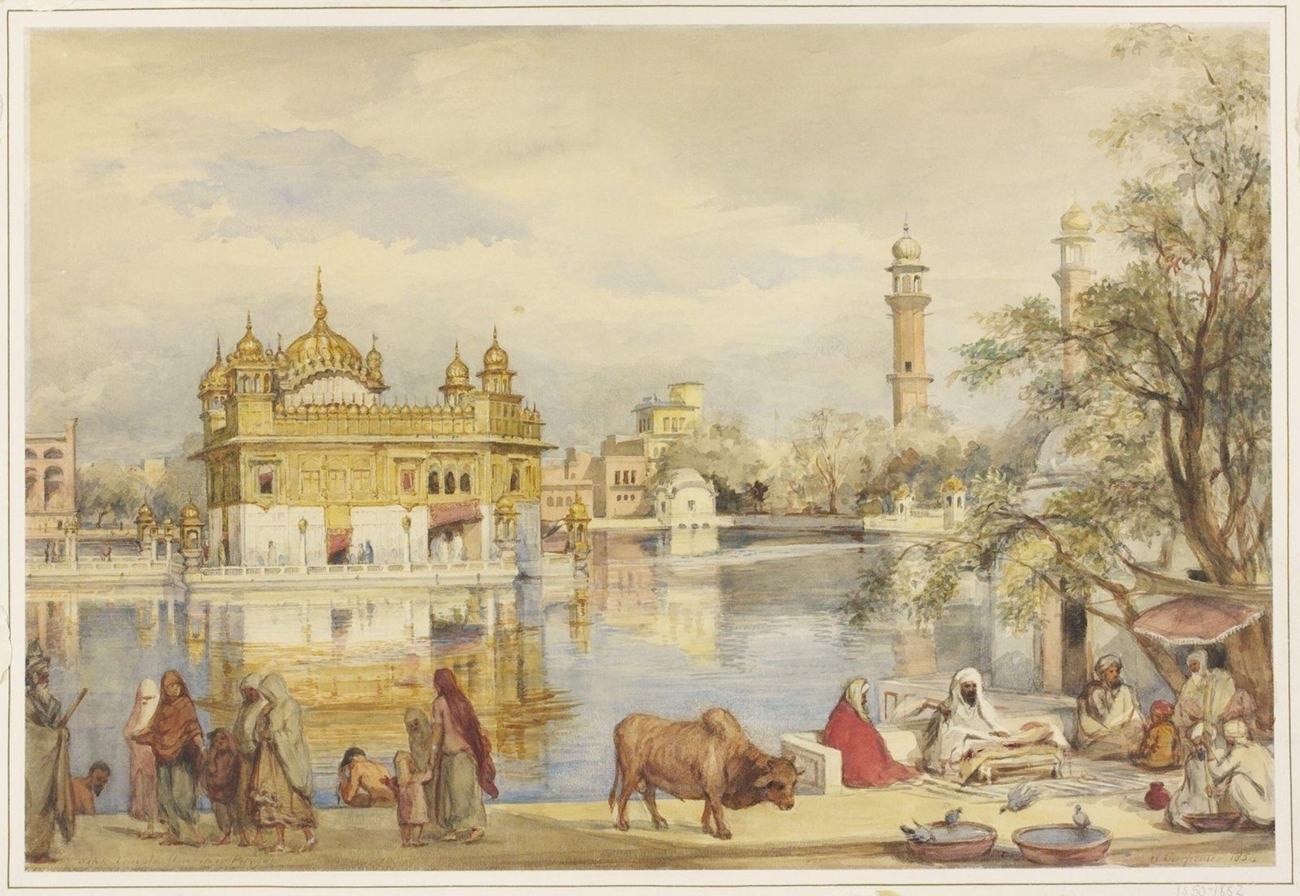
At Ramdaspur, now Amritsar, Guru Arjan and the scribe Bhai Gurdas finish one volume of the Gurus’ hymns, with verses by Hindu and Muslim saints, arranged by musical mode. The manuscript, dated in its own pages to the summer of 1604, survives at Kartarpur, near Jalandhar.
The Harmandir Sahib, watercolour by William Carpenter, 1854.Read the article →
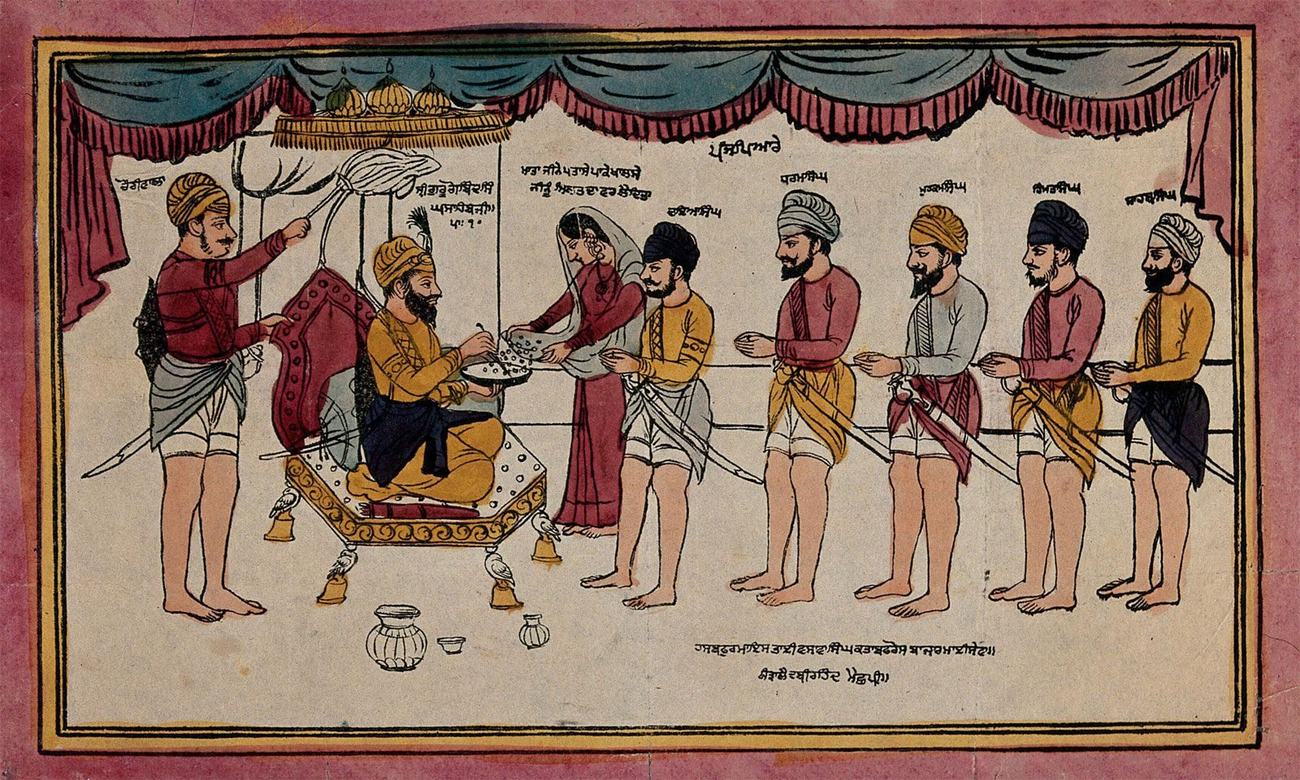
At Anandpur, at Vaisakhi 1699 by the main line of tradition, Guru Gobind Singh initiates the first Sikhs of the Khalsa: drawn from every caste, bound by one rite and one code, and answering to the Guru with no masand in between.
Guru Gobind Singh prepares amrit for the Panj Pyare: a lithograph.Read the article →
Between empires
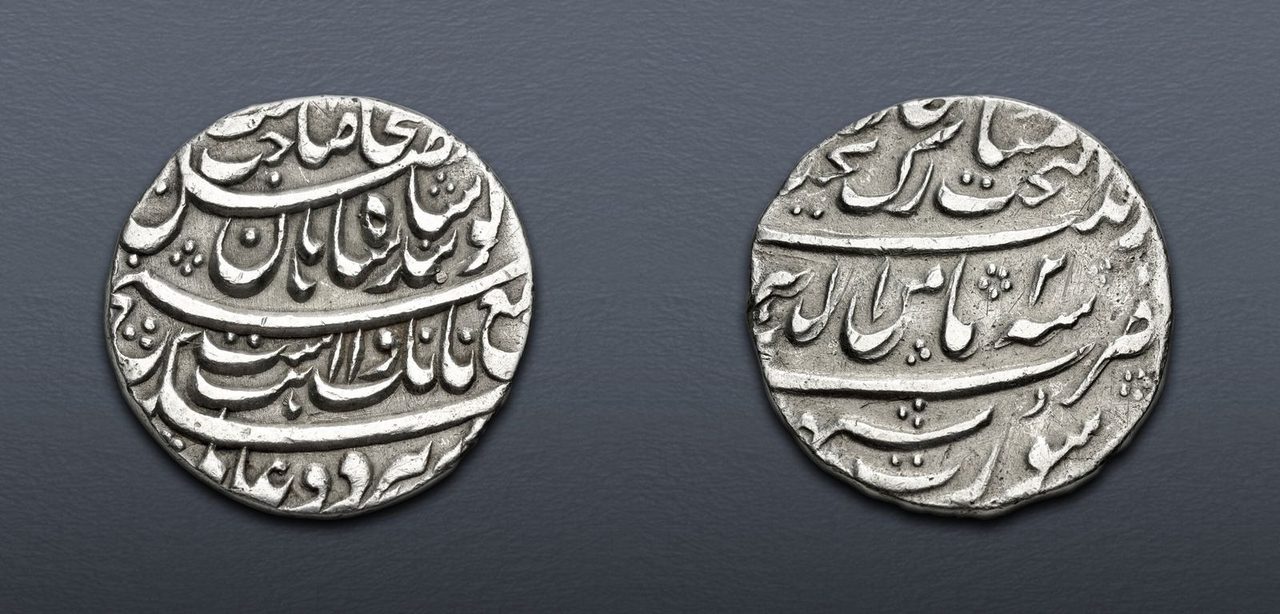
1710Banda Singh Bahadur takes Sirhind
Silver rupee struck under Banda Singh Bahadur in the names of Guru Nanak and Guru Gobind Singh, dated year 2 of his new calendar, 1711 to 1712. Photograph by Classical Numismatic Group, CC BY-SA 2.5, via Wikimedia Commons.Coming soon
1747 – 1799Ahmad Shah Durrani · Jassa Singh Ahluwalia · the Dal Khalsa
Ahmad Shah Durrani invades the subcontinent repeatedly from his new Afghan state, and Punjab is the road he takes every time. Mughal authority in Lahore collapses; the province stops functioning as an administrative unit in 1758. Into that vacuum come the misls — twelve Sikh fighting confederacies, loosely federated as the Dal Khalsa, who hold the countryside, take Lahore in 1765, and strike coin in the name of the Gurus rather than of any king. In 1799 an eighteen-year-old sardar of the Sukerchakia misl takes the city and does not give it back. His name is Ranjit Singh.
Illustrated map of the Lahore Subah, watercolour and ink, c. 1770. Sikh and Afghan cavalrymen are depicted on the same sheet — the two forces contending for Punjab at the time it was drawn. Unknown artist, commissioned by Jean Baptiste Joseph Gentil. Public domain, via Wikimedia Commons.Read the article →
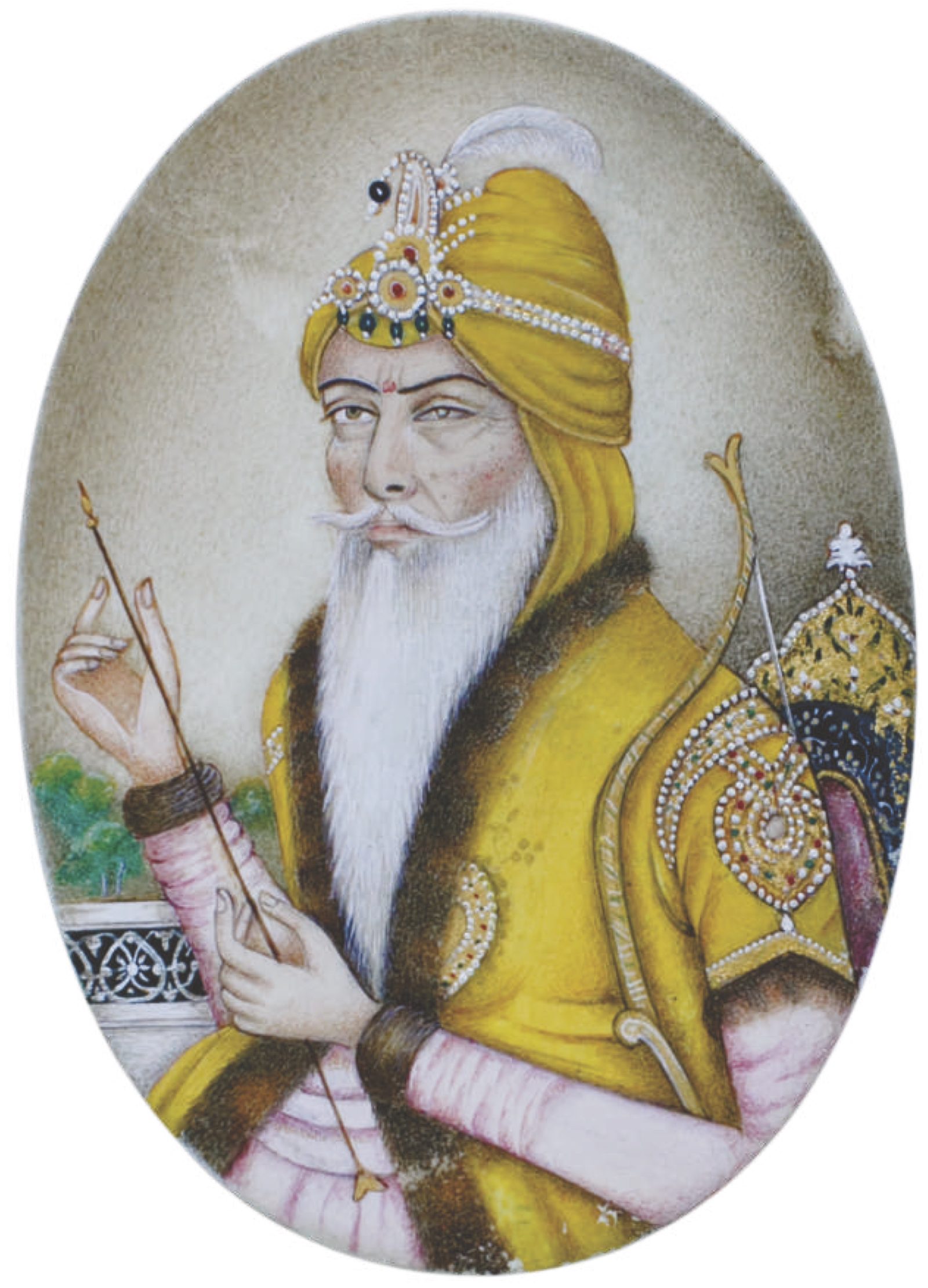
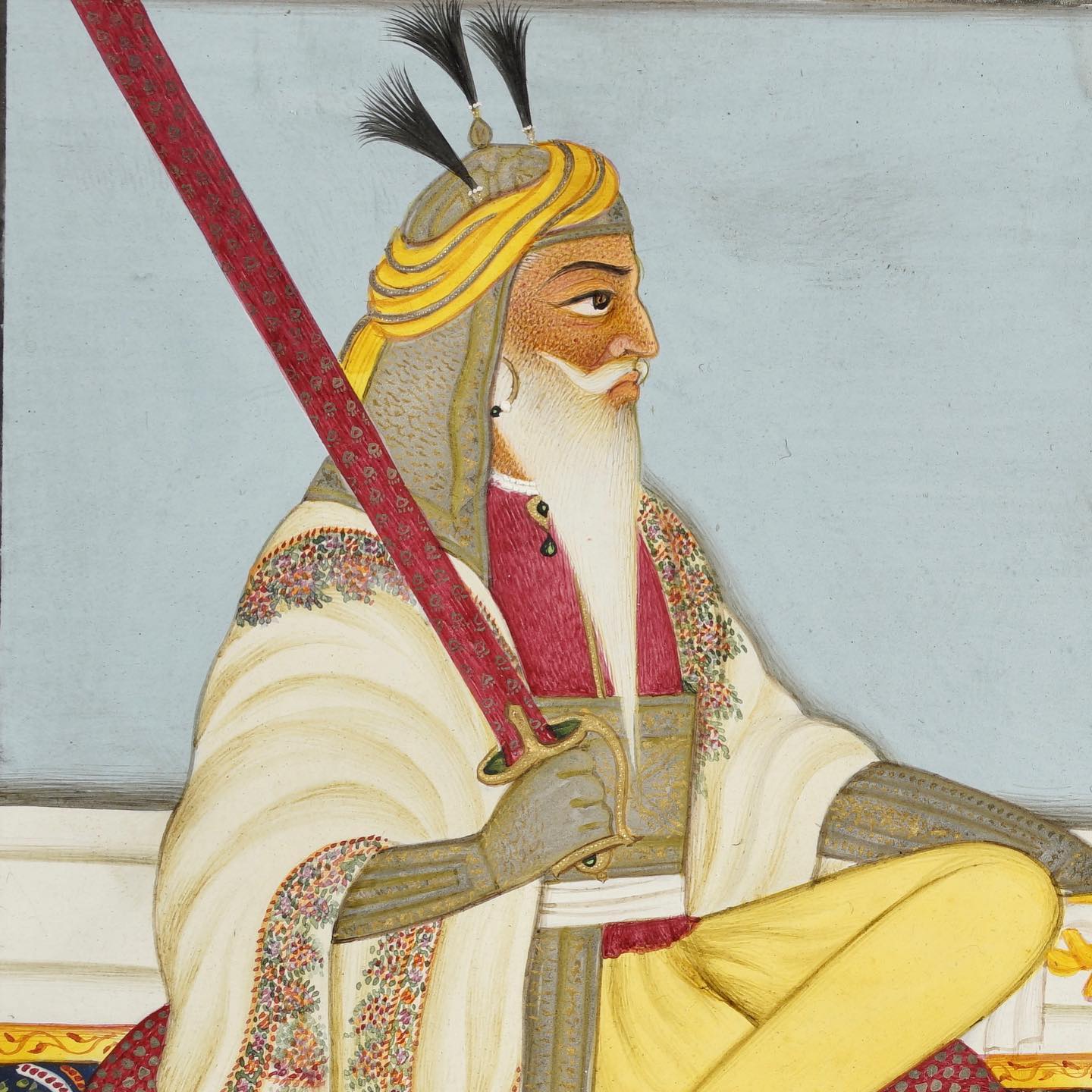
A one-eyed teenager unites the misls and is crowned at Lahore — Punjab's first sovereign empire in centuries, reaching from the Sutlej to the Khyber.
Maharaja Ranjit Singh, painted in miniature on ivory, c. 1850. The painter keeps what court flattery usually removed: the smallpox scars, and the eye he lost to the same illness as a child. Unknown artist, public domain, via Wikimedia Commons.Read the article →
Ranjit Singh's frontier general dies at Jamrud, at the mouth of the Khyber. The fort holds, and his name passes into Punjabi ballads and Pashtun warnings.
Hari Singh Nalwa, painted at Lahore by Hasan al-Din, c. 1845 to 1850, within a decade of his death at Jamrud. Public domain, via Wikimedia Commons.Read the article →
29 March 1849Maharaja Duleep Singh · the East India Company
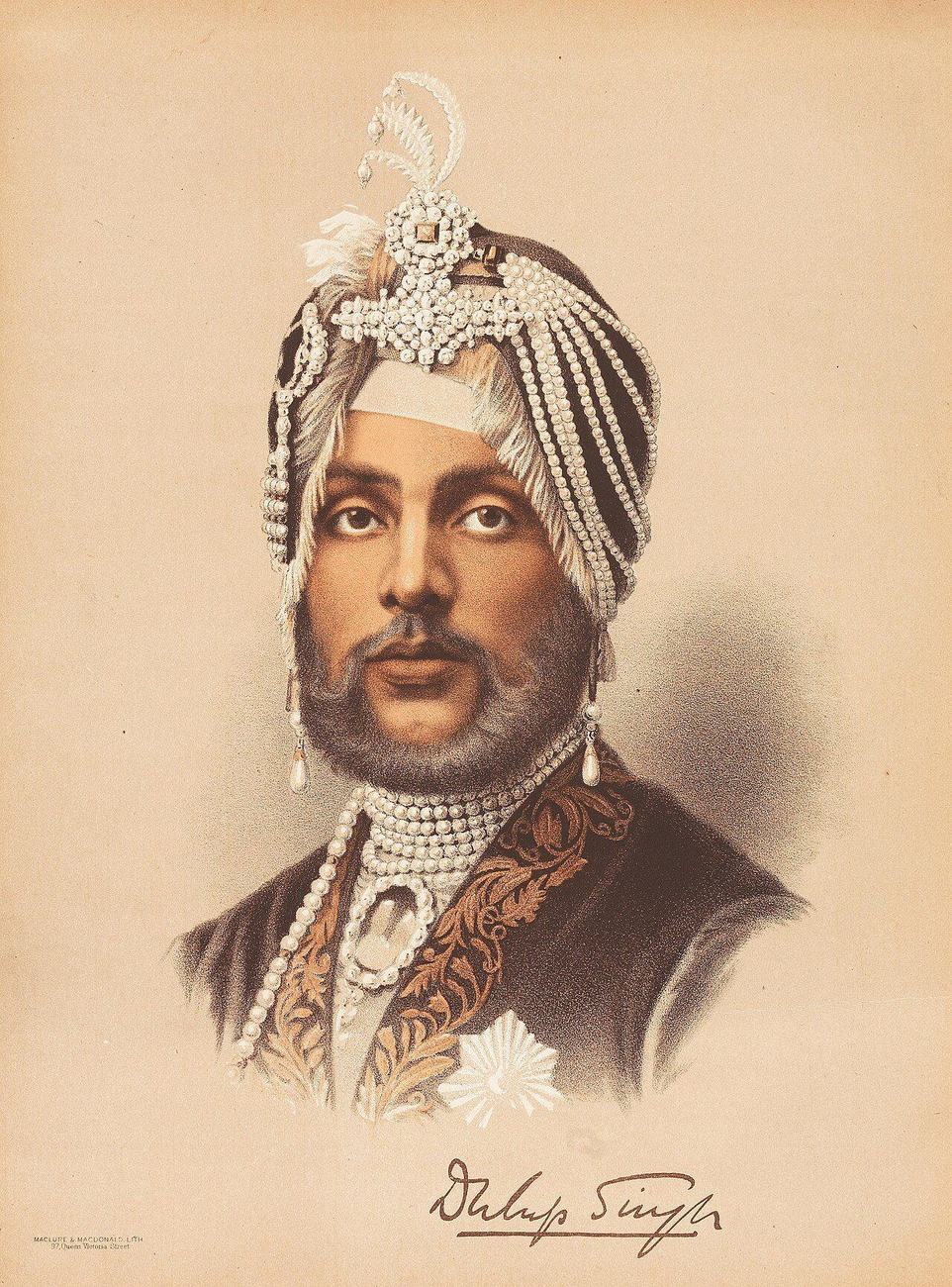
After two wars with the East India Company, the ten-year-old Maharaja Duleep Singh signs away his kingdom, and the Koh-i-Noor, in the fort at Lahore on 29 March 1849. It is the last major kingdom on the subcontinent that the Company takes by war. Punjab is ruled as a British province until it is divided in 1947.
Maharaja Duleep Singh, chromolithograph, c. 1859: deposed at ten, and exiled.Read the article →
1870sThe reform movements
Coming soon
c. 1885The canal colonies remake the land
c. 1885 – 1940The British administration · the settlers of the bars
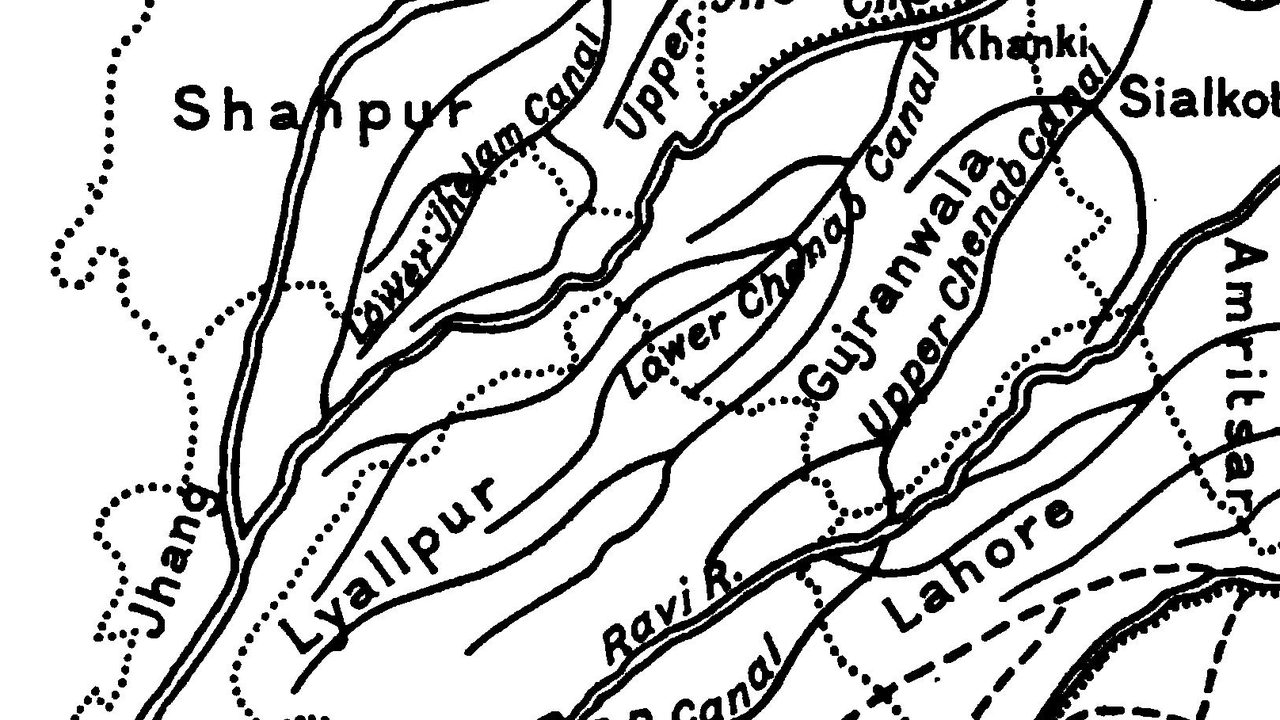
The British administration builds what was then the largest irrigation network on earth, diverting the five rivers through headworks and canals into the bars — the dry scrub plains between the rivers. Nine canal colonies are settled; millions of acres of grazing land become wheat and cotton. New towns are laid out on a grid where there had been nothing — Lyallpur, Sargodha, Montgomery. This is the century in which Punjab becomes “the breadbasket”, and the century in which who owned the land was decided.
The canals of the western Punjab: the Lower Jhelum, Lower Chenab and Upper Chenab, the headworks at Khanki, and Lyallpur, now Faisalabad, built as the capital of the Chenab Colony. Fig. 46 of Sir James Douie's The Panjab, North-West Frontier Province and Kashmir (Cambridge, 1916). Public domain, via the Internet Archive.Article coming soon
1897The Battle of Saragarhi
12 September 1897Havildar Ishar Singh · the 36th Sikhs
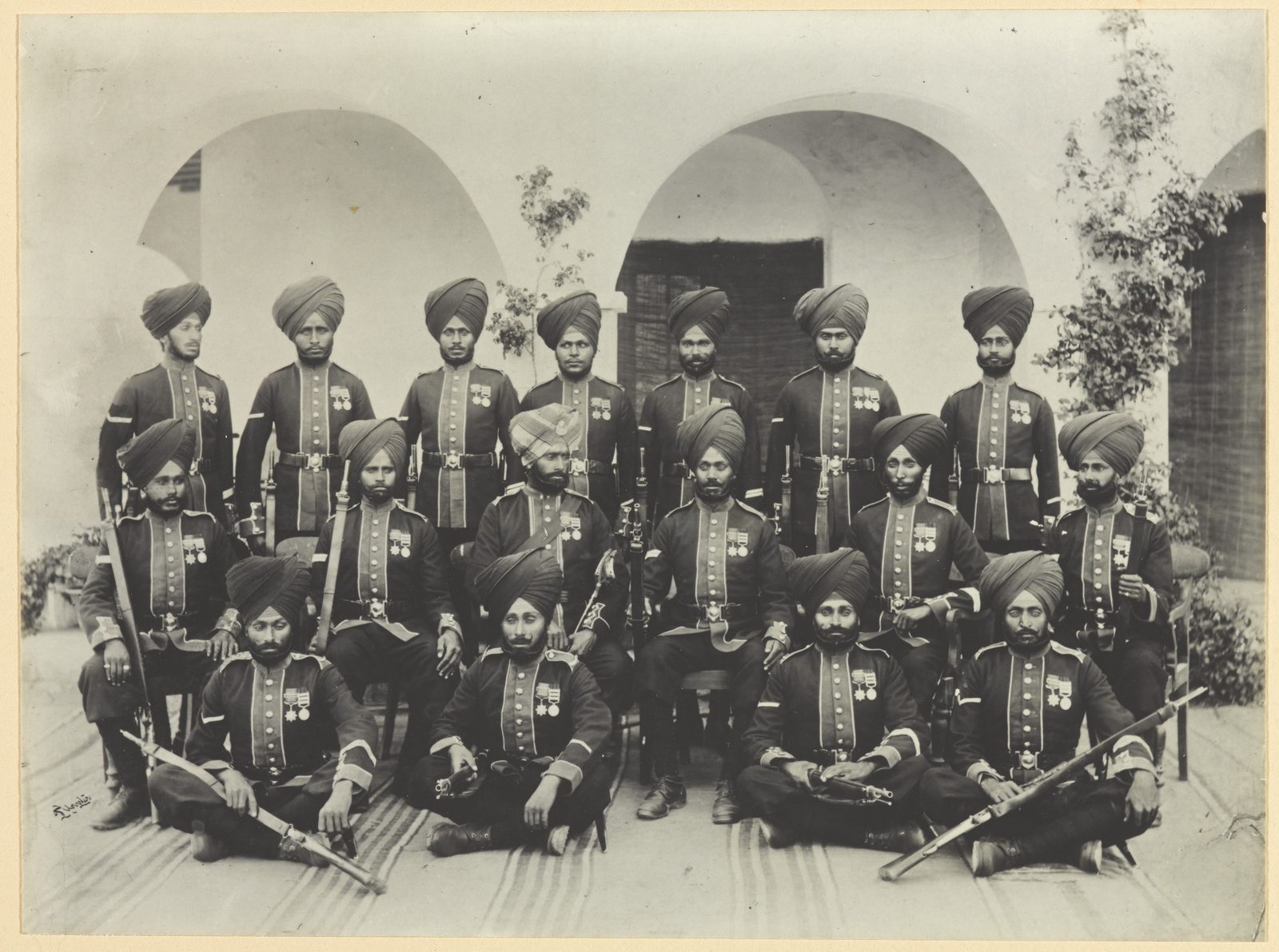
Twenty-one soldiers hold a signalling post on the Samana Range against thousands of Orakzai and Afridi tribesmen, fighting to the last man — commemorated every 12 September as Saragarhi Day.
Men of the 36th Sikhs, photographed in 1897 — the year of Saragarhi.Article coming soon
1914Ghadar and the Komagata Maru
1913 – 1914 CEGurdit Singh · the Ghadar Party · 376 passengers
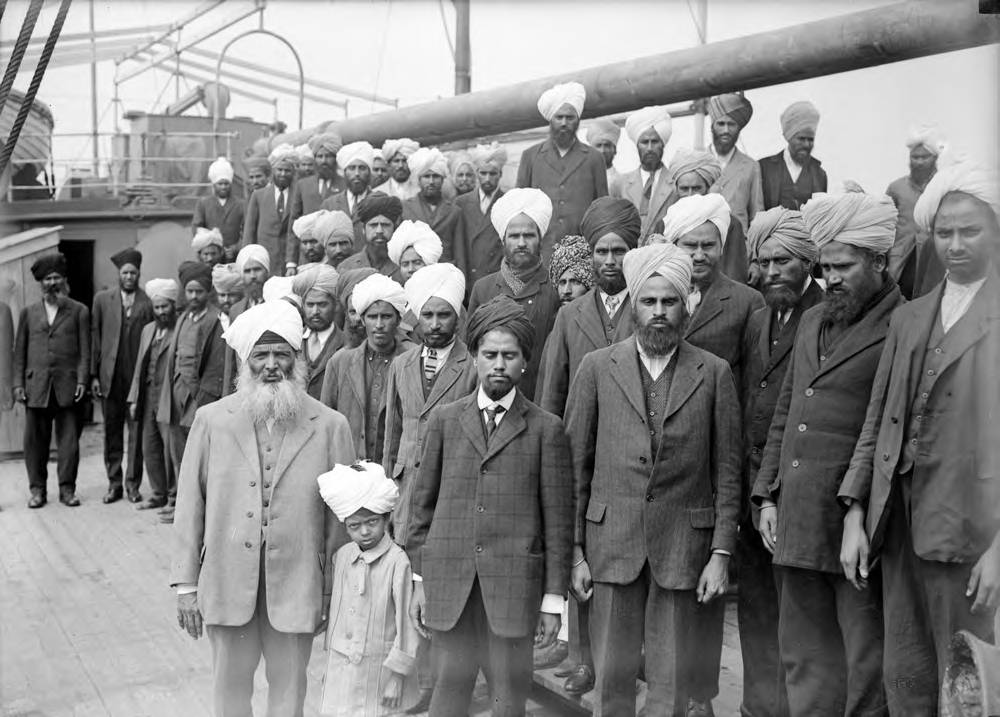
Punjabi migrants on the Pacific coast of North America found the Ghadar (“revolt” or “mutiny”) Party in 1913, printing a paper that calls openly for the end of British rule. In 1914 Gurdit Singh charters a steamship, the Komagata Maru, to carry 376 passengers from Hong Kong to Vancouver, nearly all from Punjab, mostly Sikhs with Muslims and a few Hindus, every one a British subject. The voyage tests a Canadian law written to keep them out without naming race. The ship is held in the harbour for two months and turned away, and for three decades more the doors of the West stay mostly shut.
Vaisakhi, 13 April 1919Brigadier-General Dyer · the people of Amritsar
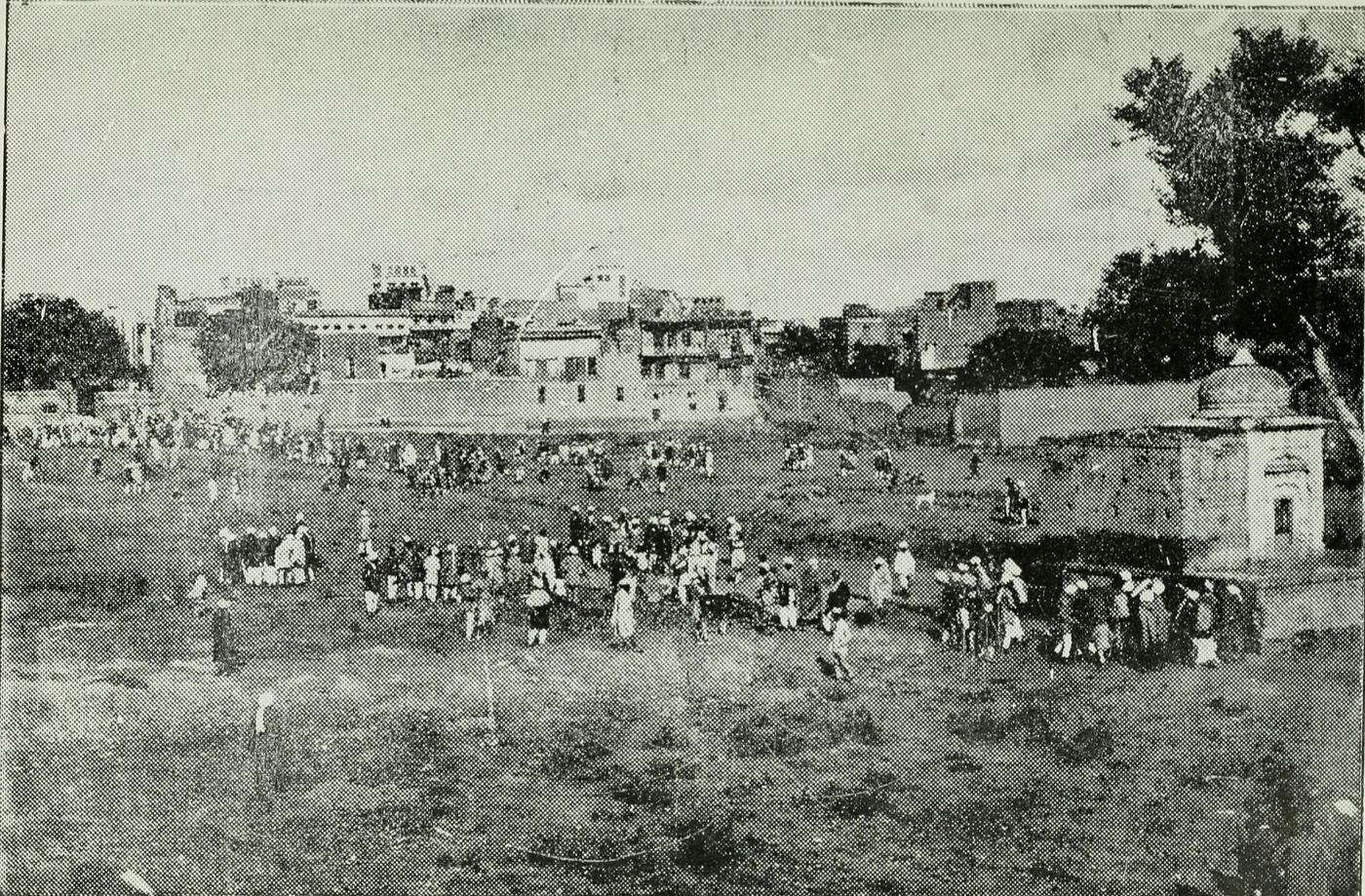
Vaisakhi, 13 April 1919: troops under Brigadier-General Dyer fire without warning into a crowd in Amritsar's Jallianwala Bagh for about ten minutes. The government counted 379 dead; the Congress inquiry put it at about 1,000. The massacre ends Gandhi's co-operation with British rule.
The Jallianwala Bagh within a year of the massacre, from the Congress inquiry's report (1920).Read the article →
1920The gurdwara reform movement
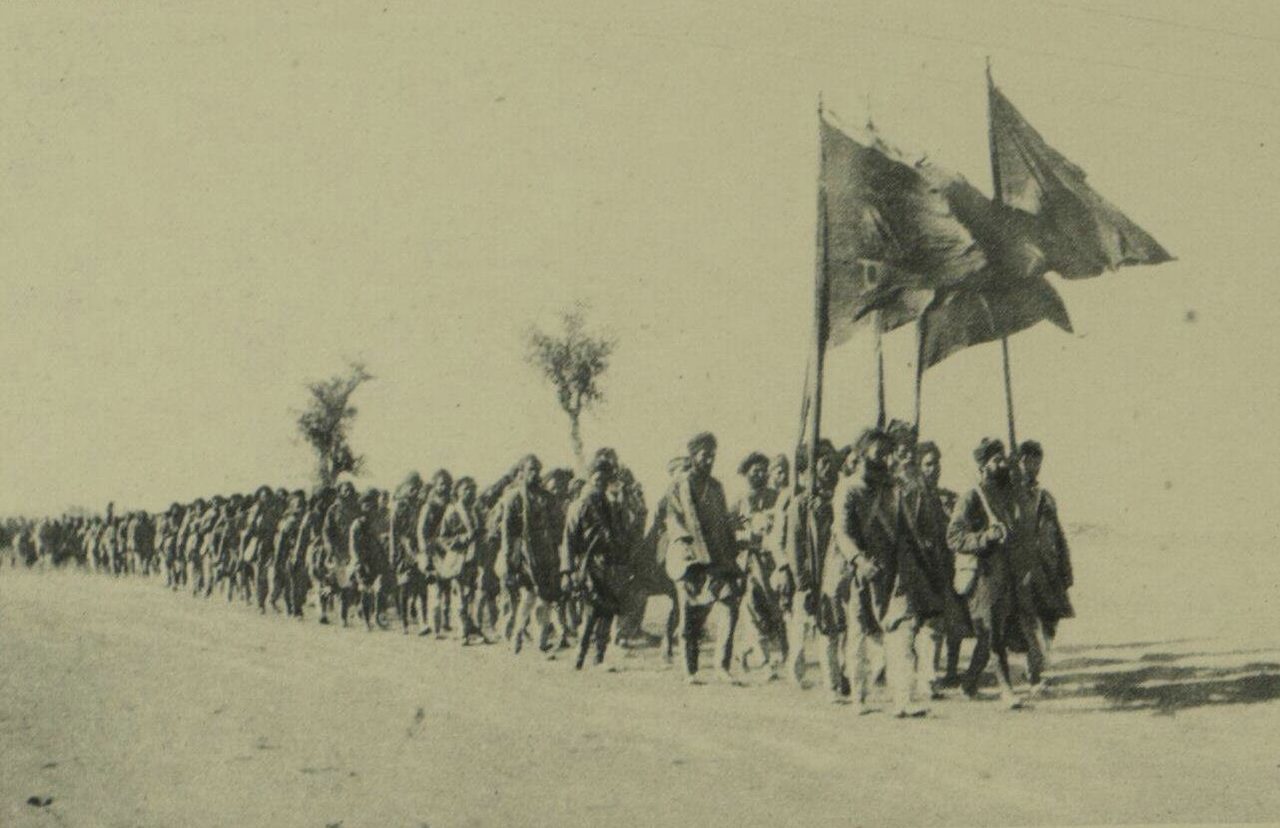
A jatha of Akali volunteers marches behind its banners at Jaito, in Nabha State, during the Jaito morcha of 1924. Special Press photograph, published in The Illustrated London News, 16 August 1924. Public domain, via Wikimedia Commons.Coming soon
1931Bhagat Singh at Lahore
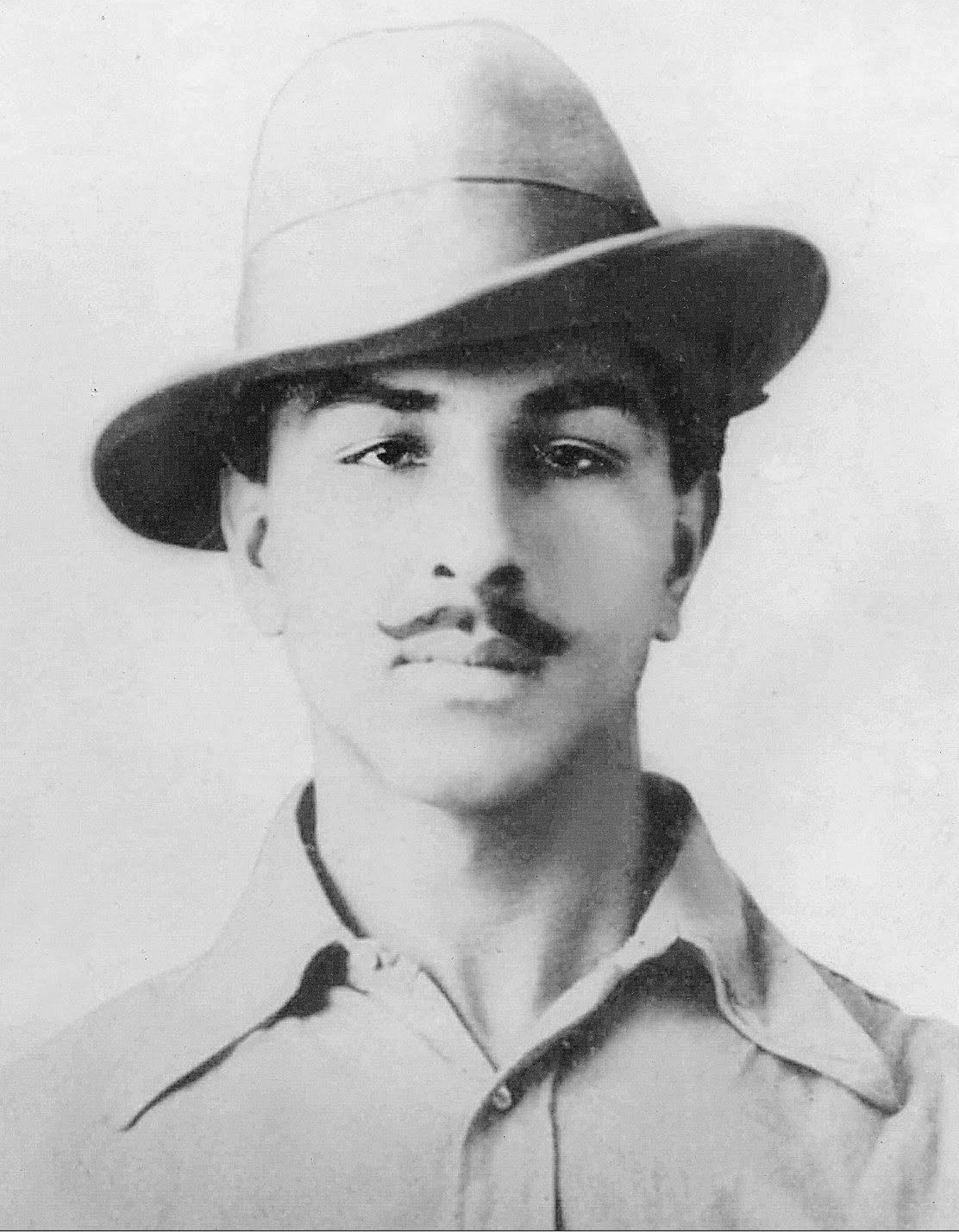
Bhagat Singh, photographed in Delhi in April 1929. Attributed to Ramnath Photographers, Delhi. Public domain, via Wikimedia Commons.Coming soon
1940The Lahore Resolution
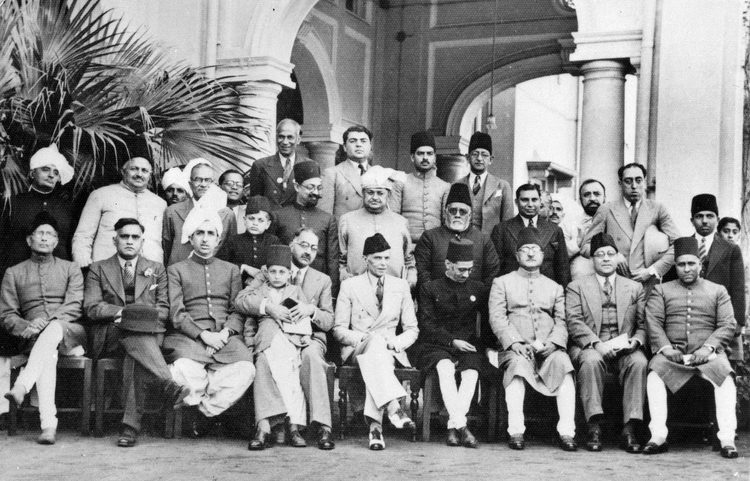
Muslim League leaders after a dinner at the house of Mian Bashir Ahmad in Lahore, 1940, with Muhammad Ali Jinnah seated at the centre. Unknown photographer, British Library Photo 429/(6). Public domain, via Wikimedia Commons.Coming soon
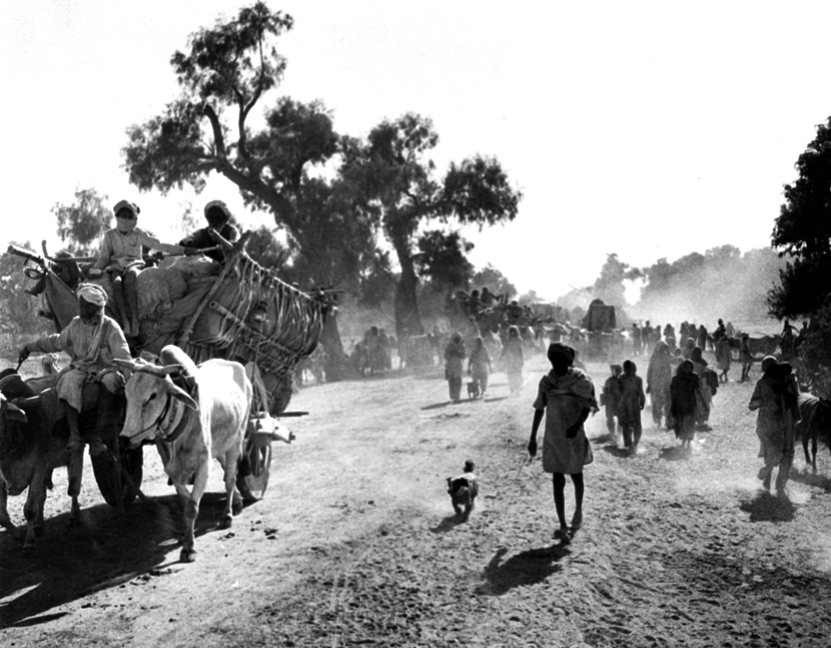
The province is cut in two along the Radcliffe Line, published two days after independence. Between eight and ten million people cross the new border in Punjab, in both directions, and estimates of the dead run from about two hundred thousand to a million and more.
Refugees on the road at Balloki Headworks on the Ravi, south-west of Lahore, 1947. Photo Division, Government of India. Public domain, via Wikimedia Commons.Read the article →
c. 1950 – 1980The Doaba · the Jhelum–Gujrat belt · Mirpur
Within a generation of Partition, Punjabis from both sides of the new border are leaving for Britain, Canada, the United States and the Gulf, and chain migration turns a few pioneers into what scholars call a third Punjab.
Platform signage at Southall station, west London, 2008. The station name appears in English and in Gurmukhi. Photograph by Sunil060902, CC BY-SA 3.0, via Wikimedia Commons.Read the article →
c. 1965The Green Revolution
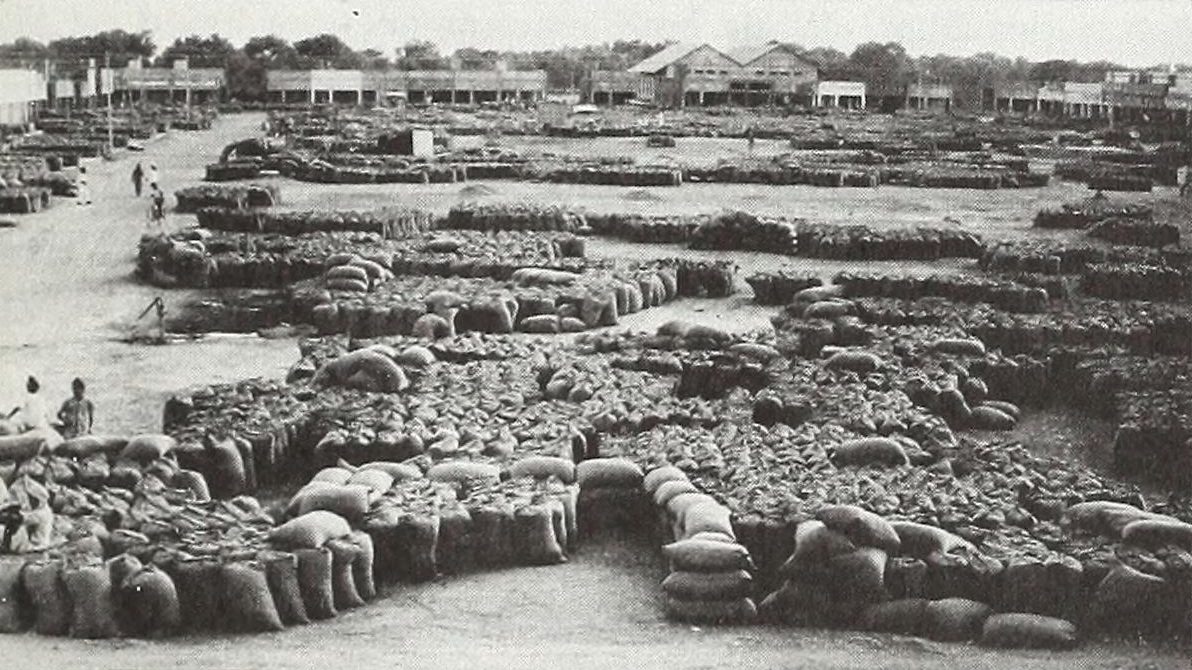
Bagged wheat in the grain market at Ludhiana, Punjab, 1969. Foreign Agriculture, US Department of Agriculture, 16 June 1969. Public domain, via the Internet Archive.Coming soon
1966Indian Punjab is reorganised
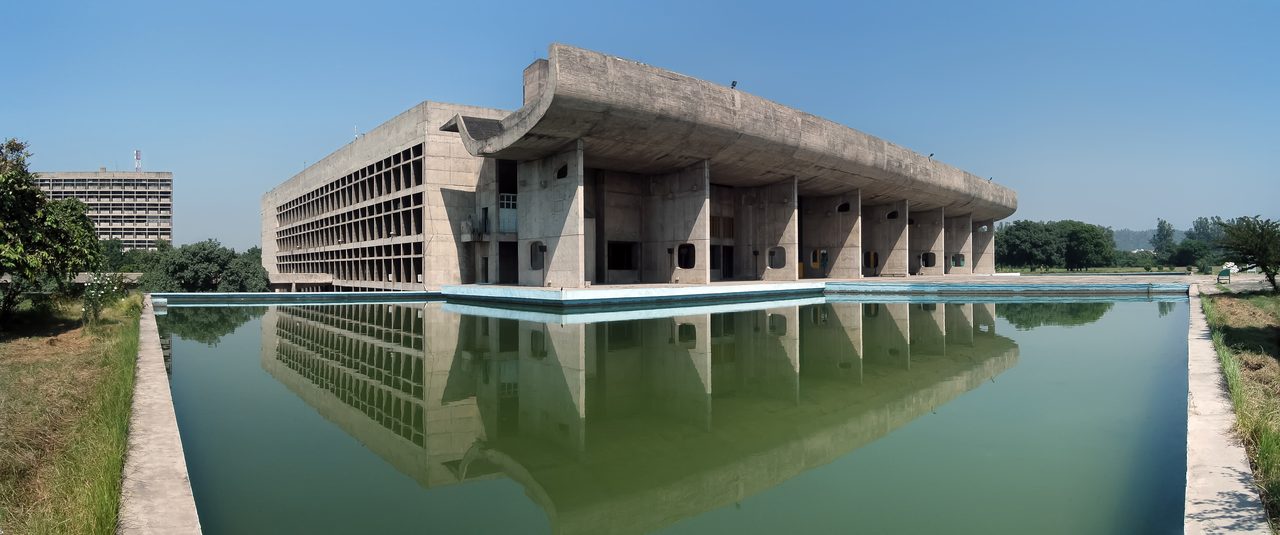
The Palace of Assembly at Chandigarh, designed by Le Corbusier for the Punjab legislature, photographed in 2006. Chandigarh became a union territory in 1966, and the building now houses the assemblies of both Punjab and Haryana. Photograph by duncid, CC BY-SA 2.0, via Wikimedia Commons.Coming soon
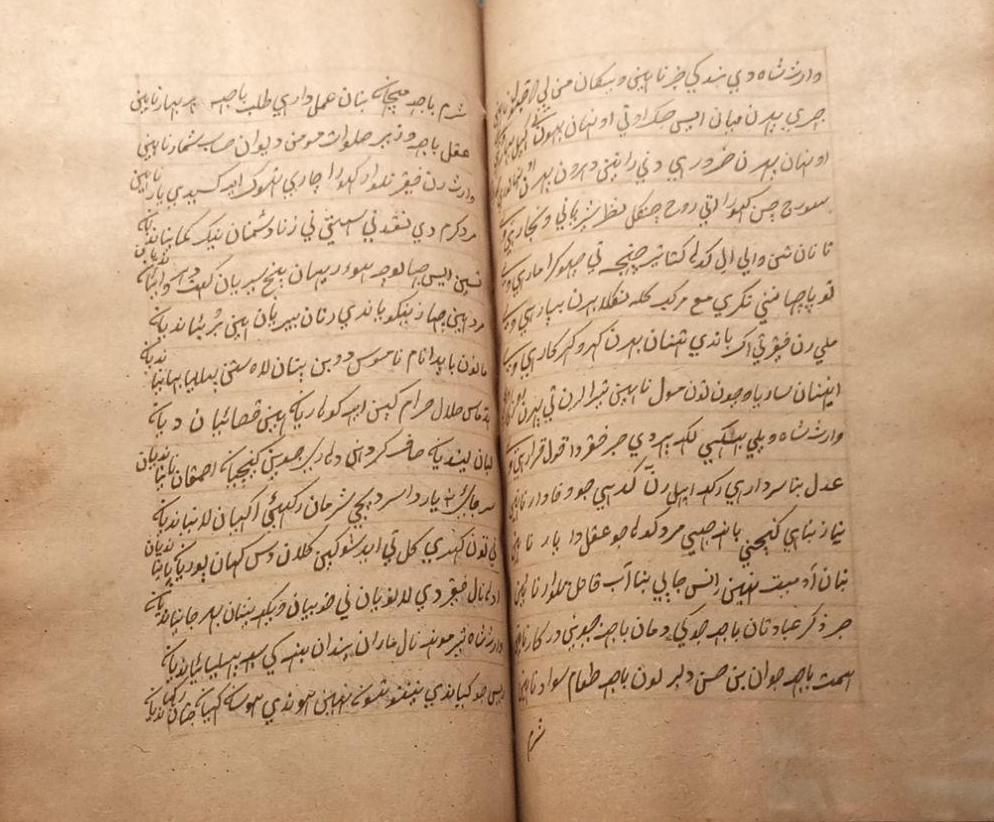
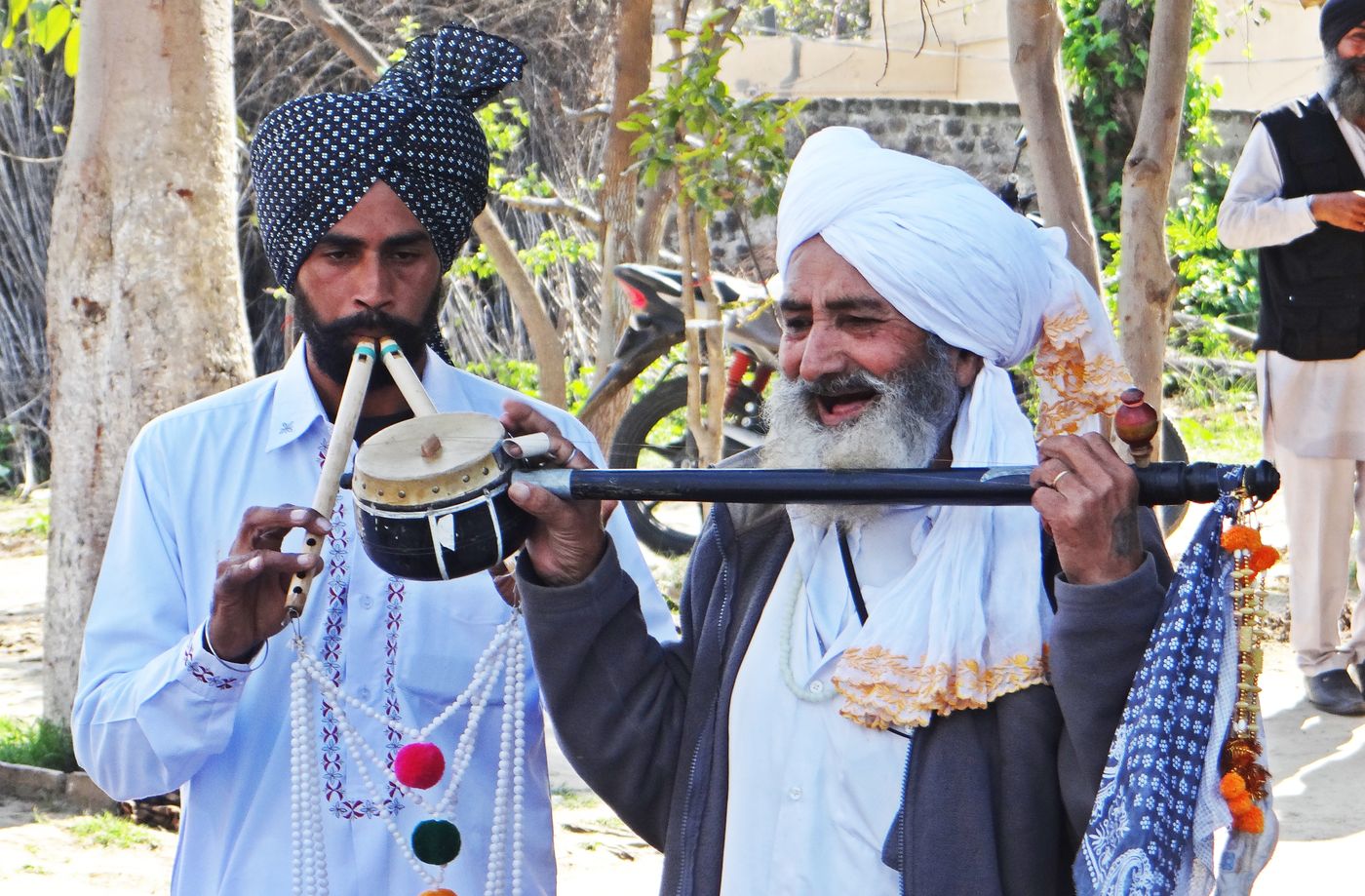
A village singer's son, born Latif Mohammad, sings Punjab's great legends as kaliyan with the writer Dev Tharike Wala, and Tere Tille Ton, his song of Ranjha at the jogis' hill, makes him Kaliyan da Badshah.
Folk singers with a toomba and an algoza at the Jarg mela, Ludhiana district, 2015. Photograph by Ravideep1971, CC BY-SA 4.0, cropped, via Wikimedia Commons.Read the article →
1984The assault on the Golden Temple, and the anti-Sikh massacre
Coming soon
The river keeps rising. Events marked coming soon are on their way.