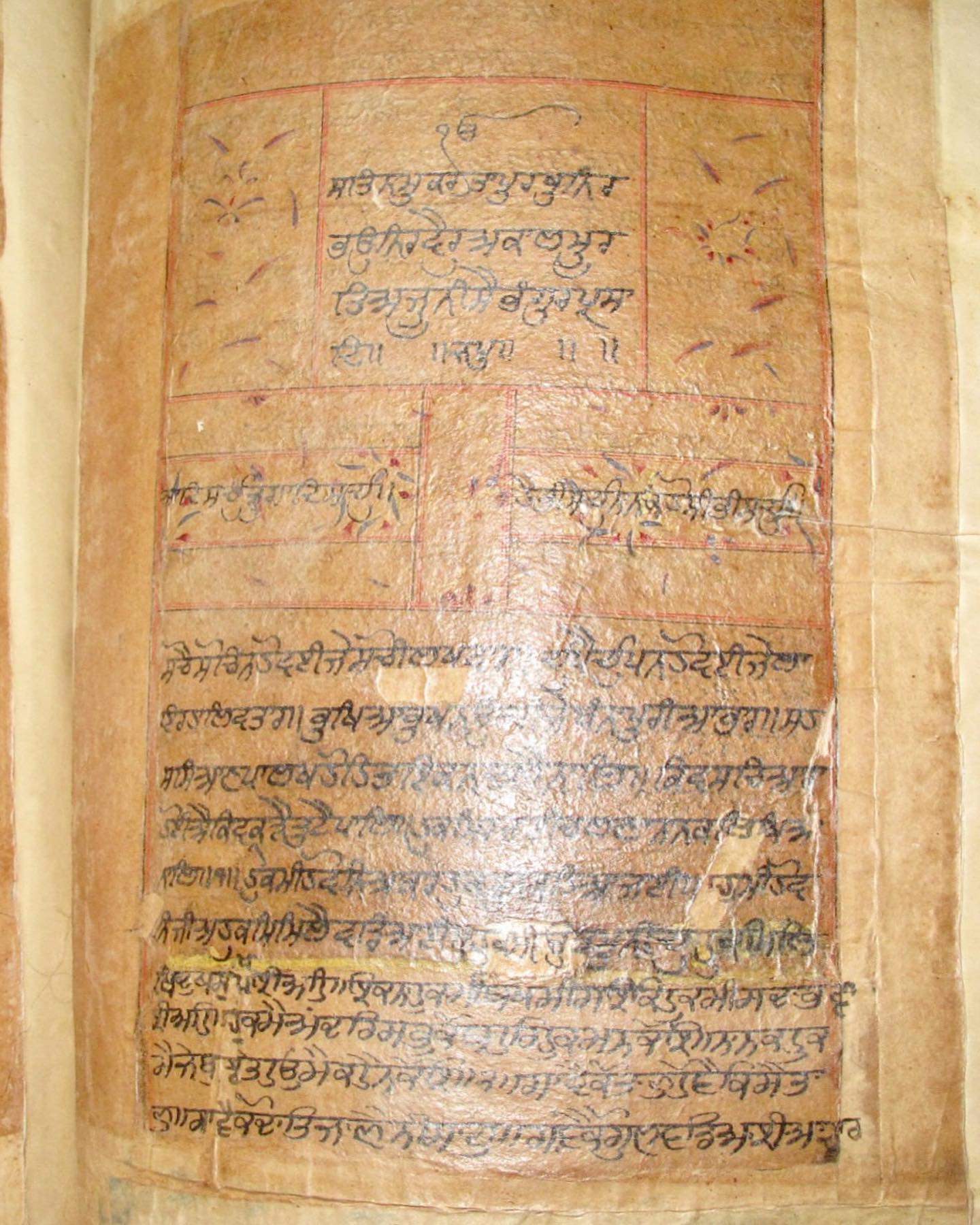
In short
- What it is
- The first authorised volume of Sikh scripture, compiled under Guru Arjan, the fifth Sikh Guru. Enlarged later in the seventeenth century, it is the text Sikhs revere as the Guru Granth Sahib
- Finished
- Bhadon vadi 1, Samvat 1661, by the manuscript's own note: Tuesday 31 July 1604 in the Julian calendar the histories use, 10 August in today's
- Where
- Ramdaspur, now Amritsar; by tradition beside a pool called Ramsar
- Scribe
- Bhai Gurdas (1551–1636), poet and theologian
- What is in it
- Hymns of the first five Gurus; of fifteen poet-saints, Hindu and Muslim; of eleven bards; and of three poets of the Gurus' own circle, arranged under thirty musical modes
- The manuscript
- The Kartarpur Pothi, 974 numbered leaves, kept by the Sodhi family of Kartarpur, Jalandhar district, India
- Languages
- Mostly the devotional idiom scholars call Sant Bhasha, with Punjabi, Braj, Persian and a Sanskrit-like register, all written in Gurmukhi
Where the kind of evidence matters, we label it, using the categories explained in our editorial standards, and say how sure we can be. Scripture appears in Gurmukhi as printed in the standard text, then in our transliteration and our translation, with its source; the dots and semicolons inside a Gurmukhi line are vishrām, a reader's guide to pausing, not punctuation. The Gurmukhi was taken from the Shabad OS text line by line, never retyped, and, like every Punjabi word on this page, it awaits a second reader's review. Hover over or tap a Punjabi word to see it in both scripts. Guru Nanak's life, and the hymns of the Gurus as teaching, are the subject of our article on the Creation of Sikhi; this one is about the book that holds them.
Two lines on page 927
Open any printed copy of the Guru Granth Sahib at page 927. Among the hymns of Guru Arjan, the fifth Sikh Guru, in rag Ramkali, stands one that is two lines long.
ਰਣ ਝੁੰਝਨੜਾ ਗਾਉ ਸਖੀ; ਹਰਿ ਏਕੁ ਧਿਆਵਹੁ ॥
raṇ jhuñjhanaṛā gāu sakhī hari eku dhiāvahu
ਸਤਿਗੁਰੁ. ਤੁਮ ਸੇਵਿ ਸਖੀ; ਮਨਿ ਚਿੰਦਿਅੜਾ ਫਲੁ ਪਾਵਹੁ ॥
satiguru tum sevi sakhī mani chindiaṛā phalu pāvahu
Sing the ringing song, my friends, and meditate on the One Lord. Serve the true Guru, my friends, and gain the fruit your heart longs for.
It has a heading, as every hymn in the book does. It calls on the singer's companions to sing, to meditate on the One and to serve the Guru. Then it stops. No stanza number follows it and no running count, none of the careful arithmetic that closes nearly every other composition in the volume, and the next thing on the page is the heading of a different poem, Guru Arjan's verses on the seasons. More than three hundred pages later, on page 1253, it happens again. After a hymn by the poet Parmanand comes a single line under the name of Surdas, the blind singer of Braj.
ਛਾਡਿ ਮਨ; ਹਰਿ, ਬਿਮੁਖਨ ਕੋ ਸੰਗੁ ॥
chhāḍi man hari bimukhan ko saṅgu
O mind, keep no company with those who have turned their faces from God.
The rest of Surdas's hymn is not there. What follows is a different hymn, headed Sārang Mahalā 5 Sūrdās, which joins Guru Arjan's heading to Surdas's name and closes with Surdas's own signature; whose it is, scholars still argue. The book's own counting notices the gap. The running total of the Bhagats' hymns in this mode stands at six at the end of Parmanand's hymn and at eight at the end of the next complete one, as if the single line had been counted though no number is written after it.
Sikhs do not handle this book as they would any other. In a gurdwara it is opened each morning beneath a canopy, a whisk, the chaur, is waved over it as it is read, and at night it is laid to rest, for Sikhs regard it not as a book about the Guru but as the Guru. That makes the broken-off hymns more interesting, not less. A book revered as a living teacher is also a book that was made: collected, sorted, copied, corrected and bound, by particular people, in a particular town, over particular months. Pages 927 and 1253 are two of the places where the making still shows.
This is a history of that making: why the fifth Guru gathered his predecessors' hymns into one volume, and why at the turn of the seventeenth century; the scribe who wrote it out and the rival families whose collections made the work urgent; the book's design and its languages; and the manuscript that survives from 1604, with a second that scholars have argued over for fifty years. Throughout, we keep apart what the documents show, what later Sikh tradition remembers, what scholars dispute, and what nobody yet knows.
First, the name. Ādi Granth means "the first book", or "the primal book". A granth is a large and weighty book; ādi means first, original. The volume of 1604 did not use that title. Its own word for itself was pothi, a book: its note of completion says that "the pothi was written" through to the end. The title Adi Granth came later, partly to set it apart from the Dasam Granth, "the book of the tenth". After 1708, when Guru Gobind Singh is remembered as having passed the Guruship to the scripture, Sikhs came to call it the Guru Granth Sahib. Historians still use Adi Granth for the text as it stood in the Gurus' own time, and so do we.
We will come back to page 927.
Hymns before the book
The Sikh tradition began in song. Guru Nanak (1469–1539) composed his hymns to be sung, with his companion Mardana, a Muslim musician, playing the rabab; his life is told in our article on the Creation of Sikhi, and his last years in Guru Nanak at Kartarpur. What matters here is that a hymn, a shabad, asked of its listeners attention rather than literacy. Most early Sikhs could not read. They learned the Guru's words by singing them together, in the congregation the tradition calls the sangat. And Guru Nanak could be sharp about reading that changes nothing in the reader:
ਪੜਿ ਪੜਿ ਗਡੀ ਲਦੀਅਹਿ; ਪੜਿ ਪੜਿ ਭਰੀਅਹਿ ਸਾਥ ॥
paṛi paṛi gaḍī ladīahi paṛi paṛi bharīahi sāth
ਪੜਿ ਪੜਿ ਬੇੜੀ ਪਾਈਐ; ਪੜਿ ਪੜਿ ਗਡੀਅਹਿ ਖਾਤ ॥
paṛi paṛi beṛī pāīai paṛi paṛi gaḍīahi khāt
ਪੜੀਅਹਿ ਜੇਤੇ ਬਰਸ ਬਰਸ; ਪੜੀਅਹਿ ਜੇਤੇ ਮਾਸ ॥
paṛīahi jete baras baras paṛīahi jete mās
ਪੜੀਐ ਜੇਤੀ ਆਰਜਾ; ਪੜੀਅਹਿ ਜੇਤੇ ਸਾਸ ॥
paṛīai jetī ārjā paṛīahi jete sās
ਨਾਨਕ. ਲੇਖੈ ਇਕ ਗਲ; ਹੋਰੁ ਹਉਮੈ ਝਖਣਾ ਝਾਖ ॥੧॥
nānak lekhai ik gal horu haumai jhakhṇā jhākh
Read and read, and you can load up carts; read and read, and fill whole caravans. Read and read, and you can load the boats; read and read, and fill the pits. Read for as many years as there are, read for every month there is; read for as long as life lasts, read with every breath. Nanak: only one thing is of account. The rest is the ego's idle babble.
Yet the same poet loved the materials of writing, and came back to them again and again as images of devotion. In Siri Rag he turns the scribe's whole craft into a discipline of the self:
ਜਾਲਿ ਮੋਹੁ. ਘਸਿ ਮਸੁ ਕਰਿ; ਮਤਿ ਕਾਗਦੁ ਕਰਿ ਸਾਰੁ ॥
jāli mohu ghasi masu kari mati kāgadu kari sāru
ਭਾਉ ਕਲਮ ਕਰਿ. ਚਿਤੁ ਲੇਖਾਰੀ; ਗੁਰ ਪੁਛਿ. ਲਿਖੁ ਬੀਚਾਰੁ ॥
bhāu kalam kari chitu lekhārī gur puchhi likhu bīchāru
Burn attachment and grind it into ink; make your understanding into the finest paper. Make love your pen and your mind the scribe; ask the Guru, and write down what you have understood.
In a salok in rag Malar he blesses the paper and the pen, the inkpot and the ink, and last of all the writer, who has written the true Name (ang 1291). Did he write his own hymns down? Gurinder Singh Mann thinks so, and points to a book. The Sodhis of Guru Harsahai, in Firozpur district, descendants of Guru Arjan's eldest brother Prithi Chand, kept a manuscript they held to be Guru Nanak's own pothi. G. B. Singh was allowed ten minutes with it at the Vaisakhi display of 1944. In 1969 it was lent to Patiala for the five-hundredth anniversary of Guru Nanak's birth, and the next year, on a train between Delhi and Ferozepur, it was stolen; it has not been seen since. Mann takes it as evidence that Guru Nanak compiled a book of his own hymns; others are more cautious, since no one can now examine it. Contested
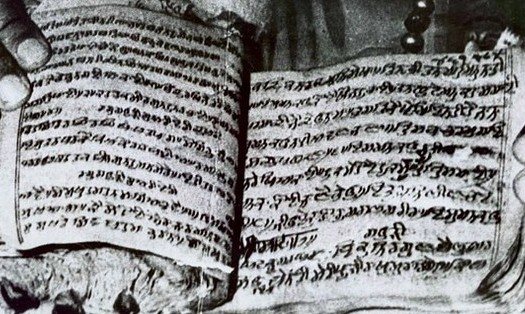
The hymns were written in Gurmukhi, which Sikh tradition credits the second Guru, Angad, with shaping from the scripts Punjabi traders already used; our Gurmukhi page tells that story.
Under the third Guru, Amar Das (Guru 1552–1574), the community's centre was Goindval, a ferry town on the Beas, now in Tarn Taran district and often spelled Goindwal. Two things from Goindval matter here. The first is a warning in Guru Amar Das's hymn Anand:
ਸਤਿਗੁਰੂ ਬਿਨਾ; ਹੋਰ ਕਚੀ ਹੈ ਬਾਣੀ ॥
satigurū binā hor kachī hai bāṇī
Without the true Guru, every other utterance is unripe.
Kachī means raw or unripe, like green fruit or unbaked clay, and bani is utterance, the word. Commentators have long read the line as a warning against verse passed off as the Gurus' own. Whatever its exact target, it shows that the question of which words were genuine was being asked in the 1570s, a generation before Guru Arjan.
The second is a set of books. The Goindval Pothis, also called the Mohan Pothis after Guru Amar Das's elder son Baba Mohan, who kept them, hold hymns of the first three Gurus together with some by the bhagats, the poet-saints we meet later. The Bhalla family's own chronicle, Sarup Das Bhalla's Mahimā Prakāsh of 1776, says they were written out by Mohan's son Sahansar Ram. Two survive, both still with Bhalla descendants of Guru Amar Das: one, by way of Ahiyapur in Hoshiarpur district, at Jalandhar; the other, taken to Hoti Mardan near Peshawar in 1940 and carried back after Partition, at Pinjore, near Chandigarh.
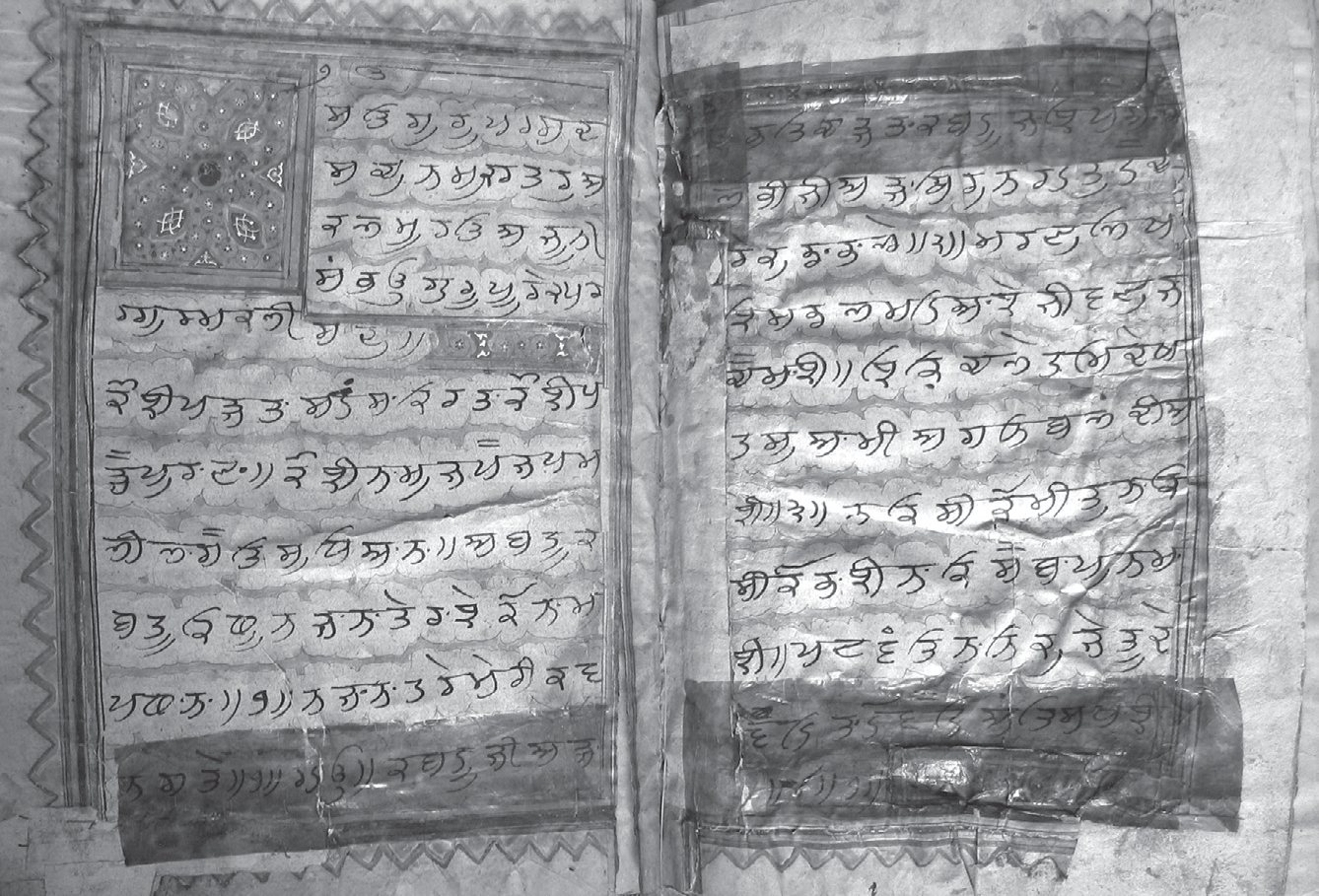
When they were written is disputed. Bawa Prem Singh, from family papers, dated them to about 1570–1572; others read a statement on the Jalandhar volume's opening leaf as dating them to 1595, and Mann argues that the statement was added in 1595 to books already decades old. Balwant Singh Dhillon, pointing to hymns headed with the numbers of the fourth and fifth Gurus in the original hand, argues that the surviving volumes were written later still, and played no part in Guru Arjan's work. Contested
What is not in doubt is the direction of travel. By the 1580s the Gurus' hymns existed in writing, in more than one collection, in more than one place, in the keeping of more than one family. And not every hymn in circulation under the name Nanak was a Guru's.
Why a book, and why then?
In 1581 the fourth Guru, Ram Das, named his youngest son as his successor. Arjan was eighteen. He had been born at Goindval in 1563, a grandson of Guru Amar Das through his mother, Bibi Bhani. The choice passed over the eldest son, Prithi Chand (1558–1618), who did not accept it.
What followed is remembered very differently depending on whose writings we read. In the mainstream Sikh tradition Prithi Chand is a schemer. He set up a rival seat at Hehar, near Lahore, courted Mughal officials, and with his son Manohar Das, known as Miharban (1581–1640), composed hymns under the Gurus' signature, Nanak, which were sung as genuine. Bhai Gurdas fixed on the family the name that stuck, mina, a dissembler. One of his ballads sets the true Guru, the true king, against the mina with the blackened face (Vār 36), and in a stanza running through the Gurus' sons who went their own way, he says in one line that Mohan went mad and in the next that Prithia became a mina (Vār 26, pauri 33).
Either way, the problem was real. By the 1590s there were several collections of hymns, several families holding them, and at least two lines claiming the Guruship. A pothi was a credential: as Mann shows, Baba Mohan's claim, Prithi Chand's and later Dhir Mal's were each aided by possession of a manuscript. A community whose authority rested on the Guru's word needed to know which words those were.
The story Sikhs tell of what came next is one of the best loved in their tradition. Guru Arjan needed the Goindval volumes, and their keeper would not part with them. In the version Max Arthur Macauliffe took in 1909 from Santokh Singh's Sūraj Prakāsh, Bhai Gurdas went to Goindval and knocked all night at Mohan's door without an answer. Baba Buddha went next, broke the door down and found Mohan in what looked like a trance. At last the Guru went himself, and sang:
ਮੋਹਨ. ਤੇਰੇ ਊਚੇ ਮੰਦਰ; ਮਹਲ ਅਪਾਰਾ ॥
mohan tere ūche mandar mahal apārā
ਮੋਹਨ. ਤੇਰੇ ਸੋਹਨਿ ਦੁਆਰ ਜੀਉ; ਸੰਤ ਧਰਮ ਸਾਲਾ ॥
mohan tere sohani duār jīu sant dharam sālā
Mohan, your temples are lofty, your mansions beyond measure. Mohan, your doors are beautiful: they are the gathering-places of the saints.
Moved, Mohan came down from his upper room and gave up the books.
One more of Guru Arjan's hymns is often linked to those books:
ਪੀਊ ਦਾਦੇ ਕਾ; ਖੋਲਿ ਡਿਠਾ ਖਜਾਨਾ ॥
pīū dāde kā kholi ḍiṭhā khajānā
ਤਾ ਮੇਰੈ ਮਨਿ; ਭਇਆ ਨਿਧਾਨਾ ॥੧॥
tā merai mani bhaiā nidhānā
When I opened my father's and grandfather's treasury and looked inside, my mind became a storehouse of riches.
Pashaura Singh reads it as Guru Arjan's delight in the manuscripts he inherited, and suggests that he received at least two sets, his father's and his maternal grandfather's. Dhillon answers that nothing in the hymn speaks of books at all: the treasure is the Name.
A second famous story needs a firmer caveat. The Akbarnāma, the chronicle of Akbar's reign, records that late in 1598 the emperor crossed the Beas at Goindval, and that on that day "the house of Arjun Guru" received the honour of his visit; the Guru asked a favour, and because the request "sprang from devotion", it was granted Well-established. Sikh tradition adds a different meeting, in which complaints that the Guru's book mocked Hindus and Muslims reached Akbar, who had passages read to him, found only praise of God and made the book an offering of fifty-one gold coins. That cannot have concerned the finished volume: Akbar left Punjab at the end of 1598 and never returned.
So why a book, and why then? The answer the tradition gives, that the Gurus' words had to be kept apart from imitations, is one the scripture itself supports. Guru Ram Das had already said as much:
ਸਤਿਗੁਰ ਕੀ ਬਾਣੀ. ਸਤਿ ਸਰੂਪੁ ਹੈ; ਗੁਰਬਾਣੀ ਬਣੀਐ ॥
satigur kī bāṇī sati sarūpu hai gurbāṇī baṇīai
ਸਤਿਗੁਰ ਕੀ ਰੀਸੈ. ਹੋਰਿ ਕਚੁ ਪਿਚੁ ਬੋਲਦੇ; ਸੇ ਕੂੜਿਆਰ ਕੂੜੇ. ਝੜਿ ਪੜੀਐ ॥
satigur kī rīsai hori kachu pichu bolde se kūṛiār kūṛe jhaṛi paṛīai
The true Guru's word is truth itself; through the Guru's word a person is made. Others, copying the true Guru, babble raw, half-baked words: they are false, and by their falsehood they fall away.
Historians add three more reasons. The community was building institutions, a town, a pool, a shrine, and a shrine needs a book at its centre. The Guruship was contested, and one authorised volume in the recognised Guru's hands settled, in ink, what his authority rested on. And the materials were ready: decades of collections, waiting to be reconciled. Mann treats 1604 as the latest stage of a process that began with Guru Nanak himself; even so, it is the decisive one, because every later copy descends from it.
The work itself, tradition says, was done a little way outside the busiest new town in Punjab.
The shrine in the pool
The town was Ramdaspur, "the town of Ram Das". The fourth Guru had begun it around a newly dug pool, from 1577, and traders and craftsmen came to it from the market towns round about. The pool was the amrit sar, the pool of the nectar of immortality, and in its middle Guru Arjan raised the shrine Sikhs call the Harmandir Sahib, "the temple of Hari", of God. He built it low, so that worshippers step down to enter, with doors on all four sides, open to anyone from any direction. A widely repeated tradition holds that the Lahore Sufi Mian Mir laid its foundation stone. No source of the time confirms it, and some Sikh sources say the Guru laid it himself Contested. The name Amritsar belonged first to the pool; in time the town took it too.
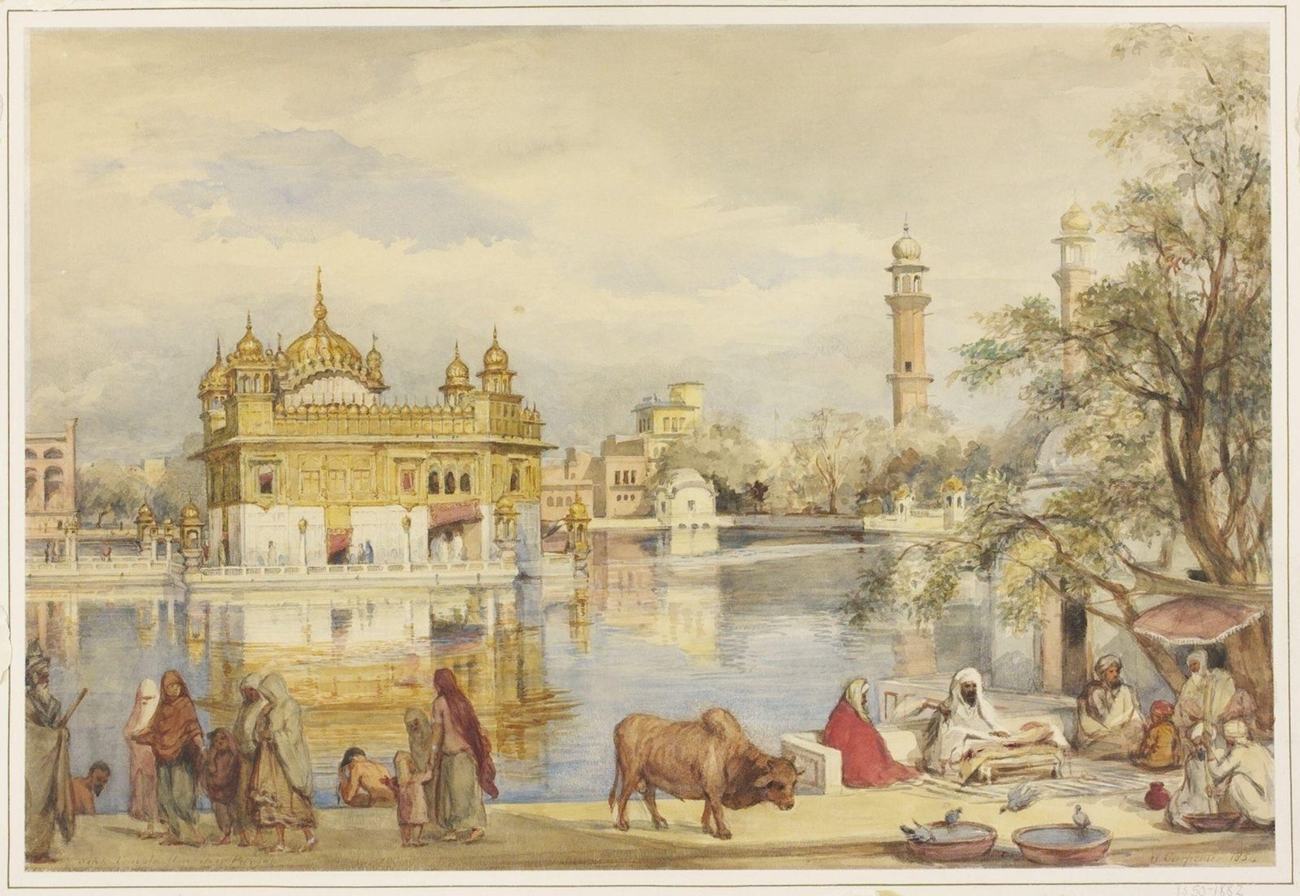
Guru Hargobind later raised the Akal Takht facing it. It was damaged and rebuilt more than once in the eighteenth century, and in the early nineteenth Maharaja Ranjit Singh's gilding gave it the golden appearance the world knows, and the name the Golden Temple.
The workshop by the pool
When the time came to compile the book, the Guru is remembered as having withdrawn from the bustle of the town to a shady spot about a kilometre away, where he had a smaller pool dug and named it Ramsar, after his father. There, tradition says, he worked through 1603 and 1604 with his scribe, and there too he composed Sukhmanī, "the jewel of peace", one of the most widely recited of all Sikh prayers. A gurdwara, Ramsar Sahib, stands on the spot, near the Chativind Gate on the south-eastern side of the old walled city; its present building dates from 1855. The particulars are tradition. That the work was done at Ramdaspur, under Guru Arjan, with Bhai Gurdas as scribe, is not in doubt.
Bhai Gurdas (1551–1636) was the obvious choice. Born at Goindval, the son of a cousin of Guru Amar Das and so a kinsman of Guru Arjan's mother, he grew up among people who had known three Gurus. He was a poet in two literary languages: his forty vārs, long ballads in Punjabi, set out Sikh teaching and history, and his several hundred kabitts, quatrains in Braj, do the same for another audience. In the Sūraj Prakāsh, as Macauliffe retells it, the Guru offered to include his verses in the book and he declined; no line of his is in it. If anyone could tell the Gurus' compositions from imitations, he could. And his was an honoured trade. Guru Ram Das had sung of it:
ਤੇ ਹਸਤ ਪੁਨੀਤ ਪਵਿਤ੍ਰ ਹਹਿ, ਮੇਰੀ ਜਿੰਦੁੜੀਏ; ਜੋ ਹਰਿ ਜਸੁ ਹਰਿ ਹਰਿ ਲੇਖਹਿ ਰਾਮ ॥
te hasat punīt pavitr hahi merī jinduṛīe jo hari jasu hari hari lekhahi rām
Holy and pure are those hands, my soul, that write the praise of the Lord.
What did the work look like? The familiar picture is of the Guru dictating and the scribe writing, but the manuscript that survives suggests something closer to an editorial workshop. Its physical evidence, recorded leaf by leaf by Jodh Singh in 1945 and 1946, points to a method. Bhai Gurdas made up the book in gatherings of eight leaves, 123 of them, and ruled a margin on every leaf before he wrote. The leaves were numbered in advance, and blocks of them were set aside for each rag, generously enough that the space would not run out. Hymns went into their sections as they were collected, checked and approved, not in one continuous run: Daljeet Singh, who studied the manuscript later, noticed that the hymns of a single Bhagat were written on different occasions, in different sizes of letter and different shades of ink. Running totals were squeezed in last, between the lines or in the margins, and a hymn that turned up late went into a margin with a mark to show where it belonged.
That is how you build a book when the material is still arriving, and it is why the manuscript is full of empty pages and looks less like a fair copy than like a book at work Probable. We will open it properly later. First, its design.
How the book is built
Open the Adi Granth at its beginning and the first thing on the page is a single character, the numeral one joined to the first letter of oankar, a name for the divine, with that letter's curve drawn out into a long arc. No other character in the script is made this way, and Unicode gives it a code point of its own. The words that follow it, the mūl mantar or "root formula", are the nearest thing the Sikh tradition has to a creed.
ੴ ਸਤਿ ਨਾਮੁ ਕਰਤਾ ਪੁਰਖੁ ਨਿਰਭਉ ਨਿਰਵੈਰੁ; ਅਕਾਲ ਮੂਰਤਿ ਅਜੂਨੀ ਸੈਭੰ ਗੁਰ ਪ੍ਰਸਾਦਿ ॥
ik oaṅkār sati nāmu kartā purakhu nirbhau nirvairu akāl mūrati ajūnī saibhaṅ gur prasādi
One Oaṅkār; Truth by name; the Creator, the Being; without fear, without enmity; timeless in form; unborn; self-existent: known by the Guru's grace.
Then comes the Japu, Guru Nanak's long meditative poem, which Sikhs recite every morning. It has no rag, because it is recited rather than sung, and after it come the hymns for evening and night, so that the volume opens with the cycle of a day's prayer.
Then the main body begins, and its organising principle is music. The volume of 1604 has thirty rags, from Siri Rag to Prabhati. A thirty-first, Jaijavanti, holds just four hymns, all by the ninth Guru, Tegh Bahadur, and so was added later in the century; the scripture today has thirty-one. Within each rag the arrangement is layered like a well-kept archive. Hymns are grouped by form: short hymns of two, three or four stanzas; longer ones of eight, the ashtpadis; lyrical chhants; and the ballads called vars. Within each form the Gurus appear in the order of their succession. Last come the Bhagats, usually led by Kabir, Namdev and Ravidas.
Every Guru signs his hymns with the same name: Nanak. What tells them apart is a heading, mahala, with a numeral: Mahala 1 for Guru Nanak, Mahala 2 for Guru Angad, and so on. The shared signature is a statement of doctrine. The Guruship was understood as one light passing from body to body, a point made in so many words by the musicians Satta and Balwand in their ballad in rag Ramkali:
ਜੋਤਿ ਓਹਾ. ਜੁਗਤਿ ਸਾਇ; ਸਹਿ ਕਾਇਆ ਫੇਰਿ ਪਲਟੀਐ ॥
joti ohā jugati sāi sahi kāiā pheri palṭīai
The light was the same, the way the same: the King had only changed his body.
Guru Angad left only short couplets, sixty-three saloks in the text we quote from, and they stand set inside the ballads rather than on their own. Guru Arjan himself is by far the largest contributor, with more than two thousand compositions, well over a third of the book.
Two small words carry a great deal. Rahau, "pause", marks the line or couplet that states a hymn's central thought, which the stanzas unfold and the singers return to as a refrain. The other word, ghar, "house", stands with a numeral in many headings, and its meaning is still argued: a rhythmic cycle, a melodic variant, a manner of performance.
The ballads were a Punjabi genre long before they were a scriptural one: heroic poems sung in praise of warriors. The scripture's twenty-two vars keep the form, a chain of stanzas called pauris, but turn the praise to God and set saloks between the stanzas, many of them probably placed there during the compilation. Couplets for which no place was found were gathered near the end under a heading only an editor could have written, Salok Varan te Vadhik, "saloks in excess of the vars" (ang 1410).
Nine of the vars also name a popular ballad to whose tune they are to be sung: the one-handed king Tunda Asraja for the var in rag Asa, Malik Murid and Chandrahara Sohia for Majh, Sikandar and Ibrahim, Rana Kailas and Maldeo, Musa. Most of those songs survive only as these titles. In the 1604 manuscript some of the tune-names are written small, in another hand or squeezed between the lines, and some writers think they were added at the wish of the sixth Guru, Hargobind Contested.
After the rags comes a coda of collections outside the musical scheme: saloks in a deliberately Sanskrit-like style, Guru Arjan's Gāthā and other short forms, the couplets of Kabir and of Farid, the eulogies of the bards, the surplus saloks, and, added later in the century, the fifty-seven saloks of Guru Tegh Bahadur. At the very end stand Guru Arjan's Mundavani, to which we return, and a short catalogue of rags, the Rāgmālā, whose authorship is disputed.
Fifteen saints and a company of bards
Few scriptures compiled by a religion's own teachers include, under their own names, the work of devotees from other traditions. The Adi Granth includes fifteen. They are called Bhagats, devotees. The earliest of them, Jaidev and Farid, lived in the twelfth and thirteenth centuries; the latest were near-contemporaries of Guru Nanak. They came from across northern India, from Bengal to Maharashtra and the Punjab. Jaidev, Trilochan and Ramanand were Brahmins. Kabir was a weaver, Namdev a calico-printer, Ravidas a leather-worker, Sain a barber, Dhanna a Jat farmer, and Sadhana, by tradition, a butcher. Pipa is remembered as a Rajput king who gave up his throne, and Farid was a Sufi shaikh. A few remain uncertain figures: the Surdas of the scripture may be the famous blind poet of Braj or another singer of that name, and the identity of Bhikhan is debated. Several Bhagats wrote about their low standing directly, and the compilers kept those lines.
ਕਬੀਰ. ਮੇਰੀ ਜਾਤਿ ਕਉ; ਸਭੁ ਕੋ ਹਸਨੇਹਾਰੁ ॥
kabīr merī jāti kau sabhu ko hasnehāru
ਬਲਿਹਾਰੀ ਇਸ ਜਾਤਿ ਕਉ; ਜਿਹ ਜਪਿਓ ਸਿਰਜਨਹਾਰੁ ॥੨॥
balihārī is jāti kau jih japio sirjanhāru
Kabir: everyone laughs at my caste. I would give my life for this caste, in which I have meditated on the Creator.
ਮੇਰੀ ਜਾਤਿ ਕੁਟ ਬਾਂਢਲਾ, ਢੋਰ ਢੋਵੰਤਾ; ਨਿਤਹਿ ਬਾਨਾਰਸੀ ਆਸ ਪਾਸਾ ॥
merī jāti kuṭ bāṅḍhalā ḍhor ḍhovantā nitahi bānārasī ās pāsā
My people are leather-cutters, who haul away dead cattle every day around Banaras.
Ravidas's hymn goes on to say that now the most eminent Brahmins bow before him, because he has taken refuge in God's Name.
The oldest Punjabi voice in the book is Farid's. Shaikh Fariduddin Mas'ud (c. 1188–1266), called Ganj-i-Shakar, "treasury of sugar", was a Chishti Sufi who settled at Ajodhan on the Sutlej, the town now called Pakpattan, in Punjab, Pakistan, where his shrine still draws Muslim, Sikh and Hindu visitors (his story is on our River of Time). The four hymns and more than a hundred couplets under his name are among the earliest poetry in Punjabi. Whether all of them are Farid's own, or partly the work of later heads of his order at Pakpattan who inherited his title, among them a sixteenth-century successor, Shaikh Ibrahim, has been debated for more than a century Contested. One of his couplets, a warning against writing "black marks", which commentators read either as judging others or as one's own wrongdoing, has a page of its own. In the scripture Farid does not speak alone: couplets by Guru Amar Das and Guru Arjan stand among his, answering him across three centuries.
The Bhagats' verses were chosen, not taken wholesale: only a part of the poetry credited to Kabir elsewhere is here. Pashaura Singh, in a book-length study of the Bhagats, argues that including them was itself an act of self-definition: by choosing whom to include, and placing them after the Gurus in every section, the compilers declared both what the Sikh path shared with the wider devotional world and where it stood apart. The exclusions tell the same story. A hymn by the Rajput princess and poet Mirabai was written into the 1604 manuscript and then crossed out: struck through, Jodh Singh recorded, not painted over. A manuscript of 1659, remembered as Ram Rai's and now at Dehradun, notes beside the same hymn that it is not to be found in the granth of the fifth Guru.
Two more groups came from the Guru's own circle. The bhatts were hereditary bards whose trade was praise, and eleven of them, by the usual count, contributed savaiyās, stanzas in praise of the first five Gurus. Their verse is ornate, full of Braj, and bold: one of them, Mathura, ends a stanza by declaring that there is no difference between the Guru and God, that Guru Arjan is God made visible (ang 1409). The compiler admitted praise of himself, as a record of how his followers saw him. The ballad in rag Ramkali quoted above is headed as the work of "Rai Balwand and Satta the Dum", two musicians of the hereditary Muslim caste of singers and genealogists whom the Punjab calls mirāsīs. Sundar, a great-grandson of Guru Amar Das, recorded the third Guru's last instructions to his family. And a few couplets in rag Bihagra are headed with Mardana's name: most commentators take them for Guru Nanak's words to him, a few for Mardana's own, which is one reason counts of the book's contributors differ.
Set out this way, the list can sound like a programme. It is better read as a portrait of the world the Gurus' community lived in: a Punjab of Sufi shrines and Vaishnava singers, of weavers, tanners and barbers, of bards who sang for pay and minstrels who sang for love, gathered into one volume and ordered by a single musical system.
What language is the Adi Granth written in?
There is no single answer. Most of the book is written in a literary language scholars call Sant Bhasha, "the language of the saints", an idiom shared by devotional poets across northern India and resting mainly on the grammar of Braj and the Khari Boli of the Delhi region, which each poet coloured with the speech of home. The linguist Christopher Shackle, whose introduction to the language of the scripture remains the standard one, has shown how the Gurus moved within it, nearer to Punjabi in some forms, nearer to Braj in others, reaching for Persian or Sanskrit when a subject called for it Well-established.
Punjabi is there from the start. Guru Nanak's ballads and his twelve-month poem in rag Tukhari are full of it, as are Guru Arjan's twelve-month poem in rag Majh and much of the minstrels' ballad. In Farid it is the Punjabi of one region, the south-west around Multan, whose speech is today often called Saraiki:
ਫਰੀਦਾ. ਕਾਲੇ ਮੈਡੇ ਕਪੜੇ; ਕਾਲਾ ਮੈਡਾ ਵੇਸੁ ॥
farīdā kāle maiḍe kapṛe kālā maiḍā vesu
Farid, black are my clothes, and black is all I wear.
The word to notice is maide, "my". A speaker from Amritsar would say mere. The scripture keeps the difference, and with it one of the oldest written records of a Punjabi dialect.
Guru Nanak could also change languages altogether. A hymn in rag Tilang opens in Persian, the language of the Mughal court and of learned Muslims:
ਯਕ ਅਰਜ ਗੁਫਤਮ. ਪੇਸਿ ਤੋ; ਦਰ ਗੋਸ ਕੁਨ, ਕਰਤਾਰ ॥
yak araj guphtam pesi to dar gos kun kartār
One plea I lay before You: lend me Your ear, Creator.
Every word of that line is Persian except the last, Kartār, "the Creator", an Indic word Punjabis still use for God: the prayer turns to the language of home to name the one it prays to.
At the other extreme are passages in a heavily Sanskritised register. The book itself labels the style sahaskritī, "Sanskrit-like". It is not Sanskrit but a vernacular dressed in Sanskrit forms, and the Gurus used it to pointed effect. In one of Guru Nanak's saloks in this style the target is the learned reader of scripture:
ਪੜਿੑ ਪੁਸ੍ਤਕ; ਸੰਧਿਆ ਬਾਦੰ ॥
paṛhi pustak sandhiā bādaṅ
You read your books, say your evening prayers, and argue.
Pustak, the word for "book" in that line, is the Sanskrit ancestor of pothi, the word the 1604 volume used for itself. Guru Arjan's Gāthā reaches further back still, into forms that echo the old Prakrits, and Jaidev's hymn in rag Gujri, by the poet best known for the Sanskrit Gītagovinda, is close to Sanskrit outright.
Between those poles lie the eastern Hindi of Kabir, traces of Marathi in Namdev, and the Braj of the bards. Arabic and Persian words run through the whole book: hukam, command, the divine order; khasam, master; sāhib, lord; dargāh, court. Even Guru Nanak's writing tools are partly borrowed: kāgad, paper, is Persian and kalam, pen, Arabic, while the ink, mas, and the scribe, lekhārī, are Indic.
One script holds all of it. Persian lines and Sanskrit-like lines, Multani and Braj, are all written in Gurmukhi, and the authoritative text of the scripture has always been Gurmukhi, though editions in Devanagari, Shahmukhi and Roman letters have been printed for readers who cannot read it. The 1604 manuscript carries a single heading in Persian script, Pran Sangli, Mahala 1, over a leaf left blank: a composition attributed to Guru Nanak that in the end was not included, and a small trace of a scribe who worked in a world of several scripts.
The early manuscripts run their words together, a style called larivar, though some early hands mark the breaks with dots. Readers had to know where one word ended and the next began, and teachers passed that knowledge on. Printed editions kept the words joined until the early 1970s, when a word-separated edition appeared over the objection that dividing the words divided the body of the Guru; both are printed today. The spelling, meanwhile, was never standardised in the modern sense. Vowel signs at the ends of words mark grammatical case and number in ways modern Punjabi has largely lost, and the text keeps variant spellings of one word side by side. Nobody corrects this text into consistency; the wedding hymns on our Anand Karaj page show what that means for a reader.
Inside the Kartarpur Pothi
The manuscript that Sikh tradition and most scholars identify as the volume of 1604 is the Kartarpur Pothi, or the Kartarpuri bir, named after the town where it has spent most of its life: not Guru Nanak's Kartarpur on the Ravi, but a second Kartarpur, in the Doaba, fifteen kilometres north-west of Jalandhar, which Guru Arjan himself founded in 1594. The book belongs to the Sodhi family of Kartarpur, descendants of Guru Hargobind's grandson Dhir Mal, and it is their private property, as a long court case confirmed in the mid-twentieth century. Scholars have seen it rarely. After a committee inspected it for an afternoon on 7 October 1945, Jodh Singh came back that November and for five days in August 1946 to make the leaf-by-leaf description, published in 1968, on which most later accounts depend. In the 1990s the family allowed Mann three long examinations, and Pashaura Singh studied it too.
It is a large book: 974 leaves, numbered by opening rather than by page. By Daljeet Singh's count, which rests on Jodh Singh's, 453 of its pages are entirely blank, and part-used pages leave room for about 133 more: just what the allotment method would produce, and the first sign of a working original rather than a copy, since a copyist has the whole text before him and no reason to leave hundreds of pages empty.
It dates itself. A note at the head of its index, in the hand of the main scribe, reads sammat 1661 mitī bhādon vadī 1 pothī likh pahunche: "Samvat 1661, Bhadon vadi 1: we have written the pothi through to here." Mann, who examined the entry closely, found no sign of tampering, and no other early manuscript makes that claim for itself.
It carries signs of supervision. Its own index lists two nīsān, "signs": the Mūl Mantar written out in the hand of the fifth Guru, and again, at the head of the second half of the book, in the hand of the sixth. Both pages are illuminated in blue and gold. Hargobind was not yet Guru in 1604, but by then everyone knew who the successor would be. In the margins, in a hand other than the scribe's, stand the words sudh, "correct", and sudh kīchai, "make it correct". Jodh Singh took them for Guru Arjan's own approvals and instructions. The identification is widely accepted, though handwriting alone can rarely settle such a question Probable.
It is corrected everywhere. Hymns copied twice are struck through; lines written out of order carry cross-references from leaf to leaf. Whole passages have been painted over with hartāl (ਹਰਤਾਲ), orpiment, a yellow arsenic mineral that scribes used much as we use correction fluid, and written over. Some leaves carry headings with nothing beneath them, most of them for hymns by Guru Arjan, as if the scribe had expected more from the living Guru than in the end arrived. And a note in the index says that the text of the Japu was copied from a manuscript in Guru Ram Das's own hand; the scribe of the next copy we have, made in 1642, calls his Japu a copy of that copy.
And it records a death. Near the front is a list of the days on which the Gurus passed from light into light, their joti jot. The first five entries are in the main scribe's hand. The fifth, for Guru Arjan, gives the day of the week as well as the lunar date: Jeth sudi 4, Samvat 1663, a Friday. Our own calculation agrees: that lunar day fell on Friday 30 May 1606, the date the histories give. Jodh Singh saw the fifth entry written with a finer pen and in a different ink from the four before it, and concluded that the scribe had come back to the book after 1606 to add it. Mann reads all five as written together, after 1606, on a leaf left blank for the purpose. Either way, the scribe who wrote out the whole volume under his Guru's eye lived to enter his Guru's death in it. Below, in another hand, come the deaths of Baba Gurditta in 1638 and of Guru Hargobind in 1644.
The book also went on growing after the date in its note. Mann counts eleven hymns of Guru Arjan added after the first writing, in spaces left blank. Guru Arjan's var in rag Basant, only three stanzas long, sits on a leaf that had been left empty and is missing from the index; tradition says he broke off composing it when told that the langar was ready, and never went back to it. The two lines on page 927 are missing from the index too, and written with a different pen. Mann concluded that the volume was compiled in 1604 but that additions continued until Guru Arjan's death in 1606. That matters, because a copy made in 1605 would keep the book as it then stood.
Not everyone has accepted the Kartarpur Pothi's standing. In 1944 G. B. Singh, in a book on the early manuscripts, argued that it was not the volume Guru Arjan prepared, and Jodh Singh's work began as an answer to him. In the 1970s W. H. McLeod raised questions about its corrections and about its long custody outside the main line of the Gurus. Today most of the scholars who have worked on the manuscripts, Mann and Pashaura Singh among them, accept that the Kartarpur Pothi is the volume prepared under Guru Arjan in 1604 Probable. What they still argue about is what some of its corrections mean, and that argument leads back to page 927. First, though, the book had to reach the shrine.
Into the shrine, August 1604
The tradition, as the Encyclopaedia of Sikhism tells it from the Gurbilās, runs like this. The Guru and his Sikhs spent the night at Ramsar, the book on a seat beneath a canopy while they slept on the ground, and the Guru lay awake deciding who should keep it. His choice fell on a disciple, not a kinsman: Baba Buddha (1506–1631), who had known Guru Nanak as a boy and had served every Guru since. At dawn the congregation set out for the Harmandir, Baba Buddha carrying the book on his head and the Guru walking behind, waving the chaur over it, while musicians sang. The book was installed in the inner sanctuary on Bhadon sudi 1, a fortnight after the date in the manuscript, and Baba Buddha became its first reader and keeper, the office later called granthi.
He opened it, the tradition continues, and read the first passage his eyes fell on, a hymn of Guru Arjan's that begins "He himself has stood by his saints in their task" (ang 783). Sikhs still consult the scripture this way: the passage at the top of the left-hand page is the day's hukam, the Guru's command, and the Harmandir's is published every morning. By night, the Guru directed, it was to be closed after the evening prayer and carried to his own quarters, and Sikhs trace to that memory the rites that surround every copy today: prakāsh, its ceremonial opening in the morning, and sukhāsan, its rest at night.
One of Guru Arjan's own hymns contains a line that has come to be associated with the occasion:
ਪੋਥੀ; ਪਰਮੇਸਰ ਕਾ ਥਾਨੁ ॥
pothī parmesar kā thānu
ਸਾਧਸੰਗਿ ਗਾਵਹਿ ਗੁਣ ਗੋਬਿੰਦ; ਪੂਰਨ ਬ੍ਰਹਮ ਗਿਆਨੁ ॥੧॥ ਰਹਾਉ ॥
sādhsaṅgi gāvahi guṇ gobind pūran braham giānu rahāu
The book is the dwelling-place of God. Those who sing God's praises in holy company come to the full knowledge of the Absolute. (Pause.)
Word for word: book · of the Supreme Lord · the place. In holy company · they sing · the virtues · of Gobind: · full · knowledge of the Absolute. Pause.
Nothing in the hymn ties it to 1604, and the book it names may be scripture in general. But its verb is "they sing": the book is God's dwelling-place when it is sung, in company.
Bhai Banno, and the argument over page 927
Now, page 927.
The tradition that explains it concerns a disciple named Bhai Banno, of Mangat, also called Khara Mangat, a village in what is now Gujrat district, Pakistan. In the oldest version, Sarup Das Bhalla's Mahimā Prakāsh, Banno borrows the finished book with the Guru's leave, has a copy made in haste, and the Guru blesses it; Bhalla calls it the Khara text, after Banno's village. In the Gurbilās and the Sūraj Prakāsh, Banno is sent to Lahore to have the book bound, has it copied on the way without leave, and slips in hymns the Guru had left out; and the village's name is read in its literal sense, khārā, brackish, as against sweet, so that "the brackish volume" became a verdict. Kahn Singh Nabha's Mahan Kosh still repeated that version in 1930. Sahib Singh concluded that they could not all be true and that the story as a whole could not be trusted Contested.
The manuscript associated with Banno is kept at Gurdwara Bhai Banno in Kanpur, in northern India, where the family brought it after Partition. It has 467 leaves and is dated Assu vadi 1, Samvat 1699, that is 1642, thirty-eight years after the Kartarpur Pothi. Its structure is the Kartarpur Pothi's own: the same arrangement, the same index, the same illuminated openings, and an index note that its Japu is a copy of a copy of Guru Ram Das's text, one step further removed than the book of 1604. Mann concludes that it is a direct copy of the Kartarpur Pothi Probable.
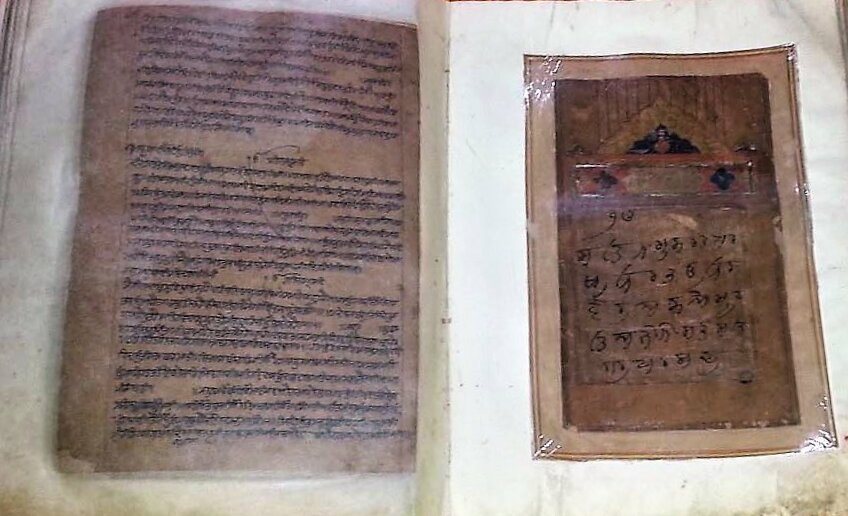
The differences are few, and they are additions. The Ramkali hymn of page 927 runs on for twenty-two more lines, through a son's birth, naming, first head-shaving, schooling, betrothal and wedding, long read as a record of Hargobind's childhood. The Surdas line is there with blank space after it, in which another hand later wrote out a complete hymn. Mirabai's hymn, crossed out in the Kartarpur Pothi, is present. And at the end stand texts the scripture does not include: two sets of saloks, one beginning with the image of a court where a hundred thousand Muhammads stand; a composition called Ratanmālā; a prose account of Guru Nanak's meeting with a king named Shivnabh; and a recipe for making ink.
So the printed text follows the Kartarpur Pothi, and the Kartarpur Pothi has only two lines of the Ramkali hymn and one of Surdas. Why? Three answers have been given, and each has serious defenders.
The first came from W. H. McLeod in 1975. If the Banno text is fuller, he reasoned, it might be the earlier, and the Kartarpur text the result of later deletion, with a motive to hand: a Guru's son having his head shaved sat awkwardly with the later rule of uncut hair. He put it as a hypothesis, and in 1979 wrote that he was "certainly not prepared" to affirm it, though he returned to it more than once. In 1991, after reading Pashaura Singh's analysis of the text, he wrote to him that his question had at last been answered.
The second answer, the one most Sikh scholars give, is that the Kartarpur Pothi shows no erasure at these places at all. Jodh Singh found no orpiment on the Ramkali page, only the two lines, written with a different pen from the text around them, and empty leaves after them; Pashaura Singh, who examined the page himself, counts more than two leaves left blank. In the Kanpur manuscript, they add, the extra stanzas are a later addition in a smaller hand, and other manuscripts of the seventeenth century lack them. Pashaura Singh goes further: the extra lines use words found nowhere else in Guru Arjan's verse, and call the Guru the true Guru, a title he never gives himself. He concludes that others completed the hymn, to lend the scripture's authority to rites the Gurus had set aside, and that the two lines are exactly what Guru Arjan approved: sayings he may have meant to build into a hymn, had he lived.
The third answer comes from Gurinder Singh Mann, who examined the early manuscripts himself. He reads the Kanpur manuscript's full Ramkali hymn as part of its original writing, finds the same hymn in every manuscript that claims to copy the Kartarpur Pothi, and, like the commentator Giani Badan Singh, is willing to accept it as Guru Arjan's. On his account the seventeenth-century copies fall into two families: one descended from a copy made in 1605, while the Kartarpur Pothi was still being revised, and taken to Peshawar for a Sikh named Bhai Milkhi; the other from the finished book of 1606. The old picture of a true Kartarpur line and a false Banno line, he argues, has no basis in the manuscripts.
What is not in doubt is what the tradition chose to do. The scripture Sikhs print and read today keeps the two lines on page 927 and the single line on page 1253 exactly as the Kartarpur Pothi has them: unfinished, unnumbered, untidied. A community that believed it was keeping the Guru's own choices left the gaps alone.
What happened to the book
Copies began almost at once. Mann traces references to copies of 1605 and 1610 that no longer survive, and lists twenty-seven from 1642 to 1692 that do, scattered from Dehradun to Patna.
Its compiler did not live to see much of that. In 1606 Guru Arjan died in Mughal custody at Lahore, on the order of the new emperor, Jahangir. Jahangir's memoir gives his reasons. At Goindval, he wrote, a Hindu named Arjan, in the garb of a holy man, had drawn many simple-hearted Hindus and even some Muslims to his ways; his house had "kept this shop warm" for three or four generations; Jahangir had long thought of putting an end to it or bringing him into Islam; and the Guru had received the rebel prince Khusrau and marked his forehead with saffron. So the emperor had his property seized and ordered him put to death Well-established. The memoir says nothing about the book; the tradition that the Guru was pressed to alter its hymns and refused belongs to devotional memory. Historians still weigh the political charge against the religious hostility the memoir also shows, and Sikhs remember Guru Arjan as the first of their martyrs.
The Kartarpur Pothi stayed in Guru Arjan's family. When Guru Hargobind left Kartarpur for the hills after a battle there in 1635, it stayed behind and passed to his grandson Dhir Mal (1627–1677), who set himself up as Guru in his own right; a decree of 1643 from Shah Jahan's court, still with his descendants, names him "the occupant of the seat of Nanak Shah". The Sodhis of Kartarpur have kept the book ever since.
Maharaja Ranjit Singh brought the family and its book to Lahore, though Mann finds no evidence that it ever left their hands. After the British annexed Punjab in 1849 it was taken into the Citadel at Lahore, then returned to the Sodhis on petition, on condition that they make a copy for the government, which was sent to Queen Victoria in the late 1850s. In 1956–57, after a court case confirmed their ownership, the family had its leaves laminated and the book rebound, and it is still shown to the public from time to time.
Meanwhile the text grew once more. The ninth Guru, Tegh Bahadur (Guru 1664–1675), composed hymns, and a tradition dominant since the nineteenth century holds that Guru Gobind Singh added them at Damdama, now Talwandi Sabo, in 1706, dictating the whole text from memory to Bhai Mani Singh. The manuscripts complicate the story: a manuscript of 1674, now at Panjab University, Chandigarh, already contains the ninth Guru's hymns, though Piar Singh doubts its note of presentation to him, and Mann dates the final text to Anandpur in the 1680s Contested. Before his death at Nanded, in the Deccan, in 1708, Guru Gobind Singh is remembered as having declared that there would be no further human Gurus, and that the Guru would henceforth be present in the scripture and in the community of the Khalsa. That is the origin of the name Guru Granth Sahib; the founding of the Khalsa has an article of its own.
Print came in the 1860s. The first edition, a lithograph, was published at Lahore in 1864–65. Early printings ran anywhere from 1,168 to 2,202 pages before the number settled at 1,430, and in 1952 a standard single-volume edition appeared, prepared by comparing the text with the Kartarpur Pothi and an early manuscript at Damdama. In Sikh usage a page of the scripture is an ang, a limb, as of a living body, and today every standard volume, or saroop, has the same 1,430 angs. That is why page 927 is the same page in Amritsar, Lahore, Nairobi and Vancouver. Since the 1990s it has been searchable line by line in databases like the one that supplied every quotation on this page.
What is still not known
A great deal about the Adi Granth is secure: who compiled it and when, what it contains, how it is arranged, and that a manuscript of 1604 survives. Around those certainties lies a ring of honest uncertainty.
Nobody knows for certain when the Goindval Pothis were written, or whether the surviving volumes are the ones Guru Arjan used. No account of the Kartarpur Pothi's corrections has won every specialist's agreement, and the argument over the Banno manuscript turns on reports of the same pages that cannot both be right.
The authorship of the Rāgmālā, the catalogue of rags, with their "wives" and "sons", that closes every printed copy, is disputed. Some hold it to be Guru Arjan's own index to the book's music. Others point out that its scheme does not match the rags the book actually uses, and that its verses are found in Mādhavānal Kāmkandalā, a romance the poet Alam wrote in 1583. Opinion within the Sikh community is divided too. The Sikh code of conduct records the difference, leaves it to local custom whether a complete reading ends with the Rāgmālā or with the Mundavani before it, and asks that no copy be printed without it Contested.
Some of the Bhagats remain partly mysterious, and the musical terms in the headings, ghar above all, still resist certain explanation.
Behind all of this lies a practical question. The early manuscripts are few and fragile, several are in private hands, and the most important has been studied at length by only a handful of people. Some of the evidence is already gone: many early manuscripts held in the Sikh Reference Library at Amritsar were lost when the library was destroyed in June 1984. Good published images of the books that survive would do more to settle the old arguments than another generation of reasoning from reports. The history of the Adi Granth is not finished. It is waiting on its own evidence.
Three things in a platter
Guru Arjan closed the book with a short composition called the Mundavani, "the sealing". Kahn Singh Nabha, the great lexicographer of Punjabi, explained the word from the royal kitchen. A king's steward had the pots sealed as his food was cooked, and when the platter was served he sealed it again, so that nothing could be added on its way to the king, and the seal was broken only in his presence. Guru Arjan sealed his book with the image of a meal.
ਥਾਲ ਵਿਚਿ. ਤਿੰਨਿ ਵਸਤੂ ਪਈਓ; ਸਤੁ ਸੰਤੋਖੁ ਵੀਚਾਰੋ ॥
thāl vichi tinni vastū paīo satu santokhu vīchāro
ਅੰਮ੍ਰਿਤ ਨਾਮੁ. ਠਾਕੁਰ ਕਾ ਪਇਓ; ਜਿਸ ਕਾ ਸਭਸੁ ਅਧਾਰੋ ॥
amrit nāmu ṭhākur kā paio jis kā sabhasu adhāro
ਜੇ ਕੋ ਖਾਵੈ. ਜੇ ਕੋ ਭੁੰਚੈ; ਤਿਸ ਕਾ ਹੋਇ ਉਧਾਰੋ ॥
je ko khāvai je ko bhuñchai tis kā hoi udhāro
Three things have been set in the platter: truth, contentment and reflection. The nectar of the Master's Name has been placed there too, the support of everyone. Whoever eats it, whoever savours it, is set free.
Word for word: in the platter · three things · have been placed: · truth, · contentment, · reflection. The nectar · Name · of the Master · has been placed, · of which · all · the support. If anyone eats, · if anyone savours, · of that one · comes · deliverance.
A thāl is the broad metal platter on which food is served in a Punjabi home and on which offerings are carried at a shrine. The Guru presents the whole volume as a meal set out for whoever comes, and Sikh practice has made it one, in the daily hukam, the sung liturgy and the shared meal of the langar that follows worship. The three things in the platter are not doctrines but dispositions. Sat is truth, and truthfulness. Santokh is contentment, the answer to the craving the book diagnoses everywhere. Vīchār is reflection, the thinking-through without which, as Guru Nanak said, cartloads of reading come to nothing. The nectar of the Name is the fourth thing, and the one the others rest on. And the verbs are the plain verbs of the table: to eat, to savour.
After the Mundavani comes one more salok, and in it the compiler of his community's scripture ends by confessing that he had not understood what had been done for him:
ਤੇਰਾ ਕੀਤਾ. ਜਾਤੋ ਨਾਹੀ; ਮੈਨੋ ਜੋਗੁ ਕੀਤੋਈ ॥
terā kītā jāto nāhī maino jogu kītoī
I did not know what you had done for me; it was you who made me worthy.
It is a fitting end for a book whose making we have followed. The Adi Granth was assembled from older collections and new hymns, argued over by rival families, sorted into a musical architecture of real sophistication, locked with arithmetic, corrected in yellow orpiment and sealed with an image of hospitality. It holds the words of Gurus, a Sufi of Pakpattan, a leather-worker of Banaras and two Muslim minstrels, in more languages than most of its first listeners could have named. Its oldest copy still bears the marks of the hands that made it: the approvals in its margins, the empty pages kept for hymns that never came, and the date of a Guru's death, written by the scribe who had outlived him.
And on page 927, two lines that stop, and that the scripture has never presumed to finish.
Timeline
| Date | Event | What kind of claim |
|---|---|---|
| 1469–1539 | Guru Nanak's hymns are sung by his followers and, by one account, collected in a pothi of his own | Established consensus on the hymns; competing interpretation on the pothi |
| c. 1570–1572, or 1595 | The Goindval Pothis are written out at Goindval | Competing interpretation |
| 1577 | Guru Ram Das begins the pool at Ramdaspur, now Amritsar | Established consensus |
| 1581 | Guru Arjan, aged eighteen, succeeds his father; Prithi Chand contests the succession | Established consensus |
| 1594 | Guru Arjan founds Kartarpur, near Jalandhar | Established consensus |
| Late 1598 | Akbar crosses the Beas at Goindval and visits Guru Arjan (Akbarnāma) | Established consensus |
| 1603–1604 | The compilation, by tradition beside the Ramsar pool, with Bhai Gurdas as scribe | Established consensus on the scribe; religious tradition on the place |
| 31 July 1604 | Bhadon vadi 1, Samvat 1661: the Kartarpur Pothi's note of completion (Julian calendar; 10 August Gregorian) | Established consensus |
| 16 August 1604 | Bhadon sudi 1: installation in the Harmandir, Baba Buddha its first keeper | Religious tradition |
| 1604–1606 | Hymns are added to the Kartarpur Pothi; a copy made in 1605 is taken to Peshawar | Probable |
| 30 May 1606 | Guru Arjan dies in Mughal custody at Lahore (Julian calendar) | Established consensus |
| 1635 | Guru Hargobind leaves Kartarpur; the Pothi stays with his family, later with Dhir Mal | Established consensus |
| 1642 | Date of the Kanpur manuscript associated with Bhai Banno, Samvat 1699 | Established consensus |
| 1643 | A decree from Shah Jahan's court names Dhir Mal "the occupant of the seat of Nanak Shah" | Established consensus |
| 1674 | A manuscript already contains Guru Tegh Bahadur's hymns | Probable; its attestation disputed |
| 1680s, or 1706 | The final text: at Anandpur in the 1680s (Mann), or at Damdama in 1706 (tradition) | Competing interpretation |
| 1708 | At Nanded, Guru Gobind Singh vests the Guruship in the scripture and the Khalsa | Religious tradition |
| 1849 | After annexation the Kartarpur Pothi is held in the Citadel at Lahore, then returned to the Sodhis | Established consensus |
| 1864–65 | The first printed edition, a lithograph from Lahore | Established consensus |
| 1945–46 | Jodh Singh examines the Kartarpur Pothi leaf by leaf (published 1968) | Established consensus |
| 1952 | A standard single-volume edition, checked against the Kartarpur Pothi | Established consensus |
| 1956–57 | The Kartarpur Pothi's leaves are laminated and the book rebound | Established consensus |
| 1970 | The Guru Harsahai Pothi is stolen | Established consensus |
| Early 1970s | Word-separated printed editions appear | Established consensus |
| June 1984 | Early manuscripts in the Sikh Reference Library, Amritsar, are lost | Established consensus |
Places then and now
| In the sources | Now | In the story |
|---|---|---|
| Goindval | Goindwal Sahib, Tarn Taran district, Punjab, Indiaਗੋਇੰਦਵਾਲ · گوئندوال | Guru Amar Das's centre; the Goindval Pothis; Akbar's crossing, 1598 |
| Ramdaspur | Amritsar, Punjab, Indiaਅੰਮ੍ਰਿਤਸਰ · امرتسر | The pool and the shrine; the compilation, 1603–1604 |
| Ramsar | Gurdwara Ramsar Sahib, near the Chativind Gate, Amritsarਰਾਮਸਰ · رامسر | The workshop, by tradition |
| Kartarpur (Doaba) | Kartarpur, Jalandhar district, Punjab, Indiaਕਰਤਾਰਪੁਰ · کرتارپور | Founded by Guru Arjan, 1594; the Kartarpur Pothi |
| Kartarpur (on the Ravi) | Kartarpur, Narowal district, Punjab, Pakistanਕਰਤਾਰਪੁਰ · کرتارپور | Guru Nanak's village: not the one that keeps the book |
| Hehar | Near Lahore, Punjab, Pakistanਹੇਹਰ · ہیہر | Prithi Chand's rival seat |
| Guru Harsahai | Guru Har Sahai, Firozpur district, Punjab, Indiaਗੁਰੂ ਹਰਸਹਾਇ · گرو ہرسہائے | The Guru Harsahai Pothi, until 1970 |
| Khara Mangat | Mangat, Phalia tehsil, Mandi Bahauddin district, Punjab, Pakistanਮਾਂਗਟ · مانگٹ | Bhai Banno's village |
| Ajodhan | Pakpattan, Punjab, Pakistanਪਾਕਪੱਟਨ · پاکپتن | Baba Farid's shrine |
| Lahore | Lahore, Punjab, Pakistanਲਾਹੌਰ · لاہور | Guru Arjan's death, 1606; the Pothi at court and in the Citadel |
| Damdama | Talwandi Sabo, Bathinda district, Punjab, Indiaਤਲਵੰਡੀ ਸਾਬੋ · تلونڈی سابو | The final text, by tradition, 1706 |
| Pinjore | Pinjore, Panchkula district, Haryana, Indiaਪਿੰਜੌਰ · پنجور | One of the two surviving Goindval Pothis |
| Kanpur | Kanpur, Uttar Pradesh, Indiaਕਾਨਪੁਰ · کانپور | The manuscript of 1642, since Partition |
Quick answers
Who compiled the Adi Granth?
Guru Arjan, the fifth Sikh Guru, with Bhai Gurdas as his scribe, at Ramdaspur, now Amritsar. He drew on earlier collections of the Gurus' hymns, added his own and those of fifteen poet-saints and several bards, and finished the volume in 1604.
When was the Adi Granth completed?
The manuscript's own note dates its completion to Bhadon vadi 1, Samvat 1661: 31 July 1604 in the Julian calendar, 10 August in today's. Tradition says it was installed in the Harmandir Sahib a fortnight later, on Bhadon sudi 1, usually given as 16 August 1604. Hymns went on being added until Guru Arjan's death in 1606.
What is the difference between the Adi Granth and the Guru Granth Sahib?
The Adi Granth, "the first book", is the volume Guru Arjan compiled in 1604, and historians use the name for the text as it stood in the Gurus' time. Later in the seventeenth century the hymns of the ninth Guru, Tegh Bahadur, were added. Since 1708, when Guru Gobind Singh is remembered as passing the Guruship to the scripture, Sikhs have called it the Guru Granth Sahib and regard it as the Guru.
What language is the Guru Granth Sahib written in?
It is written throughout in the Gurmukhi script, but in several languages: mostly Sant Bhasha, a literary idiom shared by devotional poets of northern India, with Punjabi (including the Multani of Baba Farid), Braj, Persian, a Sanskrit-like register, and touches of Marathi and eastern Hindi.
Who are the Bhagats of the Guru Granth Sahib?
Fifteen poet-saints from outside the line of the Gurus, Hindu and Muslim, whose hymns are in the scripture: among them Kabir, Namdev, Ravidas and Sheikh Farid. They range from the twelfth century to Guru Nanak's own time, and from Brahmins to a weaver, a leather-worker and a barber.
What is the Kartarpur Pothi, or Kartarpuri Bir?
The manuscript of 1604, written out by Bhai Gurdas under Guru Arjan: 974 numbered leaves, dated in its own index, with approvals in its margins. It is kept by the Sodhi family of Kartarpur, Jalandhar district, India, and has been examined at length by only a few scholars.
What is the Bhai Banno Bir?
A manuscript of 1642, kept at Gurdwara Bhai Banno in Kanpur, that follows the Kartarpur Pothi closely but adds material, above all a full version of a two-line hymn on page 927. Tradition says Banno copied the scripture on the way to have it bound at Lahore; scholars still disagree about where the additions came from.
Why are the pages of the Guru Granth Sahib called ang?
Because Sikhs regard the scripture as the living Guru, a page is called an ang, a limb of the Guru's body, rather than a page. Every standard volume has the same 1,430 angs, so a page number points to the same passage in every copy.
Punjabi words in this article
| Word | Say it | Meaning |
|---|---|---|
| pothīਪੋਥੀ · پوتھی | “POH-tee” | a book, especially a handwritten or sacred one |
| granthਗ੍ਰੰਥ · گرنتھ | “grunth” | a large, weighty book; a scripture |
| bāṇīਬਾਣੀ | “BAA-nee” | utterance, the word; the Gurus' compositions |
| rāgਰਾਗ · راگ | “raag” | a melodic mode; the scripture is arranged by them |
| bhagatਭਗਤ · بھگت | “PUG-ut”, with a falling tone | a devotee; one of the fifteen poet-saints of the scripture |
| mahalāਮਹਲਾ · محلا | “MEH-laa”, with a falling tone | the heading that tells which Guru composed a hymn |
| rahāuਰਹਾਉ · رہاؤ | “ruh-HAA-oo” | “pause”: the line that carries a hymn's central thought |
| vārਵਾਰ | “vaar” | a ballad in stanzas |
| pauṛīਪਉੜੀ | “POW-ree” | a stanza of a vār; a step of a ladder |
| mundāvaṇīਮੁੰਦਾਵਣੀ · منداونی | “moon-DAA-vuh-nee” | “the sealing”: Guru Arjan's closing composition |
| laṛīvārਲੜੀਵਾਰ · لڑی وار | “luh-REE-vaar” | in a continuous chain: scripture written without spaces; a serial |
| bīṛਬੀੜ · بیڑ | “beerr” | a bound volume of the scripture; a manuscript line |
| granthīਗ੍ਰੰਥੀ | “GRUN-thee” | the reader and keeper of the scripture |
| angਅੰਗ | “ung” | a limb; a page of the Guru Granth Sahib |
| sarūpਸਰੂਪ | “suh-ROOP” | a volume of the scripture |
| chaurਚੌਰ | “chowr” | the ceremonial whisk waved over the scripture |
| shabadਸ਼ਬਦ · شبد | “shuh-bud” | the Word; a hymn |
| sangatਸੰਗਤ · سنگت | “sung-at” | the congregation |
| hukamਹੁਕਮ · حکم | “hu-kum” | command; the divine order; the day's reading from the scripture |
| langarਲੰਗਰ · لنگر | “lung-ar” | the free community kitchen |
| jotī jotਜੋਤੀ ਜੋਤ · جوتی جوت | “JOH-tee joht” | “light into light”: a Guru's death |