At a glance
- Where
- The Taxila valley, Rawalpindi District, Punjab, Pakistan, about 30 km north-west of Islamabad, at the northern edge of the Pothohār plateau
- Names
- Takṣaśilā in Sanskrit (तक्षशिला); Takkasilā in Pali; Takhaśila in Gāndhārī inscriptions; Τάξιλα, Taxila, in Greek and English; ਟੈਕਸਲਾ · ٹیکسلا in Punjabi and Urdu for the modern town
- Lived in
- By farmers from the late fourth millennium BCE; a town from about the sixth century BCE, and a city until the fifth century CE
- Cities
- The Bhir Mound, Sirkap and Sirsukh, with older settlements at Sarai Khola and Hathial
- Protected
- A UNESCO World Heritage Site since 1980, made up of 18 sites, ten in Punjab and eight in Khyber Pakhtunkhwa
- Known for
- Its teachers and their students; Gandhāran Buddhist monasteries and sculpture; its place where the roads from the Ganges plain, Kashmir and Central Asia met
- The myth
- "The world's first university". The reality: a city of independent teachers. Was Taxila really a university?
Taxila is in Pakistani Punjab, and we give every place its modern district and country. The notes in this article carry the labels explained on our About page: established consensus, competing interpretation, folklore, mythology, religious tradition, oral history, and modern political narrative. Where it matters we also say how sure we are, on the same page's three-step scale. The labels travel with the claims; they are not decoration. Hover over or tap a Punjabi word to see it in both scripts.
Prologue: the boy with one pair of sandals
In a story told for more than two thousand years, a king of Benares sends for his son in the year the boy turns sixteen. He gives him three things: a pair of sandals with a single sole, a sunshade made of leaves, and a purse of a thousand coins. Then he names a destination. There is a famous teacher in Benares itself, and the story admits it, but that is not where the prince is going. He is going to Takkasilā, on the far side of the five rivers, well over a thousand kilometres to the north-west.
The storyteller explains the king's reasons with a father's bluntness. Kings of old, he says, sent their sons to study in distant countries even when a famous teacher lived in their own city, so that they would quell their pride, learn to bear heat and cold, and come to know the ways of the world. So the prince sets out in his one-soled sandals. When at last he reaches Takkasilā, he asks the way to the teacher's house and finds the man walking up and down at his own door, the day's lesson just over.
He almost certainly never existed.
The prince is a character in the Tilamuṭṭhi Jātaka, "the handful of sesame", one of the 547 Buddhist jātakas, or "birth stories", that tell of the Buddha's earlier lives. The prose in which he travels to Taxila reached its surviving form in Sri Lanka around the fifth century CE, wrapped around verses that are older. Yet the storytellers did not invent his destination. Again and again in these tales, a young man who needs the best education there is goes to Taxila, whether he wants the Vedas, archery, medicine, or what the texts call the "eighteen arts". The boy is fiction. His journey was, to the people who told his story, the most natural thing in the world.
Today that journey has been turned into something else. Look Taxila up and you will be told, with great confidence, that it was the world's first university: founded in 700 BCE, attended by 10,500 students from as far away as Babylon and China, offering 68 subjects. No ancient source contains any of those numbers.
The real Taxila is harder to sum up, and far more interesting. It was not one city but several, built one after another in the same valley and ruled in turn by Persians, Macedonians, Mauryas, Greeks, Scythians, Parthians and Kushans. It produced a Greek envoy who honoured an Indian god. It welcomed one Chinese monk who found it flourishing and another who found it in ruins. And its ruins ended up named by Punjabi villagers after a demon who gambled for human heads.
This is the story of that valley. It begins some five thousand years ago with farmers and polished stone axes, and it is not over: in 2025 archaeologists reopened trenches in Taxila's oldest city and began to find things. Along the way we will answer three questions the popular version skips:
- If Taxila was not a university, what kind of school was it?
- Why are its greatest ruins named after a demon?
- What, in the end, emptied it?
Where the roads meet
Stand on the Hathial ridge in the middle of the valley and the reason for Taxila is laid out around you. The Margalla hills close the horizon to the south and east; beyond the ridges to the north the land climbs towards Hazara and Kashmir. Below, two small rivers, the Tamra and the Haro with their feeder streams, water a bowl of good farmland. And through the bowl runs the road.
Ancient Indian texts call it the Uttarāpatha, the "northern road". It ran from the Ganges plain, across the rivers of Punjab, to the crossing of the Indus and on towards Kabul and Bactria. Taxila sat on it three days' march east of the Indus, where another road branched north towards Kashmir and the high passes. Armies, caravans and pilgrims moving between the subcontinent and Central Asia all came this way, and the Grand Trunk Road still follows much the same line.
Strabo, drawing on men who had marched with Alexander, calls the country round Taxila
spacious and very fertile
. Good land fed the city; the road filled it. A place where
soldiers, merchants and monks pass year after year collects what they carry: coins,
languages, gods, rumours and, as we shall see, teachers.
On a modern map, Taxila lies at the northern edge of the Pothohār plateau (ਪੋਠੋਹਾਰ · پوٹھوہار), the upland country between the Jhelum and the Indus. Just to the north, across the provincial boundary in Khyber Pakhtunkhwa, is Haripur, the town Hari Singh Nalwa founded in 1822. The everyday speech of the valley is Pothwari. Many linguists group it with the western varieties of Punjabi, and many of its speakers regard it as a language in its own right; that is a Contested question, and not one this article settles.
In ancient geography Taxila belonged to Gandhāra, whose heartland lay west of the Indus around Puṣkalāvatī, near modern Charsadda. Buddhist stories speak of kings of Gandhāra reigning at Takkasilā; Greek historians call Taxila the largest city between the Indus and the Jhelum, which they knew as the Hydaspes. Both are true. The river was a highway, not a wall.
What's in a name
Takṣaśilā (तक्षशिला) is a Sanskrit
compound, and its parts are not in doubt. Takṣa- has to do with
cutting and shaping; the same root gives Sanskrit its word for a carpenter. Śilā
means stone or rock. Read literally, the name means something like "cut stone" or "hewn
rock", and John Marshall, who excavated the city, glossed it as the city of cut
stone
. The reading suits a valley whose carvers still work its dark stone. But names
are rarely that simple, and ancient writers had other explanations.
The epics make Taxila a royal foundation. In the Rāmāyaṇa, Rāma's younger brother Bharata conquers Gandhāra and founds two cities, making his sons their rulers: Takṣa at Takṣaśilā and Puṣkala at Puṣkalāvatī. The name becomes "the rock of Takṣa". The Mahābhārata remembers King Janamejaya as the city's conqueror, and ties it to the great sacrifice he held to destroy the serpents, at which, by the epic's own account, the whole Mahābhārata was first recited. The echo between Takṣa, the serpent king Takṣaka and Takṣaśilā is irresistible. It is an echo, not evidence.
The Chinese pilgrim Faxian, who reached the city around 400 CE, was told that its name
meant the severed head
. Here, the monks said, the future Buddha had given away his
own head, in an earlier life, to a man who asked for it. Faxian was repeating what he was
told, and the explanation almost certainly rests on the sound of the name rather than its
grammar: takṣa-śilā, "cut rock", sounds close to
takṣa-śira, "cut head". Alexander Cunningham, who spotted the pun in
the 1860s, was sure the name came first and the legend was made to fit it. Keep that
severed head in mind. It will not be the last in this story.
What we can say with confidence is that the name is old, and local:
- Pāṇini's grammar of Sanskrit, probably composed between the fifth and fourth centuries BCE, names Takṣaśilā in one of its rules.
- An edict of the emperor Ashoka, in the third century BCE, calls it Takhasilā.
- A Greek ambassador from the city, recording a dedication in central India late in the second century BCE, describes himself as Takhkhasilaka, "a man of Taxila".
The Greeks heard the local form and wrote it Taxila, the version the rest of the world adopted. They even called its king Taxiles, "the man from Taxila".
The name has since come full circle. The modern town is ਟੈਕਸਲਾ · ٹیکسلا (Ṭaiksalā, often said Ṭeksilā) in Punjabi and Urdu: the Greek form, come home by way of English. Writers of Punjabi in Gurmukhi often keep the older, learned form ਤਕਸ਼ਿਲਾ (Takshilā) for the ancient city.
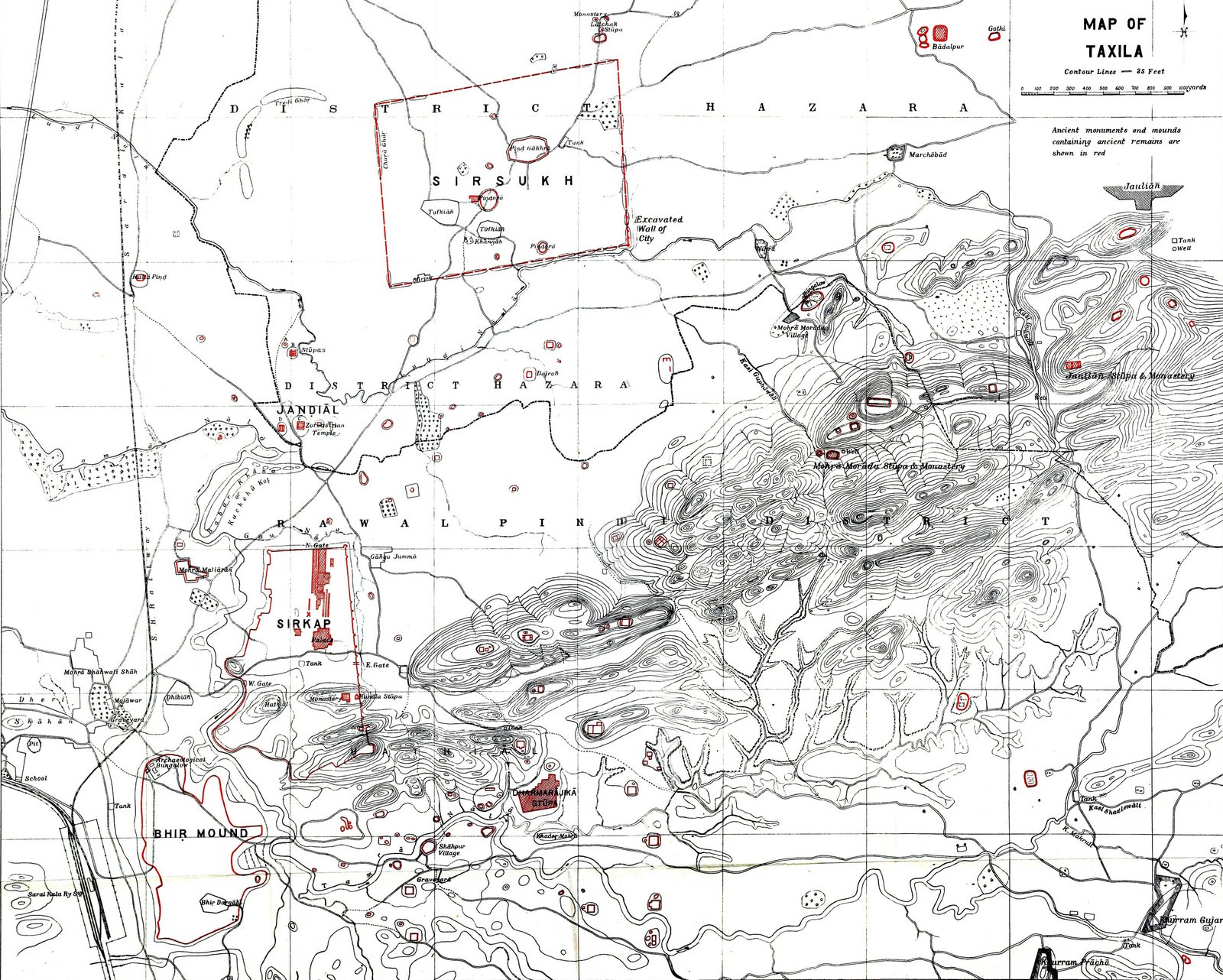
Five cities in one valley: Bhir Mound, Sirkap and Sirsukh
"Taxila" is not a single ruin. It is a sequence of settlements, each founded a short walk from the last, so the valley reads like a stack of centuries laid out side by side. Every few hundred years the city moved, never far, and left its old site to become a mound.
Punjabi has an exact word for such a place: a theh (ਥੇਹ · تھیہ), the mound an abandoned settlement leaves behind, where old bricks and potsherds work their way to the surface after rain. Taxila is a valley of thehs.
The oldest traces are not urban at all. A cave at Khanpur, on the valley's edge, has yielded stone tools of the Mesolithic, the long age of hunter-gatherers. Then come the farmers.
In 1968 Pakistani archaeologists identified a prehistoric mound at Sarai Khola, which UNESCO spells Saraikala, just south-west of today's Taxila Museum. Excavations by F. A. Khan and M. A. Halim uncovered a village of the Neolithic, the first farming age, with polished stone axes. By radiocarbon dating it was first lived in between the late fourth and early third millennium BCE, and the find pushed the valley's history back by some three thousand years. Later levels belong to the Kot Diji tradition, a regional culture of the early Indus age that grew up before, and then alongside, the cities of Harappan Punjab. Later still, the site became an Iron Age cemetery.
At Hathial, the ridge at the centre of the valley, burnished red pottery suggests a settlement from around 1000 BCE, perhaps earlier. It is arguably the first town of Taxila, though how much of a town it was is Probable rather than proven.
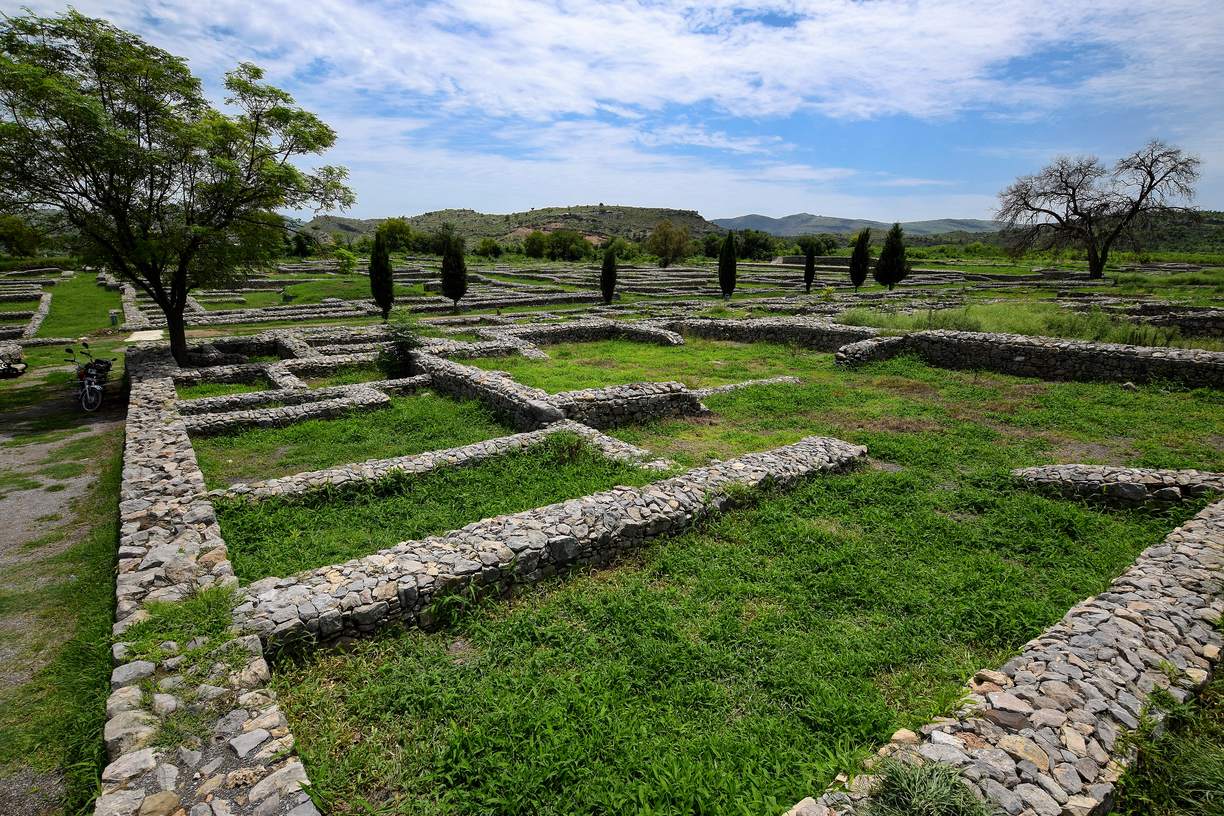
The first city you can actually walk through is the Bhir Mound, beside the museum. John
Marshall dug it from 1913 and found a maze of irregular lanes and houses of rough stone
rubble, with no grid and no obvious plan, rebuilt again and again. He counted four layers
of building and put the lowest probably to the sixth or seventh century B.C.
Others date the town's beginning to the sixth century, and the excavations resumed in 2025
have reported traces of occupation beneath the sixth-century levels. This was the Taxila
that Alexander saw.
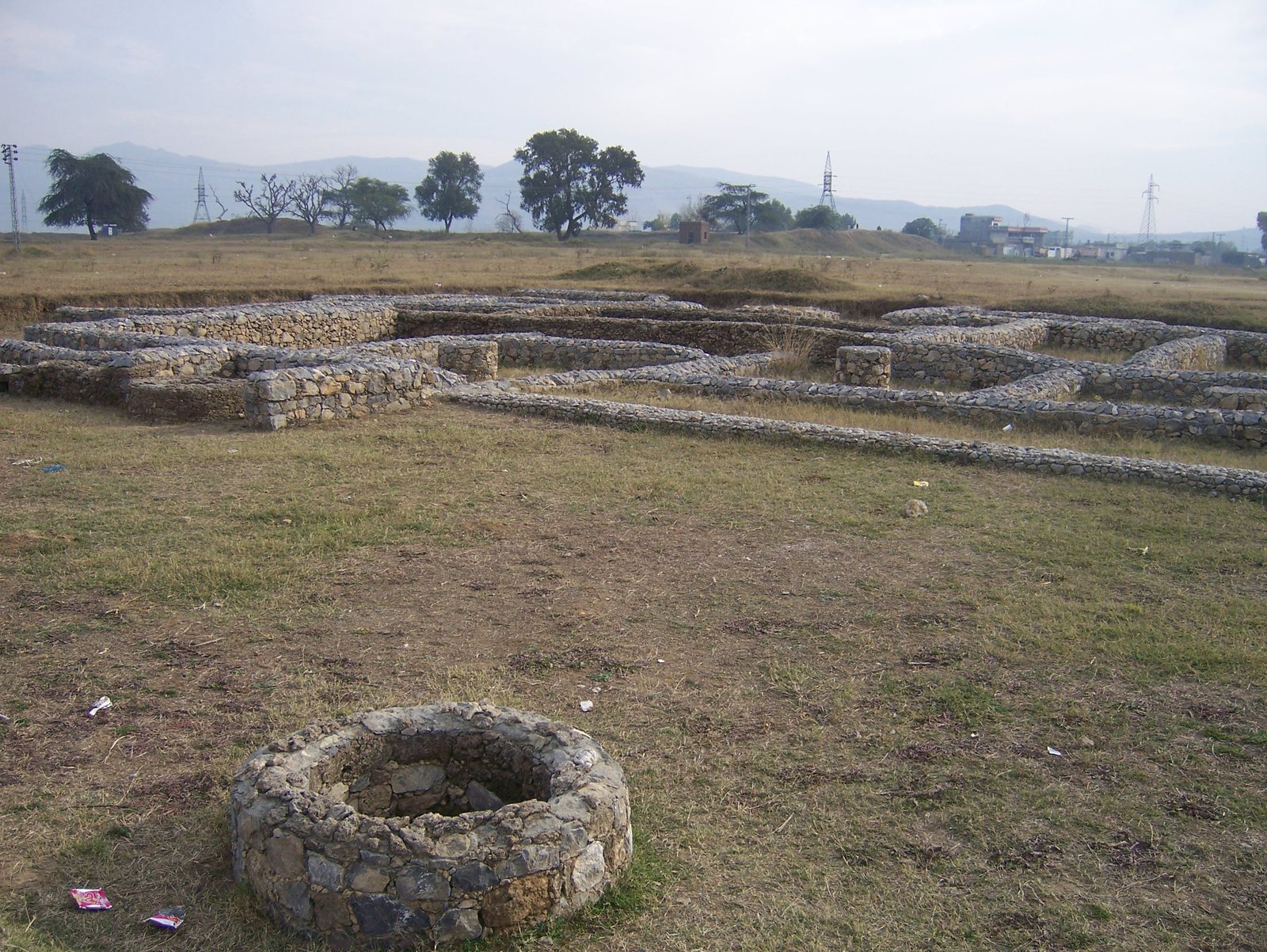
In the second century BCE the city moved across the Tamra stream to the western end of the Hathial ridge, the site now called Sirkap. The new city was laid out on a grid, the plan Greek town-planners had used since the fifth century BCE: a long, straight main street, with blocks of houses, shops and shrines opening off it at right angles.
Finally, late in the first century CE or early in the second, the Kushan kings moved the city north-east across the Lundi stream to a walled enclosure now called Sirsukh. Its walls, faced with dressed stone and set with rounded bastions, show the influence of Central Asian building. Marshall found the interior hard to dig, low-lying and irrigated, with the ancient remains buried deep under silt, and little of it has been excavated since. Three modern villages stand on top of it.
Why did Taxila keep moving? New dynasties wanting capitals of their own, defence, water, perhaps earthquakes: archaeologists still argue about which mattered when. What matters here is that an ancient writer's "Taxila" may mean any of three cities, and that the teachers of the Buddhist stories, if they lived anywhere, lived in the lanes of the Bhir Mound.
And the names? When Cunningham surveyed the valley in 1863–64 the villagers already had a name for every part of it: Bir or Pher for the oldest mound, Hatiāl for the ridge, Sir-Kap-kā-Kot for the second city and Sir-Sukh-kā-Kot for the third. "Bhir" is the village that stood on the mound. Sirkap and Sirsukh are something else entirely. We will come to them.
Persian Taxila
Around 520 BCE the Persian king Darius I had a list of his provinces carved into the cliff at Bisotun, in western Iran. Among them is Gandāra. For roughly two centuries, until Alexander, the north-west of the subcontinent belonged, at least on paper, to the Achaemenid Empire, which stretched from the Aegean to the Indus. Whether Taxila itself, east of the river, lay inside it is less certain.
How much did Persia make Taxila? UNESCO's statement on the site says the Bhir Mound was
probably founded
by the Achaemenids, and Marshall thought so too. Other scholars
point to Hathial and to the older pottery at the Bhir Mound, and argue that the Persians,
if they came at all, took over a place that was already growing on its own. The new
excavations may help to settle the question. For now it is open.
What is not open is the Persian legacy you can still read. The Achaemenid chancery wrote in Aramaic. In Gandhāra, scribes adapted its alphabet to write their own speech, a Prakrit, an everyday Indo-Aryan language and cousin to Sanskrit, now called Gāndhārī. The result was Kharoṣṭhī, written right to left like its Aramaic parent. For some seven centuries it was the script of the north-west: of coins, contracts, donors' inscriptions and, eventually, some of the oldest Buddhist manuscripts in existence.
Here Taxila touches the Punjab of today in a way that is easy to miss. Aramaic is also the distant ancestor, through a long chain of scripts, of the Arabic alphabet, and so of Shahmukhi, in which Punjabi is written in Pakistan. The region's other script was Brāhmī, the ancestor of almost every Indian script, Gurmukhi among them by way of Śāradā and Laṇḍā. Both families left their mark here. An Aramaic inscription turned up at Sirkap, the only one Marshall knew of in India, and Brāhmī was written in the valley too. To walk through Taxila is to walk among the ancestors of both the scripts Punjabis write today. There is more on each in our pages on Gurmukhi and Shahmukhi.
City of teachers
This is the part of Taxila's story everyone has heard, and the part most often told wrong. Begin with what the sources actually say.
What the stories say
Taxila's reputation for learning comes overwhelmingly from Buddhist literature, above all the Jātakas. In dozens of them a young man of sixteen is sent to Takkasilā: a prince of Benares, a priest's son, a boy from the Ganges plain. He goes to study under a teacher the texts call disāpāmokkha, "famous in every direction", and learns "the three Vedas and the eighteen arts", a stock phrase the stories fill with archery, elephant lore, medicine and the reading of omens.
The shape of this education is remarkably consistent, and it is not the shape of a
university. There is no institution. There is a teacher, an
ācariya, who takes pupils into his own household. The pupil, an
antevāsin, "one who lives near", lodges with him, serves him and
learns. The Tilamuṭṭhi Jātaka spells out the two ways in. Pupils who could not pay
attend on their teacher by day, and at night they learn of him
. Those who brought a
fee, a thousand coins in the prince's case, are treated like the eldest sons in his
house
. The bond outlasted the lessons: teachers visited old pupils, and pupils honoured
teachers for life.
The rest of our prince's story shows how seriously that bond was taken. Walking to bathe with his teacher, the prince takes a handful of an old woman's sesame three mornings running, and the teacher has him held by two boys and struck three times across the back with a bamboo stick. The prince finishes his studies educated and resentful. Years later, as king, he sends for his old master to take his revenge. The teacher waits until the king's temper has had time to cool, then comes and tells him the beating is why he became an honest king rather than a thief. The courtiers agree. The king offers his teacher the kingdom, is refused, sends to Takkasilā for the teacher's family, and makes him his royal priest, treating him, the story says, like a father.
The doctor's final exam
The most vivid student in the Taxila tradition appears not in a fable but in the
Vinaya, the Buddhist code of monastic discipline. Jīvaka
Komārabhacca began life on a rubbish heap at Rājagaha, modern Rajgir in Bihar, where his
mother had him left in an old winnowing basket. A prince named Abhaya saw the crows
gathering, asked whether the child was alive, was told he was, and had him raised; the
name Jīvaka comes from the word for "alive". Needing a trade, the young man slipped away
without asking leave and travelled the length of northern India to Takkasilā, to study
under a world-renowned physician
.
After seven years he grew impatient. He learned much and learned easily, he told his teacher, and forgot nothing, and still he could not see the end of the art. When would it be over? The teacher handed him a spade and told him to search a yojana, a league of several miles, all round Takkasilā and bring back any plant that was not a medicine. Jīvaka searched and came back empty-handed: he had found nothing that was not medicinal. Then you have learned enough to earn your living, said the teacher, and gave him a little money for the road. It ran out at Saketa, and he earned his fare home by curing a merchant's wife of a seven-year illness.
It may be the best examination story in ancient literature, and it shows how Taxila's education worked: the test was set, judged and certified by one teacher alone. Jīvaka went home to become, in Buddhist tradition, physician to King Bimbisāra of Magadha and to the Buddha. In Thailand he is still honoured as the "father doctor" of traditional medicine. Later texts name his teacher Ātreya; the Pali account does not name him at all.
The grammarian and the kingmaker
Two of the most famous names attached to Taxila deserve more careful handling than they usually get.
Pāṇini wrote the Aṣṭādhyāyī, "eight chapters": a description of Sanskrit in about four thousand compressed rules, so rigorous that linguists and computer scientists still study it. The American linguist Leonard Bloomfield called it one of the greatest monuments of human intelligence. Pāṇini was almost certainly a man of the north-west. His grammar names Takṣaśilā in a rule for words that mean "someone whose family comes from such-and-such a place". The very next rule names Śalātura, a town near the Indus crossing that the pilgrim Xuanzang, in the seventh century CE, was told was Pāṇini's birthplace. Later tradition calls him Śālāturīya, "the man from Śalātura", a word his own grammar explains how to form. That he came from the north-west is Well-established.

Xuanzang heard a story at Śalātura that belongs in this article. A Buddhist saint, passing
through, found a brahmin beating a small boy he was teaching grammar. Asked why, the brahmin
said the child was making no progress. The children of this town, who are his
disciples
, he added of Pāṇini, revere his eminent qualities, and a statue erected to
his memory still exists.
The story is a Buddhist one, told to make a point about
rebirth, and it is religious tradition rather than record. But in the town the pilgrim
heard it in, centuries after the grammar was written, its author's pupils were still being
taught it, stick and all.
That Pāṇini himself studied or taught at Taxila, however, is a later tradition, not a record, and Contested. Even his dates are uncertain: most scholars place him somewhere between the sixth and fourth centuries BCE.
Chāṇakya, the strategist said to have put Chandragupta Maurya on the throne around 320 BCE, is harder still. A commentary on the Sri Lankan Buddhist chronicle, the Mahāvaṃsa, dated anywhere from the sixth to the thirteenth century CE, makes him a brahmin of Takkasilā who spots a boy playing at kings and makes him an emperor. The Jain version, told by Hemacandra in the twelfth century, has him born in a village called Caṇaka. The Arthaśāstra, the treatise on statecraft attributed to one Kauṭilya, was probably composed and revised between about the first century BCE and the third century CE, and its identification with the Chāṇakya of legend is itself a later tradition. He may have been a man of Taxila. What is certain is that when storytellers needed a birthplace for a genius, Taxila was the obvious choice.
Some names attached to Taxila have no ancient support at all. The physician Charaka is often said to have studied there; no ancient source says so.
Was Taxila really a university?
Put the evidence together and the answer is clear, even if it is not the one the internet prefers. Taxila was a great centre of learning. It was not a university.
The only eyewitness description of its teachers says as much. Aristobulus, who marched
with Alexander in 326 BCE, saw two teachers at Taxila, both brahmins, one old with a shaven
head and one young with long hair, both followed by disciples
. When not otherwise
engaged they spent their time in the market-place, honoured as counsellors, allowed to take
whatever goods they liked, and so well regarded that passers-by poured sesame oil over
them. There is no building in his account, and no institution: two men, their pupils and
the market.
Scholars have said so for nearly a century:
- A. S. Altekar, in Education in Ancient India (1934), noted
that the Jātakas tell many stories of Taxila's students and teachers, but
not a single episode even remotely suggests
that its world-renowned teachers belonged to any college or university. Each ran an independent school. In his second edition he put it flatly: Taxila had no collegeor university in the modern sense of the term. It was simply a centre of education.
There were no degree examinations, and so no degrees. - He compared it with Benares as the French traveller François Bernier saw it in the
seventeenth century:
a kind of university
, with no colleges or regular classes, the masters spread through the town in private houses. - Hartmut Scharfe's Education in Ancient India (2002), the modern survey of the evidence, reaches the same conclusion by a longer road.
What Taxila had instead was a concentration of independent teachers, each with a household of resident pupils, each setting his own course and his own tests. The Jātakas like to give a famous teacher five hundred pupils, which Altekar took for a conventional figure rather than a count. There were no degrees, no administration and no campus. The archaeology quietly agrees: teaching in houses leaves no special buildings, and no excavation at Taxila has found a school of the kind the Jātakas describe. The absence of a campus is exactly what the texts predict.
Institutions came later, in a different form. From about the first century CE, Buddhist monasteries on the hills round Taxila housed monks who studied, copied texts and taught (see Monks on the hills). Comparisons with Nalanda in Bihar, the monastic university that flourished from the fifth century CE with endowments, libraries and an administration, set two different things side by side.
So where do the 10,500 students and 68 subjects come from? We have found no ancient
source for them, and no modern one that cites any. The word "university" itself is easier
to trace. Marshall, who dug Taxila, wrote in his 1918 guide that the Jātakas showed its
great reputation as a University town
. Even Altekar, a few pages after denying it
any university, slipped into calling Pāṇini an alumnus of Taxila university
. The
label hardened as it travelled, into textbooks and exam guides in India and tourist
literature in Pakistan. UNESCO's two official summaries of the site disagree with each
other: the English calls Taxila an important Buddhist centre of learning
, while the
French says it was the seat of une université bouddhique florissante
.
The truth is better anyway. Calling Taxila a university is a little like calling a bazaar a department store: it gets the scale and the excitement right, and the structure wrong. Taxila was a place where knowledge was bought, earned and passed from one person to another, which is how most of the world's knowledge has always travelled.
Guru and chela, ustad and shagird
Punjabi still carries two vocabularies for that person-to-person teaching, one from each of the great streams that met in the region:
- Indic: gurū (ਗੁਰੂ · گرو), teacher, from a Sanskrit word whose literal meaning is "heavy", a person of weight; and chelā (ਚੇਲਾ · چیلا), disciple.
- Persian: ustād (ਉਸਤਾਦ · استاد), master; and shāgird (ਸ਼ਾਗਿਰਦ · شاگرد), apprentice.
In Sikh usage Gurū also has a further, sacred meaning, reserved for the ten Gurus and the Guru Granth Sahib; in everyday speech both pairs describe the same bond. Musicians, wrestlers and craftsmen in both Punjabs still speak of years in a master's company, learning by imitation and service until the master judges them ready. Even the Punjabi word for teaching, sikkhiā (ਸਿੱਖਿਆ · سکھیا), comes from Sanskrit śikṣā, which was also the name of one of the ancient auxiliary sciences of the Vedas: the study of pronunciation.
None of this means that the Punjab of today inherited its teaching customs directly from Taxila. Twenty-five centuries and many other influences lie between them, and a direct line is Contested at best. But when a young musician moves into his ustād's household, or a stone-carver's son learns the chisel at his father's bench, the shape of the relationship would have been familiar to Jīvaka.
Alexander at the gate
In the spring of 326 BCE, Taxila made the most consequential decision in its history. It opened its gates.
Its king had been in touch with Alexander of Macedon for some time, while the Macedonian army was still fighting its way through the mountains to the west. His own name was probably Āmbhi; the Greeks called him Omphis, or simply Taxiles. His motives are not hard to guess. His great rival was Porus, whose kingdom lay beyond the Jhelum, and an alliance with the invader was one way of dealing with a neighbour.
When Alexander reached the Indus, according to the historian Arrian, he found gifts
waiting from Taxiles: 200 talents of silver, 3,000 oxen and more than 10,000 sheep for
sacrifice, thirty elephants and 700 horsemen. With them came word that Taxiles would
surrender his city, the largest town between the rivers Indus and Hydaspes
.
Alexander never let himself be outdone in generosity. Plutarch says the two kings traded
gifts until Alexander ended the contest with a thousand talents in coin, to the disgust of
his own officers. At Taxila he held games and sacrifices, and left a garrison when he
marched on.
For the first time we see Taxila through outsiders' eyes. Strabo, drawing on writers who were there, calls it a large city with excellent laws. Aristobulus remembered that it was at Taxila that the rains first came that year, and recorded customs that struck him as strange: the dead were left out for the vultures, and families too poor to marry off their daughters brought them to the market-place, to the sound of drums and trumpets, to find them husbands. These are foreigners' snapshots, preserved second-hand, and they tell us as much about what surprised Greeks as about what was normal in Taxila.
The most famous encounter was a lesson. Alexander sent Onesicritus, an officer who had studied under the philosopher Diogenes, to find the naked ascetics the Greeks called gymnosophists, "naked wise men", who lived twenty stades outside the city. He found fifteen of them, standing, sitting or lying motionless on stones so hot that no one could walk on them barefoot at noon. One of them, Kalanos, laughed at the Greek's cloak, hat and boots, and told him that if he wished to learn he must first take off his clothes and lie down on the stones beside him. The eldest, Mandanis, rebuked Kalanos for arrogance. Then he politely pointed out the difficulty of the whole exercise: to teach philosophy through three interpreters who knew nothing but the words, he said, would be like expecting water to flow pure through mud. He added, the Greek recorded, that he had advised Taxiles to receive Alexander.
Mandanis refused to go to the king. Kalanos went, persuaded, Plutarch says, by Taxiles himself. The Greeks called him Kalanos because he greeted people with the word kale; his real name, Plutarch adds, was Sphines. The other ascetics, according to Megasthenes, reproached him for serving an earthly lord. He travelled with the army as far as Persia, and there, old and ill, he chose to die on a funeral pyre before the assembled troops. The ancient writers disagree about where it happened. Later writers added a prophecy that he would meet Alexander again in Babylon, where the king soon died: exactly the kind of detail a historian should distrust, and Contested.
Alexander fought Porus at the Battle of the Hydaspes, where, in Arrian's telling, Porus, wounded, nearly speared Taxiles when he rode up with Alexander's message. The army pushed east until it refused to go further. Within three years Alexander was dead.
He left one small, glittering trace in Taxila's soil. In 1924 Marshall's excavators at the Bhir Mound found a hoard of 1,167 silver coins with a gold and silver necklace. Most were punch-marked coins of local types. Two were silver tetradrachms of Alexander, and one was a gold stater of his half-brother and successor, Philip Arrhidaeus, who reigned from 323 to 317 BCE, so the hoard went into the ground after that, perhaps around 300 BCE. Somebody in Taxila, a generation after the Macedonians came and went, hid their wealth in more than one currency, and never came back for it.
Ashoka's northern capital
Alexander's eastern conquests did not survive him. Within a generation the north-west had passed to a new Indian power, the Maurya dynasty founded by Chandragupta, whose capital lay far to the east at Pāṭaliputra, modern Patna. Taxila became a provincial city of an empire centred on the Ganges.
We know its status from an unusually direct witness: the emperor Ashoka himself. In the
mid-third century BCE Ashoka had instructions to his officials carved on rocks across his
empire. In one of them, at Dhauli in Odisha, he orders that the prince governing Ujjayinī
send out officers at least every three years to make sure justice is being done, and then
adds: In the same way … from Takshasila also.
Taxila was one of the empire's
regional capitals, most likely governed, like Ujjayinī, by a prince of the royal family.
That it was a Mauryan provincial seat is
Well-established.
Buddhist legend adds more drama than the edicts allow. The Aśokāvadāna, a Sanskrit collection of Ashoka stories compiled around the second century CE, says that when Taxila rebelled against Ashoka's father, the young prince was sent to put the revolt down and was met by citizens who insisted they had risen against wicked ministers, not against the king.
Later another revolt brought Ashoka's son Kuṇāla, named for his beautiful eyes, to Taxila. There, the story says, a jealous queen, Tiṣyarakṣitā, whose advances he had refused, forged an order under the royal seal commanding that the prince's eyes be put out, and he submitted. Xuanzang was shown a stupa, a solid, dome-shaped Buddhist monument usually built over relics, said to mark the spot, and he was told that blind people who prayed there often recovered their sight. A ruined stupa on the ridge above Sirkap still carries Kuṇāla's name, following Marshall's identification rather than any ancient label.
A fragment of stone may bridge legend and record. In 1915 Marshall found at Sirkap part of an octagonal marble pillar inscribed in Aramaic. A damaged phrase in it is read by many scholars as "our lord Priyadarśi", "he who looks on with kindness", the title Ashoka used in his edicts. If so, this is a Mauryan inscription at Taxila, perhaps from Ashoka's time. The reading is plausible but not certain: Probable.
The Mauryas' most lasting mark was religious. Buddhism, which Ashoka famously patronised, seems to have taken root at Taxila in this period. The Dharmarājikā stupa, east of the old cities, is traditionally credited to Ashoka; its core may be Mauryan, though most of what stands today is later rebuilding. Locals call it the Chir Tope, "the split stupa", after the great cleft that nineteenth-century treasure-seekers cut through its middle. For eight centuries the hills round Taxila would fill with stupas and monasteries (see Punjab's Buddhist millennium).
Greeks, Scythians and a double-headed eagle
As Mauryan power weakened, Greek kings from Bactria, in northern Afghanistan, ruled by Greek settlers since Alexander's time, crossed the Hindu Kush early in the second century BCE. One of them, traditionally Demetrius, is credited with moving Taxila to its gridded new site at Sirkap, though the date and the founder are Contested. For three centuries, under a bewildering succession of Greek, Scythian and Parthian kings, Sirkap was one of the most cosmopolitan cities in Asia.
The coins tell the story at a glance. Indo-Greek kings struck them with a Greek legend on one side and a Kharoṣṭhī legend on the other, speaking to two publics at once.
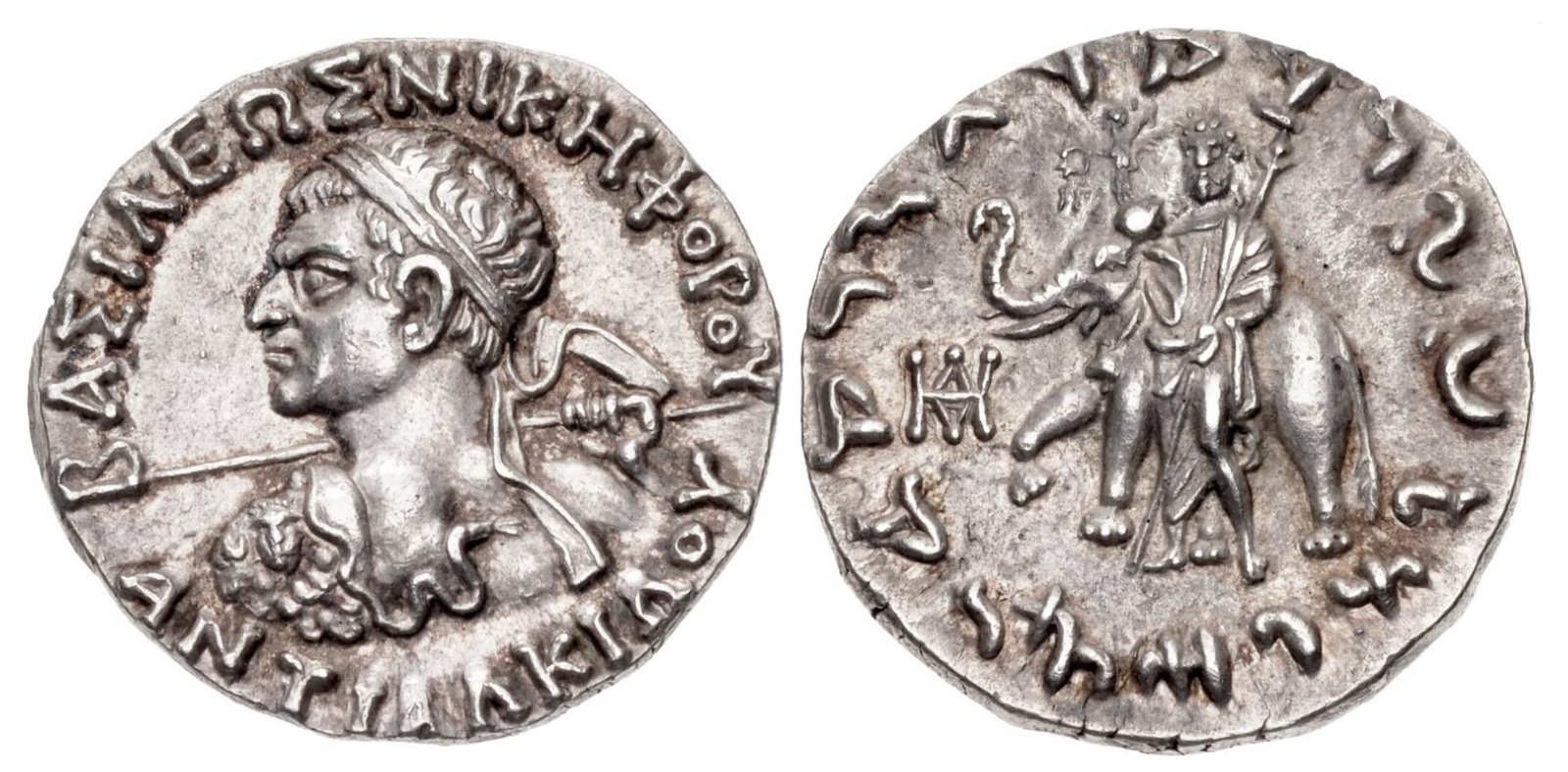
So does a pillar more than a thousand kilometres away. Late in the second century BCE a Greek envoy named Heliodorus, son of Dion, raised a column at Vidisha in central India to the god Vāsudeva, whom he worshipped. His inscription calls him a devotee, ambassador of the Greek king Antialcidas to the Indian king Bhāgabhadra, and a man of Taxila. A second inscription lists three steps to immortality: self-restraint, generosity and watchfulness. A Greek from Taxila, honouring an Indian god with Indian ethics: it is hard to think of a better emblem of the city.
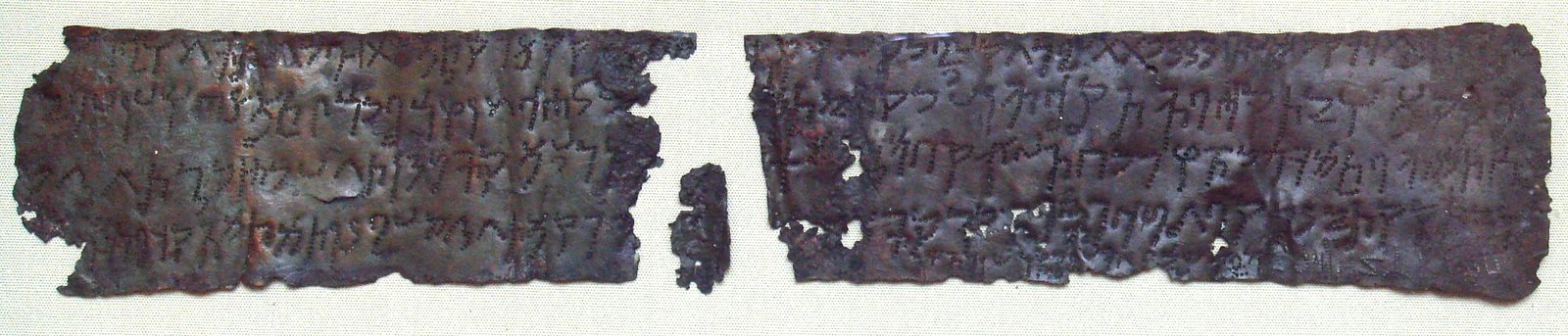
In the first century BCE the Indo-Scythians, Central Asian nomads whom Indian sources call Śakas, took over. From their time comes a thin copper plate, found in the ruins of Sirsukh, that sums up Taxila better than any essay:
- It records that Patika, son of the satrap Liaka Kusuluka, enshrined a relic of the Buddha and founded a monastery at a place called Chhema, north-east of Takhaśila.
- It is written in the local language, Gāndhārī, in Kharoṣṭhī, the script descended from Persian-era Aramaic.
- It is dated to the fifth day of Panemos, a month of the Macedonian calendar, in the
year 78 of
the great king, the great Moga
, known to historians as Maues. - It even names its overseer of works, a man called Rohinimitra.
A Scythian governor's son dated a Buddhist foundation by a Greek month, in an Indian language, in a script with Persian roots. The plate is now in the British Museum.
Next came the Indo-Parthians. Their best-known king, Gondophares, ruled at Taxila in the first half of the first century CE, as his coins and an inscription from Takht-i-Bahi show. Walk down Sirkap's main street today and you pass the monuments of this mixed world:
- The Great Apsidal Temple, the city's largest sanctuary, was Buddhist, with a row of rooms for its monks along the courtyard wall.
- The Shrine of the Double-Headed Eagle is the most photographed ruin in Taxila. Between Corinthian pilasters its base shows three kinds of niche side by side: the pediment of a Greek temple, an arch shaped like the curved roofs of Bengal, and an early Indian gateway of the kind carved at Mathura. Above one of them perches a two-headed eagle, a motif Marshall traced back to the Hittites of Western Asia and thought the Scythians had brought.
- The temple at Jandial, just outside the city, has Ionic columns and the plan of a Greek temple. Marshall thought it was used for fire worship, perhaps by Zoroastrians; others see a Greek shrine. Near it he found two small stupas that he thought more likely Jain than Buddhist.
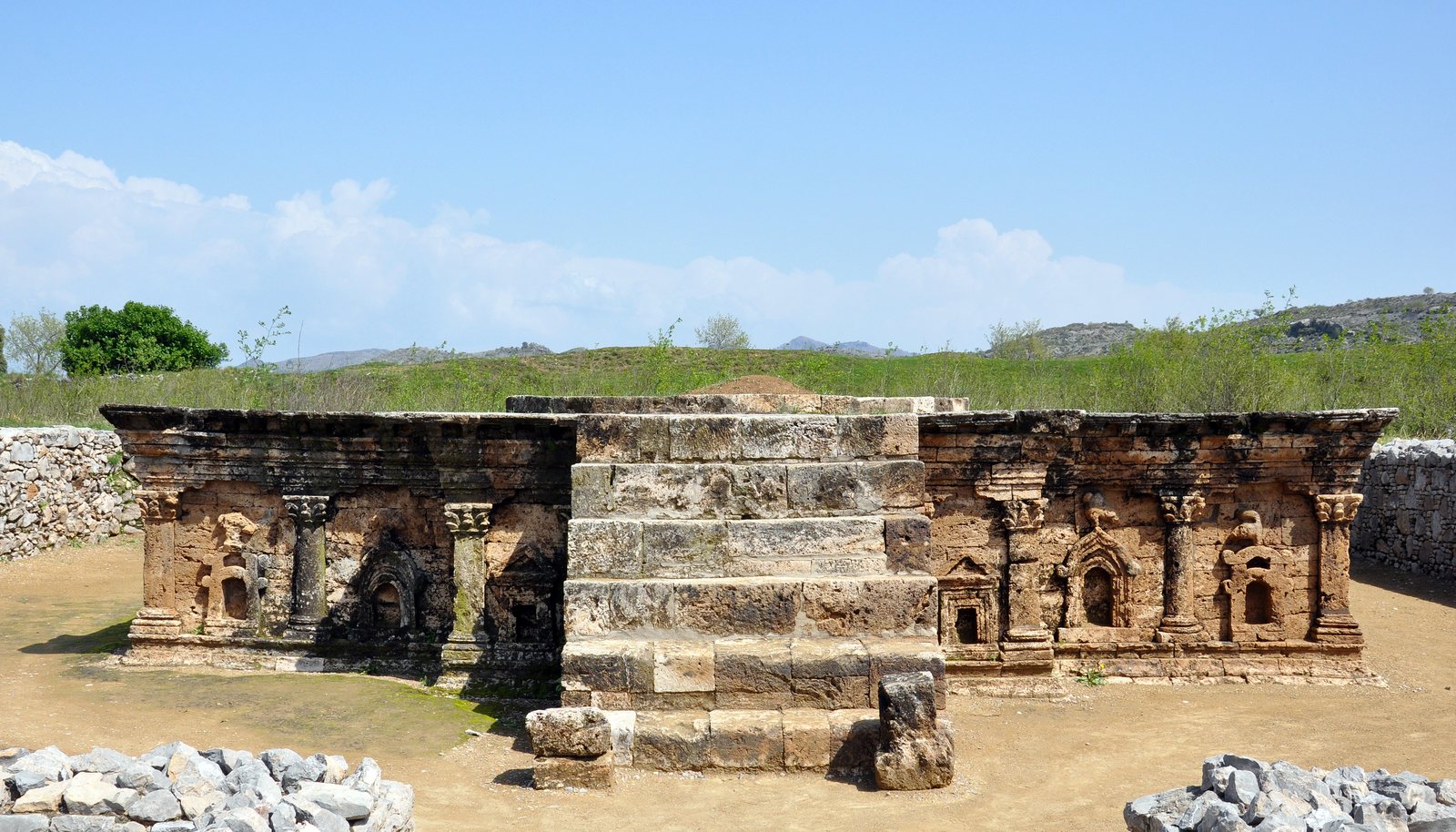
Buddhists, followers of Greek cults, devotees of Vāsudeva, and perhaps Zoroastrians and Jains lived within a short walk of one another.
From this world comes the strangest description of Taxila to survive. In the early third century CE the Greek writer Philostratus sent his hero, the wandering philosopher Apollonius of Tyana, to Taxila and its Greek-speaking king, Phraotes. The city, he says, was about as big as Nineveh and walled in the Greek manner, with narrow streets as irregular as those of Athens. Its houses looked single-storeyed from the street, but inside them rooms were dug as far below the ground as the upper rooms rose above it. Outside the walls stood a temple whose shrine was hung with bronze panels showing the deeds of Porus and Alexander. Much of Philostratus is fiction, and whether Apollonius ever reached India is Contested. Yet parts of the picture fit Sirkap as the excavators found it, basement rooms and all, with a temple outside the walls at Jandial.
The same Parthian king gave Taxila a place in Christian memory. The Acts of Thomas, a Syriac text of the early third century CE, tells how the apostle Thomas was sold as a slave to King Gudnaphar, that is Gondophares, to build him a palace, gave the money to the poor instead, and won the king to his faith.
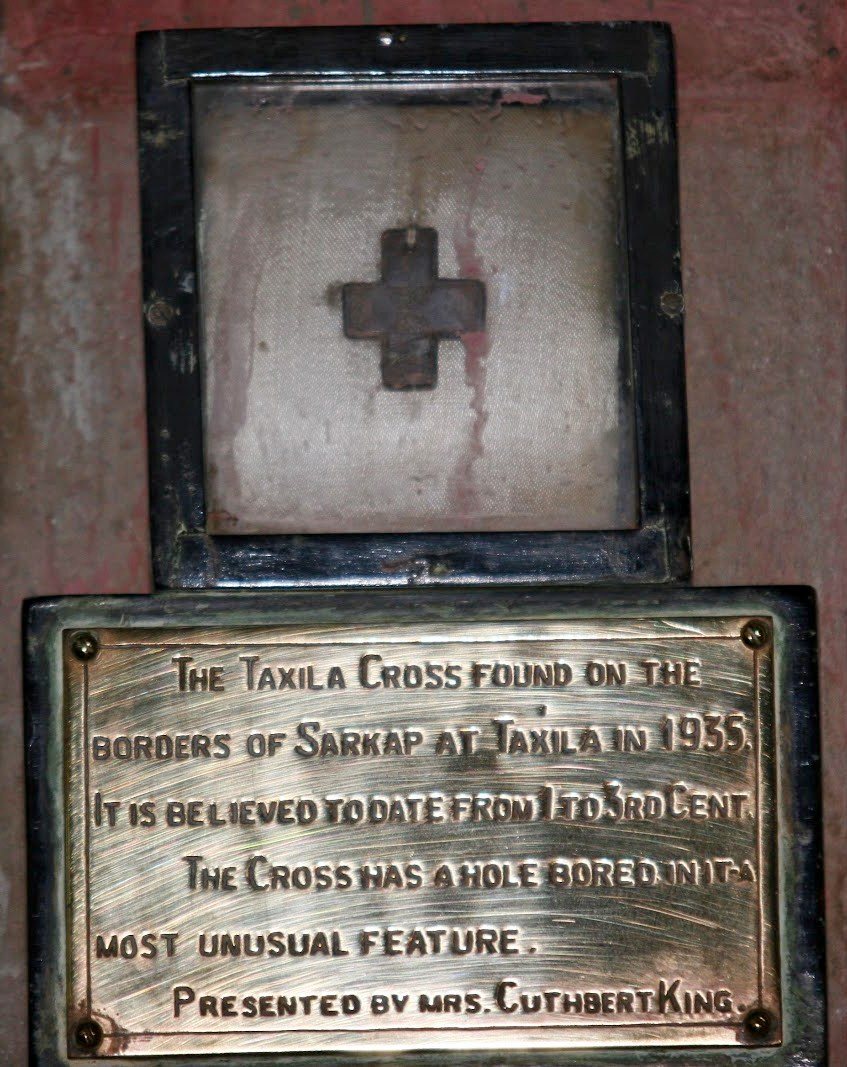
In 1935 a farmer ploughing outside Sirkap turned up a small cross. It was presented to the Anglican cathedral in Lahore by Mrs Cuthbert King, whose husband was then Deputy Commissioner of Rawalpindi, and it is displayed there as the Taxila Cross. It was not found in any datable layer, and its age is unknown. Every July, Christians from across Pakistani Punjab still gather at Sirkap for the feast of St Thomas; in 2026 some five hundred came in eight buses from a single parish in Gujranwala.
Monks on the hills
In the first century CE the Kushans arrived. They were descended from the Yuezhi, nomads pushed west from the borders of China into Bactria. Under kings such as Kujula Kadphises, Vima Kadphises and Kanishka they built an empire that reached from Central Asia to the Ganges. They moved Taxila one last time, to Sirsukh, and under their rule the valley reached the height of its prosperity.
This was the great age of Gandhāran art, a school of sculpture in grey schist and stucco whose Buddhas wear the wavy hair and heavy drapery of Greek and Roman statues. Gandhāra and Mathura, in the Ganges–Yamuna country, were the two schools that first gave the Buddha a human form; which came first is still argued.
It was also the age of the monasteries. Around the city rose Mohra Moradu, Jaulian, Kalawan, Giri, Pippala, Bhamala and more. Each had a stupa for worship and a monastery to live in: a square court ringed by small cells, with a verandah on wooden pillars, an assembly hall, a kitchen and stores. Here, at last, Taxila had institutions of learning.
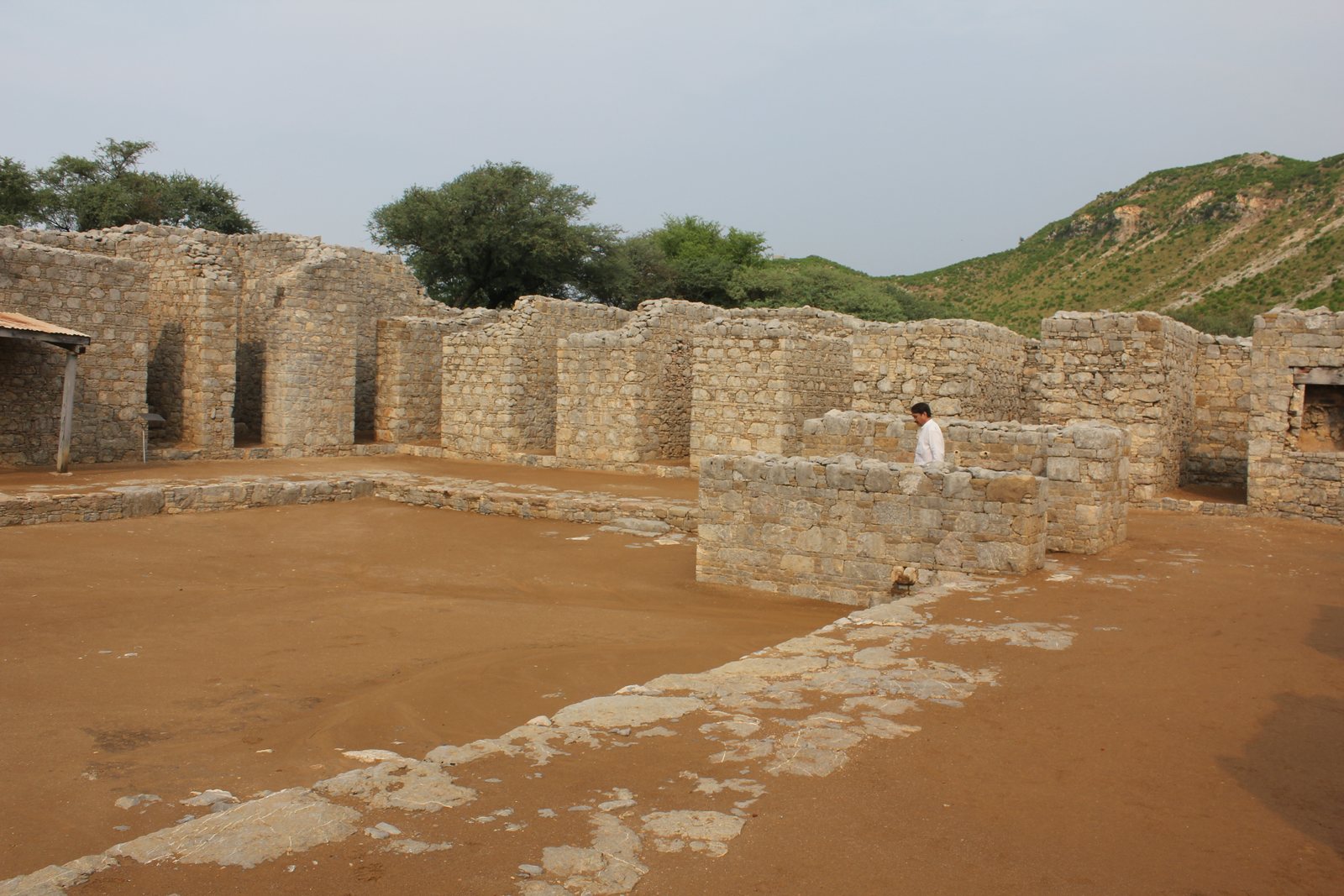
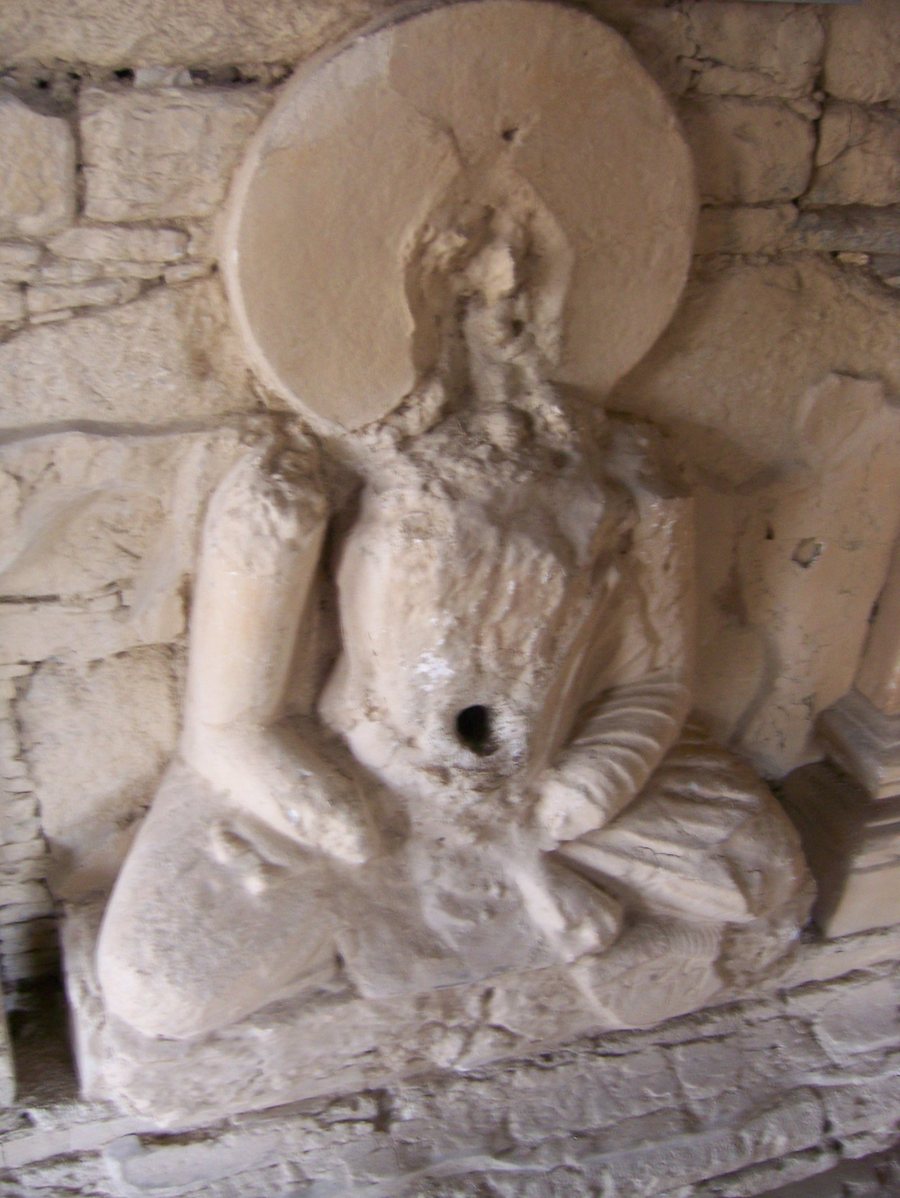
- Jaulian, on a hilltop above the valley, had two storeys of cells round
its court, a stair in one cell climbing to the upper floor. When Marshall dug it he found,
in the burnt cells, a birch-bark manuscript in Brāhmī letters of the Gupta age, badly
charred: the first manuscript of its kind, he wrote, found in any excavation in India. On
the main stupa sits a Buddha with a small hole at the navel and a Kharoṣṭhī dedication
beneath, recording it as the gift of one Budhamitra,
who delighted in the law
. Worshippers pressed a finger into the hole as they prayed to be healed. - Mohra Moradu, in a hollow of the hills, was so well sheltered that its
stupa kept stucco reliefs which elsewhere
have almost entirely perished
. They give, Marshall wrote, a much better idea than anything else of how these monuments looked when they were new. - Jinnān Wālī Ḍherī, "the mound of the jinns", a monastery of the fifth century CE excavated only in this century, yielded fragments of a wall painting of the Buddha among his followers, found in about 2005 and among the first Buddhist murals recovered anywhere in Pakistan, together with coins of the Kidarites, a Hun dynasty.
This was Taxila's second school, and in one sense a more important one than the first. Xuanzang was told that Kumāralabdha, a master of the Sautrāntika school of Buddhist thought, had once lived and written his treatises here. Gandhāra, with Taxila among its great centres, was one of the regions through which Buddhist texts, images and teachers travelled north into Central Asia and on to China. Some of the oldest Buddhist manuscripts known anywhere come from Gandhāra, though not from Taxila itself: birch-bark scrolls in the Gāndhārī language, written in Kharoṣṭhī around the first century CE.
When Faxian passed through around 400 CE, he found great stupas adorned with precious materials, and kings, ministers and people vying with one another to make offerings. He was shown the place where the future Buddha had given away his head. Two days' journey to the east, he was shown the place where, in another life, the Buddha had given his body to feed a starving tigress. It is the last glowing report anyone would write.
How Taxila emptied
Within a century and a half of Faxian's visit, much of this world lay in ruins. How that happened is one of the genuine debates in the history of the region.
The version in older books is simple. In the second half of the fifth century, Hun invaders, the "White Huns", swept over Gandhāra and the Punjab, burning monasteries and killing monks, and Taxila never recovered. That was Marshall's reading of the burnt layers he found in the monasteries, Jaulian's charred cells among them, and it is still repeated on signboards and websites.
The evidence now looks more complicated:
- The Huns themselves. Historians today usually call the Huns who ruled Gandhāra the Alchon Huns, and distinguish them from the Hephthalites further north. At first they seem to have taken part in the region's Buddhist culture rather than set out to destroy it.
- The persecutor. Buddhist writers remember a later Alchon king, Mihirakula, in the early sixth century, as a savage persecutor. But those writers were the heirs of his victims, writing long afterwards.
- The economy. Gandhāra's economy seems to have collapsed in the late fifth century. Some scholars argue that trade routes increasingly bypassed the valley, starving the monasteries of the merchant patronage they depended on.
Whatever the causes, an eyewitness recorded the result. When Xuanzang reached Taxila
around 630 CE, on his way to study in India, he found a small state that had once been
subject to Kapiśa and now paid tribute to Kashmir. The royal family being extinct
,
he wrote, the nobles contend for power by force.
There were many monasteries, but
they had become ruinous and deserted
, with very few monks.
But a valley is not a city, and it did not empty completely. In the Giri glen, at the foot of the hills, people later built a fort. Later still, a Muslim community left a three-domed mosque, a tomb and a madrasa, a school, all now part of the World Heritage site. The madrasa is not precisely dated, but UNESCO calls it medieval: the valley remembered for its teachers still had a school long after the monasteries fell silent.
The region passed meanwhile to the Hindu Shāhi kings, whose capital was at Udabhāṇḍapura, modern Hund, on the Indus, not far from Pāṇini's Śalātura. Early in the eleventh century it passed to Maḥmūd of Ghazni and his successors (see Lahore becomes a capital).
Taxila's roads outlived its cities. The Mughal emperors marched this way to Kabul and Kashmir, halting at the caravanserai of Kala-ka-Sarai, at the garden of Wah and at the springs of Hasan Abdal. Meanwhile, among the fields, the old cities lay quietly under the plough.
Demons, jinns and a king's mound
Here is the answer to our second question. When the ancient names had been forgotten, the people who farmed the valley gave the ruins names of their own, taken from the stories they told.
The greatest of those stories is the cycle of Rājā Rasālū
(ਰਾਜਾ ਰਸਾਲੂ ·
راجا رسالو), a hero
of Punjabi folklore. In the legend he is the son of Rājā Sālbāhan of Sialkot and the
half-brother of the saint Pūran Bhagat. Cunningham, who heard many versions
of it
himself in the 1860s, wrote that it belonged above all to the Pothohār, but that it was
known too near Lahore, at Pinjore east of the Sutlej and among the Gujars of the Jumna.
In the version tied to Taxila, the country was terrorised by seven rākṣasas, man-eating demons: three brothers called Sirkap, Sirsukh and Amba, and four sisters, Kapi, Kalpi, Munda and Mandehi. Rasālū came to fight them. In the end he faced the eldest, Sirkap, across a board of chaupaṛ (ਚੌਪੜ · چوپڑ), the old cross-shaped race game played with long dice, for stakes that included human heads.
In Charles Swynnerton's telling of 1884, Sirkap cheats with a trained rat, Dhol Raja,
that scurries across the board upsetting the pieces, until Rasālū finds a way round the
trick. Sirkap loses his kingdom, his wealth and finally his head. At that moment a daughter
is born to him. He orders her killed; Rasālū instead takes the baby, Kokilā, vowing to
marry her when she is grown. In the gentler version Cunningham heard west of Lahore,
Rasālū wins Sirkap's head and accepts the daughter in its place. The villagers there, he
noted, had the most undoubting faith
in the story.
So the second city of Taxila bears the name of a demon who gambled for heads, and the third bears his brother's. The name Sirkap is usually explained as "severed head" or "head-cutter", since sir means "head". Cunningham read it differently, taking all seven names as words for hunger, kap as "trembling" and sukh as "wasted". The derivation has never been settled, and either reading is Contested.
Now recall Faxian's city of the severed head, where the future Buddha gave his head away, and the tigress two days to the east. Cunningham, who first put these pieces side by side, went a long way further: he argued that the whole Rasālū story was the Buddhist tale of the body given to the starving tigress, retold. The seven hungry demons were the tigress's cubs; Rasālū, offering himself in place of a widow's only son, was the compassionate Buddha. It is a brilliant guess, and nobody has been able to prove it. Heads, like demons, are common currency in folklore everywhere, so the link is Contested. But places gather stories the way mounds gather layers.
The valley is full of such names:
- Jinnān Wālī Ḍherī, the monastery ruin, is "the mound of the jinns".
- The Dharmarājikā is the Chir Tope, "the split stupa".
- Shāh Ḍherī, the village beside the old cities where Taxila was identified in 1863, is roughly "the king's mound". A ḍherī (ਢੇਰੀ · ڈھیری) is a heap, and across the north-west the word names ancient mounds.
One more place shows the valley's sacred geography running through several faiths, at Hasan Abdal, about ten miles north-west of the ruins. Cunningham, who visited in 1848 and again in 1864, pieced its layers together:
- Buddhist. Xuanzang described a sacred tank seventy li north-west of Taxila, the home of a nāga, or serpent spirit, called Elāpatra. People went there with the monks to pray for rain or fine weather. Cunningham identified it with the springs at Hasan Abdal, and most scholars have followed him.
- Sufi. Later the spring was linked with the saint Bābā Walī Qandhārī, from Kandahar, whose shrine crowns the hill above. Hasan, called Abdāl, was by the account Cunningham was given a Gujar who built the town's sarai and lies buried at the foot of the hill.
- Sikh. Sikh tradition holds that Guru Nanak, thirsty, asked Walī for water, that the saint hurled a great stone down at him, and that the Guru stopped it with his hand. The print it left names Gurdwara Panja Sahib, "the revered handprint", one of the most revered Sikh shrines in Pakistan. Hari Singh Nalwa is credited with building its first gurdwara.
At Hasan's tomb, Cunningham was told a Muslim faqir's version in which Nanak and Walī had known each other in an earlier life. A serpent spirit, a Sufi saint, a Sikh Guru: one spring, three memories, within a day's walk of Taxila.
Finding Taxila again
By the nineteenth century nobody was sure where Taxila had been. Scholars knew the name from the Greek historians and the Chinese pilgrims, but the Roman writer Pliny put it only sixty Roman miles from Peukelaotis, near modern Charsadda, which pointed to the wrong place, and the ruins had no signboard.
The man who found it was Alexander Cunningham, a British army engineer turned antiquarian, who in 1863–64 used the Chinese pilgrims' itineraries like a treasure map. They put Taxila three days' march east of the Indus: the third halt of the Mughal emperors, at Kala-ka-Sarai. A mile from it, near the village of Shāh Ḍherī, he traced the ruins of a fortified city spread over some three miles by two. Around it he counted fifty-five stupas, two of them as large as the great stupa at Manikyala, twenty-eight monasteries and nine temples. The oldest part, the people told him, was the great mound on which stood the village of Bir.
Cunningham's reports celebrate his own deductions, and his survey leaned heavily on the
people of the valley. The best-informed of them was Nur of Shāh Ḍherī, a water-carrier who
in the 1850s and 1860s made his living by opening small stupas and selling what he found
to officials and dealers. Cunningham used Nur's memory of which mound had yielded which
relic to trace finds that had already left the ground. Marshall, half a century later,
called Nur one of the worst offenders
. A 2022 study by the Pakistani archaeologist
Ifqut Shaheen argues that Cunningham relied on such local guides while dismissing them as
ignorant destroyers, and never credited them. Nur was both at once: a man who dug stupas
for a living, and the person who knew the ground better than anyone who came to study
it.
Systematic excavation began in 1913 under John Marshall, Director-General of the Archaeological Survey of India, and continued until 1934. Marshall dug the Bhir Mound, Sirkap and the great monasteries. The foundation stone of a site museum was laid in 1918 by the viceroy, Lord Chelmsford, so the finds could stay in the valley, and the museum opened in 1928. In 1951 Marshall published three volumes that remain the starting point for everything written about Taxila since. His interpretations are now debated. His record is not.
Then, in the winter of 1944–45, Taxila became a school again. Mortimer Wheeler, newly appointed head of the Archaeological Survey, ran a training excavation at the Bhir Mound, recruiting young graduates to learn modern methods of digging by layers. His trainees went on to lead archaeology in two new countries. Among them were:
- B. B. Lal and M. N. Deshpande, both later Directors-General of the Archaeological Survey of India;
- Ahmad Hasan Dani, who trained under Wheeler at Taxila and Mohenjo-daro in 1945 and became Pakistan's foremost historian of Gandhāra. From 1997 until his death he was honorary director of the Taxila Institute of Asian Civilizations in Islamabad.
After 1947 Pakistani archaeologists took up the work, pushing the valley's story back into prehistory at Sarai Khola and Hathial. In 1980 UNESCO inscribed Taxila on the World Heritage List as eighteen sites, ten in Punjab and eight in Khyber Pakhtunkhwa. Its own assessment is frank about the threats: industrial estates, limestone blasting and quarrying in the valley, weather and vegetation on exposed walls, and looters digging at the monasteries.
And the story is not finished. In 2025 the Punjab Department of Archaeology resumed excavation at the Bhir Mound after a gap of about two decades. Its team, led by the deputy director Aasim Dogar, has since announced a run of finds:
- December 2025: streets, drains and walls, with deposits reaching the sixth century BCE, and the hope that a deeper trench will go further back.
- January 2026: fragments of lapis lazuli, a blue stone mined in Badakhshan in north-eastern Afghanistan, attributed to the sixth century BCE; bronze coins of the Kushan emperor Vasudeva; and a dancing terracotta figure of the third century BCE that a former curator of the Taxila Museum reads as a sign that Jains lived in the city alongside Buddhists.
- April 2026: eighteen glass beads, apparently from one necklace, dated to between the second century BCE and the first century CE.
These are preliminary announcements, not yet fully published, and their dates and readings will be tested: Probable at best for now. But the valley that taught for a thousand years is still, quite literally, turning up new lessons.
Epilogue: the road to school
Modern Taxila is a busy, unromantic place: a subdistrict of about three-quarters of a million people at the 2023 census, with a cantonment, heavy engineering works and a railway junction. The ruins sit among its suburbs and fields. Buddhist pilgrims from East and South-East Asia come to pray at stupas no local community has used for well over a thousand years. Christians come to Sirkap for St Thomas; Sikh pilgrims pass along the road to Panja Sahib. In workshops near the museum, carvers still shape the valley's dark stone into Gandhāran forms, learning the craft from fathers and masters in the old way, though fewer young people now want to learn it and many carvers have turned to tombstones or left the trade.
There is even a university in Taxila now, a real one, with a charter and degrees. The University of Engineering and Technology began in 1975 as a college of UET Lahore, taught its first three years at Sahiwal, moved to Taxila in 1978 and became an independent university in 1993. It is tempting to call it the ancient university reborn. It is not, and it does not need to be. What the old valley had was older than any university, and it is the thing universities were eventually invented to organise: the habit of going somewhere, often far from home, to learn from someone who knows more than you do.
The prince with the one-soled sandals never existed. But the road he took did, and people are still on it.
Taxila through time
| Date | Event | What kind of claim |
|---|---|---|
| Mesolithic | Stone tools left in the Khanpur cave | Established consensus |
| Late 4th–early 3rd millennium BCE | First farming village at Sarai Khola | Established consensus (radiocarbon) |
| 3rd millennium BCE | Kot Diji-tradition settlement at Sarai Khola | Established consensus |
| c. 1000 BCE, perhaps earlier | Settlement on the Hathial ridge | Competing interpretation on the dates |
| c. 520 BCE | Gandāra listed among the provinces of Darius I | Established consensus |
| 6th century BCE, perhaps earlier | The Bhir Mound grows into a town | Consensus on the town; its origins debated |
| 5th–4th century BCE | Pāṇini's grammar names Takṣaśilā | Consensus on the text; its date debated |
| 326 BCE | King Āmbhi, "Taxiles", hands Taxila to Alexander | Established consensus (Greek sources) |
| c. 324–323 BCE | Kalanos, an ascetic from Taxila, dies on a pyre in Persia | Established consensus; place and year disputed |
| After 317 BCE | Hoard with coins of Alexander and Philip Arrhidaeus buried at the Bhir Mound | Established consensus |
| Late 4th century BCE | The north-west passes to the Mauryas | Established consensus |
| Mid-3rd century BCE | Ashoka's edict at Dhauli names Takhasilā as a provincial seat | Established consensus |
| 3rd century BCE (attributed) | Dharmarājikā stupa founded | Religious tradition; a Mauryan core is debated |
| 2nd century BCE | Indo-Greeks move the city to Sirkap | Competing interpretation on date and founder |
| Late 2nd century BCE | Heliodorus of Taxila raises his pillar at Vidisha | Established consensus |
| 1st century BCE | Indo-Scythian rule; Patika's copper plate | Established consensus |
| First half of the 1st century CE | Gondophares rules; setting of the St Thomas tradition | Consensus on the king; religious tradition on Thomas |
| Late 1st or early 2nd century CE | Kushans build Sirsukh | Established consensus; exact date debated |
| 2nd–5th centuries CE | Jaulian, Mohra Moradu and the other monasteries flourish | Established consensus |
| c. 400 CE | Faxian visits | Established consensus |
| Late 5th–early 6th century CE | Decline under the Alchon Huns | Competing interpretation on the causes |
| c. 630 CE | Xuanzang finds Taxila ruined and tributary to Kashmir | Established consensus |
| Medieval period | Fort, mosque, tomb and madrasa at Giri | Established consensus; dates imprecise |
| 16th–17th centuries | Mughal road; Kala-ka-Sarai; the garden at Wah | Established consensus |
| 1863–64 | Cunningham identifies Taxila near Shāh Ḍherī | Established consensus |
| 1913–1934 | Marshall's excavations; museum begun 1918, opened 1928 | Established consensus |
| 1944–45 | Wheeler's training excavation at the Bhir Mound | Established consensus |
| 1968–1973 | Sarai Khola excavated | Established consensus |
| 1975–1993 | UET Taxila founded (1975), moved to Taxila (1978), chartered (1993) | Established consensus |
| 1980 | UNESCO World Heritage inscription | Established consensus |
| 2025–26 | Bhir Mound excavations resume; preliminary finds announced | Preliminary; not yet published |
Quick answers
Where is Taxila?
Taxila is in Rawalpindi District of Punjab, Pakistan, about 30 km north-west of Islamabad, at the northern edge of the Pothohār plateau. Its ancient remains lie around the modern town and together form a UNESCO World Heritage Site: three city sites, older settlements, and dozens of Buddhist monasteries.
Was Taxila the world's first university?
No. Taxila was a renowned centre of learning, but the evidence shows independent teachers taking resident pupils into their own households, not an institution with colleges, an administration or degrees. Figures such as "10,500 students" and "68 subjects" have no ancient source. Organised Buddhist monastic education came later, from about the first century CE.
What does the name Taxila mean?
"Taxila" is the Greek form of the Sanskrit Takṣaśilā, usually read as "cut stone" or "the rock of Takṣa". The Rāmāyaṇa credits the city to Takṣa, a nephew of Rāma, while the Chinese pilgrim Faxian was told it meant "the severed head". The meaning of the word's parts is secure. What its founders intended is not.
Is Taxila in India or Pakistan?
Taxila is in Pakistan, in Punjab province. In ancient times it belonged to Gandhāra and was linked by road to the whole of northern South Asia. Its history is claimed with pride on both sides of the border and belongs to the shared heritage of the Punjab region.
Who destroyed Taxila?
No single conqueror did. The old view that "White Huns" destroyed it in the fifth century CE is now debated. Historians point to a combination of economic decline, lost patronage, shifting trade routes and episodes of violence under the Alchon Huns. By about 630 CE the Chinese monk Xuanzang found it largely in ruins.
Who studied at Taxila?
The best-known student is Jīvaka, physician to the Buddha, whose seven years there are told in the Buddhist monastic code, a religious text rather than a record. The only eyewitness account of Taxila's teachers is Greek: in 326 BCE Aristobulus saw two brahmins there with their disciples. Later traditions add the grammarian Pāṇini and the statesman Chāṇakya; both are possible, and neither is proven. Claims about Charaka have no ancient support.
What is Taxila famous for?
Its teachers and students in Buddhist tradition; a succession of cities from the sixth century BCE to the fifth century CE; its part in Alexander's campaign and the Mauryan empire; Gandhāran Buddhist art and monasteries; and its place on the roads linking the Ganges plain, Kashmir and Central Asia.
Punjabi words in this article
| Word | Say it | Meaning |
|---|---|---|
| thehਥੇਹ · تھیہ | “tay”, with a breathy t; the written ਹ is heard as a tone, not a sound | mound of ruins; tell |
| ḍherīਢੇਰੀ · ڈھیری | “DHAY-ree”, with the tongue curled back; the ḍh is heard as a low tone on a plain ḍ | a small heap; an old mound |
| chaupaṛਚੌਪੜ · چوپڑ | “CHOW-purr”, the ṛ a quick flap of the curled-back tongue | chaupar, a cross-shaped race game |
| chelāਚੇਲਾ · چیلا | “CHAY-laa” | disciple, pupil |
| ustādਉਸਤਾਦ · استاد | “oos-TAAD” | master, teacher |
| sikkhiāਸਿੱਖਿਆ · سکھیا | “SIK-khee-aa”, holding the k | teaching, instruction, education |
Names
| Name | Say it | What it is |
|---|---|---|
| Ṭaiksalāਟੈਕਸਲਾ · ٹیکسلا | “TEK-suh-laa”, with the tongue curled back for the ṭ; often said Ṭeksilā | the modern town, a borrowing of the Greek Taxila by way of English; the older learned form ਤਕਸ਼ਿਲਾ is kept in Gurmukhi for the ancient city |
| Pothohārਪੋਠੋਹਾਰ · پوٹھوہار | “POH-toh-haar” | the upland plateau of northern Punjab between the Jhelum and the Indus; its speech is Pothwari |
| Sirkapਸਿਰਕਪ · سرکپ | “SIR-kup” | the second city of Taxila; in folklore the demon king Rājā Rasālū beat at chaupaṛ. Its companion Sirsukh (ਸਿਰਸੁਖ · سرسکھ) is named for his brother |
Punjabi is written in two scripts, Gurmukhi and Shahmukhi. Each word in the first table links to its full entry in the Punjabi word archive, with its origin, cultural background and an example sentence. All Gurmukhi and Shahmukhi on this page are awaiting review by a native reader.
Keep going: the Battle of the Hydaspes, where Taxila's king rode with Alexander; Punjab's Buddhist millennium, the age of the monasteries; and Harappan Punjab, the cities that came before.