At a glance
- Lahore
- ਲਾਹੌਰ · لاہور · Lāhaur. The capital of Punjab province, Pakistan, and the country's second-largest city. Lahore district counted 13,004,135 people in the 2023 census, and about three in four gave Punjabi as their first language.
- First named
- In the Hudud al-Alam, a Persian geography completed in 982 CE. No reliable founding date exists.
- Seat of an independent power
- At least five times: the last Ghaznavid sultans (c. 1160–1186); Qutb al-Din Aibak (1206–1210); the emperor Akbar's court (1586–1598); the Sikh chiefs who shared the city (1765–1799); Maharaja Ranjit Singh and his successors (1799–1849).
- Seat of a province
- For most of the rest: Ghaznavid India from the 1020s, the Mughal province of Lahore, British Punjab (1849–1947), West Punjab (1947–1955), West Pakistan (1955–1970) and Punjab province (since 1970).
- World heritage
- The Lahore Fort and the Shalamar Gardens have been a UNESCO World Heritage Site since 1981. UNESCO named Lahore a City of Literature in 2019.
- Neighbour
- Amritsar lies about 50 kilometres east, across the border at Wagah and Attari.
This is a long read, and we tell it in order. Where the evidence is solid we say so plainly. Where a claim rests on religious tradition, folklore, oral history or a live argument among historians, a labelled note says which, using the labels explained on our About page, and where it matters we say how sure we are on the same page's three-step scale. Anything unlabelled is established history. Our editorial standards explain the rest. Tap or hover over a Punjabi word to see it in both scripts.
Prologue: the gate
On 7 July 1799, somebody inside Lahore opened a gate.
The soldiers waiting outside belonged to an eighteen-year-old Sikh chief from Gujranwala named Ranjit Singh. He had come to take the city, but not to besiege it. Lahore was ruled by the sons of three chiefs who had shared it for a generation, and its people had had enough of them, and some of the city's leading men were in league with him. Who they were depends on whom you read. The earlier British accounts name Muslim notables only. Syad Muhammad Latif, who wrote Lahore's history in 1892 from the memories of its families, names Hakim Rai, Bhai Gurbakhsh Singh, Mian Ashiq Muhammad and Mir Shadi: by their names, a Hindu, a Sikh and two Muslims. He says the gate itself was opened by the chaudhri who kept it, Mohkam Din.
It was the Lohari Gate, which Latif says is properly the Lahori Gate, named after the city itself. Local tradition holds that its quarter was the first to be lived in when Lahore was rebuilt after an older conquest, eight centuries before. Ranjit Singh had camped his troops in Anarkali, south of the walls, and his mother-in-law, the formidable Sada Kaur, rode with him. Of the three rulers, one was away at Gujrat; the two in the city fled, though some later accounts have Chet Singh hold out in the Fort for a night before accepting terms and an estate. Every account agrees that the city changed hands with remarkably little bloodshed.
Two years later, at the spring festival of Vaisakhi, Ranjit Singh was proclaimed Maharaja in the city he had taken. He came from Gujranwala, and he did not make Gujranwala his capital. Nobody who wanted to rule the Punjab ever did. They came to Lahore.
That is the puzzle this article sets out to solve. Lahore has been the seat of an independent power at least five times in the last thousand years, and the seat of a province for most of the time in between. Sultans from Ghazni, an emperor of the house of Timur, Sikh chiefs, a Sikh maharaja, a British governor and the governments of modern Pakistan have all ruled from it. People who agreed on almost nothing else agreed on this: whoever holds Lahore holds the Punjab.
Why here? Part of the answer is written in the land. Part of it is written in a river that no longer runs where it used to, in a small silver coin struck in Lahore in two alphabets nearly a thousand years ago, and in a Persian title that passed from one dynasty's money to the next like an heirloom. We will come to all three.
And part of the answer is harder to footnote. It is the reason families on both sides of a border still say, generations after leaving, that whoever has not seen Lahore has not been born.
A city without a birthday
Lahore has no founding date, and anyone who offers you one is repeating a story.
The best-loved story is sacred and very old. In a tradition preserved among Lahore's Hindus, the city was founded by Lava, or Loh, one of the twin sons of Rama and Sita, and was once called Lavapurī, "the city of Lava". The same tradition gives his brother Kusha the town of Kasur, some fifty kilometres to the south-east. Inside the Lahore Fort a small shrine is associated with Loh to this day, and the Walled City of Lahore Authority, which looks after the Fort, still opens its account of the place with him.
Scholars have tried other routes. In the nineteenth century some suggested that a place called Labokla in Ptolemy's second-century geography was Lahore, or that a large city the Chinese pilgrim Xuanzang passed through in the seventh century stood here. Both identifications rest on a likeness of sound or a rough match of distances, and neither is better than Contested. The name itself has attracted theories, among them "fort of Loh" and a link with a word for iron. None can be proved.
The ground is more honest than the etymologists. The Fort stands on a mound built up from the debris of the settlements that stood there before it. In 1959 archaeologists digging in front of its hall of public audience found a gold coin of Mahmud of Ghazni, dated 1025, deep in the mound, and the remains of an older, pre-Muslim town below it. People lived here long before anyone wrote the name down.
When the name does appear in writing, it appears without ceremony, and with a surprise. The
Hudud al-Alam, "The Regions of the World", is an anonymous Persian geography
completed in 982 CE for a prince in what is now northern Afghanistan. It is the oldest
securely dated text to name the town, and its entry is three lines long. Lahore, it says, is
"a town with numerous districts". Its government is on behalf of the chief of Multan.
It has markets and temples; all its people, it says, are idolaters, the word Muslim
geographers used for Hindus, and there are no Muslims there. It adds that pine-nut trees,
almonds and coconuts grow there, which suggests that the compiler, writing a long way off, was
working from report.
Multan, three hundred kilometres to the south-west, had been ruled by Muslim amirs since the Arab conquest of Sindh in the eighth century. If the geographer was right, the first thing the written record tells us about Lahore is that it was governed from somewhere else. A generation later the scholar al-Biruni, who knew the Punjab at first hand, called the whole region Lauhāwar and gave its capital as a place he calls Mandahukur, "east of the river Irāwa", the Ravi. Nobody has securely identified Mandahukur. The spelling wandered too: Luhāwar in the Persian chronicles, Lāhanūr in the poet Amir Khusrau. The place stayed where it was.
So the first thing to know about Lahore is that its importance does not come from great age. Taxila, some 280 kilometres to the north-west, had been famous for more than a thousand years before Lahore is named anywhere, and Multan was the great Muslim city of the Punjab. Lahore mattered because of where it was, and because, at the end of the tenth century, the wider world arrived at its gates.
The lie of the land
Capitals are rarely chosen for their beauty. They are chosen, usually by soldiers, for four duller things: water, defence, food and roads. Lahore had all four.
Water came from the Ravi, the Paruṣṇī of the Rigveda and the Irāvatī of later Sanskrit, one of the five rivers that give the Punjab its name. For most of Lahore's history the river ran close along the city's northern edge; in the Mughal period it flowed beneath the Fort's northern wall, and the ferry for Kabul was just outside it. It brought water, fish and boats, and deodar timber floated down on rafts from the forests of Chamba. It also brought floods, which is one reason the city clung to its mound.
Defence came from that mound and from distance. Lahore lies far enough from the Khyber and the other north-western passes that an army coming down them would be reported long before it arrived, and near enough that a ruler in Lahore could send an army up them. A seat of government placed close to the frontier it exists to watch is what historians call a forward capital.
Food came from the Bari Doab, the tongue of land between the Ravi and the Beas, which forms the heart of the country Punjabis call Majha. A doab is the land between two rivers (the word in the archive), and this one is among the most fertile ground in the subcontinent. A court, a mint and a garrison of many thousands of horsemen all had to be fed every day, and the country around Lahore could do it.
And the roads came from everywhere. The great route from Kabul through Peshawar, across the Indus at Attock and on towards Delhi and the Ganges plain passed through Lahore. Sher Shah Suri rebuilt it in the 1540s; the British called it the Grand Trunk Road. Other routes ran north to Kashmir and south to Multan and Sindh. The names of the old city's gates are a map of the world they opened onto: the Delhi Gate faces Delhi and the Kashmiri Gate faces Kashmir. One gate, the Ṭaksālī, takes its name, by the usual account, from the ṭaksāl, the mint, that stood near it. The mint will matter later.
Put these together and Lahore becomes the natural place from which to govern the plains between the Indus and the Sutlej. Geography made Lahore eligible. It took an invasion to make it a capital.
The frontier becomes a seat of power, c. 1000–1044
At the end of the tenth century the strongest power in the Punjab was the dynasty historians call the Hindu Shahis. Its kings ruled from Udabhandapura, which the Persian writers called Waihind, the modern village of Hund on the Indus near Attock, and at their height their lands ran from the Kabul valley deep into the Punjab. Who governed Lahore itself is less clear. The Hudud al-Alam, as we have seen, puts it under the amir of Multan in 982; later Persian histories make it part of the Shahi kingdom, or give it a raja of its own. The sources do not agree, and none of them is close enough to settle it.
To the west, in Ghazni, a Turkic dynasty had risen out of the slave-soldiers of the Samanid state. Its greatest ruler, Mahmud of Ghazni (r. 998–1030), defeated the Shahi king Jayapala near Peshawar in 1001, beat his son Anandapala a few years later, and took the Shahi stronghold of Nandana in the Salt Range in 1014. In 1006 he had also stormed Multan and massacred the followers of its Isma'ili ruler. Around 1020–21 (the sources disagree on the year) Mahmud took Lahore.
Some historians think the last Shahi kings, driven out of Nandana, made Lahore their seat in those final years, which would make Lahore's first spell as a capital a Hindu one. Others place their last courts elsewhere. The evidence is thin and late, and the honest answer is that we do not know: Contested.
Mahmud is remembered in two ways that cannot easily be reconciled. In India he is the raider of temples, above all of Somnath in 1025–26. In the Persian world he is the patron at whose court al-Biruni worked and to whom Firdausi presented the Shahnameh. Historians still argue over how far his Indian campaigns were driven by piety and how far by plunder, and the argument has long since become political as well as scholarly. What is not in dispute is that the taking of Lahore, unlike his raids, was meant to last.
What that meant can be held in the hand. In 1027 and 1028 the Lahore mint, which the coins now call Mahmudpur, "Mahmud's city", struck silver dirhams of a kind issued nowhere else. One face carries the usual Arabic legends. The other is in Sanskrit, written in the Śāradā script then used across the north-west. It renders the Muslim profession of faith into Sanskrit, describing the Prophet with the word avatāra; it calls the coin a ṭaṅka struck at Mahmudpur; and it dates it by what it calls the era of the Tājikas, which is to say the Hijri calendar, explained to a Sanskrit-reading public. So far as is known, these coins were struck only at Lahore and only in those two years. The new government, it seems, needed its money to be understood by people who did not share its faith or its language.

Look at that coin again with a Punjabi reader's eyes. Śāradā is the ancestor of the Laṇḍā scripts from which Gurmukhi grew. The Arabic script on the other face is the ancestor of Shahmukhi. The forebears of both alphabets in which Punjabi is written today sit back to back on a small disc of silver struck in Lahore nearly a thousand years ago. How Punjabi came to be written in two scripts
The Ghaznavid hold on Lahore was never simply a matter of Muslim over Hindu. After Mahmud died in 1030, his son Mas'ud nearly lost the Indian command. Ahmad Niyaltigin, the officer in charge of the Indian provinces, led a daring raid as far as Benares in 1033 and then turned rebel, and the court historian Baihaqi records that "numerous turbulent fellows of Lahore, from all classes of people" flocked to him. When the sultan asked his council who would go against him, the man who stepped forward was Tilak, a Hindu who had risen high in Ghaznavid service. Baihaqi says he was the son of a barber, handsome and eloquent, and wrote an excellent hand in both Hindi and Persian: the two worlds of the Mahmudpur coin in one man. It was Tilak and his Indian troops who broke the rebellion in 1034.
In 1036 Mas'ud appointed his own son Majdud to govern India, and sent him with three commanders, a splendid army, a secretary and an accountant. Baihaqi names the accountant as Sa'd-i Salman. Remember him; his son would become Lahore's first great poet.
Where, then, is Ayaz? He was the most famous favourite of the Ghaznavid court, the young Turkish slave whose devotion to Mahmud, and Mahmud's to him, became a stock theme of Persian poetry and Sufi allegory. Lahore remembers him as something more: the man who rebuilt the city after its conquest and raised its first walls. Latif wrote down the tradition in 1892, placing him in charge of Mahmud's garrison from 1023, and a small tomb in the Rang Mahal quarter of the old city is venerated as his.
Eight and a half centuries later, Muhammad Iqbal, who lived and is buried in Lahore, made "Mahmud and Ayaz standing in a single row" an Urdu byword for master and servant made equal at prayer. Poetry, as so often in this story, kept a memory the chronicles never held.
Then, in 1040, everything changed. At Dandanqan, in the desert near Merv, the Seljuk Turks destroyed Mas'ud's army and took the rich province of Khurasan. The Ghaznavids were left with the mountains of Afghanistan and the plains of the Punjab, and the plains were the richer half. When an alliance of Indian kings besieged Lahore in 1043–44, the city held out for months, by one account seven, until the siege was broken.
By the middle of the eleventh century, Lahore was no longer a frontier town. It was the second city of an empire whose first city was in danger.
A saint, a poet and two prisoners
A capital is not only a fort and a mint. It is where a state's educated people go to find patrons, and where they stay. Ghaznavid Lahore gave South Asia one of its best-loved saints and the Persian language one of its finest poets, in the same generation. Both, as it happens, knew what it was to be held against their will.
The saint came from Ghazni. Ali Hujwiri, who also called himself al-Jullabi, was a scholar
and mystic who had travelled for years through Iraq, Syria and Khurasan before he came to
Lahore. There he wrote the Kashf al-Mahjub, "The Unveiling of the Veiled", the
earliest treatise on Sufism in the Persian language. At one point he breaks off a story
because he cannot check it. His books, he explains, had been left behind at Ghazni, while he
himself had become a captive among uncongenial folk in the district of Lahawur, which is a
dependency of Multan
.
It is an extraordinary sentence to find at the root of Lahore's most loved shrine. Reynold Nicholson, who translated the book in 1911, took "captive" at its word: Hujwiri, he thought, had been brought to Lahore against his will. It may also be a homesick scholar's figure of speech. Either way, a Sufi writing in Lahore two generations after the conquest still described it as a dependency of Multan, as the geographer of 982 had. Lahore's rise was slower than its later glory makes it look.
Hujwiri died in Lahore, probably between 1072 and 1077. His tomb grew over nine centuries into the Data Darbar, one of the most visited shrines in South Asia, and Lahoris know him as Data Ganj Bakhsh. A popular tradition says the title was first given to him in a Persian couplet spoken at his grave by the Chishti master Mu'in al-Din of Ajmer. That is religious tradition, and Contested.
The poet was born in Lahore. Mas'ud Sa'd Salman came into the world in the late 1040s, the son of that accountant from Hamadan in Iran who had come east with the prince Majdud. He grew up in the city's Persian-speaking official class, learned his craft from the older Lahori poet Abu'l-Faraj Runi, served the Ghaznavid princes who governed from Lahore, and wrote court poetry in the grand manner. Then his patron, Prince Mahmud, fell out of favour with his father the sultan, and in 1089–90 Mas'ud was imprisoned too. He spent the next ten years in three mountain fortresses in what is now Afghanistan, Dahak, Su and Nay. Pardoned in 1099, he was made governor of Jalandhar; the next year his new patron fell, and he spent seven more years in the fortress of Maranj in India.
Those years produced his habsiyat, his prison poems, which are counted among the masterpieces of classical Persian, and the most admired of them are the poems addressed to the prison of Nay and to Lahore itself, the city he could not go home to. Consider what that means. Within a lifetime of the conquest, a Lahori poet of Iranian descent was writing homesickness for Lahore in the literary Persian of Khurasan. Eight centuries later, the Iranian poet laureate Bahar echoed it in a poem on Tehran. The city had already begun to do what it would do to every ruling class that settled in it. It made them Lahori.
One footnote belongs to him. Writing in the 1220s, the anthologist 'Awfi credited Mas'ud with poems in Hindi as well as Persian and Arabic. Not a line of the Hindi survives, and his modern biographer, Sunil Sharma, calls the claim "extremely dubious". Whether its language would have been recognisable to a Punjabi is beyond recovery.
The first great poet of the Punjabi language did not come from Lahore at all. He came from the river towns to the south: Baba Farid, at Ajodhan on the Sutlej, in the thirteenth century. Lahore wrote in Persian. It would be the sixteenth century before a Lahori, the Sufi Shah Husain, made the city famous in Punjabi verse.
Meanwhile, in the mountains, Ghazni was about to burn.
The last capital of the Ghaznavids, c. 1150–1186
Around 1150 a prince of Ghur, the mountain country east of Herat, avenged the killing of his brothers by storming Ghazni and burning it for seven days. History remembers him as Ala al-Din Husayn Jahānsūz, the World-Burner. The Ghaznavid sultan, Bahram Shah, fled to Lahore. He went back when the Ghurids withdrew, but the old capital never recovered. Lahore and the Punjab had become what they would be for every later master of Kabul: the refuge in bad times, and the treasury from which to win back the hills.
Around 1160 bands of Oghuz Turks, driven east out of Khurasan, took Ghazni for themselves and held it for twelve or fifteen years. The sources disagree on the year, and the historian C. E. Bosworth, who knew them best, declined to choose. This time the sultans did not go back. The last Ghaznavid ruler, Khusrau Malik, succeeded to the throne at Lahore in about 1160 and reigned there for a quarter of a century. For the first time the city was the capital of a sovereign dynasty: where the sultan lived, where his coins were struck, and where the remnant of a court that had once patronised Firdausi and al-Biruni gathered.
It was a real court. Poets addressed Khusrau Malik by his titles, and one of them took his pen name, Siraji, from the sultan's title Siraj al-Daula. The chronicler Juzjani, writing at Delhi seventy years later, calls him the Mild Sultan, generous and unassuming but, he adds, "addicted to pleasure". When the anthologist 'Awfi passed through Lahore around 1220 he could still hear the verses of Khusrau Malik's poets, passed on to him by the city's chief religious dignitary.
It was also a capital with a shrinking map. The Ghurids, now led by Mu'izz al-Din Muhammad, the "Muhammad of Ghor" of the history books, took Ghazni from the Oghuz in 1173 and Peshawar a few years later. In 1181–82 they came to the gate of Lahore, and Khusrau Malik bought them off by sending one of his sons and a fine elephant. In 1185–86, invited by the king of Jammu, Mu'izz al-Din laid waste the country round the city but could not take it. In 1186 he came back. Khusrau Malik was persuaded to come out under the terms of a treaty, and was seized. He and his family were sent as prisoners into the mountains of Ghur, and later put to death. With them, Juzjani wrote, the dynasty of Sabuktigin "became obliterated".
The city was not. So far as we know it was not sacked, and at least two of Khusrau Malik's poets were welcomed into the service of the Ghurid sultan. A court, it turned out, could change masters without changing address.
The Ghaznavid century holds the first lesson of Lahore's history. Lahore became a capital when the power that ruled it had its home beyond the passes and felt threatened there. The sultans governed India from Lahore while Ghazni was safe, and retreated to Lahore when it was not. As long as the Punjab's rulers looked north-west, towards Kabul and Central Asia, Lahore was their natural seat. When they began to look south-east, towards the Ganges, another city would take its place.
A sultan in Lahore, then a long winter, 1206–1540
The Ghurids ruled their Indian conquests through slave-generals, and the ablest was a Turk named Qutb al-Din Aibak. When Muhammad of Ghor was assassinated in 1206, Aibak assumed power not in Delhi, which he had taken for his master years before, but in Lahore, where he was enthroned that June. His court historian, Hasan Nizami, says he made Lahore his capital, "the place where the throne of Sultans had been established". The Ghaznavid habit had held.
Aibak spent most of his short reign there, and for a reason. His rival Yildiz held Ghazni and claimed their master's inheritance; Aibak once drove him out, took Ghazni, lost it again within weeks, and hurried back to Lahore. The histories say he stayed there after that because he did not feel safe from Yildiz anywhere else. In 1210 he died in Lahore after his horse fell during a game of chaugān, the Persian ancestor of polo. His tomb stands near Anarkali Bazaar.
So the first sultan of what history calls the Delhi Sultanate ruled, and died, in Lahore. It was the last time for almost four centuries that a sovereign made Lahore his capital. Aibak's successor, Iltutmish, ruled from Delhi, and the logic of the previous chapter now ran in reverse. The new state's heartland was the Ganges plain, and Lahore became its gatekeeper.
Keeping that gate was dangerous work. The Mongols reached the Indus in 1221. Twenty years later a Mongol army came down on Lahore and besieged it. Its governor, Qaraqash, was a brave man, Juzjani says, but the citizens neglected the fighting and the night watch, and he slipped away with his retainers in the dark. On 22 December 1241 the Mongols took the undefended city, killed its Muslims and enslaved their families. For a generation Lahore lay ruined on a contested frontier, until the sultan Balban rebuilt it around 1270.
Timur's armies swept through the Punjab in 1398. Local powers, the Khokhars above all, fought over the region through the fifteenth century. By the 1520s the Punjab was governed from Lahore by Daulat Khan Lodi, who, feuding with his own sultan in Delhi, invited a Timurid prince from Kabul to intervene. The prince was Babur. His troops plundered Lahore in 1524, two years before he won an empire at Panipat.
One small building survives from those first Mughal years: a pavilion traditionally credited to Babur's son Kamran Mirza, built around 1540. It stands today on an island in the middle of the Ravi. Nobody builds a pavilion in a river. The river moved. We will come back to that.
The emperor comes to watch the frontier, 1585–1598
In 1585 the Mughal emperor Akbar was living at Fatehpur Sikri, the red-sandstone city he had built near Agra, when news came that changed the geography of his empire. His half-brother Mirza Hakim, who had ruled Kabul as a half-independent prince and twice made trouble in the Punjab, had died at the end of July. Kabul was leaderless. Beyond it, the Uzbek ruler Abdullah Khan had taken Badakhshan and was looking for more. For the first time since the Ghaznavids, the greatest power in India faced its most dangerous frontier in the north-west, and Akbar did what the Ghaznavid sultans had done. He moved north.
He left Fatehpur Sikri in August 1585 and never lived there again. By December his tents were at Rawalpindi, and from Attock he sent armies into Kashmir and into the Yusufzai hills beyond the Indus, where, in February 1586, his favourite courtier Birbal was killed with some eight thousand men in a disastrous retreat. By 1586 the court was established at Lahore. It stayed for twelve years. From Lahore the empire annexed Kashmir, secured Kabul, took Sindh and, in 1595, Qandahar. Only after Abdullah Khan died in 1598 did the emperor leave, late that year, for the Deccan wars and Agra. Many accounts, Latif's among them, give 1584 as the start of Akbar's Lahore years; the sequence of events points to 1585–86, which is Well-established.
A court on this scale remade the city. Akbar's builders, who had begun work on the Fort around
1566, rebuilt it in fired brick on the old mound and enclosed the town within a brick wall and
its gates, the circuit that became the Walled City. Nobles laid out mansions and gardens outside
it. Merchants came from Persia and Central Asia, and so, in 1595, did Portuguese Jesuits, who
built a church in the city and gathered a small congregation. The English walker Thomas Coryat,
who passed through in 1615, called it one of the largest cities of the whole universe, for it
containeth at the least xvi. miles in compasse and exceedeth Constantinople itself in
greatnesse
.
The Mughal state had a formal way of saying what Lahore now was. On the coins struck in its mint, the city's name carries a title: dār-us-salṭanat, "the abode of sovereignty".
Keep that title in mind. It will outlive the Mughals.
Akbar left in 1598, and Lahore stopped being the seat of the emperor. It did not stop being a capital. It remained the seat of the Lahore sūbā, one of the empire's great provinces, and the emperors' residence whenever they turned towards Kashmir or Kabul. For the next half-century it was, in all but name, the empire's second city.
The Mughal century's two faces, 1598–1707
The century after Akbar gave Lahore most of the buildings the world now pictures when it hears the name. Jahangir loved the city and spent long periods in it; he is buried across the Ravi at Shahdara, with his empress Nur Jahan nearby. His son Shah Jahan was born in Lahore in 1592. Under Shah Jahan the governor Wazir Khan began, in 1634, the mosque that bears his name, covering it in glazed tile mosaic, kāshī-kārī, so densely that the building looks embroidered rather than built. In 1641–42 the Shalamar Gardens were laid out as terraces of water, fed by a canal led from the upper Ravi. In 1671–73 Aurangzeb raised the Badshahi Mosque opposite the Fort, with a courtyard so vast that for three centuries it was often called the largest mosque in the world. The Fort and the Shalamar Gardens have been a UNESCO World Heritage Site together since 1981.
The same city has another Mughal history, and it belongs in the same chapter.
The fourth Sikh Guru, Guru Ram Das, the founder of Ramdaspur, the city now called Amritsar,
was born in Lahore in 1534, in the Chuna Mandi quarter, where a gurdwara marks the place. His
son and successor, Guru Arjan, who compiled the
Adi Granth, was often in the city. In 1606
the rebel prince Khusrau passed through the Punjab, and the Guru was accused of having blessed
him. Jahangir's own memoir records what followed, in his words. For three or four generations,
he wrote of the Guru's following, they had kept this shop warm
, and he had long wanted
to put a stop to it. He had the Guru brought before him, handed his houses and children to an
officer, confiscated his property, and commanded that he should be put to death
.
Both histories are true, and neither cancels the other. A Lahore of gardens and tilework and a Lahore of the Guru's martyrdom stand side by side, and an honest account keeps them there.
The city's religious life was also more intertwined than either story alone suggests. The Qadiri Sufi Mian Mir, who died in Lahore in 1635, was revered by the emperor's eldest son, Dara Shikoh, who wrote his life. A much-loved tradition says that Guru Arjan invited Mian Mir to lay the foundation stone of the Harmandir Sahib at Amritsar in 1588.
And Lahore at last found its Punjabi voice. Shah Husain (1538–1599), a Sufi of the city remembered for his red robes and his contempt for outward piety, composed kāfīs, short sung poems with a refrain, in the plain Punjabi of the streets, and they are still sung. He is buried at Baghbanpura near the Shalamar Gardens beside Madho Lal, the young Brahmin whom tradition makes his beloved disciple, and the shrine is still known by both their names. Each spring the Melā Chirāghāṅ, the Festival of Lamps, fills the area with fire and music. The kafi and Punjab's sung poetry
One more change came quietly in these decades. In 1665 the French physician François Bernier,
at Lahore with the emperor Aurangzeb, wrote that the river has receded a full quarter of a
league from Lahor, to the great inconvenience of the inhabitants
, and that the King's
palace is no longer seated on its banks
. A side channel lingered, which Lahoris came to call
the
Buḍḍhā Rāvī, the Old
Ravi. The river that had made Lahore a fortress had begun, slowly, to leave it.
Bernier noticed something else. Since the court had lived at Delhi or Agra for twenty years or more, he wrote, most of the houses of Lahore were in a ruinous state, and the heavy rains had brought many of them down. A capital that loses its court begins at once to shrink. Lahore would learn that lesson again.
A throne without a king, 1707–1799
After Aurangzeb died in 1707, the empire that had built Mughal Lahore came apart, and the city's position, so valuable inside a strong empire, became its curse. Anyone marching from Kabul to Delhi had to pass it. In 1739 the Persian conqueror Nader Shah took Lahore on his way to sack Delhi. From 1748 the Afghan king Ahmad Shah Durrani invaded again and again, and over the next two decades Lahore changed hands more often than anyone could comfortably count: Mughal governors, Afghan governors, a brief Maratha occupation in 1758, and the rising power of the Sikh misls, the armed confederacies of Sikh chiefs. Suburbs emptied. Much of the Mughal city fell into decay.
For Sikhs, Lahore in these years is remembered as a place of persecution. Under the Mughal governors of the 1740s and 1750s Sikhs were hunted, imprisoned and executed there, and shrines in the city, such as the Shahid Ganj of Bhai Taru Singh, who was put to death in 1745, mark the places of that memory. The invasions fell on Muslims, Hindus and Sikhs alike, though not on all of them in the same way. The Afghan century and the rise of the misls
Two objects tell the rest of the story.
The first is a gun. In 1757, in a foundry at Lahore, a metalsmith named Shah Nazir cast two enormous guns for Ahmad Shah's chief minister, Shah Wali Khan. The metal, Latif writes, was raised as a tax on unbelievers: a copper or brass vessel taken from every Hindu house in the city. The gun that survives is called Zamzama, a word that can mean a lion's roar. It fired at the battle of Panipat in 1761; its twin was lost crossing the Chenab on the way home, and Zamzama was left behind at Lahore because its carriage for Kabul was not ready. In 1762 the Bhangi Sikh chief Hari Singh raided the Afghan governor's arsenal outside the city and took it. From then on Lahoris called it the Bhaṅgīāṅ dī Top, the Bhangis' gun.
What happened next reads like a parable. When the Bhangi chiefs took Lahore, Charat Singh of the Sukerchakia misl, Ranjit Singh's grandfather, came to claim his share of the spoil, and they offered him the gun, hoping it was too heavy to move. He hauled it off to Gujranwala. The Chatha chiefs took it from him and fought one another for it, and sons on both sides died. A Bhangi chief took it to Gujrat, Charat Singh took it back, the Chathas seized it again, and in 1773 the Bhangis carried it to their fort at Amritsar, where it stayed until 1802. Latif says it came to be regarded as a talisman of supremacy. Many in his day, he adds, took it for an incarnation of Mahadeo, the god Shiva.
The second object is a coin. In 1765 three Sikh chiefs, Lehna Singh and Gujjar Singh of the Bhangi misl and Sobha Singh of the Kanhaiya misl, took Lahore and divided it between them. They began at once to strike rupees in the Lahore mint, and those rupees are remarkable twice over. They carry no ruler's name at all: they are struck in the name of the Gurus, with a Persian couplet where a king's name would be. And on the reverse, where the mint is named, they keep the old Mughal title. Zarb dār-us-salṭanat lāhaur, they say: struck at Lahore, the abode of sovereignty.
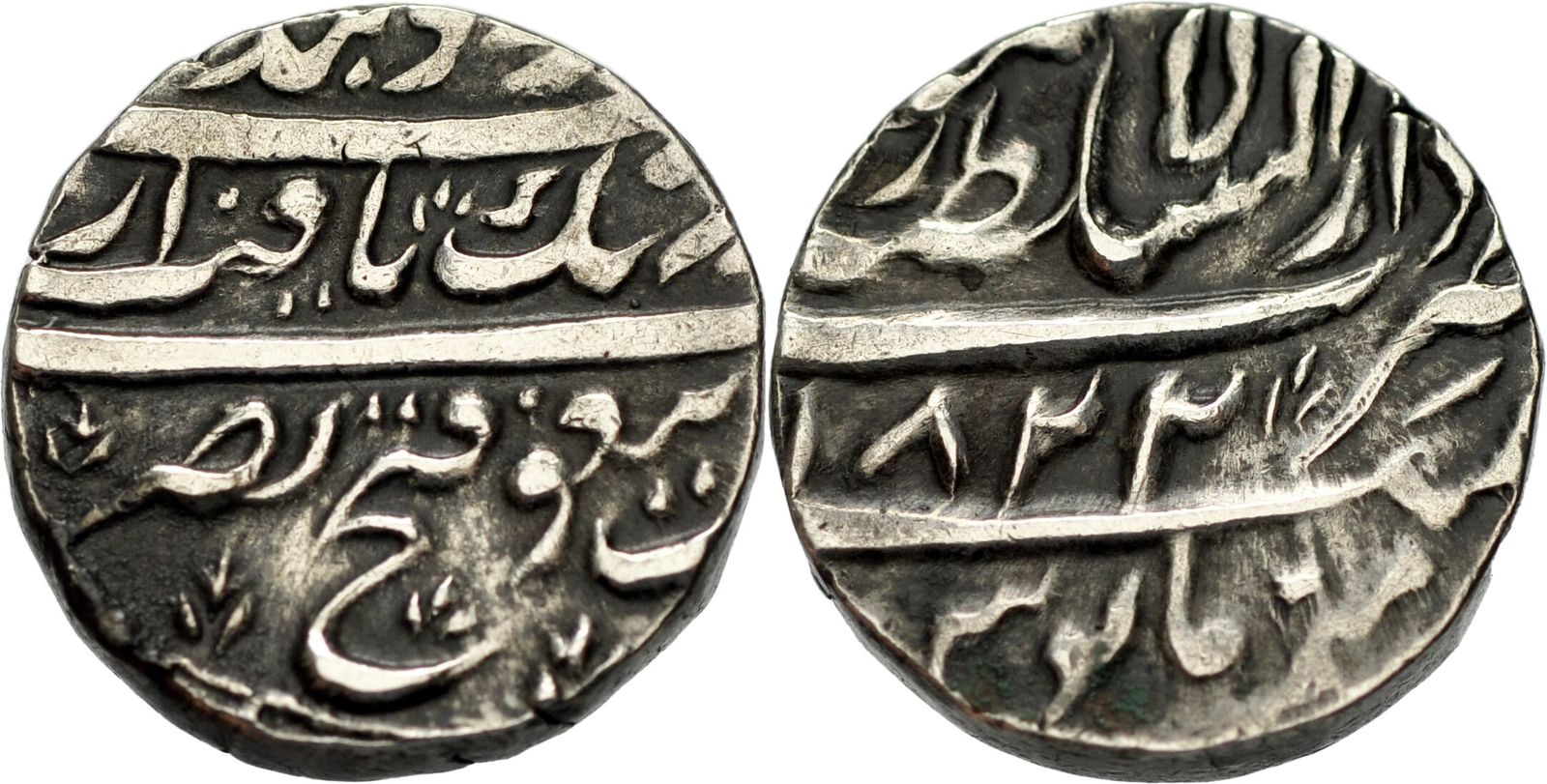
The emperors had gone; their title stayed. Numismatists explain part of that kind of continuity as commercial prudence, since a rupee is trusted when it looks like the rupees people know. It was also a claim. Whoever held the city meant to hold its dignity too. The three chiefs and their heirs ruled Lahore for more than thirty years, and when Ahmad Shah came back in 1766, the story goes, a deputation of the city's leading men told him that Lehna Singh had been a good ruler who made no distinction between Hindus and Muslims. Lahore's citizens were learning to choose their masters.
There is a tantalising earlier coin. In 1761, when the Sikh leader Jassa Singh Ahluwalia briefly occupied Lahore, a rupee bearing a couplet in his own name is reported. Some historians think it was genuine and quickly withdrawn; others that it was struck by his enemies to provoke the Afghan king. It is a competing interpretation with no coin to settle it.
By the 1790s the chiefs' heirs were quarrelling, and the Afghan king Zaman Shah was invading again. He entered Lahore in 1798 and left within months. On the way home he lost twelve guns in the flooded Jhelum, and a young chief from Gujranwala recovered eight of them and sent them on to him. Later British accounts say the Shah rewarded him with a grant of Lahore and the title of Raja. The story rests on a single officer's report, and even Lepel Griffin, who repeated it in 1892, called it "a barren grant": the city still had to be taken. The following summer a gate opened, and we are back where we began.
Sarkar: Ranjit Singh's Lahore, 1799–1839
The young chief who rode in through the Lohari Gate became the most formidable ruler Lahore had known since the Mughals. On 12 April 1801, at Vaisakhi, he was proclaimed Maharaja of the Punjab at Lahore. Like the chiefs before him he struck his coins in the name of the Gurus rather than his own. His government called itself the Sarkār-i-Khālsā, the government of the Khalsa, and he himself was addressed simply as the Sarkar. He is often said never to have worn a crown, which is oral history rather than record.
From Lahore he built a state that stretched, at its height, from the Sutlej to the Khyber and from Kashmir to Multan. For the fifth time, Lahore was the capital of an independent power, and it looked the part. The court was as mixed as the city. Fakir Azizuddin, his physician and foreign minister, came from a Muslim family of Lahore. His finance minister, Dina Nath, was a Kashmiri Pandit. The Dogra brothers Gulab Singh and Dhian Singh rose to the highest offices. French and Italian veterans of the Napoleonic wars, among them Allard, Ventura, Avitabile and Court, trained his army on European lines. In 1802 he took the Zamzama from the Bhangis at Amritsar and carried it on his campaigns until it was damaged at the siege of Multan in 1818, after which it stood at Lahore's Delhi Gate. In 1813, at Lahore, he obtained the Koh-i-Noor diamond from the exiled Afghan king Shah Shuja.
He also made the city defensible again. Akbar's walls were falling down, and in 1812, Latif writes, Ranjit Singh rebuilt most of them and surrounded them with a deep, broad ditch. In 1818 he built the marble pavilion in the Hazuri Bagh, the square between the Fort and the Badshahi Mosque.
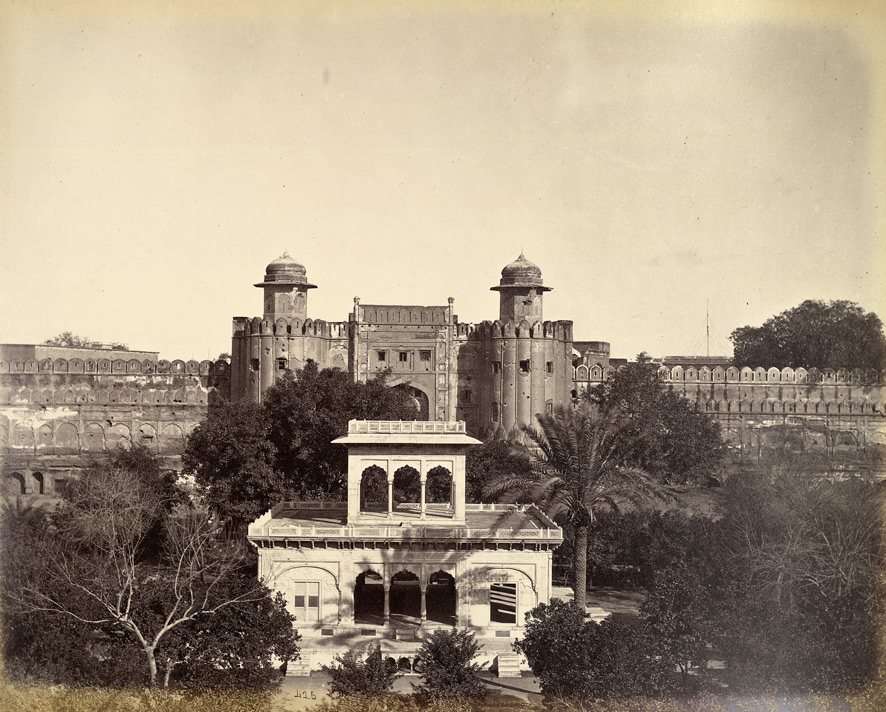
The Mughal city fared unevenly under the Sarkar. Some buildings were repaired and used; others were stripped of marble for new work, and Latif, writing in 1892, lists old buildings pulled down for cantonments and parade grounds for the troops the French officers drilled. The Badshahi Mosque was used as a magazine and store for military supplies. Every regime that held Lahore treated its predecessors' monuments as a resource, and the British, as we shall see, were no exception. This is Probable in its details, and well attested in outline.
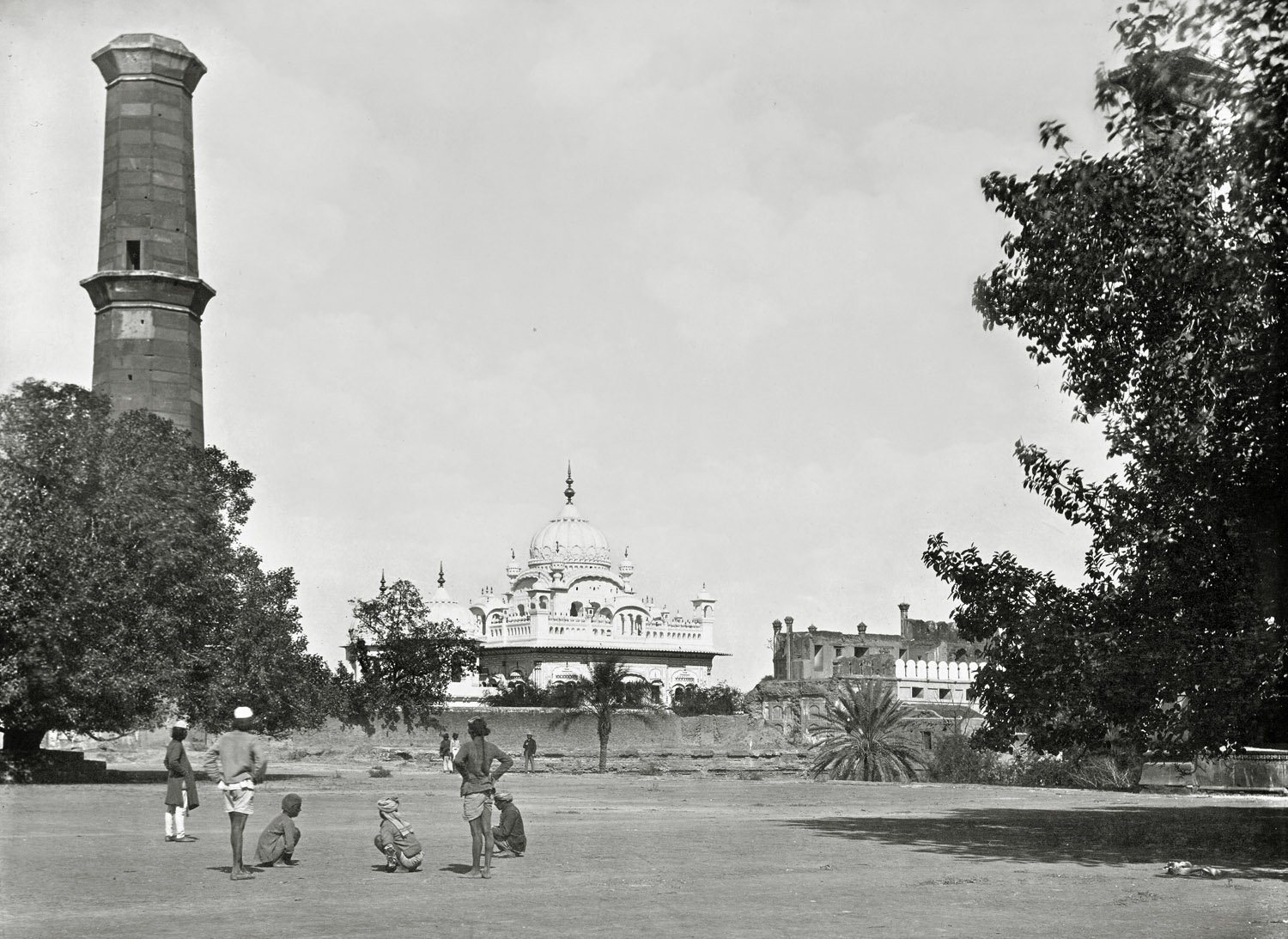
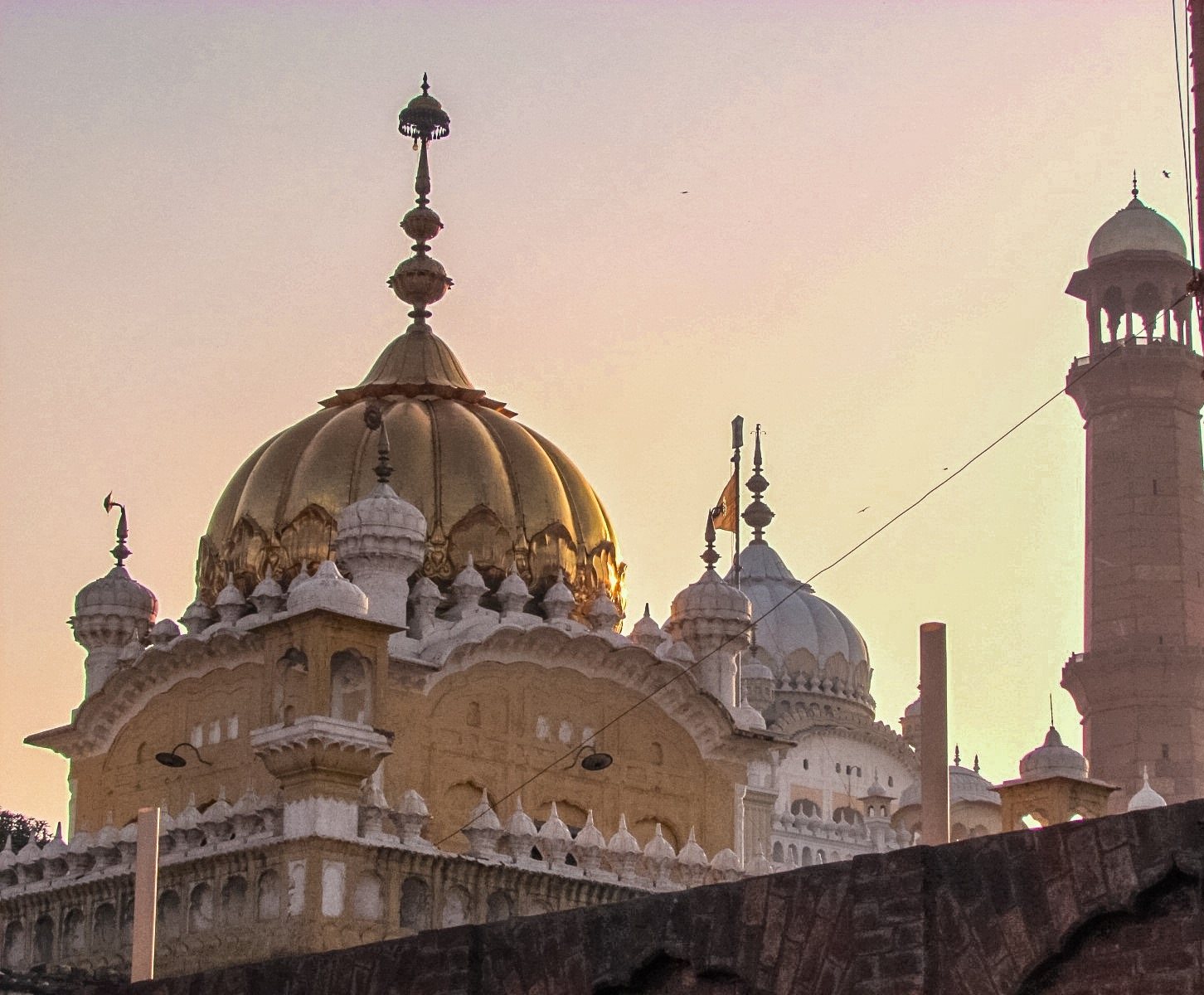
Ranjit Singh died in Lahore on 27 June 1839. He was cremated beside the Fort, and the samādh that holds his ashes, completed in 1848, stands beside the Badshahi Mosque and within a few steps of Gurdwara Dera Sahib: a Mughal mosque, the place of a Sikh Guru's martyrdom and a Sikh maharaja's memorial, all within sight of one another. Few places anywhere show a city's layers so plainly from a single spot. Maharaja Ranjit Singh
The fall of the Sarkar, 1839–1849
Ranjit Singh left an empire, an army of formidable quality and no settled way of passing power from one ruler to the next. The decade after his death is one of the bloodiest in Lahore's history.
His son Kharak Singh ruled briefly and died in November 1840. On the day of the cremation, Kharak Singh's own son and heir, the able Nau Nihal Singh, was struck by falling masonry as he passed beneath a gateway near the Fort, and died within hours. Whether it was an accident or a murder arranged by courtiers has been argued ever since. Rival claimants followed: Kharak Singh's widow, Chand Kaur; then Sher Singh, who besieged her in the Fort in January 1841 and posted his matchlockmen on the minarets of the Badshahi Mosque to fire down into it. In September 1843 Sher Singh was murdered, with his chief minister Dhian Singh, by the Sandhanwalia sardars, and the next faction mounted light guns on the same minarets. The throne passed to a five-year-old, Duleep Singh, with his mother, Maharani Jind Kaur, as regent, while the army's elected committees and the court's factions fought for control.
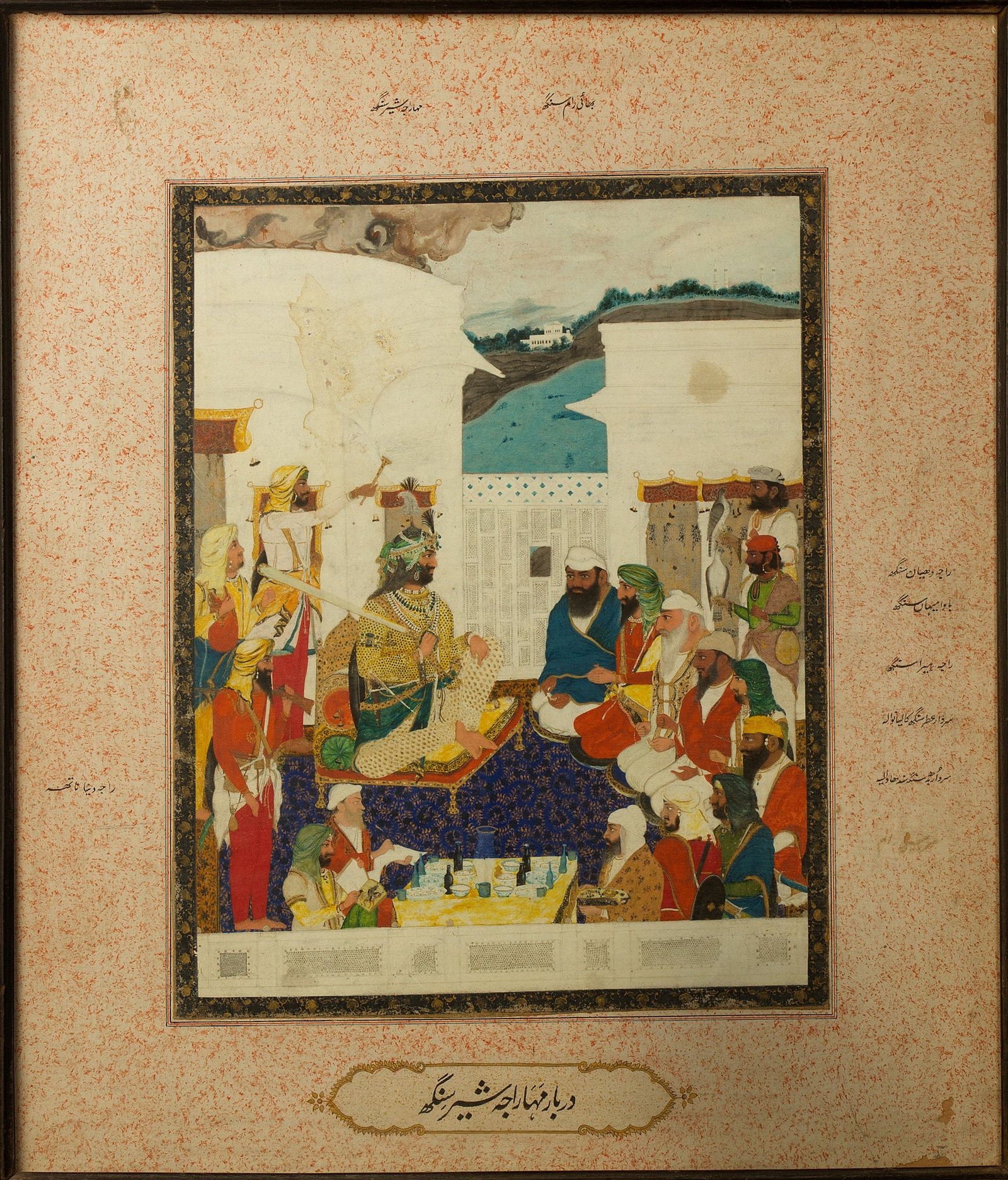
The East India Company, whose frontier had reached the Sutlej, was watching. The First Anglo-Sikh War of 1845–46 ended with a British army marching up to the walls of Lahore in February 1846, and with the Treaty of Lahore, signed in the city on 9 March. The Punjab lost the Jalandhar Doab; Kashmir passed to the Company and within days was sold to Gulab Singh; and before the year was out a British Resident sat in Lahore, governing in the child's name.
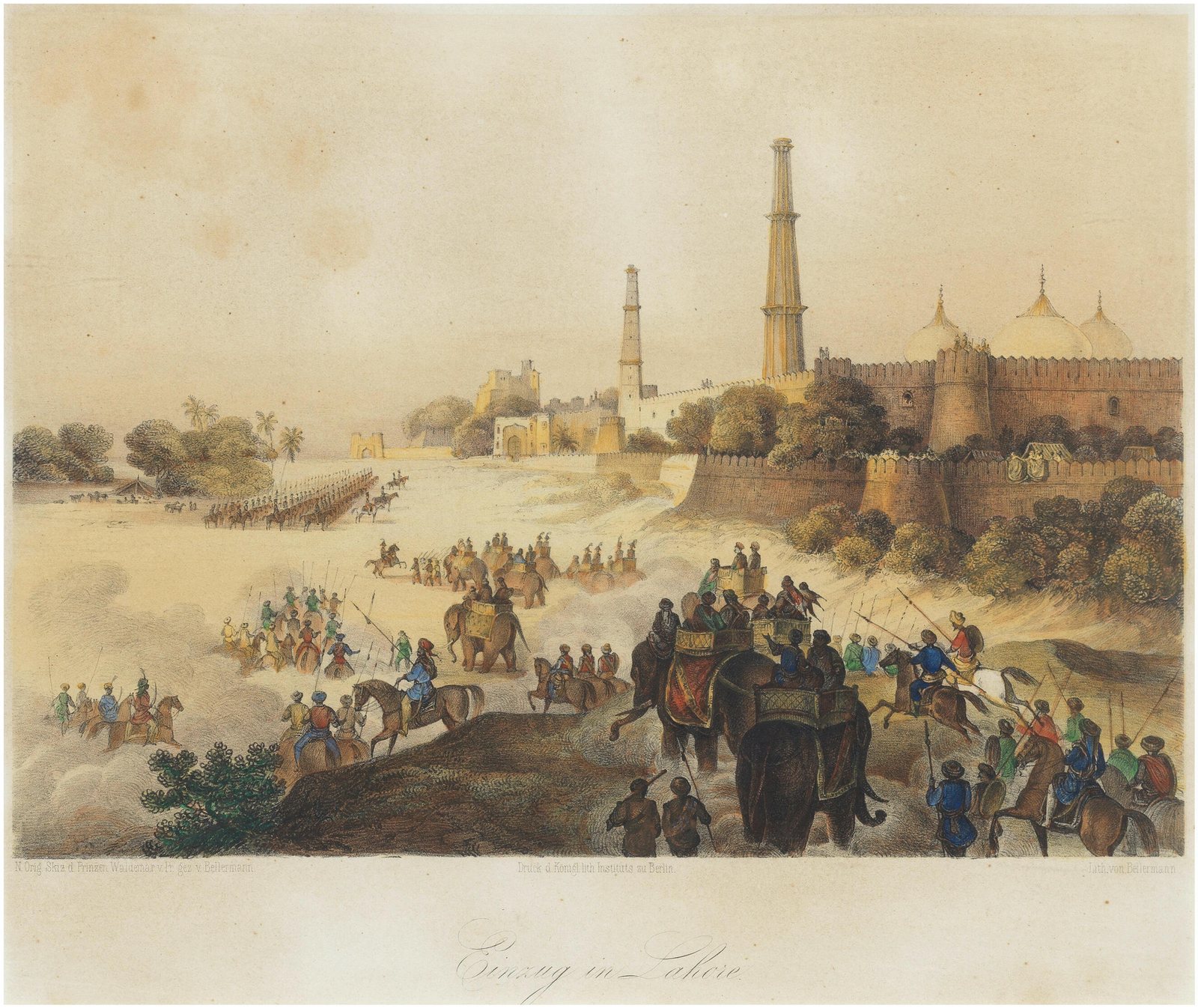
The Second Anglo-Sikh War followed in 1848–49. After the battle of Gujrat in February 1849, the Company annexed the Punjab. The proclamation was read at Lahore on 29 March 1849. In the name of the ten-year-old Duleep Singh, his government signed away the kingdom and surrendered the Koh-i-Noor to the British Crown. He was later sent to Britain. The British annexation of the Punjab
For the first time since the Ghaznavid century, Lahore was the capital of a province whose true masters lived far away. This time they lived across an ocean.
Capital of British Punjab, 1849–1947
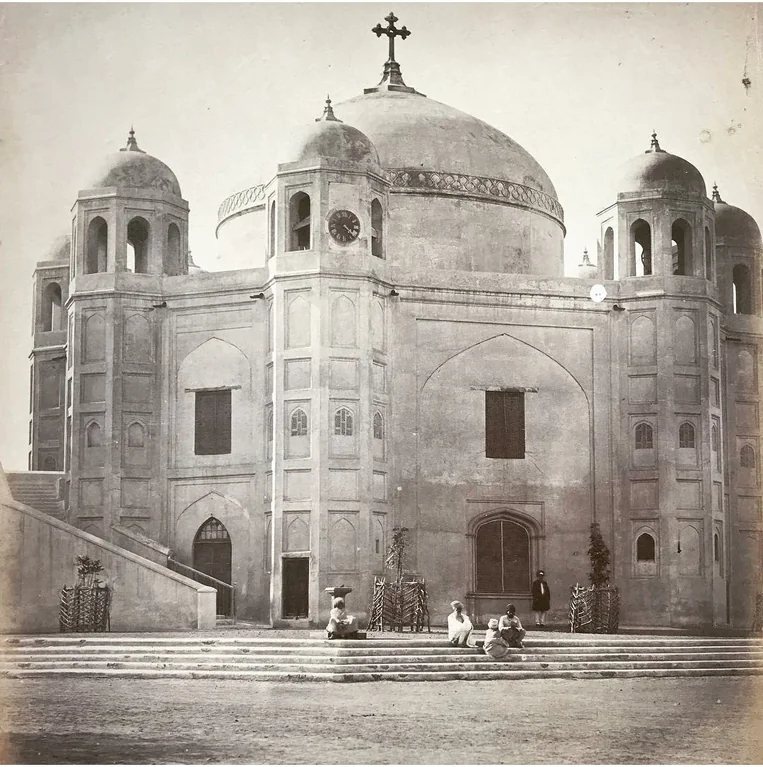
The British made Lahore the capital of their new province and set about making it safe for themselves. The walls that Ranjit Singh had rebuilt were cut down from about thirty feet to fifteen, the ditch was filled in and planted as a ring of gardens, and the gates lost their military purpose; several were later pulled down and rebuilt. The Roshnai Gate beside the Fort is usually described as the one that keeps its Mughal form. Mughal buildings were put to new uses: the tomb in the Anarkali garden became offices and then, from 1851, an Anglican church. The Badshahi Mosque was handed back to Lahore's Muslims only in 1856, and the British pulled down the arcades of students' rooms along its eastern side. South of the old city a new one grew up around the Mall, with its courts, colleges and civil lines. The cantonment, laid out in the early 1850s, took its name from the Sufi near whose shrine it stood: Mian Mir. The railway station, begun in 1859, looks like a castle, with turrets and loopholes; whether its builders meant it to be defended, after the uprising of 1857, or only to look defensible is still debated.
The province governed from Lahore was vast. Until 1901 it ran to the Khyber, and from 1858 until the capital of British India moved there in 1911 it included Delhi. For half a century the old Mughal capital was a district of a province ruled from Lahore, a reversal the Ghaznavid sultans would have enjoyed.
Colonial Lahore was a city of institutions, and they belonged to every community. Government College and the American Presbyterian mission's college, later Forman Christian College, both opened in 1864; the Mayo School of Art in 1875, under John Lockwood Kipling; the University of the Punjab in 1882; the Arya Samaj's Dayanand Anglo-Vedic College in 1886; and the Anjuman-i-Himayat-i-Islam's Islamia College soon afterwards. Lahore became the publishing capital of the Punjab, printing in Urdu, Punjabi, Hindi and English. Bhai Ram Singh, from a family of Sikh carpenters, trained at the Mayo School, later became its principal, and designed buildings as far afield as the Durbar Room at Osborne House, Queen Victoria's home on the Isle of Wight. The engineer Sir Ganga Ram designed several of the city's landmark public buildings and founded the hospital that still bears his name.
Lockwood Kipling's son Rudyard worked on a Lahore newspaper, the Civil and Military
Gazette, from 1882 to 1887. In 1901 he published Kim, which opens with its boy hero
astride the old gun, moved in 1870 to stand in front of the Lahore Museum: the
ajāib-ghar, "house of wonders", as
Lahoris called it. The second sentence of the novel is perhaps the most famous line ever written
in English about the city: Who hold Zam-Zammah, that "fire-breathing dragon", hold the Punjab,
for the great green-bronze piece is always first of the conqueror's loot.
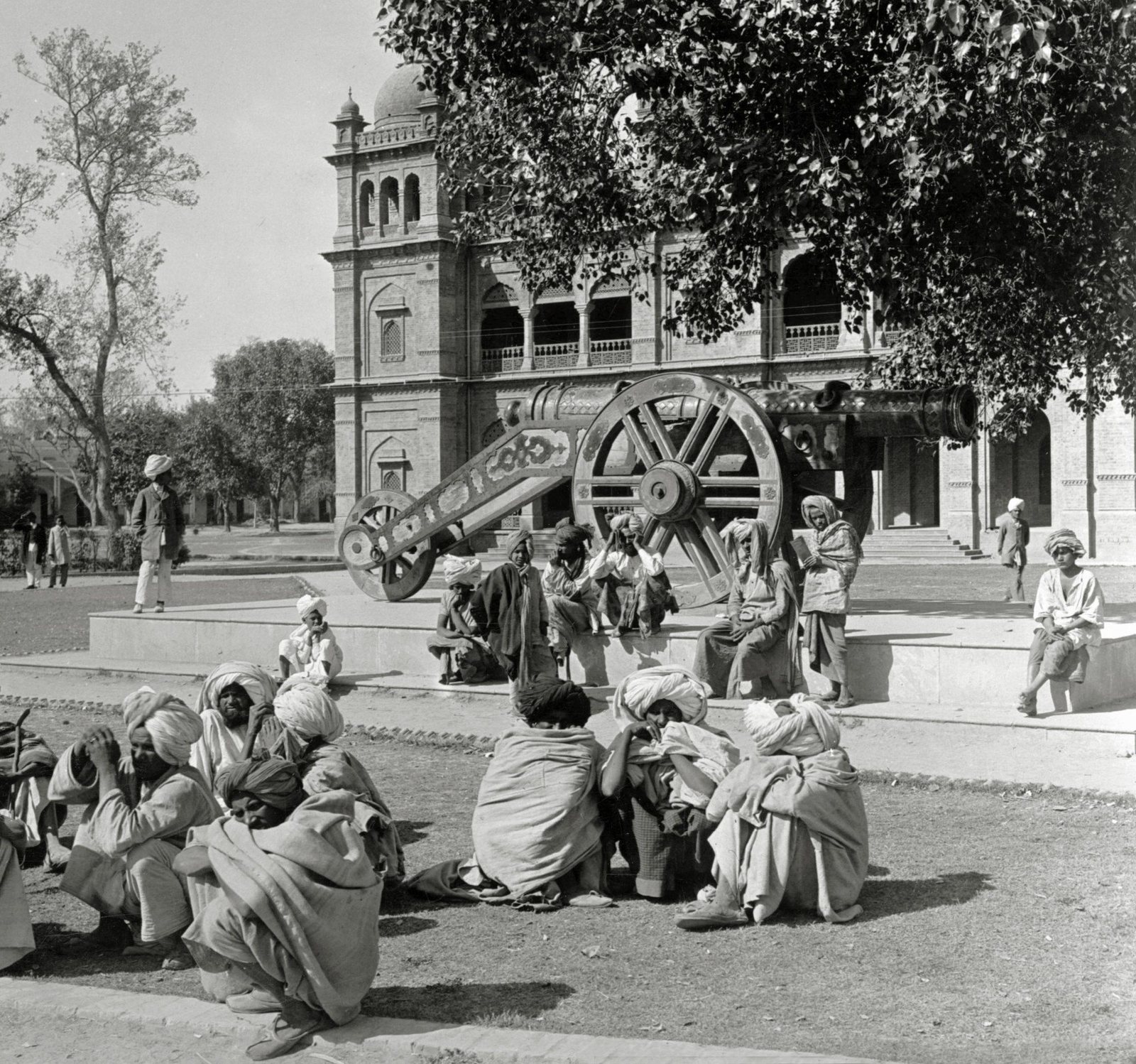
The quotation marks are Kipling's, and they point at the gun itself. The Persian verses cut
into its barrel end with a line that gives its date and calls it, in Latif's translation,
a weapon like a fire-raining dragon
. Kipling meant his sentence as an imperial boast; the
next one tells us that Kim had a right to the gun because the English held the Punjab. But the
line only worked because it restated what every earlier master of Lahore had understood, and what
the gun's own journey from Panipat to Gujranwala to Amritsar to the museum lawn had proved.
In the twentieth century Lahore became the capital of competing futures. In 1928 the nationalist leader Lala Lajpat Rai was beaten by police at a protest in the city and died weeks later. The young revolutionaries who avenged him, Bhagat Singh, Sukhdev and Rajguru, were hanged in Lahore Central Jail on 23 March 1931. At the end of December 1929 the Indian National Congress, meeting in Lahore, adopted the goal of complete independence, and Jawaharlal Nehru raised the flag on the bank of the Ravi. On 23 March 1940, at a session of the All-India Muslim League in Minto Park beside the Fort, the resolution later known as the Pakistan Resolution was moved. Founding statements of two future nations were read out within a few kilometres of each other.
1947
In 1941 the municipality of Lahore had 671,659 people. About 64.5 per cent were Muslims; almost all the rest were Hindus and Sikhs, with a small Christian community. Hindus and Sikhs owned a large share of the city's property and business, by the political scientist Ishtiaq Ahmed's estimate some 80 per cent, and many of them believed until very late that Lahore would go to India or somehow stay undivided. The property figure is Probable.
It did not stay undivided. Communal violence broke out in Lahore in March 1947 and returned in waves. In June, fire consumed Shah Almi, the great Hindu commercial quarter of the old city. Attacks and reprisals followed on every side, and families began to leave. India and Pakistan became independent on 14 and 15 August. The boundary award that decided which country Lahore was in was published on 17 August. Lahore went to Pakistan; Amritsar, fifty kilometres to the east, went to India.
Within months Lahore's Hindus and Sikhs had gone almost to a person, and Muslim refugees from East Punjab and beyond had taken their place. None of the city's upheavals since 1241 changed its people so completely. The violence was committed by, and against, all three communities. Partition of the Punjab, 1947 · The great migrations
The writers of both Punjabs have never let it go. Saadat Hasan Manto, who moved from Bombay to Lahore in 1948, wrote a sketch of a few lines about a mob attacking the statue of Sir Ganga Ram, and then, when one of its members is hurt, shouting for him to be rushed to the Ganga Ram Hospital. Amrita Pritam, who had lived in Lahore and left it, wrote the most famous Punjabi poem of Partition as an appeal to Waris Shah, the poet of Heer. And the playwright Asghar Wajahat took a Punjabi proverb as the title of a play, first staged under Habib Tanvir in 1989, about an old Hindu woman who refuses to leave her house in Lahore after 1947.
After 1947 Lahore became the capital of West Punjab. From 1955 to 1970 it was the capital of all of West Pakistan, merged into a single province; since 1970 it has been the capital of Pakistan's Punjab province. The Minar-e-Pakistan, completed in 1968, stands where the resolution of 1940 was moved. Within sight of it, pilgrims from the other Punjab still come to Gurdwara Dera Sahib and the samadh of Ranjit Singh, and to the house in Chuna Mandi where Guru Ram Das was born.
Why Lahore matters
We began with a question: why here?
The land answers the first part. A defensible mound on a great river; one of the richest doabs in the subcontinent to feed a court and an army; the road from Kabul to Delhi running through the middle; a frontier near enough to watch and far enough to survive. Whenever the rulers of the Punjab looked north-west, as the last Ghaznavids did, as Akbar did while he watched the Uzbeks, as Ranjit Singh did while he pushed towards Peshawar, Lahore was their natural seat. When power looked south-east, to Delhi, Lahore was its gate.
Geography does not explain why Lahore stayed first when its rulers were weak, or how it survived being sacked, emptied and remade. It does not explain how a town that a geographer in 982 and a saint in the eleventh century both called a dependency of Multan came to outrank Multan for good. For that you need the second part of the answer, which is accumulation. Once a city has a fort, a mint, a treasury, a shrine that draws pilgrims from across the region, a class of scribes and poets and merchants who know how government works, and its name on the money, taking it becomes a way of claiming everything it stands for. Khusrau Malik's poets walked into the Ghurid court. Aibak's historian called it "the place where the throne of Sultans had been established". The coins made the point: dār-us-salṭanat, the abode of sovereignty, passed from Mughal rupees to Sikh ones because each new master wanted what the last had. The gun on the museum lawn made it too.
Geography made Lahore eligible. Conquest made it a capital. Habit made it permanent.
What is Lahore's importance now? The plainest answer is scale: Lahore district counted just over thirteen million people in Pakistan's 2023 census, which makes it the country's second city and the capital of its most populous province.
The deeper answer is that Lahore belongs to more people than live in it. It holds the shrine of Data Ganj Bakhsh, where Muslims of every school come in their thousands, and the tombs of Mian Mir and Shah Husain. It is the birthplace of Guru Ram Das, the place of Guru Arjan's martyrdom and the capital of Ranjit Singh's empire, and Sikhs come from across the world to its gurdwaras and to the samadh. It keeps the Hindu tradition of Lava in the heart of its Fort, and the memory of the Hindu families who built so much of its modern commerce and learning before 1947. It is where Hujwiri wrote the first Persian book on Sufism, where Mas'ud Sa'd Salman learned to miss home, and where Muhammad Iqbal lies buried beside the steps of the Badshahi Mosque; in 2019 UNESCO named it a City of Literature. Its Fort and gardens belong to the world's heritage. And it is still a Punjabi city: in the 2023 census about three in four of the district's people gave Punjabi as their first language.
It has lost things too. The river that made it a fortress left its walls in the seventeenth century, and since the Indus Waters Treaty of 1960 assigned the Ravi's waters to India, the channel that passes Lahore is often little more than a trickle. The Lohari Gate through which Ranjit Singh rode still stands, rebuilt. Shah Almi's gate burned in 1947, and only the name survives. Every master of Lahore rebuilt it in his own image, and every one of them is now part of it.
Lahoris have a phrase for all this, used when no comparison will do: Lāhaur Lāhaur ae, Lahore is Lahore. And there is the older saying, the one that families who left in 1947 carried with them to Amritsar and Delhi, and later to Southall and Surrey, and handed to grandchildren who had never seen the place: whoever has not seen Lahore has not been born.
A thousand years of conquerors would have understood it perfectly. That is why they came.
A thousand years of capitals, at a glance
- Seat of an independent power: 1 the last Ghaznavids, c. 1160–1186; 2 Qutb al-Din Aibak, 1206–1210; 3 Akbar's court, 1586–1598; 4 the Sikh chiefs, 1765–1799; 5 Ranjit Singh and his successors, 1799–1849
- Seat of a province: Ghaznavid India, the Ghurids, the Delhi Sultanate, the Mughal province of Lahore, British Punjab, West Punjab, West Pakistan, Punjab province
- Debated: the last Hindu Shahi kings, c. 1015–1021
- Gaps: ruined after the Mongol sack, 1241–c. 1270; fought over, 1752–1765
Timeline
982
Lahore is named
The Hudud al-Alam, the oldest securely dated mention, says the town is governed on behalf of the amir of Multan.
c. 1020–21
Mahmud of Ghazni takes Lahore
It becomes the seat of Ghaznavid India. That the last Hindu Shahi kings ruled from it just before is possible but contested.
1027–28
Coins in two alphabets
The Lahore mint, called Mahmudpur, strikes silver in Arabic and in Sanskrit written in Śāradā.
1034
Tilak breaks a rebellion
The Hindu general Tilak defeats the rebel commander Ahmad Niyaltigin.
1043–44
The city holds
An alliance of Indian kings besieges Lahore for months, and fails.
c. 1040s–1070s
Hujwiri in Lahore
He writes the Kashf al-Mahjub; the poet Mas'ud Sa'd Salman is born in the city in the late 1040s.
c. 1150
Ghazni burns
The Ghurid World-Burner sacks Ghazni; the sultan flees to Lahore.
c. 1160–1186
Capital of the Ghaznavids
Seat of an independent power. Khusrau Malik reigns from Lahore after Ghazni is lost.
1186
Muhammad of Ghor takes Lahore
Khusrau Malik is lured out under a treaty and seized; the dynasty ends.
1206–1210
Aibak's capital
Seat of an independent power. Qutb al-Din Aibak is enthroned at Lahore and dies there.
1241
The Mongols take Lahore
22 December. The city lies ruined until Balban rebuilds it around 1270.
1534
Guru Ram Das is born
In the Chuna Mandi quarter. Babur's troops had plundered the city ten years before.
1586–1598
Akbar's court
Seat of an independent power. The emperor governs from Lahore to watch the Uzbeks.
1606
Guru Arjan is executed
On Jahangir's order, at Lahore.
1634–1673
The great Mughal buildings
Wazir Khan Mosque (begun 1634), Shalamar Gardens (1641–42), Badshahi Mosque (1671–73).
1665
The river moves
Bernier finds that the Ravi no longer runs beneath the palace.
1757–1762
Zamzama
The great gun is cast at Lahore, fired at Panipat in 1761 and taken by the Bhangi Sikhs in 1762.
1765–1799
The Sikh chiefs
Seat of an independent power. Three chiefs share Lahore and strike rupees in the Gurus' name at dār-us-salṭanat lāhaur.
1799–1849
Ranjit Singh's capital
Seat of an independent power. He enters on 7 July 1799, is proclaimed Maharaja on 12 April 1801 and dies in Lahore on 27 June 1839.
9 March 1846
Treaty of Lahore
Signed in the city after the First Anglo-Sikh War.
29 March 1849
Annexation
Lahore becomes the capital of British Punjab, which from 1858 to 1911 includes Delhi.
1901
Kim
Kipling opens his novel on the Zamzama, moved in 1870 to the front of the Lahore Museum.
1929–1940
Competing futures
Congress adopts complete independence at Lahore in December 1929; Bhagat Singh, Sukhdev and Rajguru are hanged there on 23 March 1931; the Lahore Resolution is moved on 23 March 1940.
17 August 1947
Lahore goes to Pakistan
The boundary award is published two days after independence.
1955–1970
Capital of West Pakistan
Then, from 1970, of Punjab province.
1981 · 2019
World heritage
The Fort and the Shalamar Gardens are inscribed in 1981; Lahore becomes a UNESCO City of Literature in 2019.
2023
Thirteen million
Lahore district counts 13,004,135 people; about three in four speak Punjabi as their first language.
Quick answers
When did Lahore first become a capital?
Lahore became the seat of Ghaznavid government in India after Mahmud of Ghazni took it around 1020–21, and the capital of the Ghaznavid dynasty itself around 1160, after Ghazni was lost. Some historians think the last Hindu Shahi kings ruled from Lahore a few years before Mahmud, but the evidence is thin.
Was Lahore the capital of the Mughal Empire?
Yes, for a time. Akbar held court at Lahore from 1586 to 1598 to watch the north-west frontier. Before and after, Lahore was the capital of the Lahore province, one of the empire's chief provinces, and its mint called it dār-us-salṭanat, "the abode of sovereignty".
Why did Ranjit Singh make Lahore his capital?
Because Lahore was already the recognised seat of power in the Punjab; its fort, mint and name carried authority. Ranjit Singh, a chief from Gujranwala, entered Lahore on 7 July 1799 with the help of its leading citizens and was proclaimed Maharaja there on 12 April 1801.
When did Lahore become the capital of Punjab?
Lahore became the capital of the British province of the Punjab at annexation in 1849. Since 1947 it has been the capital of Pakistan's Punjab: West Punjab (1947–55), West Pakistan (1955–70) and Punjab province (since 1970). The capital of Indian Punjab is Chandigarh.
What does the name Lahore mean?
No one knows for certain. A Hindu tradition derives it from Lava, son of Rama, and calls the early city Lavapurī; the other suggested etymologies cannot be proved. The oldest securely dated mention is in the Persian geography Hudud al-Alam (982 CE).
Did Ayaz build Lahore?
That is Lahore's own tradition, written down by Latif in 1892, and a tomb in the Rang Mahal quarter is venerated as his. The chronicles of the time do not put Mahmud's favourite Ayaz in Lahore, and the tomb is modern.
Why is Lahore important?
For about a thousand years it was the seat from which the Punjab was governed; it holds places sacred to Muslims, Sikhs and Hindus; its Mughal Fort and gardens are a UNESCO World Heritage Site; and it is Pakistan's second-largest city, with some thirteen million people, and the cultural capital of Pakistani Punjab.
Why did Lahore go to Pakistan in 1947?
The city had a Muslim majority, about 64.5 per cent in 1941, and the boundary award published on 17 August 1947 placed it in Pakistan. Cyril Radcliffe later said he had nearly given it to India but decided Pakistan needed a large city.
How far is Lahore from Amritsar?
About 50 kilometres, with the Wagah–Attari border crossing between them.
Punjabi words in this article
| Word | Scripts | Meaning |
|---|---|---|
| Lāhaur | ਲਾਹੌਰ · لاہور | Lahore |
| rājdhānī | ਰਾਜਧਾਨੀ · راجدھانی | a capital city; "the seat of rule" |
| dār-us-salṭanat | ਦਾਰ-ਉਸ-ਸਲਤਨਤ · دارالسلطنت | "the abode of sovereignty"; Lahore's title on Mughal and Sikh coins |
| darvāzā | ਦਰਵਾਜ਼ਾ · دروازہ | gate, door |
| dātā | ਦਾਤਾ · داتا | giver |
| sarkār | ਸਰਕਾਰ · سرکار | government; Ranjit Singh's title |
| ajāib-ghar | ਅਜਾਇਬਘਰ · عجائب گھر | a museum; literally "house of wonders" |
| Bhaṅgīāṅ dī Top | ਭੰਗੀਆਂ ਦੀ ਤੋਪ · بھنگیاں دی توپ | "the Bhangis' gun", the Zamzama |
| Buḍḍhā Rāvī | ਬੁੱਢਾ ਰਾਵੀ · بڈھا راوی | "the Old Ravi", the channel the river left behind |
| chaugān | ਚੌਗਾਨ · چوگان | the Persian game from which polo descends |
| doāb | ਦੋਆਬ · دوآب | land between two rivers |
| kāfī | ਕਾਫ਼ੀ · کافی | a short sung Sufi poem with a refrain |
| kāshī-kārī | ਕਾਸ਼ੀਕਾਰੀ · کاشی کاری | glazed tile mosaic |
| Melā Chirāghāṅ | ਮੇਲਾ ਚਿਰਾਗ਼ਾਂ · میلہ چراغاں | the Festival of Lamps at Shah Husain's shrine; melā is a fair |
| misl | ਮਿਸਲ · مثل | an eighteenth-century Sikh confederacy |
| samādh | ਸਮਾਧ · سمادھ | a memorial over a cremation site or its ashes |
| sūbā | ਸੂਬਾ · صوبہ | a province; the Mughal subah |
| ṭaksāl | ਟਕਸਾਲ · ٹکسال | a mint |